Multidrug-Resistant Salmonella and XDR Typhoid Fever
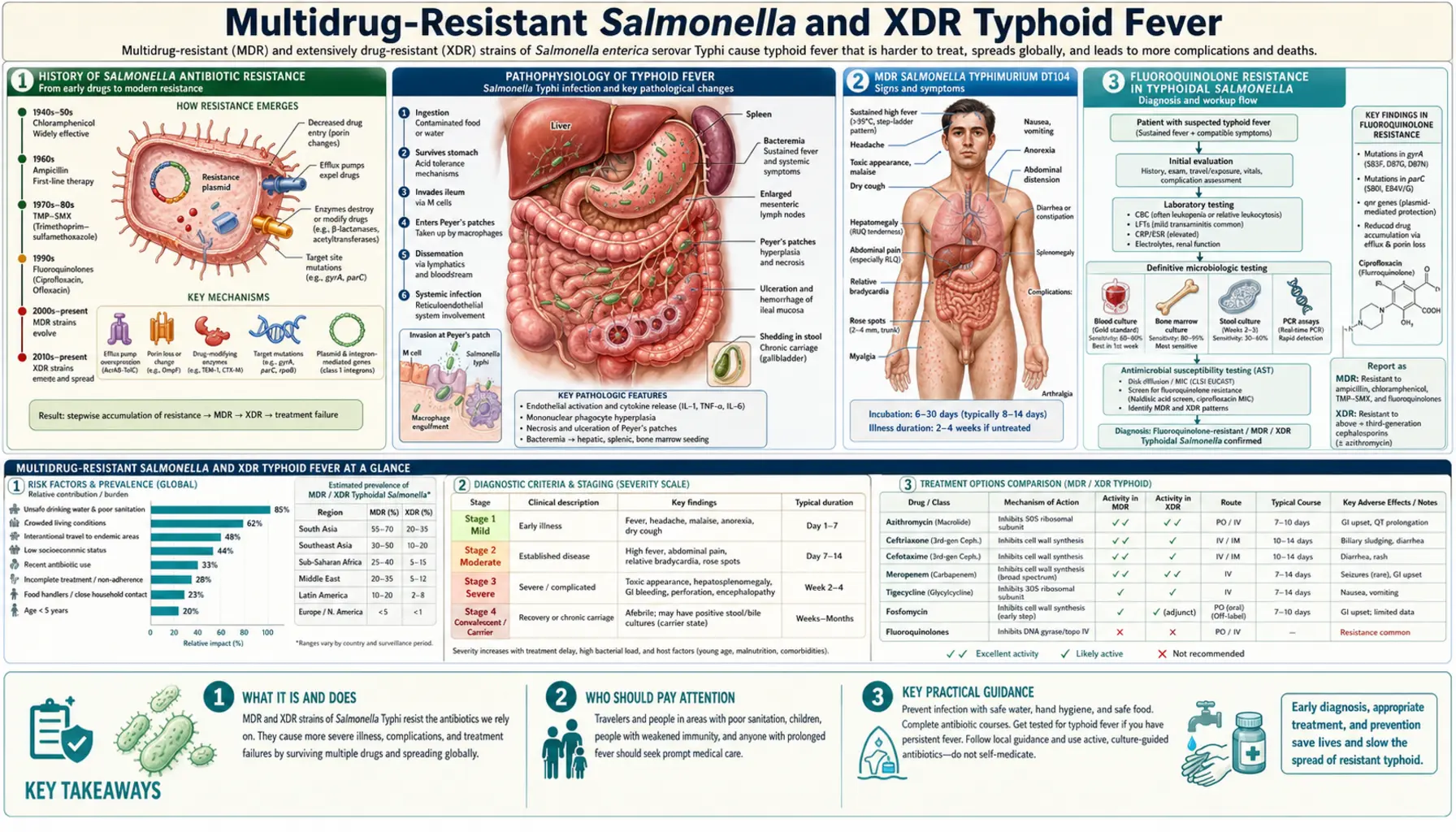
When antibiotics stop working against Salmonella, a routine gut infection can become a life-threatening emergency. Multidrug-resistant (MDR) Salmonella and extensively drug-resistant (XDR) typhoid fever represent one of the most urgent antibiotic resistance crises facing global public health today. Understanding how resistance develops, which strains carry the greatest risk, and what treatment options remain is essential for anyone traveling to high-risk regions, caring for someone with typhoid, or simply trying to understand why this once-simple infection has become so difficult to treat.
- History of Salmonella Antibiotic Resistance
- MDR Salmonella Typhimurium DT104
- Fluoroquinolone Resistance in Typhoidal Salmonella
- The H58 Clade and Global Spread
- XDR Typhoid: Pakistan 2016 and Beyond
- Treatment Options for MDR and XDR Typhoid
- MDR Salmonella in the Food Animal Reservoir
- Infection Control and Public Health Response
- Key Research Papers
- Connections
History of Salmonella Antibiotic Resistance
The story of antibiotic resistance in Salmonella is essentially the story of medicine trying to stay one step ahead of a bacterium that evolves faster than we can develop new drugs. Each drug that worked was followed, within years, by strains it no longer touched.
Chloramphenicol and the first effective typhoid treatment. Chloramphenicol was the reference treatment for typhoid fever before resistant strains spread: a 2011 review of resistance in typhoidal salmonellae records that ciprofloxacin became the first-line drug of choice only after the widespread emergence and spread of strains resistant to chloramphenicol, ampicillin and trimethoprim (PubMed PMID: 21860101).
The first wave of chloramphenicol resistance. Resistance to chloramphenicol in Salmonella Typhi spread through plasmids — small circles of DNA that bacteria exchange — and a 2011 review of the history records that the drug has a documented history of plasmid-mediated resistance (PubMed PMID: 21722249). Ampicillin and trimethoprim-sulfamethoxazole (TMP-SMX) were pressed into service as alternatives.
MDR typhoid: resistance to all three first-line drugs. Strains then emerged that were simultaneously resistant to chloramphenicol, ampicillin, and TMP-SMX — the definition of multidrug-resistant (MDR) typhoid used in the literature since. In southern Vietnam, a survey of 1,393 Typhi strains found the proportion of MDR isolates still at 50 percent in 2004, and a cross-sectional sample of 381 strains from eight Asian countries collected in 2002–2004 found MDR rates of 16 to 37 percent (PubMed PMID: 17908946). Fluoroquinolones such as ciprofloxacin and third-generation cephalosporins such as ceftriaxone became the replacements (PubMed PMID: 21860101).
The fluoroquinolone era and its erosion. Fluoroquinolones worked well at first. In the same Vietnamese series, nalidixic acid resistance — the laboratory marker of reduced fluoroquinolone susceptibility — rose from 4 percent of isolates in 1993 to 97 percent in 2005, and the eight-country sample showed rates of 5 to 51 percent (PubMed PMID: 17908946). Related fluoroquinolones were also used in food animal production, which is covered further down this page.
XDR: the worst outcome yet. In 2016 a strain appeared in Sindh, Pakistan that combined resistance to the three first-line drugs with resistance to fluoroquinolones and third-generation cephalosporins; the authors who sequenced it classified it as extensively drug resistant (XDR) and noted that it leaves most drugs used to treat typhoid ineffective (PubMed PMID: 29463654).
MDR Salmonella Typhimurium DT104
While typhoid resistance was evolving in Asia, a separate and equally alarming resistance crisis was unfolding in cattle farms in the United Kingdom during the 1980s and 1990s. The culprit was Salmonella Typhimurium phage type DT104 — a strain that would become a textbook example of how antibiotic resistance spreads from farm animals to humans.
What is DT104? DT104 refers to a specific phage type (a classification based on which bacteriophages can infect the bacteria) of Salmonella Typhimurium. What made DT104 alarming was not its phage type but its resistance profile, called ACSSuT:
- A — Ampicillin resistance
- C — Chloramphenicol resistance
- S — Streptomycin resistance
- Su — Sulfonamide resistance
- T — Tetracycline resistance
Five antibiotics, all simultaneously non-functional. What made this even more alarming was that these resistance genes were not on a loose plasmid that might be lost — they were encoded in a chromosomal element called Salmonella Genomic Island 1 (SGI1), a stable genomic island that is inherited by every daughter cell and cannot easily be cured out of the bacterium.
Salmonella Genomic Island 1 (SGI1). The complete sequence of SGI1 from a DT104 isolate is a 43-kilobase region containing 44 predicted open reading frames, and it carries the genes associated with the ACSSuT phenotype; several of its reading frames resemble plasmid genes, suggesting at least a partly plasmid origin. The same island was identified in multidrug-resistant Salmonella Typhimurium phage type DT120 and in serovar Agona isolates with similar resistance phenotypes (PubMed PMID: 11544236).
Emergence in cattle and spread to people. The 1998 US survey that first characterized DT104 in the United States described this strain as already a major cause of illness in humans and animals in Europe, especially the United Kingdom. In US national surveys of antimicrobial resistance, the share of Typhimurium isolates with the five-drug resistance pattern rose from 0.6 percent in 1979–1980 to 34 percent in 1996; such isolates were found at 36 of 46 surveillance sites in 1994–1995, and 39 of 43 of them were phage type DT104 or a closely related type (PubMed PMID: 9571252).
How people were exposed. Outbreak investigations traced human DT104 infections to the food chain. In Yakima County, Washington, 54 culture-confirmed Salmonella Typhimurium cases were reported between January and May 1997; all case-patient isolates were phage type DT104 or DT104b and 91 percent were resistant to ampicillin, chloramphenicol, streptomycin, sulfamethoxazole, and tetracycline. Eating unpasteurized Mexican-style soft cheese was reported by 77 percent of case patients versus 28 percent of matched controls, and raw milk from a local farm was traced as the source; milk samples from nearby dairies also yielded DT104 (PubMed PMID: 10340368).
Why the DT104 pattern matters. The ACSSuT pattern means five of the older antibiotics are inactive against the strain, which is why isolates from these infections are tested for susceptibility rather than treated by assumption; the 1998 survey concluded that more prudent use of antimicrobial agents in farm animals and better disease prevention on farms were needed to slow further resistance in this and other Salmonella strains (PubMed PMID: 9571252). For non-severe Salmonella diarrhoea in otherwise healthy children and adults, a Cochrane review of 12 trials in 778 participants found no evidence of clinical benefit from antibiotic therapy, more adverse effects, and a tendency to prolong detection of the bacteria in stool; typhoid and paratyphoid infections were excluded from that review (PubMed PMID: 10796610).
Fluoroquinolone Resistance in Typhoidal Salmonella
Fluoroquinolones — drugs like ciprofloxacin — became the go-to treatment for typhoid once MDR strains made the original drugs useless. They kill bacteria by inhibiting DNA gyrase and topoisomerase IV, enzymes that bacteria need to replicate and repair their DNA. For a time, they worked brilliantly. Then Salmonella found ways around them.
How fluoroquinolone resistance develops: gyrA mutations. The important mechanism of reduced fluoroquinolone susceptibility in Salmonella Typhi is point mutation in the gyrA gene, which encodes the A subunit of DNA gyrase, one of the enzymes the drug targets. In a survey of Typhi strains from Asia, the Ser83→Phe substitution in GyrA was the predominant alteration in isolates from Vietnam, found in 117 of 127 isolates (92.1 percent), with no mutations in gyrB, parC or parE detected in 55 of those strains. Laboratory time-kill experiments in the same work showed reduced ofloxacin efficacy against strains carrying a single substitution at codon 83 or 87 of GyrA, and a more marked loss against a strain carrying both (PubMed PMID: 17908946).
These mutations do not always push the minimum inhibitory concentration (MIC) of a fluoroquinolone above the breakpoint a laboratory calls "resistant." Pooled individual patient data from seven randomised trials in Vietnam, covering 540 patients treated with ofloxacin, found that failure was significantly more common when the infecting isolate had an MIC of 0.25 µg/mL or above than when it was 0.125 µg/mL or below, despite longer treatment at a higher dose (PubMed PMID: 21713025).
Nalidixic acid non-susceptibility as a surrogate marker. Nalidixic acid is an older quinolone that laboratories still test because resistance to it tracks the gyrA changes that blunt fluoroquinolones. The authors of the pooled Vietnamese analysis concluded that an ofloxacin MIC of 0.25 µg/mL or above, or the presence of nalidixic acid resistance, can be used to define Salmonella Typhi infections in which the response to ofloxacin may be impaired (PubMed PMID: 21713025).
What that means in treated patients was measured directly in Viet Nam. Against MDR but nalidixic-acid-susceptible isolates, short courses of ofloxacin cured more than 90 percent of patients with an average fever clearance time of 4 days and fewer than 3 percent relapsed or had a positive post-treatment stool culture. Against nalidixic-acid-resistant isolates the same approach did much worse: ofloxacin at 20 mg/kg/day for 7 days cured only 75 percent, fever clearance took 7 days, and 19 percent of patients had positive post-treatment faecal cultures. The alternatives available for those infections were ceftriaxone, cefixime, and azithromycin, described in that review as reasonably effective but expensive (PubMed PMID: 15138078).
What this changes in practice. Because a "ciprofloxacin susceptible" report can coexist with a gyrA mutation, nalidixic acid testing and the measured MIC both carry information. US clinical guidance for typhoid and paratyphoid fever states that most infections diagnosed in the United States are caused by strains that are not susceptible to fluoroquinolones and that fluoroquinolones are not to be used for empiric treatment, with antimicrobial susceptibility testing used to guide treatment decisions (CDC clinical guidance for typhoid fever).
Beyond gyrA: plasmid-carried quinolone resistance. Quinolone resistance determinants can also travel on plasmids. The plasmid carried by the XDR Salmonella Typhi clone from Pakistan carries the qnrS fluoroquinolone resistance gene alongside its extended-spectrum beta-lactamase gene, so a single plasmid acquisition adds to resistance already present on the chromosome (PubMed PMID: 29463654).
The H58 Clade and Global Spread of Resistant Typhoid
To understand why resistant typhoid has spread so widely and so fast, you need to understand the H58 clade — a single genetic lineage of Salmonella Typhi that has essentially colonized much of the typhoid-endemic world.
What is H58? H58 is a lineage of Salmonella Typhi that, under the genotyping framework built from the whole-genome sequences of nearly 2,000 isolates from more than 60 countries, is designated genotype 4.3.1. That study described the rest of the global Typhi population as highly structured into dozens of geographically restricted subclades, with 4.3.1 the exception that disseminated rapidly (PubMed PMID: 27703135).
Resistance built into the lineage. Whole-genome analysis of 1,832 Salmonella Typhi isolates identified H58 as a single dominant MDR lineage, and found that H58 isolates can carry a complex MDR element either on transmissible IncHI1 plasmids or within multiple chromosomal integration sites. The same analysis found H58 lineages displacing antibiotic-sensitive isolates and so changing the global population structure of the pathogen (PubMed PMID: 25961941). Mathematical modelling of culture-confirmed cases in Blantyre, Malawi found that an increase in the duration of infectiousness and/or in the transmission rate following the emergence of H58 fitted the observed surge better than rising population density or waning cross-immunity (PubMed PMID: 26449939).
Spread out of Asia. The same whole-genome study reported that H58 had emerged and spread throughout Asia and Africa over the preceding 30 years, identified numerous transmission events including multiple transfers from Asia to Africa, and described an ongoing, previously unrecognised MDR epidemic within Africa itself (PubMed PMID: 25961941).
Africa: an underappreciated burden. A phylogenetic reconstruction of 249 Salmonella Typhi isolates collected between 2008 and 2015 in 11 sub-Saharan African countries found that 225 of them (90 percent) belonged to just three genotypes: 4.3.1 (H58) at 40 percent, 3.1.1 at 39 percent, and 2.3.2 at 12 percent, with 4.3.1 confined to East Africa and 3.1.1 to West Africa. More than half of the organisms within those dominant genotypes had an MDR phenotype, and the highest incidence of MDR typhoid was calculated in children under 15 in high-burden locations (PubMed PMID: 30504848).
The XDR branch of genotype 4.3.1. Whole-genome sequencing of more than 80 of the Pakistani XDR isolates showed they were of haplotype H58, carried a chromosomally located resistance region, and additionally carried a plasmid with further resistance genes. In evolutionary terms XDR typhoid is not a new pathogen: the authors described Typhi transforming from MDR to XDR in a single step through acquisition of a plasmid (PubMed PMID: 29463654).
XDR Typhoid: Pakistan 2016 and the Emergence of the Last-Resort Problem
The outbreak was picked up by surveillance rather than by alarm: a clinical microbiology laboratory in Karachi identified an outbreak of ceftriaxone-resistant Salmonella Typhi in Hyderabad, Pakistan through antimicrobial resistance surveillance, and an outbreak investigation followed to find the risk factors and institute control measures (PubMed PMID: 30767003). The third-generation cephalosporins that had been the fallback for MDR typhoid were no longer working.
The XDR resistance profile. XDR (extensively drug-resistant) typhoid is defined by resistance to:
- Chloramphenicol
- Ampicillin
- Trimethoprim-sulfamethoxazole (TMP-SMX)
- All fluoroquinolones (ciprofloxacin, ofloxacin, levofloxacin)
- Third-generation cephalosporins (ceftriaxone, cefixime)
Resistance to third-generation cephalosporins in this clone is mediated by blaCTX-M-15, a gene encoding an extended-spectrum beta-lactamase (ESBL) enzyme that breaks the cephalosporin down before it can act. The authors who sequenced the clone described it as resistant to the majority of drugs available for the treatment of typhoid fever (PubMed PMID: 29463654).
The plasmid. The added resistance in the XDR clone is carried on an IncY plasmid that encodes the blaCTX-M-15 extended-spectrum beta-lactamase and the qnrS fluoroquinolone resistance gene. This antibiotic resistance-associated plasmid showed high sequence identity to plasmids found in other enteric bacteria isolated from widely distributed geographic locations, which is how the authors framed the concern that such plasmids move between species (PubMed PMID: 29463654).
Scale of the Pakistan outbreak. The 2018 genomic report counted more than 300 XDR typhoid cases in Sindh, Pakistan since November 2016, together with a single case of travel-associated XDR typhoid identified in the United Kingdom (PubMed PMID: 29463654). The outbreak investigation in Hyderabad documented 101 culture-confirmed ceftriaxone-resistant cases over four months, with the first on 30 November 2016; the cases were confined to two subdistricts, 60 percent were in children aged 6 to 60 months, about 60 percent were admitted to hospital, and more than half developed typhoid-related complications (PubMed PMID: 30767003). Looking across five large laboratory networks in Pakistan for 2017–2019, among 464,956 blood cultures Typhi and Paratyphi were isolated in 23,924 (5 percent), and XDR isolates were found in 57 percent of the Typhi isolates; most Typhi isolates were resistant to ampicillin (79.8 percent), chloramphenicol (80.8 percent), co-trimoxazole (80.2 percent), ciprofloxacin (66.4 percent), cefixime (64.6 percent), and ceftriaxone (63.3 percent), while both Typhi and Paratyphi remained susceptible to azithromycin and the carbapenems (PubMed PMID: 40212028). Cases have also been reported in travellers returning to high-income countries.
Which antibiotics still work. In the Pakistani laboratory data above, Typhi isolates remained susceptible to azithromycin, and 99.8 percent were susceptible to meropenem (PubMed PMID: 40212028). A 2023 review of enteric fever treatment states that resistance has been described for all antimicrobials used against enteric fever, including chloramphenicol, amoxycillin, trimethoprim-sulfamethoxazole, ciprofloxacin, ceftriaxone and azithromycin, and that extensively drug-resistant typhoid isolates require treatment with azithromycin and/or meropenem; it also notes that an oral carbapenem, tebipenem, has yet to be clinically evaluated for this use (PubMed PMID: 37274536). US clinical guidance states that for patients who travelled to Pakistan or Iraq, uncomplicated illness may be treated empirically with azithromycin and complicated illness with a carbapenem (CDC clinical guidance for typhoid fever).
The typhoid conjugate vaccine (TCV) response. A typhoid conjugate vaccine campaign ran in the two affected subdistricts of Hyderabad from 21 February to 31 December 2018, vaccinating 207,000 children aged 6 months to 10 years. In the cohort study that followed, vaccine effectiveness was 55 percent (95% CI 52–57) against suspected typhoid regardless of culture confirmation and 95 percent (93–96) against culture-confirmed Salmonella Typhi; the authors reported that the vaccine was effective irrespective of antimicrobial resistance and that, with moderate deployment, it curtailed a major XDR outbreak in a densely populated setting (PubMed PMID: 34297962). A later one-time catch-up campaign in November 2019 in Karachi and Hyderabad, evaluated among 968 culture-confirmed cases of whom 61 percent were XDR, gave an estimated effectiveness of 98 percent using the campaign coverage data; the same authors noted that improvements in sanitation and hygiene are also needed to prevent spread (PubMed PMID: 35945044).
Treatment Options for MDR and XDR Typhoid: What the Studies Report
When a typhoid isolate is MDR or XDR, the treatment picture reported in the literature narrows sharply. What follows is what trials, laboratory surveys and public-health guidance report, not advice; decisions about treatment belong with a clinician.
Susceptibility testing comes first. US clinical guidance states that antimicrobial susceptibility testing can help guide treatment decisions, that most typhoid and paratyphoid infections diagnosed in the United States are caused by strains not susceptible to fluoroquinolones, and that fluoroquinolones are not to be used for empiric treatment. While results are pending, the same guidance ties empiric choice to travel history: azithromycin for uncomplicated illness and a carbapenem for complicated illness in people who travelled to Pakistan or Iraq, with ceftriaxone and azithromycin described as appropriate empiric options for people returning from most other countries (CDC clinical guidance for typhoid fever).
What the trials reported for MDR typhoid that was still nalidixic-acid-susceptible:
- Short courses of ofloxacin cured more than 90 percent of patients infected with MDR but nalidixic-acid-susceptible isolates, with an average fever clearance time of 4 days (PubMed PMID: 15138078)
- Against nalidixic-acid-resistant isolates the same drug at 20 mg/kg/day for 7 days cured only 75 percent, and the alternatives listed in that review were ceftriaxone, cefixime and azithromycin (PubMed PMID: 15138078)
- A 2023 review reports that systematic reviews of randomised trials have shown no significant differences between the antimicrobials used for enteric fever in their ability to treat it, and that antimicrobial choice is guided by local resistance patterns and national guidance (PubMed PMID: 37274536)
What is reported for XDR typhoid (resistant to fluoroquinolones and to third-generation cephalosporins):
- Azithromycin: taken orally; Pakistani laboratory data for 2017–2019 found Typhi isolates still susceptible to it, and US guidance describes empiric azithromycin for uncomplicated illness after travel to Pakistan or Iraq (PubMed PMID: 40212028)
- Carbapenems (meropenem): given intravenously; 99.8 percent of Typhi isolates in the same Pakistani data were susceptible to meropenem, and US guidance describes empiric carbapenem treatment for complicated illness after travel to Pakistan or Iraq (PubMed PMID: 40212028)
- Combination and newer agents: a 2023 review describes combining antimicrobials that target intracellular and extracellular typhoid bacteria as a strategy being tested in a randomised trial of azithromycin plus cefixime in South Asia, and notes that the oral carbapenem tebipenem still needs clinical evaluation (PubMed PMID: 37274536)
- Chronic carriage: the same review states there is a paucity of evidence to guide antimicrobial management of chronic faecal carriers (PubMed PMID: 37274536)
Supportive care and corticosteroids. A randomised, double-blind trial in 38 patients with culture-positive severe typhoid fever, all of whom received chloramphenicol, compared high-dose dexamethasone (initial dose 3 mg per kilogram) with placebo: the case-fatality rate was 10 percent (2 of 20) in the dexamethasone group and 55.6 percent (10 of 18) in the placebo group. There was no significant difference in complications among survivors, and the authors described dexamethasone as unnecessary for most patients with typhoid but recommended it for patients who are delirious, obtunded, stuporous, comatose, or in shock (PubMed PMID: 6361558).
Azithromycin resistance has appeared. Typhoid surveillance in two paediatric hospitals in Bangladesh from 2009 to 2016 identified 1,082 Salmonella Typhi and Paratyphi A strains, of which 13 (12 Typhi, 1 Paratyphi A) were azithromycin-resistant, the first in 2013. The 12 resistant Typhi strains clustered within sub-clade 4.3.1.1 and shared a mutation in the gene encoding the AcrB efflux pump, changing arginine at position 717 to glutamine; introducing that change raised the azithromycin MIC in laboratory strains, confirming its role (PubMed PMID: 31730615). Because azithromycin is one of the few oral options left against XDR typhoid, its loss is what the authors of that work flagged as the concern (PubMed PMID: 37274536).
Vaccines, as the policy documents describe them. The World Health Organization's March 2018 position paper on typhoid vaccines replaced the 2008 paper, re-emphasised vaccination to control typhoid fever, and set out recommendations on the use of the newer typhoid conjugate vaccines (PubMed PMID: 29661581). A review of that policy notes that greater understanding of the disease burden, the increasing threat of antimicrobial resistance, and licensure of a new generation of conjugate vaccines led to recommendations for routine and catch-up vaccination, and that the first WHO-prequalified conjugate vaccine plus Gavi funding for eligible countries made vaccination a realistic control strategy, especially combined with improved water and sanitation, stronger surveillance and appropriate antimicrobial treatment (PubMed PMID: 30767001). For travellers, a 2018 review states that the WHO position paper indicates preference for the newer conjugate vaccines over the existing parenteral Vi-polysaccharide and oral live-attenuated Ty21a vaccines (PubMed PMID: 30476199). US clinical guidance lists both an oral vaccine, 4 capsules taken every other day with a booster every 5 years, and an injectable vaccine given as a single 0.5 mL injection with a booster every 2 years (CDC clinical guidance for typhoid fever).
MDR Salmonella in the Food Animal Reservoir
The antibiotic resistance crisis in Salmonella is not solely a human medicine problem. A significant portion of the resistance burden can be traced directly to antibiotic use in food animal production — a practice that creates selection pressure for resistant bacteria in environments (farms, feedlots, processing plants) that are intimately connected to the human food supply.
The cattle-to-people route. Salmonella Typhimurium DT104 with the ACSSuT resistance pattern became a major cause of illness in humans and animals in Europe, especially the United Kingdom, before being characterized in the United States; the authors of that survey concluded that more prudent use of antimicrobial agents in farm animals and more effective disease prevention on farms were needed to reduce its dissemination (PubMed PMID: 9571252). Outbreak investigation then showed the food-chain step directly: raw milk from a local dairy, made into unpasteurized soft cheese, was the traced vehicle in a 1997 county-wide DT104 outbreak (PubMed PMID: 10340368).
Fluoroquinolone use in poultry and its withdrawal. Enrofloxacin, a fluoroquinolone used in veterinary medicine, was used in poultry while human infections with fluoroquinolone-resistant Campylobacter became increasingly common and were associated with consumption of poultry. Those findings, with other data, prompted the US Food and Drug Administration to propose withdrawal of fluoroquinolone use in poultry in 2000; a lengthy legal hearing concluded with an order to withdraw enrofloxacin from use in poultry, effective in September 2005. The authors of that account noted that fluoroquinolone-resistant enteric infections would continue to be seen, because resistant Campylobacter kept circulating in poultry flocks and in travellers returning from abroad (PubMed PMID: 17342653).
NARMS: tracking resistance across the food system. The National Antimicrobial Resistance Monitoring System (NARMS) is described by its own agencies as a US public health surveillance system that tracks antimicrobial resistance in foodborne and other enteric bacteria, run as an interagency partnership among the Centers for Disease Control and Prevention, the Food and Drug Administration, the Department of Agriculture, and state and local health departments. It monitors resistance from three sources: humans (tested by CDC), retail meats (FDA), and food animals (USDA) (CDC: About NARMS).
Resistance in these bacteria is also tracked in the national threat assessments: the 2019 US antibiotic resistance threats report lists drug-resistant nontyphoidal Salmonella and drug-resistant Salmonella serotype Typhi among its "serious threats" (CDC: Antimicrobial Resistance Threats).
Comparing to MRSA: a useful frame. The emergence of MDR Salmonella in food animals mirrors the MRSA (methicillin-resistant Staphylococcus aureus) crisis in human hospitals in an important structural way: antibiotic overuse created selection pressure for resistant strains, those strains amplified in the selective environment (hospitals for MRSA, farms for MDR Salmonella), and then crossed into the general community through contact (patient discharge for MRSA, food consumption for Salmonella). The policy responses are structurally similar: antibiotic stewardship, infection control, and in Salmonella's case, stricter regulation of veterinary antibiotic use.
Where consumer exposure comes from. The documented exposures in the DT104 record were food-chain exposures. In the 1997 county outbreak traced to raw milk, the county's Salmonella Typhimurium incidence returned to its earlier level after interventions based on the investigation's findings, and the investigators concluded that continued efforts were needed to discourage consumption of raw milk products and to study the ecology of multidrug-resistant Salmonella Typhimurium (PubMed PMID: 10340368). Food handling guidance itself comes from the food-safety agencies.
Infection Control and Public Health Response
MDR and XDR Salmonella infections are not only medical problems — they are public health events, and a set of legally mandated reporting and investigation steps follows a confirmed case. Knowing what that system does explains official attention that might otherwise seem intrusive.
Salmonellosis is a nationally notifiable condition in the United States. The national notifiable conditions list records salmonellosis as notifiable from 1944 to the present (CDC National Notifiable Diseases Surveillance System). Reports are what make outbreak detection possible: PulseNet, a national laboratory network of 83 public health and food regulatory laboratories, "uses the DNA fingerprints of bacteria making people sick to detect thousands of local and multistate outbreaks" (CDC: About PulseNet), which is how a common source can be identified before more people are affected.
Contact tracing for MDR and XDR cases. When an MDR or XDR Salmonella case is identified, public health officials may conduct contact tracing — interviewing the patient about their food history, travel history, and household contacts. For XDR typhoid in particular, health officials need to know whether the person traveled to Pakistan, whether they had contact with other travelers from Pakistan, and whether any household members have developed fever (suggesting person-to-person spread, which is rare but possible for Salmonella Typhi through the fecal-oral route).
Imported cases. After the Pakistani outbreak began, CDC started enhanced surveillance for ceftriaxone-resistant Typhi in March 2018 and reported an update on US cases of XDR typhoid fever linked to Pakistan for 2018–2019, together with a new, unrelated cluster of ceftriaxone-resistant Typhi infections in travellers linked to Iraq. That report states that travellers to areas with endemic Typhi should receive typhoid vaccination before travelling and follow safe food and water precautions, that treatment should be guided by antimicrobial susceptibility testing whenever possible, and that clinicians should consider travel history when selecting empiric therapy (PubMed PMID: 32437343). A single travel-associated XDR case had already been identified in the United Kingdom by the time the clone was sequenced (PubMed PMID: 29463654).
The role of typhoid conjugate vaccines in outbreak control. The measured effect in the outbreak itself came from the Hyderabad cohort study: vaccine effectiveness was 95 percent (95% CI 93–96) against culture-confirmed Salmonella Typhi and 55 percent (52–57) against suspected typhoid, and the authors reported that the vaccine protected irrespective of antimicrobial resistance and that moderate deployment curtailed a major XDR outbreak in a densely populated setting (PubMed PMID: 34297962). The WHO's revised global policy, issued in March 2018, followed evidence-based recommendations for routine and catch-up vaccination with typhoid conjugate vaccines and highlighted universal, risk-based or phased strategies for different settings; the first WHO-prequalified conjugate vaccine and Gavi funding for eligible countries are what the authors describe as making vaccination a realistic control strategy, especially alongside improved water and sanitation services, stronger surveillance, and appropriate antimicrobial treatment (PubMed PMID: 30767001).
Food safety as outbreak prevention. In food-animal-associated MDR Salmonella outbreaks (like those linked to DT104 in cattle), public health responses typically involve traceback investigations to identify contaminated farms or processing facilities, recall of implicated food products, and regulatory action against facilities with persistent contamination. The USDA Food Safety and Inspection Service (FSIS) works with CDC and state health departments to identify and act on outbreak sources. Reports from people who fall ill are what start a traceback, so local health departments are the route by which a suspected food source enters an investigation.
Antibiotic stewardship. The authors of the sub-Saharan African genomic survey concluded that antimicrobial stewardship, MDR surveillance, and the introduction of typhoid conjugate vaccines will be critical for the control of MDR typhoid in Africa (PubMed PMID: 30504848), and the 1998 US DT104 survey reached the parallel conclusion for farm animals (PubMed PMID: 9571252). The 2019 US threats report still lists drug-resistant nontyphoidal Salmonella and drug-resistant Salmonella serotype Typhi among its serious threats (CDC: Antimicrobial Resistance Threats).
Key Research Papers
The following papers are the sources for the findings reported on this page. Each links to its PubMed record.
- Glynn MK et al. (1998). Emergence of multidrug-resistant Salmonella enterica serotype typhimurium DT104 infections in the United States. New England Journal of Medicine 338(19):1333-8 — PubMed PMID: 9571252
- Villar RG et al. (1999). Investigation of multidrug-resistant Salmonella serotype typhimurium DT104 infections linked to raw-milk cheese in Washington State. JAMA 281(19):1811-6 — PubMed PMID: 10340368
- Boyd D et al. (2001). Complete nucleotide sequence of a 43-kilobase genomic island associated with the multidrug resistance region of Salmonella enterica serovar Typhimurium DT104 and its identification in phage type DT120 and serovar Agona. Journal of Bacteriology 183(19):5725-32 — PubMed PMID: 11544236
- Parry CM et al. (2004). The treatment of multidrug-resistant and nalidixic acid-resistant typhoid fever in Viet Nam. Transactions of the Royal Society of Tropical Medicine and Hygiene 98(7):413-22 — PubMed PMID: 15138078
- Chau TT et al. (2007). Antimicrobial drug resistance of Salmonella enterica serovar typhi in Asia and molecular mechanism of reduced susceptibility to the fluoroquinolones. Antimicrobial Agents and Chemotherapy 51(12):4315-23 — PubMed PMID: 17908946
- Parry CM et al. (2011). The influence of reduced susceptibility to fluoroquinolones in Salmonella enterica serovar Typhi on the clinical response to ofloxacin therapy. PLoS Neglected Tropical Diseases 5(6):e1163 — PubMed PMID: 21713025
- Wong VK et al. (2015). Phylogeographical analysis of the dominant multidrug-resistant H58 clade of Salmonella Typhi identifies inter- and intracontinental transmission events. Nature Genetics 47(6):632-9 — PubMed PMID: 25961941
- Wong VK et al. (2016). An extended genotyping framework for Salmonella enterica serovar Typhi, the cause of human typhoid. Nature Communications 7:12827 — PubMed PMID: 27703135
- Klemm EJ et al. (2018). Emergence of an extensively drug-resistant Salmonella enterica serovar Typhi clone harboring a promiscuous plasmid encoding resistance to fluoroquinolones and third-generation cephalosporins. mBio 9(1):e00105-18 — PubMed PMID: 29463654
- Park SE et al. (2018). The phylogeography and incidence of multi-drug resistant typhoid fever in sub-Saharan Africa. Nature Communications 9:5094 — PubMed PMID: 30504848
- Yousafzai MT et al. (2019). Ceftriaxone-resistant Salmonella Typhi outbreak in Hyderabad City of Sindh, Pakistan: high time for the introduction of typhoid conjugate vaccine. Clinical Infectious Diseases 68(Suppl 1):S16-S21 — PubMed PMID: 30767003
- Yousafzai MT et al. (2021). Effectiveness of typhoid conjugate vaccine against culture-confirmed Salmonella enterica serotype Typhi in an extensively drug-resistant outbreak setting of Hyderabad, Pakistan: a cohort study. Lancet Global Health 9(8):e1154-e1162 — PubMed PMID: 34297962
- Thobani RS et al. (2022). Field evaluation of typhoid conjugate vaccine in a catch-up campaign among children aged 9 months to 15 years in Sindh, Pakistan. Vaccine 40(36):5391-5398 — PubMed PMID: 35945044
- Qamar FN et al. (2025). Trends of enteric fever and emergence of extensively drug-resistant typhoid in Pakistan: population-based laboratory data from 2017-2019. Open Forum Infectious Diseases 12(4):ofaf106 — PubMed PMID: 40212028
- Hooda Y et al. (2019). Molecular mechanism of azithromycin resistance among typhoidal Salmonella strains in Bangladesh identified through passive pediatric surveillance. PLoS Neglected Tropical Diseases 13(11):e0007868 — PubMed PMID: 31730615
- François Watkins LK et al. (2020). Update on extensively drug-resistant Salmonella serotype Typhi infections among travelers to or from Pakistan and report of ceftriaxone-resistant Salmonella serotype Typhi infections among travelers to Iraq — United States, 2018-2019. MMWR Morbidity and Mortality Weekly Report 69(20):618-622 — PubMed PMID: 32437343
- Parry CM et al. (2023). What should we be recommending for the treatment of enteric fever? Open Forum Infectious Diseases 10(Suppl 1):S26-S31 — PubMed PMID: 37274536
- Hoffman SL et al. (1984). Reduction of mortality in chloramphenicol-treated severe typhoid fever by high-dose dexamethasone. New England Journal of Medicine 310(2):82-8 — PubMed PMID: 6361558
- Nelson JM et al. (2007). Fluoroquinolone-resistant Campylobacter species and the withdrawal of fluoroquinolones from use in poultry: a public health success story. Clinical Infectious Diseases 44(7):977-80 — PubMed PMID: 17342653
- Pitzer VE et al. (2015). Mathematical modeling to assess the drivers of the recent emergence of typhoid fever in Blantyre, Malawi. Clinical Infectious Diseases 61(Suppl 4):S251-8 — PubMed PMID: 26449939
- World Health Organization (2019). Typhoid vaccines: WHO position paper, March 2018 — recommendations. Vaccine 37(2):214-216 — PubMed PMID: 29661581
- Bentsi-Enchill AD, Hombach J (2019). Revised global typhoid vaccination policy. Clinical Infectious Diseases 68(Suppl 1):S31-S33 — PubMed PMID: 30767001
- Britto C et al. (2018). Prevention of enteric fever in travellers with typhoid conjugate vaccines. Journal of Travel Medicine — PubMed PMID: 30476199
- Crump JA (2019). Progress in typhoid fever epidemiology. Clinical Infectious Diseases 68(Suppl 1):S4-S9 — PubMed PMID: 30767000
- Ao TT et al. (2015). Global burden of invasive nontyphoidal Salmonella disease, 2010. Emerging Infectious Diseases 21(6):941-9 — PubMed PMID: 25860298
- Majowicz SE et al. (2010). The global burden of nontyphoidal Salmonella gastroenteritis. Clinical Infectious Diseases 50(6):882-9 — PubMed PMID: 20158401
- Gordon MA (2008). Salmonella infections in immunocompromised adults. Journal of Infection 56(6):413-22 — PubMed PMID: 18474400
- Feasey NA et al. (2012). Invasive non-typhoidal salmonella disease: an emerging and neglected tropical disease in Africa. Lancet 379(9835):2489-2499 — PubMed PMID: 22587967
- Sirinavin S, Garner P (2000). Antibiotics for treating salmonella gut infections. Cochrane Database of Systematic Reviews (2):CD001167 — PubMed PMID: 10796610 — Superseded (a later version of this Cochrane review was published: doi:10.1002/14651858.CD001167.pub2)
PubMed Topic Searches
Connections
- All Bacteria
- Salmonella Typhimurium Overview
- Salmonella Treatment & Prevention Hub
- Antibiotic Treatment and Rehydration
- Food Safety and Prevention
- Symptoms & Diagnosis Hub
- Typhoid Fever and Bacteremia
- Gastroenteritis and Food Poisoning
- Diagnosis: Stool Culture and Serology
- Sepsis
- Escherichia Coli
- Staphylococcus Aureus (MRSA)