Tooth Abscess (Dental Abscess)
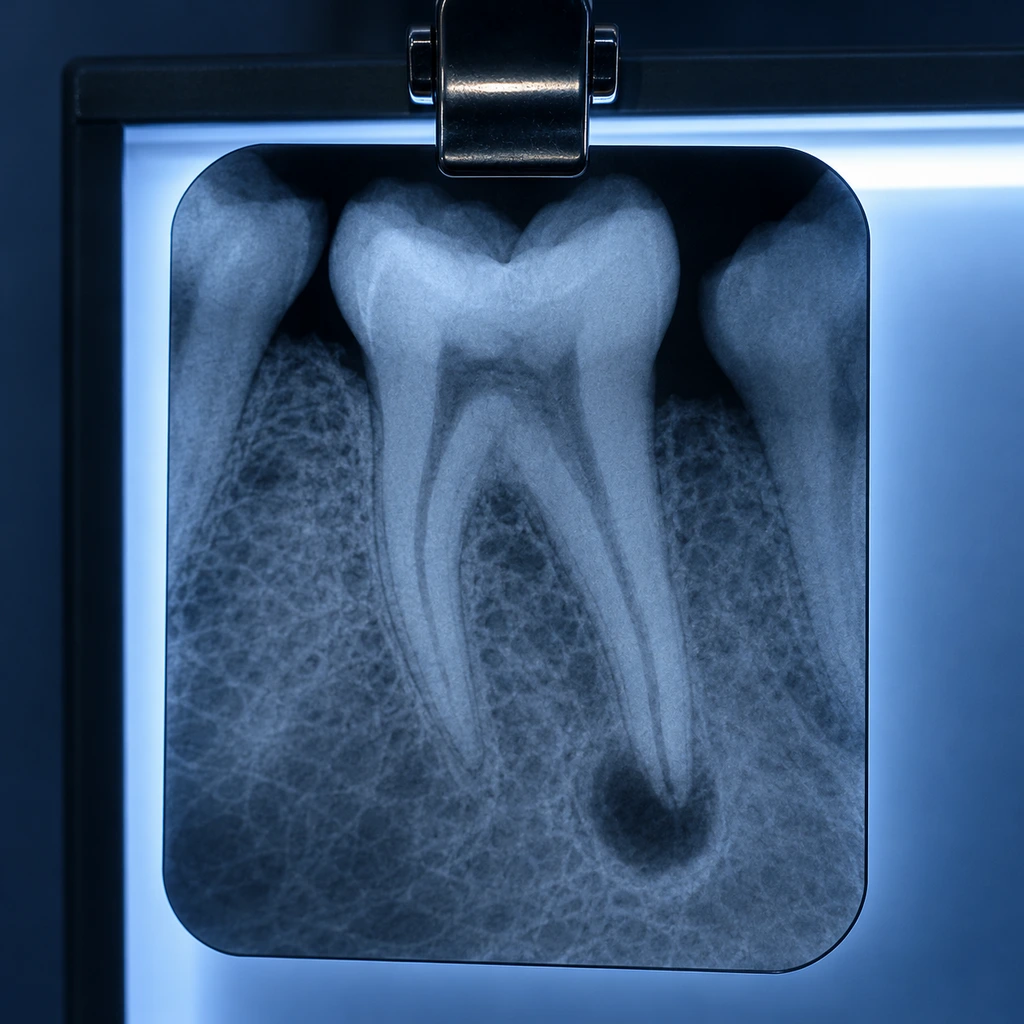
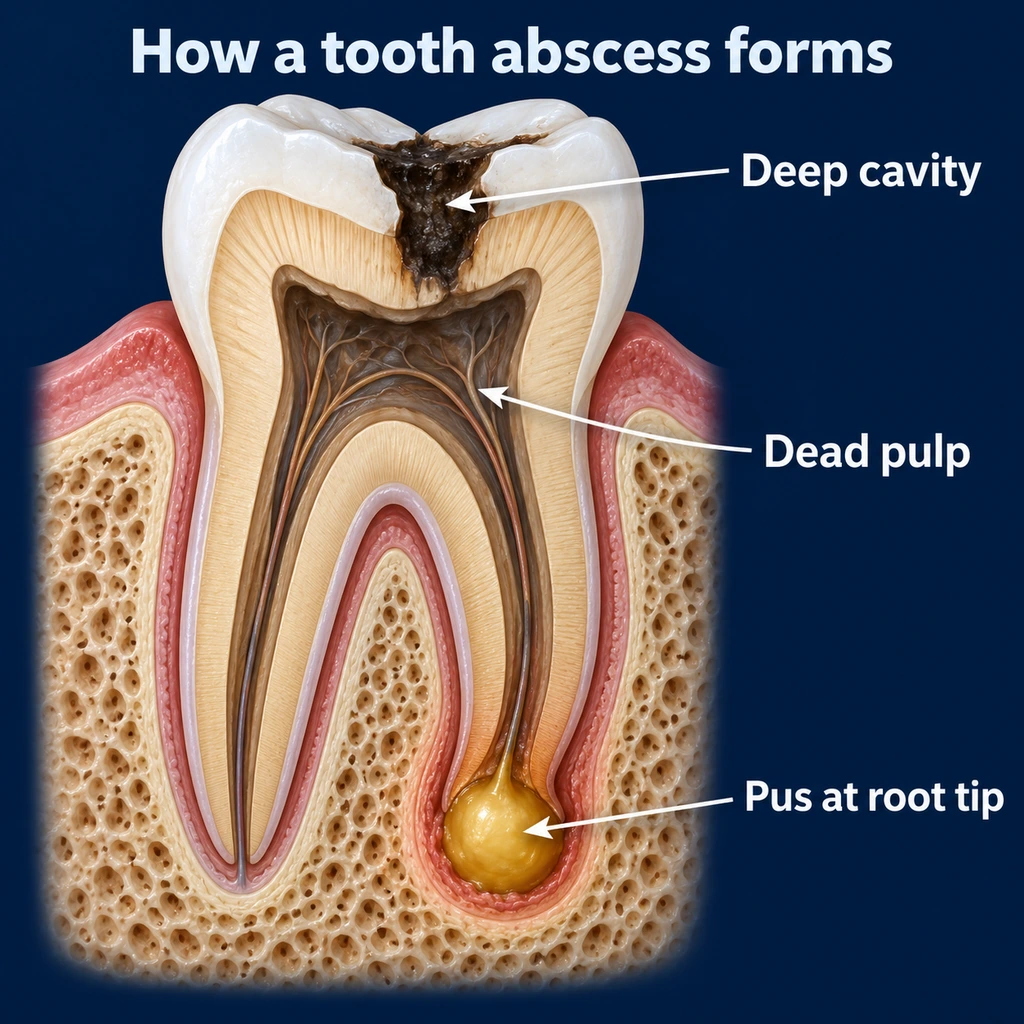

A tooth abscess is a pocket of pus caused by a bacterial infection inside a tooth or in the gum beside it. It usually starts with a deep cavity, a crack or advanced gum disease, and it often announces itself with a throbbing toothache and swelling. Most abscesses stay in the mouth and are treated by removing the source of the infection — draining the pus and cleaning out or removing the infected tooth. A small number spread into the face, neck, sinuses or bloodstream, and a spreading dental infection can be life-threatening.
Interactive Visualization How Cavities Form (and How to Stop Them) Most tooth abscesses begin as an untreated cavity. Watch plaque acid dissolve enamel and see how decay moves toward the nerve of the tooth. Launch →Table of Contents
- What a Tooth Abscess Is
- The Three Main Types of Dental Abscess
- Causes and Risk Factors
- Symptoms
- How a Tooth Abscess Is Diagnosed
- Treatment
- What the Research Shows About Antibiotics
- Prevention
- Complications: How a Dental Infection Spreads
- Warning Signs and Urgent Signs
- Key Research Papers
- Connections
- Featured Videos
What a Tooth Abscess Is
An abscess is a collection of pus — dead white blood cells, bacteria and broken-down tissue — walled off inside the body. A dental abscess is an abscess that starts from a tooth or from the gum and bone that hold it.
The inside of every tooth contains a soft core called the pulp: nerves and blood vessels that run down through thin channels in the roots (the root canals) and out through a tiny opening at the tip of each root. The pulp is sealed off from the mouth by hard enamel and dentin. When that seal is broken — by a deep cavity, a crack or a broken filling — bacteria from the mouth reach the pulp. The pulp becomes inflamed (pulpitis), and if the infection keeps going the pulp dies (pulp necrosis). The dead, infected root canal then leaks bacteria out of the root tip into the jawbone, and the body’s defences build an abscess there.
A review in Clinical Microbiology Reviews describes this acute apical abscess — an abscess at the tip (apex) of the root — as the most common form of dental abscess, caused by infection of the tooth’s root canal. It is usually confined to the mouth, but in some cases it spreads and causes severe complications or death [3]. A dental-clinics review likewise names the periapical infection (“around the root tip”) as the most common form of infection arising from the teeth [2].
The bacteria involved are not one single germ. Reviews describe a dental abscess as polymicrobial — a mixed community of many species — dominated by anaerobes, bacteria that live without oxygen. Named groups include Prevotella, Fusobacterium, Porphyromonas, Parvimonas, Dialister, Treponema, anaerobic cocci and streptococci such as the Streptococcus anginosus group [1][3]. These are normal residents of the mouth that cause harm once they reach a closed, oxygen-poor space such as a dead root canal. The review authors note that how badly an abscess behaves depends on how aggressive the bacteria are, the person’s own resistance, and the local anatomy of the jaw [1].
The Three Main Types of Dental Abscess
Dentists name an abscess by where it starts. The difference matters because each one is treated a little differently.
Periapical (apical) abscess — from inside the tooth
This is the abscess described above: the pulp dies, the root canal becomes infected, and pus gathers at the root tip. It is the most common type [3]. It often follows a large untreated cavity, a deep filling, a cracked tooth, or an old knock to the tooth that slowly killed the pulp. A tooth that has already had root canal treatment can also develop an abscess years later if bacteria get back into the canals [7].
Periodontal abscess — from the gum pocket
A periodontal abscess forms in the gum and bone beside a tooth, usually inside a deep pocket left by periodontitis. The tooth’s pulp may still be alive. A review in Periodontology 2000 calls it a relatively frequent dental emergency that can worsen the outlook for the affected tooth, and notes that bacteria from the abscess can spread and cause infections in other parts of the body [8]. The same review distinguishes abscesses that form in an existing gum pocket from those that arise at otherwise healthy sites [8] — for example when a piece of food such as a popcorn husk is forced under the gum.
Pericoronal abscess — around a partly erupted tooth
When a tooth, most often a lower wisdom tooth, has only partly come through the gum, a flap of gum over it traps food and bacteria. Inflammation there is called pericoronitis, and it can progress to an abscess. A 2022 systematic review searched for controlled trials of antibiotics in periodontal abscesses and pericoronitis and found that not a single randomised or non-randomised controlled trial had tested them in adults [10].
A fourth pattern, the endodontic-periodontal lesion, is a combined infection in which a dead pulp and a deep gum pocket connect along the same root. A 2026 systematic review found that studies of these lesions were too varied and too small for strong conclusions about the best treatment, with tooth-loss rates ranging from 0% to 25% across studies [9].
Causes and Risk Factors
The direct causes
- Untreated tooth decay — the most common route. A cavity that reaches the pulp lets bacteria straight in.
- A cracked or broken tooth, including fine cracks from grinding or biting something hard.
- Trauma — a blow to a tooth can kill the pulp slowly, sometimes with no visible damage, and an abscess may appear months or years later.
- Deep or leaking fillings and crowns, which can let bacteria seep underneath.
- Advanced gum disease — the deep pockets of periodontitis are where periodontal abscesses form [8].
- A partly erupted wisdom tooth with a gum flap that traps debris.
Things that make an abscess more likely or more dangerous
- Weakened immune defences — diabetes that is poorly controlled, chemotherapy, long-term steroid medicines, human immunodeficiency virus (HIV) infection, or other immune problems. Reviews describe host factors, temporary or permanent, as influences on whether an abscess develops and how severe it becomes [3], and an antibiotics review describes medically compromised people as more prone to complications from dental infections [6].
- Limited access to dental care. A 2024 review of children’s dental infections described them as largely preventable, and found they fall disproportionately on ethnic and racial minorities and on low-income and uninsured families [15]. A small cavity is cheap to fill; the same tooth left for years becomes an abscess.
- Frequent sugar and refined starch, which feeds the acid-making bacteria that cause decay.
- Dry mouth, since saliva protects teeth against decay (see Dry Mouth).
- Smoking, which worsens gum disease.
Symptoms
Symptoms vary with the type of abscess and how far it has gone. The most common are:
- Severe, throbbing toothache that can spread to the jaw, ear or neck on the same side.
- Pain on biting or tapping the tooth; the tooth can feel “high” or slightly loose.
- Sensitivity to hot and cold. Lingering pain after heat is a typical sign of an inflamed or dying pulp.
- Swelling of the gum, cheek, jaw or under the jaw.
- A pimple-like bump on the gum (a “gum boil”, or sinus tract) that may leak salty, bad-tasting fluid.
- Bad breath or a foul taste in the mouth.
- Tender, swollen lymph glands under the jaw or in the neck.
- Fever and feeling generally unwell — a sign the body as a whole is reacting to the infection.
When the pain goes away
Pain sometimes stops on its own. This usually means either that the nerve inside the tooth has died, or that the abscess has found a way to drain through the gum. In both cases the infection is still there: a dead, infected root canal does not heal by itself, and the abscess can flare again or keep slowly destroying bone around the root. Some long-standing abscesses cause no pain at all and are found only on an X-ray.
How a Tooth Abscess Is Diagnosed
A review of endodontic emergencies (“endodontics” is the branch of dentistry dealing with the pulp and root canals) sets out the order dentists follow as the “3 D’s”: Diagnosis first, then Definitive dental treatment, then Drugs — and it stresses telling inflammation apart from infection before deciding on treatment or medicines [7].
The usual steps are:
- History — how long the pain has lasted, what triggers it, whether there is swelling or fever, and any medical conditions.
- Examination — looking for decay, cracks, swelling, a draining bump on the gum, and deep gum pockets measured with a probe.
- Tapping and pressure tests — an abscessed tooth is often tender when tapped.
- Pulp tests — a cold stimulus or a mild electric current shows whether the nerve inside the tooth is still alive. A dead pulp points to a periapical abscess; a live pulp with a deep pocket points to a periodontal abscess.
- Dental X-rays — a dark area around the root tip shows bone lost to infection. A very new abscess may not yet show on an X-ray.
- Scans for spreading infection — when swelling extends into the neck or floor of the mouth, hospitals use a computed tomography (CT) scan of the neck with contrast to map the infection, and point-of-care ultrasound helps when a person cannot lie flat [12].
Treatment
Across the reviews and guidelines on this page, one principle is constant: the infection is cured by removing its source, not by medicine alone. A review in Dental Clinics of North America states that the most important element in treating dental infections is eliminating the primary source, with antibiotics as an add-on [2], and a microbiology review notes that most localised dental abscesses respond to surgical treatment, with antibiotics limited to severe spreading infections [1].
The procedures dentists use
- Incision and drainage — a small cut into the swelling under local anaesthetic lets the pus out. Relief is often fast because the pressure is released.
- Root canal treatment — the dentist opens the tooth, removes the dead and infected pulp, cleans and disinfects the canals, and seals them. This keeps the tooth. The Cochrane review groups extraction, incision and drainage, and this kind of endodontic cleaning together as the “surgical interventions” for an acute apical abscess [5].
- Extraction — pulling the tooth removes the source of infection completely. It is the usual choice when the tooth cannot be restored, and it is often the least expensive option.
- Drainage and deep cleaning for a periodontal abscess — for abscesses in the gum, reviews describe treatment as drainage and cleaning of the pocket, followed later by treatment of the underlying gum disease [8]. A 2026 systematic review concluded that periodontal abscesses can be managed effectively by initial drainage followed by periodontal therapy, while noting that this rests on limited and weak evidence; the abscess came back in 13.3% to 23% of cases within 15 months of follow-up [9].
- Hospital treatment — a spreading infection of the floor of the mouth or neck is managed in hospital with airway protection, broad-spectrum antibiotics through a drip, and surgical drainage [12].
When a root-canal-treated tooth becomes infected again
If an abscess returns after root canal treatment, the options are to redo the root canal through the crown (retreatment) or to reach the root tip through the gum and remove it (root-end surgery). A Cochrane review of 20 randomised trials found no clear evidence that either approach healed the lesion better at one year (risk ratio 1.15, 95% confidence interval 0.97 to 1.35; two trials, 126 participants; very low-quality evidence). More people in the surgical group reported pain in the first week (risk ratio 3.34). In one trial of 250 participants, preventive antibiotics before surgery did not reduce infection afterwards [16].
Pain relief
Draining the abscess is itself the main pain relief. A review on medical clearance for dental procedures describes multimodal, non-narcotic pain relief for acute dental pain — that is, combining non-opioid painkillers such as ibuprofen and acetaminophen (paracetamol) — and names acetaminophen as the painkiller of choice for people with liver disease or cirrhosis who do not drink alcohol [14]. Painkillers dull the pain but do not treat the infection; the pus remains until it is drained.
What the Research Shows About Antibiotics
Many people expect a tooth abscess to be treated with antibiotics alone. The research points the other way for most abscesses that are confined to the mouth.
The 2019 American Dental Association guideline
An expert panel of the American Dental Association (ADA) reviewed the evidence on antibiotics for toothache and intra-oral swelling in healthy adults, including a localised acute apical abscess. Finding likely negligible benefits and potentially large harms, the panel recommended against antibiotics in most situations, whether or not dental treatment was immediately available. It recommended antibiotics when there is systemic involvement — signs such as fever or malaise (feeling generally unwell) — or a high risk of progressing to it, and stated that immediate dental treatment should be prioritised in all cases [4].
The Cochrane review
A 2024 Cochrane review looked for randomised trials of antibiotics for symptomatic apical periodontitis (inflammation at the root tip) and acute apical abscess in adults. It found only three trials with 134 participants [5]:
- In one trial of 72 adults, a single dose of clindamycin before root canal cleaning made little to no difference to pain or swelling at any time point; median pain scores were 3.0 out of 10 in both groups at 24 hours.
- Two trials (62 participants) of a seven-day course of penicillin V after root canal cleaning found no differences in pain or swelling, but the evidence was rated very uncertain.
- No trial compared antibiotics with placebo when no dental procedure was done at all.
The review notes that clinical guidelines reserve antibiotics for spreading infection (cellulitis, swollen lymph nodes, diffuse swelling) or systemic involvement (fever, malaise), that dentists often prescribe them without these signs, and that this raises concern about antibiotic-resistant bacteria [5].
The European position
A European Society of Endodontology review states that for a discrete, localised swelling the primary aim is drainage without additional antibiotics. It describes antibiotics as an add-on when infection is spreading, when there is systemic involvement, in persistent infections, and in people with weakened immunity or certain heart and joint conditions. It names penicillin V, possibly with metronidazole, as still effective in most cases, amoxicillin (alone or with clavulanic acid) as preferred for better absorption and fewer side effects, and clindamycin when a person has a confirmed penicillin allergy [6].
Why this matters to patients
Antibiotics without drainage or tooth treatment can quiet the symptoms for a while, but the dead pulp or infected pocket remains, so the abscess commonly returns. Antibiotics also carry their own risks, including allergic reactions and gut infections such as Clostridioides difficile diarrhoea. For people who cannot reach a dentist quickly, the guidelines above draw the line at signs of spreading or whole-body illness.
Antibiotics before dental work
A family-medicine review states that preventive antibiotics before dental procedures are not recommended to prevent prosthetic joint infections or infective endocarditis except in certain circumstances [14]. People with particular heart conditions, such as an artificial heart valve or a past episode of infective endocarditis, fall into those exceptions under heart-association guidance.
Prevention
Because most abscesses begin as decay or gum disease, preventing those two conditions prevents most abscesses. A 2024 review of children’s dental infections concluded that these infections are largely preventable and could be reduced with better access to routine dental care [15].
- Treating cavities while they are small. A filling placed before decay reaches the pulp stops the chain that leads to an abscess.
- Daily plaque removal — brushing twice a day and cleaning between the teeth with floss or interdental brushes.
- Limiting how often sugar reaches the teeth. Decay depends more on how often sugary foods and drinks are taken than on the total amount. Whole foods — vegetables, fruit, whole grains such as brown rice, nuts, eggs, fish and meat — leave less fermentable sugar on the teeth than sweets, soft drinks and refined snacks.
- Gum disease care — treating gingivitis and periodontitis removes the deep pockets where periodontal abscesses form.
- Mouthguards for contact sports, which reduce tooth injuries that can kill the pulp.
- Attention to a cracked or broken tooth before bacteria get inside it.
- Fluoride. Dental guidelines use fluoride toothpaste and professionally applied fluoride varnish to reduce decay. Fluoride exposure is a subject of public debate; the site’s Fluoride section covers the safety questions so readers can make an informed choice.
Complications: How a Dental Infection Spreads
Most dental abscesses stay in the mouth. When one does break out, it follows the planes of soft tissue in the face and neck, or travels in the blood. A review in Dental Clinics of North America notes that although dental infections usually stay near the tooth-bearing ridge of the jaw, they can spread into the deep spaces of the head and neck [2]. Possible complications include:
- Facial cellulitis — a spreading infection of the cheek, jaw or around the eye. See Cellulitis.
- Ludwig’s angina — a rapidly spreading infection of the floor of the mouth, under the tongue and under the jaw. An emergency-medicine review describes it as more common in people with poor dentition or weakened immunity, with a woody, hard floor of the mouth and swelling under the jaw; difficulty opening the mouth (trismus) is a late sign. Its danger is rapid blockage of the airway, and treatment is airway protection, broad-spectrum antibiotics and surgical drainage, followed by intensive-care monitoring [12].
- Deep neck infection and mediastinitis — infection tracking down the neck into the chest, between the lungs [2].
- Sinus and eye-socket infection — upper back teeth sit right under the maxillary sinus, so an upper-tooth abscess can cause sinusitis and, rarely, orbital cellulitis.
- Cavernous sinus thrombosis — a blood clot in a large vein at the base of the brain, a rare but grave complication [2].
- Brain abscess — a 2024 review names dental and ear-nose-throat infections among the important predisposing conditions for brain abscess, and identifies mouth bacteria, including anaerobes, as the predominant germs found in brain abscesses [13].
- Sepsis and septic shock — the body’s overwhelming reaction to infection in the blood. A 2021 case report described a 23-year-old man whose acute apical abscess and cheek-space infection progressed to septic shock, with confusion, high fever, a racing heart, low blood pressure, breathing failure and kidney problems. The authors note that once septic shock develops, mortality is nearly 50%, and that early antimicrobial treatment is associated with survival [11]. See Sepsis.
- Bone infection (osteomyelitis) of the jaw and loss of the tooth.
Warning Signs and Urgent Signs
Signs that point to a tooth abscess
- A throbbing toothache that keeps a person awake or does not settle.
- A tooth that hurts to bite on or feels raised.
- Swelling of the gum next to a tooth, or a bump on the gum that leaks fluid.
- A bad taste or bad breath that does not go away.
- A darkened tooth after an old injury.
- Pain that suddenly stopped after days of severe toothache — often a sign the nerve has died, not that the infection has cleared.
Signs of a spreading infection, which can be life-threatening
Swelling that spreads to the floor of the mouth or neck, difficulty swallowing or breathing, or high fever with a tooth infection are signs of a spreading infection, which can be life-threatening. Other signs emergency services treat as urgent:
- Swelling under the tongue that lifts it or pushes it back, or a hard, board-like swelling under the jaw.
- Drooling, a muffled “hot potato” voice, or being unable to lie flat because breathing gets harder.
- Difficulty opening the mouth (trismus).
- Swelling that closes the eye, or swelling spreading quickly over hours.
- Fever, chills, a racing heart, confusion or extreme weakness — signs that the infection may have entered the bloodstream (sepsis).
- A severe headache, stiff neck, double vision or a bulging eye with a dental infection, which can signal spread toward the brain or eye socket.
Reviews describe medically compromised people as more susceptible to complications from dental infections, and Ludwig’s angina as more common in people with weakened immunity [6][12].
Key Research Papers
- Shweta, Prakash SK. Dental abscess: A microbiological review. Dent Res J (Isfahan). 2013;10(5):585-91. PubMed PMID: 24348613
- Ogle OE. Odontogenic Infections. Dent Clin North Am. 2017;61(2):235-252. PubMed PMID: 28317564
- Siqueira JF, Rôças IN. Microbiology and treatment of acute apical abscesses. Clin Microbiol Rev. 2013;26(2):255-73. PubMed PMID: 23554416
- Lockhart PB, Tampi MP, Abt E, Aminoshariae A, Durkin MJ, Fouad AF, et al. Evidence-based clinical practice guideline on antibiotic use for the urgent management of pulpal- and periapical-related dental pain and intraoral swelling: A report from the American Dental Association. J Am Dent Assoc. 2019;150(11):906-921.e12. PubMed PMID: 31668170
- Cope AL, Francis N, Wood F, Thompson W, Chestnutt IG. Systemic antibiotics for symptomatic apical periodontitis and acute apical abscess in adults. Cochrane Database Syst Rev. 2024;5(5):CD010136. PubMed PMID: 38712714
- Segura-Egea JJ, Gould K, Şen BH, Jonasson P, Cotti E, Mazzoni A, et al. Antibiotics in Endodontics: a review. Int Endod J. 2017;50(12):1169-1184. PubMed PMID: 28005295
- Abbott PV. Present status and future directions: Managing endodontic emergencies. Int Endod J. 2022;55 Suppl 3:778-803. PubMed PMID: 34958512
- Herrera D, Alonso B, de Arriba L, Santa Cruz I, Serrano C, Sanz M. Acute periodontal lesions. Periodontol 2000. 2014;65(1):149-77. PubMed PMID: 24738591
- Dommisch H, Hoedke D, Dourou M, Calciolari E, Herrera D, Toma S. Management of Periodontal Abscesses and Endodontic-Periodontal Lesions-A Systematic Review. J Clin Periodontol. 2026. PubMed PMID: 42014572
- Leroy R, Bourgeois J, Verleye L, Toma S. Should systemic antibiotics be prescribed in periodontal abscesses and pericoronitis? A systematic review of the literature. Eur J Oral Sci. 2022;130(4):e12884. PubMed PMID: 35781706
- Mannan S, Tordik PA, Martinho FC, Chivian N, Hirschberg CS. Dental Abscess to Septic Shock: A Case Report and Literature Review. J Endod. 2021;47(4):663-670. PubMed PMID: 33422573
- Bridwell R, Gottlieb M, Koyfman A, Long B. Diagnosis and management of Ludwig's angina: An evidence-based review. Am J Emerg Med. 2021;41:1-5. PubMed PMID: 33383265
- Omland LH, Nielsen H, Bodilsen J. Update and approach to patients with brain abscess. Curr Opin Infect Dis. 2024;37(3):211-219. PubMed PMID: 38547383
- Herrick KR, Terrio JM, Herrick C. Medical Clearance for Common Dental Procedures. Am Fam Physician. 2021;104(5):476-483. PubMed PMID: 34783493
- Teal L, Sheller B, Susarla HK. Pediatric Odontogenic Infections. Oral Maxillofac Surg Clin North Am. 2024;36(3):391-399. PubMed PMID: 38777729
- Del Fabbro M, Corbella S, Sequeira-Byron P, Tsesis I, Rosen E, Lolato A, et al. Endodontic procedures for retreatment of periapical lesions. Cochrane Database Syst Rev. 2016;10(10):CD005511. PubMed PMID: 27759881
PubMed Topic Searches
Connections
- Dentistry & Oral Health
- How Cavities Form — interactive animation
- Tooth Decay (Dental Caries)
- Periodontitis
- Gum Disease
- Gingivitis
- Halitosis (Chronic Bad Breath)
- Oral Microbiome
- Wisdom Teeth (Third Molars)
- Tooth Sensitivity (Dentin Hypersensitivity)
- Dry Mouth (Xerostomia)
- Cellulitis
- Sepsis
- Sinusitis
- Orbital Cellulitis
- Infective Endocarditis
- Diabetes
- Fluoride