Ergothioneine: Dietary Sources and How to Get It
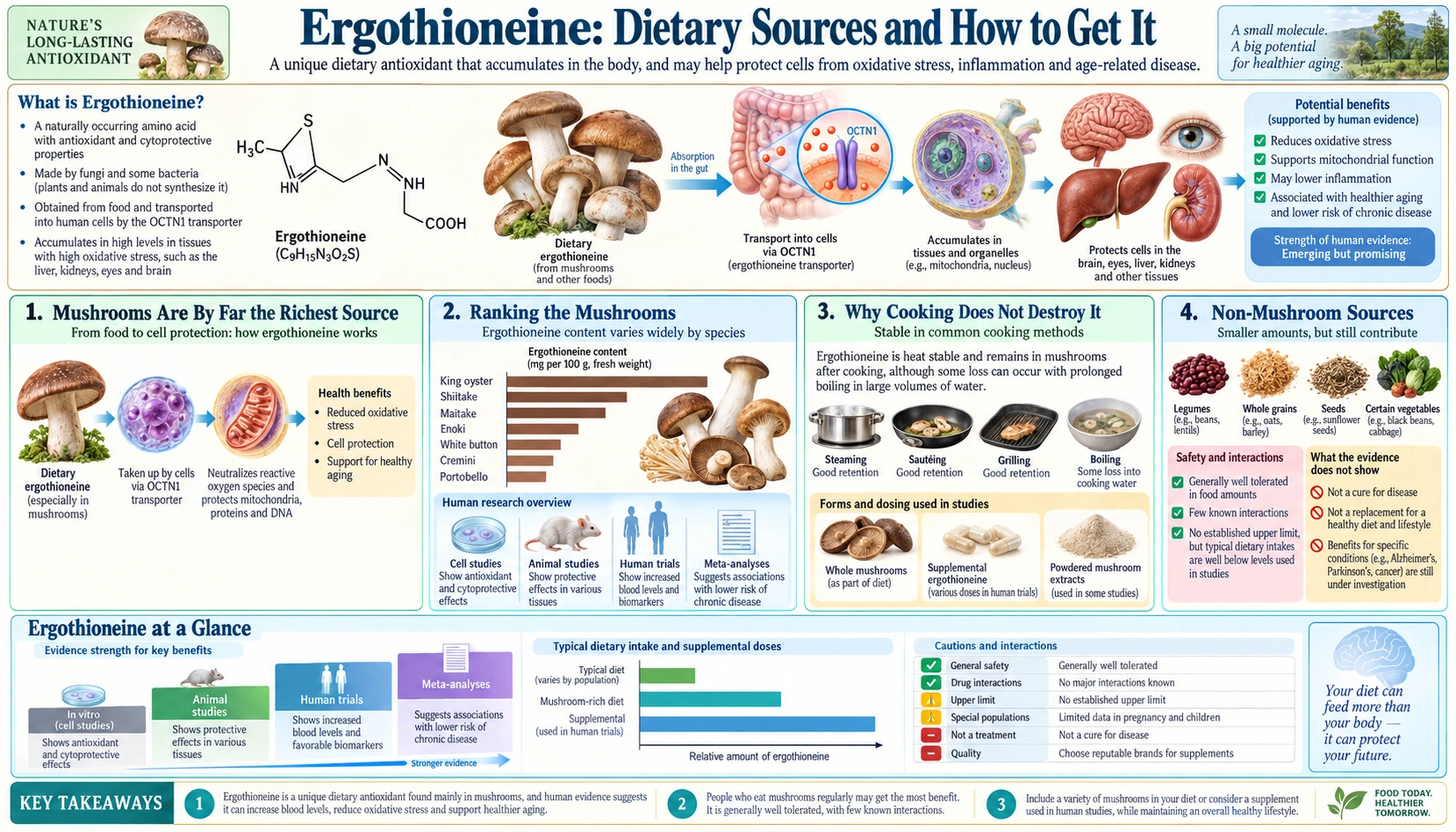
If ergothioneine turns out to matter for long-term health, the practical question becomes simple: how do you get it? The answer is refreshingly concrete. Mushrooms are by far the richest dietary source — not by a little, but by an order of magnitude or more over anything else on the plate. Among mushrooms, oyster and king oyster lead, with specialty species like porcini even higher; shiitake and maitake sit in the middle; and the familiar white button, cremini, and portobello (all the same species) are the lowest of the mushrooms but still far ahead of non-fungal foods. Smaller amounts appear in organ meats, some beans, and oat bran, all of which acquire it indirectly from fungi in the food chain. Best of all, ergothioneine is heat-stable, so ordinary cooking — unlike with many delicate antioxidants — does not destroy it. This page ranks the sources, explains why cooking is safe, and offers practical, honest guidance, including where the numbers are firm and where they vary widely.
Table of Contents
- Mushrooms Are By Far the Richest Source
- Ranking the Mushrooms
- Why Cooking Does Not Destroy It
- Non-Mushroom Sources
- Why Plants and Animals Contain Any at All
- How Much Do People Actually Eat
- Absorption and Bioavailability
- Supplements
- Practical Ways to Increase Intake
- Honest Notes on Amounts and Variability
- Key Research Papers
- Connections
- Featured Videos
Mushrooms Are By Far the Richest Source
Ergothioneine is synthesized by fungi, so it should be no surprise that fungi are where it is most concentrated. What is surprising is the size of the gap. The 2017 Food Chemistry study by Kalaras, Richie, Calcagnotto, and Beelman — aptly titled "Mushrooms: A rich source of the antioxidants ergothioneine and glutathione" — measured ergothioneine across many mushroom species and found wide differences between them (see the notes on variability below). The comparison with other foods comes from a 2020 review by Beelman and colleagues: commercially grown white button and gray oyster mushrooms held 630 and 1,310 milligrams per kilogram of dry weight, "much higher" than oats (1.8), kidney beans (2.1) or chicken livers (47 mg/kg dry weight), foods that hold some of the next highest documented levels. A single serving of a rich mushroom variety can deliver more ergothioneine than an entire day of a mushroom-free diet.
This is why every population-level analysis of ergothioneine intake tracks mushroom consumption so closely, and why the longevity-vitamin discussion is really, at the level of the plate, a discussion about eating mushrooms. For anyone wanting to raise their ergothioneine intake, the entire strategy can be summarized in one word: mushrooms.
Ranking the Mushrooms
Ergothioneine content varies substantially by species. The broad, well-replicated ranking is as follows, from richest to least (though all are good sources relative to non-fungal foods):
- Highest — specialty and oyster-type mushrooms. King oyster and oyster mushrooms (genus Pleurotus) are the richest widely available culinary mushrooms. Certain wild specialty species such as porcini (Boletus edulis) test even higher, among the highest of any food measured.
- Moderate — shiitake and maitake. Shiitake and maitake carry solid mid-range amounts — less than oyster mushrooms but well above the button family.
- Lower (but still far ahead of non-mushrooms) — the button family. White button, cremini, and portobello are all the same species, Agaricus bisporus, at different stages of maturity. They contain the least ergothioneine among common culinary mushrooms, yet a serving still provides more than most people get from the rest of their diet combined. See the white button mushroom page.
In short, oyster and king oyster mushrooms deliver the most ergothioneine per serving, while everyday white and cremini mushrooms still supply far more than non-mushroom foods. Darker, more strongly flavored, and specialty mushrooms tend to be richer than pale, mild ones.
Why Cooking Does Not Destroy It
Many prized food antioxidants are fragile — vitamin C leaches into cooking water and degrades with heat, for instance. Ergothioneine is the opposite: it is notably heat-stable. Studies measuring ergothioneine in mushrooms before and after cooking find that it survives boiling, sauteing, frying, and other ordinary preparation with little loss. The same thione chemistry that lets it resist auto-oxidation in the body (explained on the antioxidant page) also makes it robust in the pan.
A 2026 study of store-bought mushrooms by Guthrie, Hasic, and Gordon reported that ergothioneine "is a thermally stable compound and does not appear to degrade but rather increases in concentration in cooked mushrooms." The same study found the highest levels in mushroom species that are able to break down cellulose (the tough fibre of plant material).
This is genuinely good practical news, and it removes a common worry. Eating mushrooms raw brings no ergothioneine advantage, and cooking improves the digestibility of mushrooms and breaks down certain undesirable raw-mushroom compounds. Ordinary cooking methods leave the ergothioneine in place. If you cook them in a soup or stew, any small amount that leaches out stays in the broth, so you still consume it.
Non-Mushroom Sources
Beyond mushrooms, ergothioneine appears in a scattering of other foods, in much smaller amounts. These matter mostly for people who eat few mushrooms, since together they can still contribute:
- Organ meats — liver and kidney are the best animal sources, because animals accumulate ergothioneine from their own diets and concentrate it in these organs (which, like ours, express the OCTN1 transporter). See beef liver and chicken liver.
- Beans — certain beans, particularly black and red/kidney beans, contain modest amounts taken up from soil fungi.
- Oat bran — among grains, oats and especially oat bran carry measurable ergothioneine.
- Fermented foods — foods fermented with fungi, such as tempeh, can contain ergothioneine contributed by the mold used in fermentation. The 2020 Beelman review lists tempeh, a soybean food fermented with fungi, as having "moderately high levels" (201 mg/kg dry weight), more than the oats, kidney beans and chicken livers in the same comparison.
For scale, the same review gives these dry-weight figures: white button mushroom 630 mg/kg, gray oyster mushroom 1,310 mg/kg, tempeh 201 mg/kg, chicken liver 47 mg/kg, kidney beans 2.1 mg/kg and oats 1.8 mg/kg. The review adds that tempeh is rarely eaten in the American diet.
Ey, Schömig, and Taubert catalogued dietary sources in a 2007 Journal of Agricultural and Food Chemistry study, confirming this pattern: mushrooms far in the lead, with organ meats, some legumes, and certain grains providing lesser amounts, and most other foods containing little or none.
Why Plants and Animals Contain Any at All
Since only fungi and some bacteria can synthesize ergothioneine, its presence in beans, oats, and liver requires an explanation — and the explanation is the food chain. Plants do not make ergothioneine, but their roots take it up from the soil, where it is produced by soil fungi and by the mycorrhizal fungi that live in partnership with plant roots. Legumes and grains grown in fungally active soils therefore accumulate small amounts.
Animals, in turn, obtain ergothioneine by eating plants and other organisms, and concentrate it in tissues rich in the OCTN1 transporter — liver, kidney, and blood. This is exactly parallel to how humans acquire it. In every case, the ultimate source is fungal; the ergothioneine simply travels up the food chain from the organisms that can make it to those, like us, that cannot. It is a small, elegant illustration of how dependent the rest of life is on fungi.
How Much Do People Actually Eat
Dietary ergothioneine intake varies enormously between individuals and between countries, driven almost entirely by mushroom consumption. Robert Beelman's 2020 review cites estimates that Americans consume about 1.1 milligrams per day — low, because Americans eat relatively few mushrooms — less than people in four European countries, where estimates reach up to about 4.6 milligrams per day in Italy.
Beelman used this contrast to frame his "limited in the American diet" argument, discussed in full on the longevity-vitamin page. The practical point here is narrower and firmer: most people could easily multiply their ergothioneine intake several-fold simply by adding a couple of servings of mushrooms per week, moving from the low end of the intake range toward the high end without any supplement at all.
Blood levels have also been followed over time. In Japan's Hisayama Study (Meng and colleagues, 2025), 1,344 community residents aged 65 and over without dementia were followed for a median of 11.2 years; 273 developed dementia, 201 of them Alzheimer's disease. The risk of all-cause dementia, Alzheimer's disease and other (non-Alzheimer's) dementia fell step by step across rising quarters of blood ergothioneine, and the link held after accounting for cardiovascular, lifestyle and dietary factors, including daily vegetable intake. This is an observational link, not proof that eating more ergothioneine prevents dementia.
Absorption and Bioavailability
Getting ergothioneine into food is only useful if the body can absorb it — and it can. The OCTN1 transporter is expressed in the lining of the small intestine, where it actively pulls ergothioneine out of digested food and into the bloodstream. Weigand-Heller, Kris-Etherton, and Beelman showed in a 2012 Preventive Medicine pilot study that ergothioneine from white button mushrooms is bioavailable in humans: in 10 healthy men who ate a test meal with 8 g or 16 g of mushroom powder, it was taken up into red blood cells. Blood antioxidant capacity (measured as total ORAC, oxygen radical absorbance capacity) actually fell after the mushroom meals, while the after-meal rise in blood fats (triglycerides) tended to be smaller.
The controlled human study by Cheah and colleagues (2017), covered on the antioxidant page, went further, showing that orally administered ergothioneine is well absorbed and then retained in the body for weeks with minimal urinary loss: the authors describe it as "avidly absorbed and retained", with less than 4% of the dose lost in urine. Markers of oxidative damage and inflammation, including C-reactive protein, showed some downward trends, but "most of the changes were non-significant". In other words, ergothioneine from a plate of mushrooms is efficiently captured and held, not passed through — which is precisely what you would want from a nutrient the body appears to value.
Supplements
Purified ergothioneine supplements exist and have been used in the human studies described across these pages; they are well absorbed and, in trials to date, free of notable adverse effects. That said, a few honest caveats apply:
- Food is the tested vehicle for most benefit data. The strongest positive associations come from people eating whole diets rich in mushrooms, which deliver ergothioneine alongside fiber, B vitamins, potassium, and other compounds.
- Efficacy is still being established. Because outcome trials are only beginning, buying a supplement is a bet on a hypothesis, not on proven benefit.
- Mushrooms are cheaper and more nutritious overall. A few servings of mushrooms a week raises intake through food, at lower cost than a supplement.
For someone who supplements — for instance, someone who genuinely cannot or will not eat mushrooms — the safety record so far is reassuring, though supplementing remains closer to an experiment than a proven therapy.
Regulators have reviewed the synthetic form. In a 2017 statement, the European Food Safety Authority (EFSA) nutrition panel kept the no-observed-adverse-effect level (the highest dose with no harm seen in toxicology studies) of 800 mg per kilogram of body weight per day from its original novel-food assessment of synthetic L-ergothioneine. It judged the proposed uses safe for infants, toddlers, and pregnant and breastfeeding women, with margins of exposure (the gap between that level and the highest expected daily intake) of 284, 236 and 610 respectively.
Practical Ways to Increase Intake
- Mushrooms as an everyday vegetable. They can be sauteed into eggs, pasta, stir-fries, grain bowls, and pasta sauces. Even everyday white and cremini mushrooms add up.
- Oyster-type mushrooms deliver the most. Oyster and king oyster mushrooms deliver the most ergothioneine per serving and have a meaty texture that works well roasted or seared.
- Mushrooms blended into ground-meat dishes. Finely chopped mushrooms mixed into burgers, meatballs, tacos, or chili add ergothioneine (and moisture and flavor) while stretching the meat.
- Dried mushrooms. Dried porcini and shiitake are concentrated, keep indefinitely, and rehydrate into soups, stocks, and sauces — the soaking liquid holds the ergothioneine too.
- Non-mushroom sources are small. Beans, oats, and liver help, but no realistic amount of them matches a serving of mushrooms.
Honest Notes on Amounts and Variability
A word of caution about precise numbers. Published ergothioneine values for a given mushroom can differ severalfold between studies, because content depends on species, strain, growing substrate, maturity at harvest, and the analytical method used. For that reason this page gives a reliable ranking of sources and only a few published figures, rather than false-precision milligram figures for each food — the ranking is robust even where the exact numbers are not.
The Kalaras 2017 study shows how wide the spread is: across the mushroom species it tested, ergothioneine ranged from 0.15 to 7.27 milligrams per gram of dry weight. In the species where caps and stems were compared, the caps held more, and white button mushrooms (Agaricus bisporus) picked in a later (third) harvest flush held more than those from the first flush.
The bottom line is durable regardless of the uncertainty: mushrooms dominate as a source, oyster-type and specialty mushrooms lead the mushrooms, cooking does not hurt, and the whole thing is easy, safe, and inexpensive to act on. Whether or not the grander longevity-vitamin hypothesis is ultimately confirmed, eating more mushrooms is a low-risk, well-supported dietary habit on its own merits.
Key Research Papers
- Kalaras MD, Richie JP, Calcagnotto A, Beelman RB (2017). Mushrooms: A rich source of the antioxidants ergothioneine and glutathione. Food Chemistry 233:429–433. — PubMed PMID: 28530594
- Ey J, Schömig E, Taubert D (2007). Dietary sources and antioxidant effects of ergothioneine. Journal of Agricultural and Food Chemistry 55(16):6466–6474. — PubMed PMID: 17616140
- Weigand-Heller AJ, Kris-Etherton PM, Beelman RB (2012). The bioavailability of ergothioneine from mushrooms (Agaricus bisporus) and the acute effects on antioxidant capacity and biomarkers of inflammation. Preventive Medicine 54 Suppl:S75–S78. — PubMed PMID: 22230474
- Beelman RB, Kalaras MD, Phillips AT, Richie JP Jr (2020). Is ergothioneine a ‘longevity vitamin’ limited in the American diet? Journal of Nutritional Science 9:e52. — PubMed PMID: 33244403
- Cheah IK et al. (2017). Administration of Pure Ergothioneine to Healthy Human Subjects: Uptake, Metabolism, and Effects on Biomarkers of Oxidative Damage and Inflammation. Antioxidants & Redox Signaling 26(5):193–206. — PubMed PMID: 27488221
- Tang RMY, Cheah IK, Yew TSK, Halliwell B (2018). Distribution and accumulation of dietary ergothioneine and its metabolites in mouse tissues. Scientific Reports 8:1601. — PubMed PMID: 29371632
- Guthrie C, Hasic S, Gordon H (2026). Interspecies distribution and processing stability of ergothioneine and histidine in commercially available mushrooms. microPublication Biology 2026. — PubMed PMID: 42564551
- EFSA Panel on Dietetic Products, Nutrition and Allergies (NDA), Turck D, Bresson JL, et al. (2017). Statement on the safety of synthetic l-ergothioneine as a novel food – supplementary dietary exposure and safety assessment for infants and young children, pregnant and breastfeeding women. EFSA Journal 15(11):e05060. — PubMed PMID: 32625352
- Meng X, Ohara T, Nishioka K, Shibata M, Katsube M, Tateishi N, Nakamura Y, Oishi E, Sakata S, Furuta Y, Nakao T, Ninomiya T (2025). Serum ergothioneine and risk of dementia in a general older Japanese population: the Hisayama Study. Psychiatry and Clinical Neurosciences 79(12):808–816. — PubMed PMID: 40908798
- Gründemann D et al. (2005). Discovery of the ergothioneine transporter. PNAS 102(14):5256–5261. — PubMed PMID: 15795384
- Borodina I et al. (2020). The biology of ergothioneine, an antioxidant nutraceutical. Nutrition Research Reviews 33(2):190–217. — PubMed PMID: 32051057
PubMed Topic Searches
External Authoritative Resources
- U.S. Department of Agriculture (USDA) FoodData Central (nutrient database for mushrooms and other foods)
- PubChem — Ergothioneine (chemical properties and stability)
- PubMed — ergothioneine food-source literature