Spirulina: History and Discovery
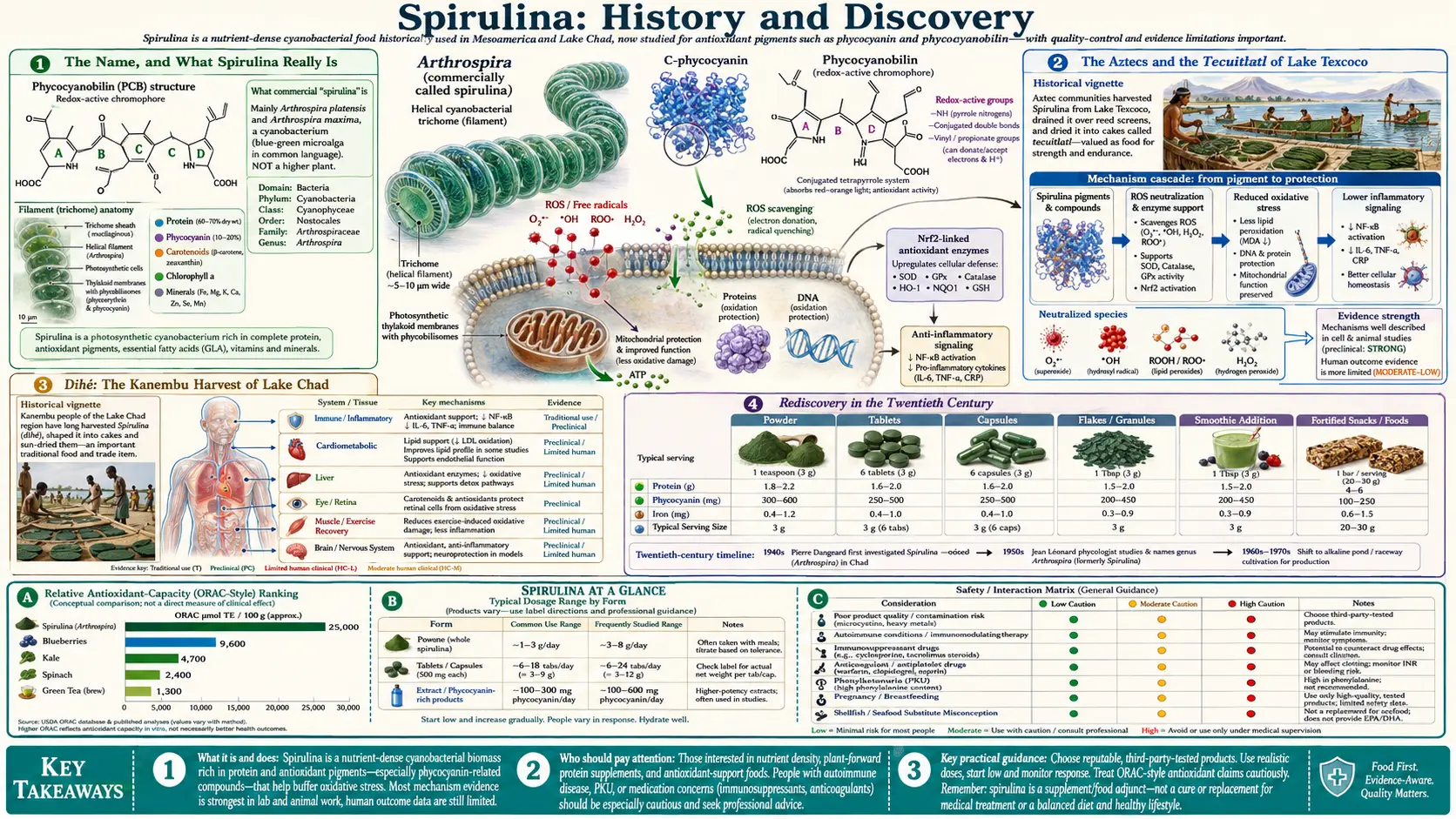
Long before anyone called it a "superfood," spirulina was simply food — scooped from the surface of warm, salty lakes, dried in the sun, and eaten by people on two different continents who never met. This is the story the historical record actually supports: a blue-green microbe harvested by the Aztecs from Lake Texcoco and by the Kanembu people from Lake Chad; its scientific rediscovery in twentieth-century Africa; a genuinely tangled argument among botanists over what to even name it; the moment it became the world's first farmed cyanobacterium; and its journey from a folk cake to a candidate space ration and a heavily studied dietary supplement. Where the record is firm we say so. Where a claim is folklore, marketing, or still debated — including the famous "NASA said one gram equals a kilo of vegetables" line — we say that too.
Table of Contents
- The Name, and What Spirulina Really Is
- The Aztecs and the Tecuitlatl of Lake Texcoco
- Dihé: The Kanembu Harvest of Lake Chad
- Rediscovery in the Twentieth Century
- A Tangle of Names: Spirulina, Arthrospira, Limnospira
- From Soda Lake to Superfood: The First Farms
- Spirulina Goes to Space — and the "Earth Food" Claim
- From Folk Food to Modern Research
- Research Papers and References
- Connections
- Featured Videos
The Name, and What Spirulina Really Is
The word spirulina comes from the Latin spira, meaning a coil, twist, or spiral — the same root behind English words like spiral. It is an apt name. Under a microscope the organism appears as long, blue-green filaments wound into tidy corkscrew helices, and that distinctive shape is exactly what early naturalists were describing when the name was coined. The genus name Spirulina is generally credited to the French naturalist Pierre Jean François Turpin, who examined spiral blue-green filaments around 1827.
Here is the first surprise of spirulina's history, and it is a real one: the "spirulina" sold as a supplement is not, in the strict modern sense, Spirulina at all. It is a cyanobacterium — a photosynthetic bacterium, one of the most ancient forms of life on Earth — not a true alga, even though it is almost universally called "blue-green algae." And the two species actually grown for food, long written as Spirulina platensis and Spirulina maxima, were reclassified by scientists into the genus Arthrospira, and more recently into a brand-new genus, Limnospira. The familiar word "spirulina" survived as the everyday and commercial name even after the formal botany moved on — a tangle worth its own section, below. For this article, "spirulina" means the edible blue-green microbe people have eaten for centuries, whatever a taxonomist would call it this decade.
What is not in doubt is where it grows and why people found it. Spirulina thrives in warm, strongly alkaline (high-pH, often soda-rich) lakes — harsh waters where little else flourishes. In such lakes it can bloom so densely that it stains the surface a deep blue-green and can be skimmed off by the bucketful. That single ecological fact — an edible, protein-rich organism growing thick on lakes that were otherwise nearly barren — is the thread that runs through every chapter of its human story.
The Aztecs and the Tecuitlatl of Lake Texcoco
The earliest documented human use of spirulina belongs to the Aztecs of central Mexico, who harvested it from Lake Texcoco, the large shallow soda lake on which their capital Tenochtitlan was built. They called the dried blue-green substance tecuitlatl, gathered it from the lake surface with fine nets, and pressed it into cakes that were sold in the markets and eaten as a savoury food.
This is not merely oral tradition; it rests on a written eyewitness source. Bernal Díaz del Castillo, a soldier who marched with Hernán Cortés during the conquest that began in 1519, described in his memoir of the campaign the market sellers offering small cakes made from a slimy substance collected from the great lake — a food he likened to a kind of cheese. Sixteenth-century missionary accounts associated with the Franciscan friar Toribio de Benavente (known as Motolínía) are also cited as describing the gathering of this lake harvest. The eyewitness market description is the firmly documented part; the precise details of preparation come from these early colonial chronicles and should be read as period testimony rather than modern analysis.
The practice did not survive the colonial era. As the lakes of the Valley of Mexico were progressively drained for farmland and for the growing city, Lake Texcoco shrank and the harvest of tecuitlatl faded from everyday life, so that by later centuries it had largely been forgotten. It is worth being careful with the larger claims sometimes attached to this story — for example, that tecuitlatl alone could have fed the whole population of Tenochtitlan. That is an estimate, not a measured historical fact. What the record firmly supports is narrower and still striking: the Aztecs deliberately harvested, sold, and ate spirulina as food, and a Spanish eyewitness wrote it down.
Dihé: The Kanembu Harvest of Lake Chad
On the other side of the world, and apparently entirely independently, the same lake-harvesting tradition grew up in Africa. Around Lake Chad, in the Kanem region, the Kanembu people have for generations skimmed blue-green algae from the alkaline waters and dried it in the sun into thin, dark cakes called dihé (also written dihe). Dihé is broken into pieces and used especially as the base of a sauce eaten with grains — a genuine dietary staple rather than a curiosity. Remarkably, this is one tradition that never lapsed: dihé is still harvested and eaten by the Kanembu today.
The African use is the more recent to be documented in the scientific literature, and that documentation is what makes spirulina's twentieth-century rediscovery possible. The French phycologist Pierre Dangeard (Pierre Jean-Louis Dangeard, 1895–1970) is credited with noting around 1940 that the dihé eaten near Lake Chad was a dried preparation of blue-green algae from the lake. (Many popular accounts — and even some encyclopedia entries — mistakenly call Dangeard "Belgian," apparently confusing him with the Belgian botanist Jean Léonard who took up the trail two decades later; the biographical record is clear that Dangeard was French.) His observation was not widely followed up at the time, and it took another two decades before the link was nailed down (see the next section).
Two independent peoples, an ocean apart, harvesting the same kind of microbe from the same kind of harsh soda lake and turning it into the same kind of dried cake — this parallel is the genuinely remarkable centre of spirulina's human history. It is most honestly read not as evidence of contact between them, but as two cultures separately recognising that a thick lake bloom others would ignore was, in fact, good and abundant food.
Rediscovery in the Twentieth Century
Spirulina re-entered the modern scientific world through the work of the Belgian botanist Jean Léonard. While taking part in a trans-Saharan expedition in the early 1960s, Léonard encountered the dihé cakes being sold in markets in the Lake Chad region. Following up on what Dangeard had noted decades earlier, Léonard confirmed during 1964 and 1965 that dihé was indeed made of spirulina — identifying the organism behind the traditional food and reconnecting the African tradition to a name.
Léonard's contemporary, the botanist Pierre Compère, is associated with the taxonomic work on the Lake Chad material in this same period. Out of this African research came the practical questions that drove the next chapter: what exactly are this organism's growth requirements, and could it be cultivated deliberately rather than merely skimmed from wild lakes? Through the 1970s, study of spirulina's biology aimed squarely at making large-scale, controlled production possible.
It is worth pausing on the shape of this story. Spirulina was not "discovered" by any single scientist in the way a new element or a distant moon is discovered. Two peoples had been eating it for centuries. What twentieth-century researchers like Dangeard and Léonard did was different and specific: they identified the microbe behind a traditional food, gave it a verifiable scientific name, and worked out how it lived — turning an ancient practice into something that could be measured, farmed, and tested.
A Tangle of Names: Spirulina, Arthrospira, Limnospira
Few foods carry as confusing a naming history as spirulina, and the confusion is real science, not pedantry — it changes which organism a label legally refers to. The short version: the popular name and the formal scientific name parted ways more than a century ago, and the formal name has changed several times since.
The genus Spirulina was named by Turpin around 1827. In 1852, the naturalist Ernst Stizenberger noticed that some of these coiled blue-green filaments had internal cross-walls (septa) dividing them into cells, and proposed a separate genus for those multicellular, helical forms: Arthrospira. Then in 1925 the influential phycologist Lothar Geitler set Stizenberger's distinction aside and folded Arthrospira back into Spirulina, a consolidation he maintained in his major 1932 treatment of the blue-green algae. Because Geitler's authority was so great, the merged name Spirulina stuck — which is precisely why the edible species came to be sold under that word.
Later researchers, however, concluded that Stizenberger had been right to separate them: in 1989 the genus Arthrospira was reinstated (in the work of Castenholz and colleagues), and the edible food organisms were returned to it — so the species are correctly written Arthrospira platensis and Arthrospira maxima. Most recently, in 2019, a detailed study by Paulina Nowicka-Krawczyk, Radka Mühlsteinová, and Tomáš Hauer separated the commercially grown taxa once more, placing them in a newly erected genus, Limnospira. Under that scheme the strains farmed for food fall under names such as Limnospira fusiformis, L. maxima, and L. indica. The authors noted that the type species of Arthrospira itself differs from the cultivated taxa, which is part of why the reshuffling was needed.
For an ordinary person three honest takeaways are enough. First, the "spirulina" on a supplement label is a real, specific organism — the long debate is about which genus drawer to file it in, not about whether it exists. Second, it is a cyanobacterium (a photosynthetic bacterium), not a true plant or true alga, even though "blue-green algae" is the universal nickname. Third, expect to see all of Spirulina, Arthrospira, and increasingly Limnospira used for the same thing in books, labels, and research papers — the names are tracking a single, well-defined microbe.
From Soda Lake to Superfood: The First Farms
Spirulina has the distinction of being one of the first microorganisms ever farmed deliberately as human food, and the place that began is well documented: the Sosa Texcoco works on the remnant of Lake Texcoco in Mexico — the very lake the Aztecs had harvested centuries before. Sosa Texcoco was an industrial operation extracting sodium compounds (soda ash) from the alkaline lake, and according to industry histories its managers noticed that spirulina was blooming so heavily in the evaporation basins that it interfered with production.
The French engineer Hubert Durand-Chastel, who directed the plant, is the figure most associated with turning that nuisance bloom into a crop. By industry accounts, deliberate cultivation of Arthrospira maxima at the site began in the late 1960s, with commercial production of dried spirulina established through the 1970s — making Sosa Texcoco the first large-scale commercial spirulina operation in the world. These dates and details come largely from later trade and biographical histories rather than from a single primary scientific record, so we present them as the widely reported account rather than as settled fact; the broad point — that the first commercial spirulina farm grew on the old Aztec lake in Mexico — is well established.
From that beginning, cultivation spread. By the 1980s spirulina was being farmed commercially elsewhere, including in the United States and in Asia, generally in shallow open "raceway" ponds where paddlewheels keep the alkaline broth circulating in sunlight. International interest in spirulina as a weapon against malnutrition grew alongside the farms, championed over the years by advocates and by intergovernmental bodies, on the strength of its high protein content and the ease of growing it in hot, dry regions on land unsuited to ordinary crops. That dual identity — a premium health supplement in wealthy countries and a potential cheap protein source in poor ones — has shaped spirulina's modern story ever since.
Spirulina Goes to Space — and the "Earth Food" Claim
One reason spirulina captured the public imagination is that space agencies took it seriously. Both the United States' NASA and the European Space Agency (ESA) have studied spirulina as a candidate food for long-duration missions, where every kilogram launched is precious and a crop that produces dense nutrition while also generating oxygen and consuming carbon dioxide is enormously attractive.
The documented reality is concrete. In the late 1980s NASA-supported researchers characterised spirulina as a potential component of a Controlled Ecological Life Support System (CELSS) — a closed, self-renewing system meant to feed a crew far from resupply — producing technical reports on growing and analysing it for that purpose. The ESA pursued the same idea in its long-running MELiSSA project (Micro-Ecological Life Support System Alternative), in which spirulina is a core organism, valued for doing three jobs at once: making food, releasing oxygen, and recycling carbon dioxide. This research is real and verifiable.
What is not a verified NASA statement is the widely repeated marketing line that "one gram of spirulina equals a kilogram of vegetables" (or that one kilogram of spirulina equals a thousand kilograms of mixed produce). This striking figure circulates throughout the supplement world and is often attributed to NASA, but it traces to promotional and popular sources rather than to any official agency finding, and it does not hold up as a literal nutritional equivalence — a gram of spirulina and a kilogram of vegetables simply are not interchangeable across the nutrients that matter. The accurate, defensible statement is the modest one: spirulina is exceptionally nutrient-dense for its weight and easy to grow in a closed system, which is exactly why space agencies studied it. We flag the "1 gram = 1 kilogram" slogan here because it appears so often that readers deserve to know it is folklore, not a NASA measurement.
From Folk Food to Modern Research
Once spirulina could be farmed reliably, the obvious next question followed: beyond being protein-rich, does it actually do anything for health? The last few decades have seen that question pursued in the laboratory and the clinic. A useful marker of the field's maturity is the 2011 review by P. D. Karkos and colleagues, Spirulina in Clinical Practice: Evidence-Based Human Applications, which gathered the human trials of spirulina — covering areas such as blood lipids, allergic rhinitis, and immune effects — into a single evidence-focused summary, while being candid that much of the research was still early. Comprehensive scholarly treatments such as the 2008 volume edited by M. E. Gershwin and Amha Belay, Spirulina in Human Nutrition and Health, did the same for the nutrition and safety literature.
The thread connecting a Kanembu sauce, an Aztec market cake, and a capsule on a pharmacy shelf is genuinely unbroken — but two honest cautions belong at the end of any history like this. First, the fact that people have eaten spirulina for centuries is an excellent reason to study it, not proof that it treats any disease; tradition raises questions, and controlled research is the slow business of answering them. Second, spirulina's safety depends heavily on where it is grown: because it is harvested or farmed in open, mineral-rich water, poor-quality product can carry contaminants such as heavy metals or toxins from other blue-green organisms, which is why reputable supplies are tested. The detailed evidence on benefits, dosing, sourcing, and cautions is covered on the main Spirulina page and in the companion Spirulina Benefits articles; this page has been concerned only with how a microbe on a lake became a food, a science, and a global supplement.
Research Papers and References
The list below combines key peer-reviewed and authoritative sources on spirulina's biology, taxonomy, and documented use with curated PubMed topic-search links into the historical and ethnobotanical literature. Historical eyewitness sources (the conquest-era account of Bernal Díaz del Castillo and the colonial chronicles associated with Toribio de Benavente) are named in the article as period testimony rather than as modern citations. Author names, titles, and journals are given as plain text; only the stable DOI, PMID, or archive link is hyperlinked, and each opens in a new tab.
- Karkos PD, Leong SC, Karkos CD, Sivaji N, Assimakopoulos DA. Spirulina in clinical practice: evidence-based human applications. Evidence-Based Complementary and Alternative Medicine. 2011;2011:531053. — PMID: 18955364
- Nowicka-Krawczyk P, Mühlsteinová R, Hauer T. Detailed characterization of the Arthrospira type species separating commercially grown taxa into the new genus Limnospira (Cyanobacteria). Scientific Reports. 2019;9:694. — doi:10.1038/s41598-018-36831-0
- Gershwin ME, Belay A, editors. Spirulina in Human Nutrition and Health. Boca Raton, FL: CRC Press; 2008. (Book; reviews chemistry, nutrition, therapeutic research, and safety. Cited as a comprehensive scholarly source.)
- Spirulina. In: LiverTox: Clinical and Research Information on Drug-Induced Liver Injury. National Institute of Diabetes and Digestive and Kidney Diseases. — NCBI Bookshelf: NBK548312
- Spirulina / Arthrospira history and traditional use — PubMed: Spirulina / Arthrospira history and traditional use
- Spirulina ethnobotany and Lake Chad dihé — PubMed: Spirulina, dihé, and the Kanembu of Lake Chad
External Authoritative Resources
- NIH LiverTox — Spirulina
- Karkos et al. (2011) — free full text on PubMed Central
- PubMed — All research on Spirulina / Arthrospira