Carnosine: Food Sources and Supplements
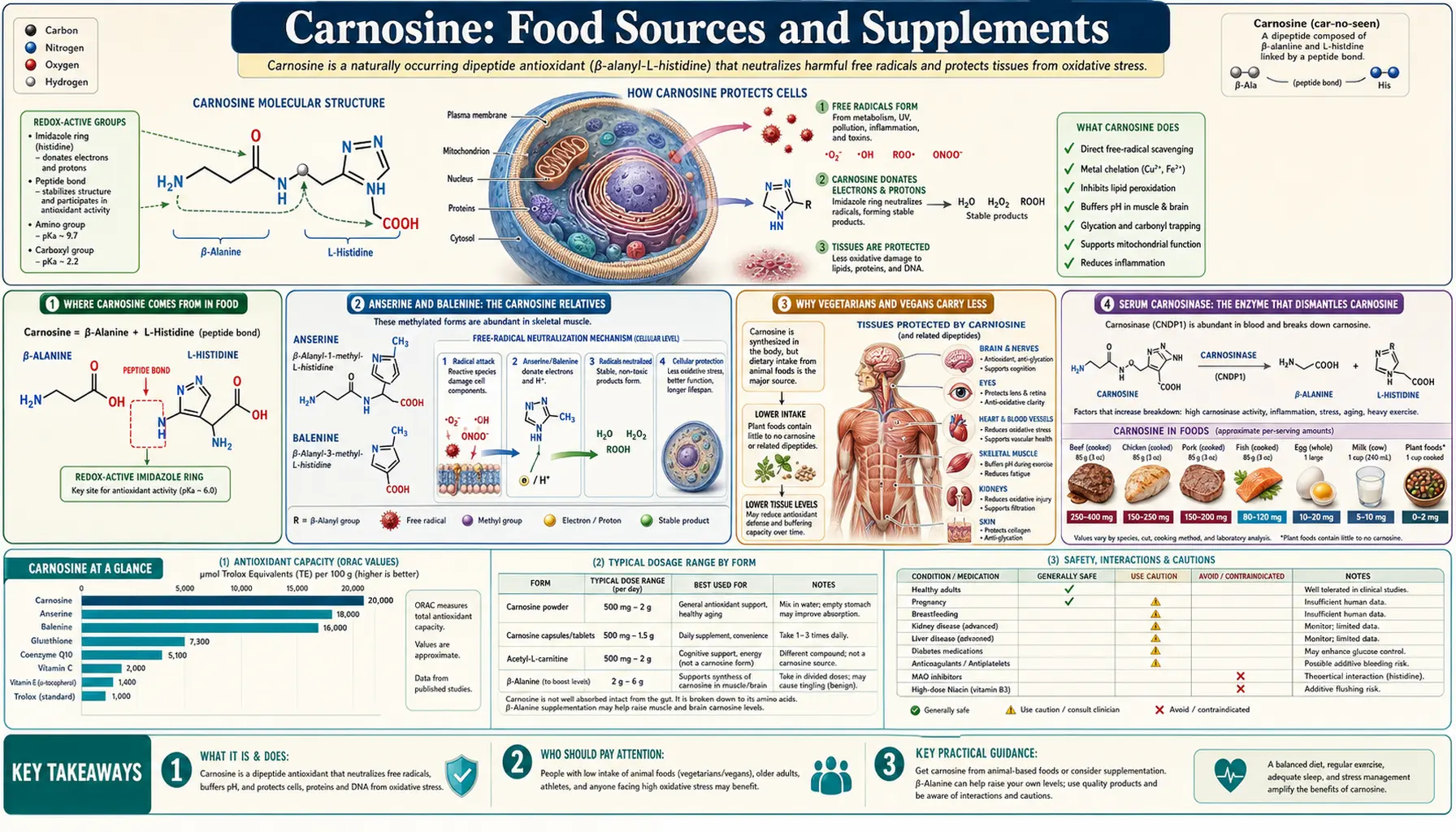
Carnosine is fundamentally an animal-tissue molecule: it is found in meat, poultry, and fish, and essentially not at all in plants — which is why vegetarians carry measurably less of it in their muscles. That single fact frames the whole practical discussion. The research on carnosine supplements turns on an enzyme most people have never heard of: serum carnosinase, which chops swallowed carnosine into pieces in the bloodstream within minutes, and whose activity is set partly by your genes. This page maps where carnosine comes from in the diet, why the body defends against intact carnosine so aggressively, and what has been measured for plain L-carnosine, its precursor beta-alanine, and a specialized form like zinc-carnosine.
Table of Contents
- Where Carnosine Comes From in Food
- Anserine and Balenine: The Carnosine Relatives
- Why Vegetarians and Vegans Carry Less
- Serum Carnosinase: The Enzyme That Dismantles Carnosine
- CNDP1 Genetics: Why It Varies Between People
- Oral Carnosine vs Beta-Alanine
- Supplement Forms on the Shelf
- Safety, Interactions, and Cautions
- What Trials Report in Diabetes
- Practical Takeaways
- Key Research Papers
- Connections
- Featured Videos
Where Carnosine Comes From in Food
Carnosine is concentrated in the skeletal muscle of animals, so the dietary sources are exactly the muscle meats: beef, pork, poultry, and fish. Red meats such as beef and pork are generally among the richer sources of carnosine specifically, while poultry and fish are richer in its close relative anserine (discussed next). Content varies with the animal, the cut, the muscle's fiber type, and how the food is prepared — because carnosine is water-soluble, some of it leaches into cooking juices and is lost if those juices are discarded.
The single most important dietary fact is what is not a source: plants contain essentially no carnosine, anserine, or balenine. These imidazole dipeptides are synthesized and stored in animal muscle and brain; fruits, vegetables, grains, legumes, nuts, and seeds do not supply them in meaningful amounts. There is also no carnosine in dairy or eggs to speak of. This makes carnosine one of the clearest examples of a bioactive compound that a mixed omnivorous diet delivers and a strict plant-based diet does not — a point that matters for the muscle and, potentially, aging stories covered on the Muscle & Exercise and Anti-Glycation pages. For the individual foods, see our Beef, Chicken, Pork, Salmon, and Tuna pages.
Anserine and Balenine: The Carnosine Relatives
Carnosine belongs to a small family of imidazole dipeptides that share the histidine-based structure but differ slightly:
- Carnosine (beta-alanyl-L-histidine) — the parent compound, richest in mammalian muscle such as beef and pork.
- Anserine (beta-alanyl-1-methyl-L-histidine) — a methylated version abundant in poultry and fish (chicken, turkey, tuna, salmon). The added methyl group makes anserine somewhat more resistant to breakdown by human carnosinase, which is one reason several cognition trials used anserine/carnosine blends rather than plain carnosine (see the Brain page).
- Balenine (also called ophidine, beta-alanyl-3-methyl-L-histidine) — found in certain marine animals; researchers have explored it as a naturally carnosinase-resistant alternative that survives longer in human blood after ingestion (de Jager et al., 2023).
Humans do not just eat these dipeptides; we also make them. Dietary intake, endogenous synthesis from beta-alanine and histidine, and the balance of breakdown enzymes together set tissue levels. The broad pattern is red meat higher in carnosine and poultry higher in anserine, and the amounts depend on the animal's muscle type. Feeding trials in broiler chickens show that the animal's diet changes the amount too: adding blood-cell meal or pure histidine to the feed raised the histidine dipeptides in the birds' blood and muscle (Kopeć et al., 2013).
Why Vegetarians and Vegans Carry Less
Because plants supply no carnosine and no beta-alanine, people who avoid meat depend entirely on the body's own synthesis, which is limited by beta-alanine availability. The measurable result: vegetarians have lower muscle carnosine on average than omnivores. Everaert and colleagues (2011) documented this in a human study of 149 healthy people, finding that vegetarianism, female sex, and older age were each independently associated with reduced muscle carnosine (interestingly, CNDP1 genotype was not a major driver of muscle levels in that analysis). Only 12 of the 149 were vegetarians, all of them men, and their calf muscle (gastrocnemius) held 26% less carnosine than omnivores'. Men had 36, 28 and 82% more than women in three lower-leg muscles. The size of the gap varies by study: a 2012 review describes omnivore levels as "two or more times higher" than vegetarian levels (Harris et al., 2012). The Everaert report describes vegetarians and does not list a vegan group.
The effect is real but not catastrophic, and it responds to intervention. A randomized trial of 40 omnivorous women found that switching to a vegetarian diet reduced the body's creatine pool but did not substantially disturb carnosine (or carnitine) homeostasis over the study period, suggesting the body compensates to a degree (Blancquaert et al., 2018). In that same trial, the group on a vegetarian diet with low-dose beta-alanine (0.8–0.4 g a day) and creatine (1 g a day) raised carnosine in the soleus and gastrocnemius muscles. Training results differ by program: 12 weeks of high-intensity interval training raised muscle carnosine in 10 vegetarian men from 15.8 to 20.6 mmol/kg of dry muscle with no beta-alanine and no omnivore group (de Salles Painelli et al., 2018), while 5 weeks of sprint training in 20 people who had been omnivores had no effect on muscle carnosine (Baguet et al., 2011). The practical implication for plant-based athletes is discussed on the Muscle & Exercise page.
Serum Carnosinase: The Enzyme That Dismantles Carnosine
The central character in any discussion of carnosine supplements is serum carnosinase (CN1), a circulating human enzyme that hydrolyzes carnosine into its two amino acids, beta-alanine and histidine. When you swallow carnosine, much of what is absorbed is broken down in the blood within minutes, so relatively little intact carnosine reaches tissues (Bellia et al., 2014). The muscle rebuilds carnosine from the released beta-alanine. Mole for mole, that route worked as well as beta-alanine itself in a direct comparison: over 4 weeks, muscle carnosine rose an estimated 65.8% on L-carnosine and 64.2% on an equal molar amount of beta-alanine (6.4 g a day) (Harris et al., 2006), and a later review states that the same increase occurs (Harris et al., 2012).
Humans are somewhat unusual in having high serum carnosinase activity; many other mammals have little, which is one reason animal studies of oral carnosine can look more favorable than the human reality. There is, however, a revealing exception: people with low carnosinase activity retain more intact carnosine after a dose. Everaert and colleagues (2012) showed that low plasma carnosinase activity promotes "carnosinemia" — measurable circulating carnosine — after carnosine ingestion in humans. Of 25 healthy people given 60 mg of carnosine per kg of body weight, 8 showed a measurable rise in the blood, and those with no rise had about 1.5-fold higher enzyme activity. This points to the enzyme as a limit on circulating carnosine; the study did not measure absorption separately. When the three dipeptides were added to human blood plasma in the laboratory, the half-life was 1.20 minutes for carnosine, 2.14 minutes for anserine and 34.9 minutes for balenine (de Jager et al., 2023). This has driven interest in carnosinase-resistant approaches: anserine and balenine, chemically modified analogs, and D-carnosine prodrugs designed to survive the enzyme (Orioli et al., 2011; laboratory and rat data, not a human result), as well as outright carnosinase inhibitors as a drug strategy (Regazzoni, 2024).
CNDP1 Genetics: Why It Varies Between People
How much carnosinase you make is partly written in your DNA. The enzyme is encoded by the CNDP1 gene, and a common variation in a repeated sequence in that gene (a CTG trinucleotide repeat, sometimes called the Mannheim polymorphism) appears to change how much carnosinase is secreted: in a cell-culture study (transfected Cos-7 cells), variants with more than five leucines secreted significantly more enzyme, and the authors say this might explain why people carrying two five-leucine copies have low enzyme activity in the blood (Riedl et al., 2007). This genetic difference is not just academic. It has been linked to the risk of diabetic kidney disease — a review reports that the polymorphism tied to low carnosinase activity correlates with a significantly reduced risk of diabetic nephropathy, especially in women with type 2 diabetes, with the mechanism still incompletely understood (Peters et al., 2018). The picture is not simple. In a cross-sectional study, patients with type 2 diabetes who had nephropathy had lower carnosinase than those without it (among (CTG)5 homozygotes, 30.4 vs 51.2 µg/ml, and activity of 1.25 vs 2.53 µmol/ml/h), and lower levels tracked impaired kidney function (Zhang et al., 2019). Muscle carnosine itself was not related to the CNDP1 polymorphism or to plasma carnosinase activity (Everaert et al., 2011).
The upshot is that carnosine biology is genuinely personalized. Two people taking the same oral carnosine dose can end up with very different amounts of intact carnosine in circulation depending on their CNDP1 genotype. This variability helps explain why supplement trials give inconsistent results and why blanket claims about "how much carnosine to take" are unreliable — the same dose is not the same exposure in different people.
Oral Carnosine vs Beta-Alanine
The research separates two supplements by goal:
- Raising muscle carnosine for exercise buffering: the record is mostly beta-alanine. The 2015 International Society of Sports Nutrition position stand reports that 4–6 g a day for four weeks significantly raises muscle carnosine (Trexler et al., 2015). Beta-alanine is the rate-limiting precursor, it is not degraded by serum carnosinase the way carnosine is, and controlled trials confirm it loads muscle carnosine (Harris et al., 2006; Harris et al., 2012). Plain oral carnosine delivers the same beta-alanine: an equal molar amount produced the same rise in the Harris comparison.
- The anti-glycation and brain hypotheses: the answer is genuinely uncertain. These goals would require intact carnosine in tissues other than muscle, and serum carnosinase makes it unclear how well any oral form achieves that. This is where carnosinase-resistant relatives (anserine, balenine) and analogs are being investigated, and why the evidence on the Anti-Glycation and Brain pages remains preliminary.
In other words, the one goal with a clear supplement record — muscle carnosine and performance — has been studied mainly with beta-alanine, and the authors of a 2026 trial write that carnosine itself has "not been rigorously evaluated" for physical performance (O'Toole et al., 2026); and the goals that would specifically need intact carnosine are the ones where delivery is least certain. That tension is the honest core of the whole carnosine supplement question.
Carnosine and physical performance. That 2026 placebo-controlled trial randomized 299 people to 2 g of carnosine a day or placebo for about 12 weeks. Grip strength and most other tests did not differ. Only subgroups changed: calf raises in people under 40 at about 6 weeks, and step count in men over 40 at about 12 weeks (O'Toole et al., 2026).
Carnosine and memory. A 2026 review of 13 studies found that five randomized trials of L-carnosine showed no significant difference from placebo on most memory and thinking measures. L-carnosine combined with anserine or antioxidants improved the Mini-Mental State Examination score by 0.62 points compared with placebo, and the authors rate this as a low strength of evidence (Hsiao et al., 2026).
Supplement Forms on the Shelf
Several distinct products get marketed under the carnosine umbrella; they are not interchangeable:
- L-carnosine — the plain dipeptide, sold as capsules or powder. Subject to the serum-carnosinase limitation described above. Commonly marketed for anti-aging and general antioxidant support, claims that outrun the human evidence.
- Beta-alanine — the precursor, and the form with the most trial data for muscle carnosine loading and high-intensity exercise. Covered in depth on the Beta-Alanine page. Trial doses: 3.2 and 6.4 g/day for four weeks in Harris et al. (2006); the 2015 position stand reports 4–6 g/day for at least four weeks; causes harmless skin tingling at large single doses.
- Zinc-carnosine (polaprezinc) — a chelate of zinc and carnosine used mainly for the gut, where it acts locally on the stomach and intestinal lining to support mucosal healing (studied for gastric ulcers and gut-barrier integrity). Because it works topically in the digestive tract, it sidesteps the blood-carnosinase problem, but it is a different application from systemic carnosine. In a small crossover trial, 10 healthy volunteers took indomethacin (a painkiller that makes the gut leakier) for 5 days: gut permeability rose threefold on placebo and did not rise significantly with zinc-carnosine 37.5 mg twice a day. The paper's competing-interest statement says one author gave evidence at a U.S. Food and Drug Administration hearing on extended health claims for this product (Mahmood et al., 2007).
- Anserine/carnosine blends — used in the Japanese cognition trials; the anserine component resists carnosinase somewhat better than carnosine alone.
Safety, Interactions, and Cautions
- General tolerability. Both dietary carnosine and oral L-carnosine are well tolerated in the amounts studied, with no consistent pattern of serious adverse effects. Carnosine is, after all, a normal component of a meat-containing diet.
- Beta-alanine paresthesia. The main practical side effect in this family comes from beta-alanine, not carnosine: a harmless pins-and-needles tingling after large single doses, reduced by splitting doses or using sustained-release forms (see the Muscle & Exercise page). A 2019 risk assessment of 101 human and 50 animal studies found tingling to be the only reported side effect (odds ratio 8.9 compared with placebo) and a small rise in the liver enzyme alanine aminotransferase that stayed within normal ranges (Dolan et al., 2019).
- Blood-sugar handling in diabetes. Carnosine chemistry intersects with glycation and carnosinase intersects with diabetic kidney disease. Pooled trials found carnosine or beta-alanine lowered fasting glucose and hemoglobin A1c compared with placebo, so readings can change; the authors describe the supplements as potential adjuncts (see What Trials Report in Diabetes).
- Pregnancy and breastfeeding. There is insufficient safety data for supplemental doses; dietary intake from normal food is not a concern.
- Marketing claims. Some L-carnosine products promise to reverse aging, dissolve advanced glycation end products, cure autism, or prevent dementia. These extrapolate from laboratory chemistry to human outcomes that have not been demonstrated.
What Trials Report in Diabetes
A 2025 review pooled 8 randomized trials, with 377 people with prediabetes or type 2 diabetes in total, of carnosine or beta-alanine compared with placebo. Fasting blood sugar (standardized mean difference −0.53) and hemoglobin A1c (−0.36) fell compared with placebo; body mass index and fasting insulin did not change significantly. The authors describe this as potential and ask for more rigorous studies to set dose, length of treatment and long-term effect (Li et al., 2025).
Practical Takeaways
- Food: a mixed diet with meat, poultry, and fish supplies carnosine and anserine naturally; plants supply none.
- Vegetarians start with lower muscle carnosine. Muscle levels rose in vegetarian men after high-intensity interval training and in women on a vegetarian diet with low-dose beta-alanine and creatine.
- For exercise, most trials used beta-alanine, which serum carnosinase does not destroy. In one direct comparison, an equal molar amount of oral carnosine raised muscle carnosine by the same amount.
- For the gut, zinc-carnosine (polaprezinc) is a distinct, locally acting product, separate from systemic carnosine.
- The delivery problem: serum carnosinase and your CNDP1 genotype mean an oral carnosine dose is not the same exposure in everyone, which is why results and recommendations vary.
- The state of the evidence: the rise in muscle carnosine with beta-alanine is well documented; the anti-aging and brain benefits are hypotheses under study.
Key Research Papers
- Everaert I et al. (2011). Vegetarianism, female gender and increasing age, but not CNDP1 genotype, are associated with reduced muscle carnosine levels in humans. Amino Acids, 40(4):1221–1229. — PubMed PMID: 20865290
- Everaert I et al. (2012). Low plasma carnosinase activity promotes carnosinemia after carnosine ingestion in humans. Am J Physiol Renal Physiol, 302(12):F1537–F1544. — PubMed PMID: 22496410
- Bellia F, Vecchio G, Rizzarelli E (2014). Carnosinases, their substrates and diseases. Molecules, 19(2):2299–2329. — PubMed PMID: 24566305
- Riedl E et al. (2007). A CTG polymorphism in the CNDP1 gene determines the secretion of serum carnosinase in Cos-7 transfected cells. Diabetes, 56(9):2410–2413. — PubMed PMID: 17601991
- Peters V, Zschocke J, Schmitt CP (2018). Carnosinase, diabetes mellitus and the potential relevance of carnosinase deficiency. J Inherit Metab Dis, 41(1):39–47. — PubMed PMID: 29027595
- Zhang S et al. (2019). Carnosinase concentration, activity, and CNDP1 genotype in patients with type 2 diabetes with and without nephropathy. Amino Acids, 51(4):611–617. — PubMed PMID: 30610469
- Harris RC et al. (2012). Determinants of muscle carnosine content. Amino Acids, 43(1):5–12. — PubMed PMID: 22327512
- Blancquaert L et al. (2018). Changing to a vegetarian diet reduces the body creatine pool in omnivorous women, but appears not to affect carnitine and carnosine homeostasis: a randomised trial. Br J Nutr, 119(7):759–770. — PubMed PMID: 29569535
- Baguet A et al. (2011). Effects of sprint training combined with vegetarian or mixed diet on muscle carnosine content and buffering capacity. Eur J Appl Physiol, 111(10):2571–2580. — PubMed PMID: 21373871
- de Salles Painelli V et al. (2018). High-intensity interval training augments muscle carnosine in the absence of dietary beta-alanine intake. Med Sci Sports Exerc, 50(11):2242–2252. — PubMed PMID: 30334920
- de Jager S et al. (2023). Acute balenine supplementation in humans as a natural carnosinase-resistant alternative to carnosine. Sci Rep, 13(1):6484. — PubMed PMID: 37081019
- Harris RC et al. (2006). The absorption of orally supplied beta-alanine and its effect on muscle carnosine synthesis in human vastus lateralis. Amino Acids, 30(3):279–289. — PubMed PMID: 16554972
- Orioli M et al. (2011). Design, synthesis, ADME properties, and pharmacological activities of β-alanyl-D-histidine (D-carnosine) prodrugs with improved bioavailability. ChemMedChem, 6(7):1269–1282. — PubMed PMID: 21634010
- Kopeć W et al. (2013). Influence of different histidine sources and zinc supplementation of broiler diets on dipeptide content and antioxidant status of blood and meat. Br Poult Sci, 54(4):454–465. — PubMed PMID: 23768017
- Trexler ET et al. (2015). International society of sports nutrition position stand: Beta-Alanine. J Int Soc Sports Nutr, 12:30. — PubMed PMID: 26175657
- Dolan E et al. (2019). A Systematic Risk Assessment and Meta-Analysis on the Use of Oral β-Alanine Supplementation. Adv Nutr, 10(3):452–463. — PubMed PMID: 30980076
- Mahmood A et al. (2007). Zinc carnosine, a health food supplement that stabilises small bowel integrity and stimulates gut repair processes. Gut, 56(2):168–175. — PubMed PMID: 16777920
- Li N et al. (2025). Effect of carnosine or beta-alanine supplementation therapy for prediabetes or type 2 diabetes mellitus: a systematic review and meta-analysis of randomized controlled trials. BMC Endocr Disord, 25(1):210. — PubMed PMID: 40999397
- Hsiao YF et al. (2026). The Effects of Carnosine on Cognitive Function and Mental Health-A Systematic Review and Meta-Analysis. Nutrients, 18(9):1385. — PubMed PMID: 42123986
- O'Toole TE et al. (2026). Effects of carnosine supplementation on physical endurance: a placebo-controlled randomized clinical trial. J Int Soc Sports Nutr, 23(1):2679716. — PubMed PMID: 42308284
- Regazzoni L (2024). State of the art in the development of human serum carnosinase inhibitors. Molecules, 29(11):2488. — PubMed PMID: 38893364
PubMed Topic Searches
External Authoritative Resources
- PubChem — Carnosine
- NCBI Gene — CNDP1 (serum carnosinase)
- U.S. Department of Agriculture (USDA) FoodData Central (nutrient composition of meats and fish)