Grape Seed Extract: History and Discovery
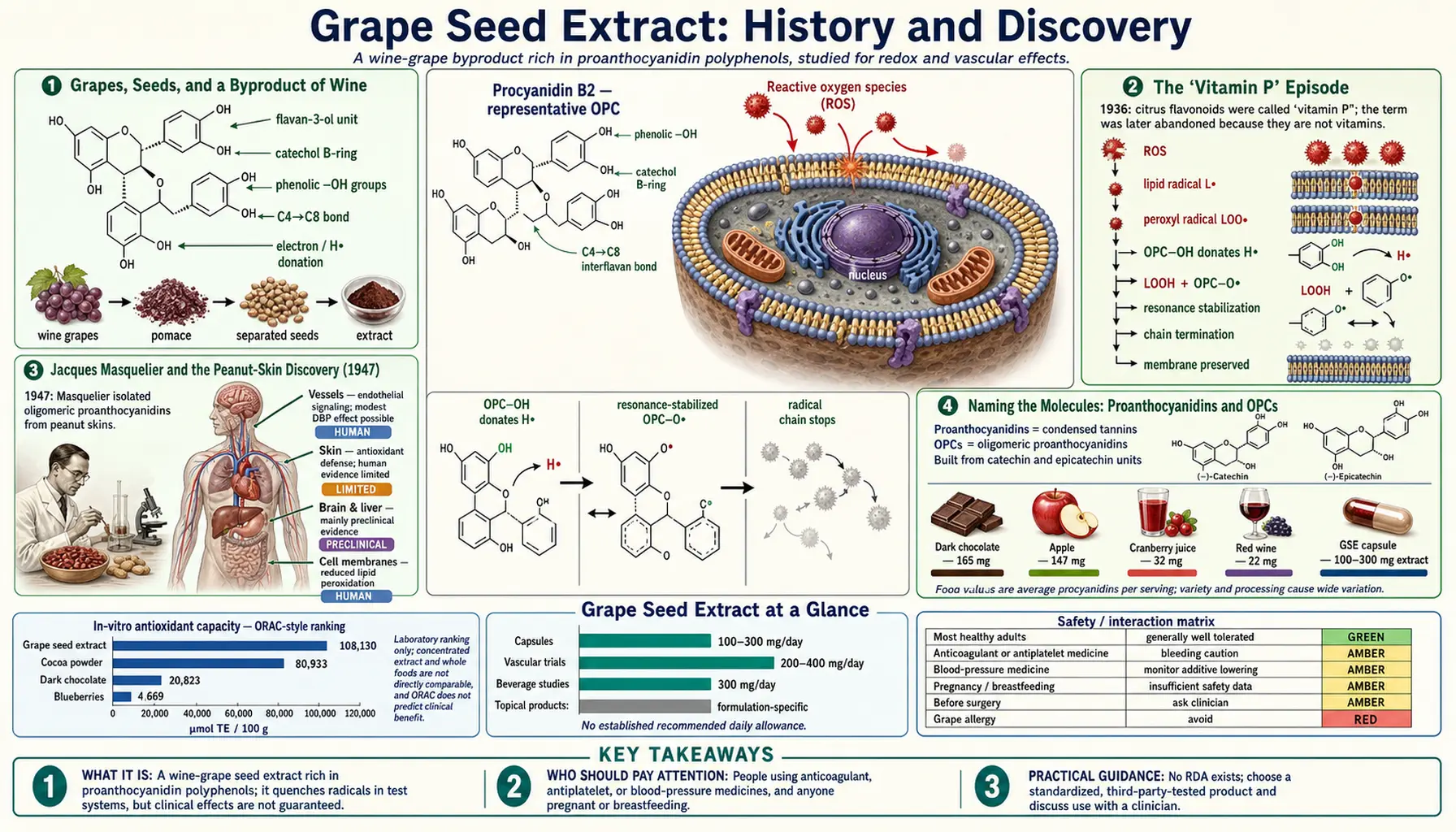
People have eaten grapes — seeds and all — for thousands of years, but the modern story of grape seed extract is not an ancient folk remedy; it is a twentieth-century laboratory story, and an unusually well-documented one. It begins not with grapes at all but with the red-brown skins of peanuts, and with a young French researcher named Jacques Masquelier who, in 1947, isolated a colourless fraction of plant compounds during his doctoral work. The molecules he found — later named proanthocyanidins, and in their short-chain form oligomeric proanthocyanidins (OPCs) — turned out to be present in many plants, and especially concentrated in pine bark and in the seeds of the wine grape, Vitis vinifera. This article traces what the historical record actually supports: the dietary backdrop, the "vitamin P" episode that set the stage, Masquelier's discovery and the molecules he named, the patents that turned the chemistry into products, the assay that let the extracts be standardised, and the slow path from a European prescription remedy to a worldwide supplement. Where a date or a name is firmly documented we give it; where popular accounts disagree, we say so.
Table of Contents
- Grapes, Seeds, and a Byproduct of Wine
- The "Vitamin P" Episode
- Jacques Masquelier and the Peanut-Skin Discovery (1947)
- Naming the Molecules: Proanthocyanidins and OPCs
- From Pine Bark to Grape Seed: The Patents
- Measuring the Extract: The Bate-Smith Assay
- From European Remedy to Global Supplement
- What Modern Research Made of It
- Research Papers and References
- Connections
- Featured Videos
Grapes, Seeds, and a Byproduct of Wine
The grape, Vitis vinifera, is one of humanity's oldest cultivated plants, grown for the table and for wine across the Mediterranean, the Near East, and beyond for several thousand years. For almost all of that time the seeds were an afterthought — the small, bitter, tannic pips that a person spits out or that settle in the press during winemaking. Pressing grapes for wine and juice leaves behind a residue called pomace (skins, stems, and seeds), and the seeds within it are produced in enormous quantities every harvest. This abundance matters to the story: grape seed extract became commercially practical precisely because its raw material is a cheap, plentiful agricultural leftover rather than something that has to be specially grown.
It would be a mistake, though, to dress this up as an ancient herbal tradition. There is no well-documented historical record of grape seeds being concentrated and used as a medicine in antiquity; the seeds were simply part of eating grapes, and grape-derived tannins were known to winemakers as a feature of the drink rather than as an isolated remedy. What changed in the twentieth century was not the grape but the chemistry: researchers learned which molecules in the seed were biologically active, how to extract and concentrate them, and how to measure them. The dietary backdrop is genuine — people really had been consuming grape and other plant proanthocyanidins all along — but the extract is a modern invention, and its history is a scientific one.
The "Vitamin P" Episode
To understand why anyone went looking for compounds like those in grape seed, it helps to start in the 1930s with the Hungarian-born physiologist Albert Szent-Györgyi, who won the 1937 Nobel Prize in Physiology or Medicine for his work on vitamin C. While studying vitamin C from citrus, Szent-Györgyi and his colleagues observed that a fraction of citrus extract seemed to reduce the fragility and excessive leakiness of small blood vessels (capillaries) in a way that pure vitamin C did not fully explain. He attributed this capillary-protecting effect to a group of plant compounds — the flavonoids — and proposed the name "vitamin P" for them, the "P" standing for permeability.
This is an important but frequently garbled point, so it is worth stating carefully. "Vitamin P" was a real, historically used term coined by Szent-Györgyi's circle for flavonoids that affected capillary permeability; it was not a name for grape seed extract, and the flavonoids he studied (such as the citrus compound he called citrin, and rutin) are not the same molecules later isolated from grape seed. Crucially, "vitamin P" never gained official status as a true vitamin — these compounds are not dietary essentials in the strict sense — and the term has long since been abandoned by nutrition science. What it left behind, however, was a research question that mattered enormously for the grape seed story: which plant flavonoids strengthen blood vessels, and how? That question is exactly the one Jacques Masquelier would take up.
Jacques Masquelier and the Peanut-Skin Discovery (1947)
The central figure in the history of grape seed extract is the French pharmacist and researcher Jacques Masquelier (often anglicised as "Jack" Masquelier), who worked for most of his career at the University of Bordeaux. The well-documented founding event took place in 1947: while carrying out the research for his doctoral thesis, Masquelier extracted a colourless fraction from the thin red-brown skins of peanuts and found that it had a vascular-protective, capillary-strengthening effect — the very kind of activity that the "vitamin P" flavonoids had been credited with. This 1947 peanut-skin work is the date and the source consistently given by the peer-reviewed history of the field and by the holders of Masquelier's own legacy.
A word on conflicting dates is owed here, because casual sources cite everything from "1936" to "1948." The most reliable accounts — including the detailed scientific review by Antje Weseler and Aalt Bast in Nutrition Journal (2017) — place the foundational discovery in 1947, during Masquelier's PhD work on peanut skins; nearby years that appear elsewhere generally refer to his thesis defence or to early publications and patents that followed. This page therefore treats 1947 as the documented discovery year and notes the small spread in secondary sources rather than pretending the record is more precise than it is.
The conceptual leap Masquelier made was to connect a specific, isolable class of plant molecules to a specific biological effect on the blood vessels, and then to pursue those molecules wherever they were richest. Peanut skins were where he first found them, but they were not where the story would settle — he soon recognised that the same family of compounds occurred, in useful concentration, in other inexpensive plant materials.
Naming the Molecules: Proanthocyanidins and OPCs
The compounds Masquelier had isolated belong to the flavonoid family and are built from flavan-3-ol units — principally catechin and epicatechin, the same building blocks found in green tea and cocoa. When several of these units link together they form chains. The whole class came to be called proanthocyanidins, a name that captures a defining chemical behaviour: when these molecules are heated in acid, they break down and yield coloured pigments called anthocyanidins. In other words, "pro-anthocyanidin" literally means a precursor that produces anthocyanidin colour on hydrolysis. (Older literature also calls them condensed tannins, procyanidins, or, confusingly, leucoanthocyanidins.) This colour-forming reaction is not just a naming curiosity — as the section on the Bate-Smith assay explains, it later became the practical way to measure how much active material an extract actually contained.
Masquelier's own contribution to the vocabulary was the term oligomeric proanthocyanidins, abbreviated OPCs. He used the Greek-derived prefix oligo- ("few") to single out the short-chain molecules — roughly two to five flavan-3-ol units linked together — as the most biologically interesting and absorbable fraction, distinct from the long, poorly-absorbed polymers. The acronym OPC, and the related label oligomeric proanthocyanidin complexes, became the standard shorthand for the active fraction in both pine bark and grape seed products and is still used on supplement labels today.
One naming caution belongs here, because it causes real confusion. Masquelier also used the word "pycnogenol" (lowercase) as a general chemical name for this class of compounds, regardless of which plant they came from. That generic term is not the same thing as Pycnogenol® (capitalised, registered trademark), which today refers specifically to a single standardised French maritime pine-bark extract. So "pycnogenols" in the older literature can mean OPCs in general, while "Pycnogenol" on a modern shelf means one particular pine-bark product — a distinction worth keeping straight when reading about the history.
From Pine Bark to Grape Seed: The Patents
Discovering and naming the molecules was only half the work; turning them into a usable product meant developing reliable ways to extract and concentrate them, and protecting those methods with patents. Masquelier did this for two raw materials in turn. The first was the bark of the French maritime pine (Pinus pinaster): a French patent covering the extraction of these compounds from pine bark was filed in 1951 (French patent no. 1 036 922). This pine-bark line of work is the ancestor of the modern Pycnogenol® product.
The grape entered the picture later. A French patent for obtaining the OPC fraction from grape seeds was filed in 1970 (French patent no. 2 092 743), naming Masquelier together with a co-inventor, J. Michaud. Grape seeds proved to be an especially attractive source: abundant as a winemaking byproduct, and rich in exactly the catechin/epicatechin-based oligomers Masquelier was after. Later, in 1987, the United States Patent Office granted Masquelier a patent specifically for the use of proanthocyanidins as antioxidants — a notable shift, because it reframed these molecules from vessel-protecting agents toward the broader antioxidant role for which grape seed extract is best known today.
These patent dates — 1951 for pine bark, 1970 for grape seed, 1987 for the antioxidant use — are among the firmest, most checkable facts in the whole story, because patents are dated public documents. They also explain a structural feature of the market that persists now: Pycnogenol is a single, tightly defined patented pine-bark extract, whereas grape seed extract became a broader category of products made by many manufacturers from the same kind of raw material.
Measuring the Extract: The Bate-Smith Assay
A recurring problem with plant extracts is knowing what is actually in the bottle. Two grape seed products can both say "grape seed extract" on the label and yet contain very different amounts of the active oligomers. The history of grape seed extract is therefore also the history of learning to measure proanthocyanidins, and here the key tool is named after the British plant biochemist E. C. Bate-Smith, who studied the chemistry of plant phenolics and the colour reactions of these compounds in the mid-twentieth century.
The method that carries his name — the Bate-Smith reaction, used to compute a so-called procyanidolic index (sometimes written PCO index) — relies on exactly the colour-forming behaviour that gave proanthocyanidins their name: heat the extract in acid, the proanthocyanidins break down into red anthocyanidin pigments, and the intensity of the red colour reflects how much proanthocyanidin was present. High-quality grape seed extracts are often described by a Bate-Smith / procyanidolic index in the range of roughly 80 to 100 or higher. Over time this and related assays let manufacturers standardise grape seed extract to a stated percentage of proanthocyanidins — the familiar "95% OPCs" specification — which is what made consistent dosing, and therefore meaningful clinical trials, possible.
From European Remedy to Global Supplement
For its first few decades, the practical use of OPC extracts was largely a European, and especially French, affair. Standardised grape seed and pine-bark preparations were developed and sold in France as remedies aimed mainly at the blood vessels — for fragile capillaries, easy bruising, and the heavy, aching, swollen legs of chronic venous insufficiency. (A grape seed OPC preparation was marketed in France under the name Endotélon, and Masquelier's standardised material later reached consumers under the "Masquelier's Original OPCs" line.) The original framing, in other words, stayed close to Szent-Györgyi's old capillary question: these were vein-and-vessel remedies first.
The broader, English-speaking supplement market came later. As the antioxidant theory of health gained popularity in the 1980s and 1990s — and as Masquelier's 1987 US patent recast OPCs explicitly as antioxidants — grape seed extract was repackaged for a worldwide audience as a general-purpose antioxidant rather than a narrow vascular drug. Its appeal was helped by two things: the raw material was cheap and plentiful, and the "French Paradox" era of interest in grape and red-wine polyphenols (the same cultural wave that lifted resveratrol) gave anything grape-derived a tailwind. By the turn of the millennium, grape seed extract had moved decisively out of the French pharmacy and onto supplement shelves around the world.
What Modern Research Made of It
Once grape seed extract was a standardised, measurable product, it could finally be tested properly — and the modern research has tended to confirm the oldest claim while trimming back the broadest ones. The strongest, most consistent clinical evidence is for the indication Masquelier started with: the blood vessels. Pooled analyses of randomised trials report that grape seed extract modestly lowers blood pressure, and the European literature continues to support its use for the leg symptoms of chronic venous insufficiency. An influential year-2000 review by Debasis Bagchi and colleagues in Toxicology helped consolidate the antioxidant case, and a comprehensive 2017 review by Weseler and Bast traced the whole arc — from the 1947 peanut-skin discovery to a well-characterised, evidence-supported supplement — in a single peer-reviewed account.
Two honest cautions close the history. First, the molecules in grape seed extract are not a vitamin and never were; Szent-Györgyi's "vitamin P" was an early, ultimately abandoned label, and OPCs are non-essential plant compounds, not nutrients the body requires. Second, a great deal of the more dramatic modern interest — in cancer, neuroprotection, and metabolic disease — rests on laboratory and animal work rather than solid human trials, and should be read as promising rather than proven. The detailed, up-to-date evidence on benefits, mechanisms, dosing, and cautions is covered on the main Grape Seed Extract page; this article's job is only to explain how a spat-out grape pip and a tray of peanut skins became one of the most widely sold antioxidant supplements in the world.
Research Papers and References
The list below pairs the key peer-reviewed histories and reviews of grape seed proanthocyanidins with curated PubMed topic-search links into the historical and phytochemical literature. Author names, titles, and journals are given as plain text; only the stable DOI, PMID, or archive link is hyperlinked, and each opens in a new tab. Historical primary documents — Masquelier's French patents (no. 1 036 922, 1951; no. 2 092 743, 1970) and his 1987 US antioxidant-use patent — are named in the article as historical sources rather than as modern citations.
- Weseler AR, Bast A. Masquelier's grape seed extract: from basic flavonoid research to a well-characterized food supplement with health benefits. Nutrition Journal. 2017;16:5. — doi:10.1186/s12937-016-0218-1 · PMID: 28103873
- Fine AM. Oligomeric proanthocyanidin complexes: history, structure, and phytopharmaceutical applications. Alternative Medicine Review. 2000;5(2):144-151. — PMID: 10767669
- Bagchi D, Bagchi M, Stohs SJ, et al. Free radicals and grape seed proanthocyanidin extract: importance in human health and disease prevention. Toxicology. 2000;148(2-3):187-197. — doi:10.1016/S0300-483X(00)00210-9 · PMID: 10962138
- Zhang H, Liu S, Li L, et al. The impact of grape seed extract treatment on blood pressure changes: a meta-analysis of 16 randomized controlled trials. Medicine (Baltimore). 2016;95(33):e4247. — doi:10.1097/MD.0000000000004247 · PMID: 27537554
- Grape seed proanthocyanidins — history and discovery — PubMed: grape seed proanthocyanidin history (Masquelier)
- Proanthocyanidin chemistry and structure — PubMed: proanthocyanidin structure and flavan-3-ols
External Authoritative Resources
- NCCIH — Grape Seed Extract
- MedlinePlus — Grape Seed Extract
- PubMed — All research on grape seed proanthocyanidins
Connections
- Grape Seed Extract
- All Antioxidants
- Pycnogenol (Pine Bark OPCs)
- Resveratrol
- Quercetin
- Bilberry
- Oxidative Stress