Fisetin: History and Discovery
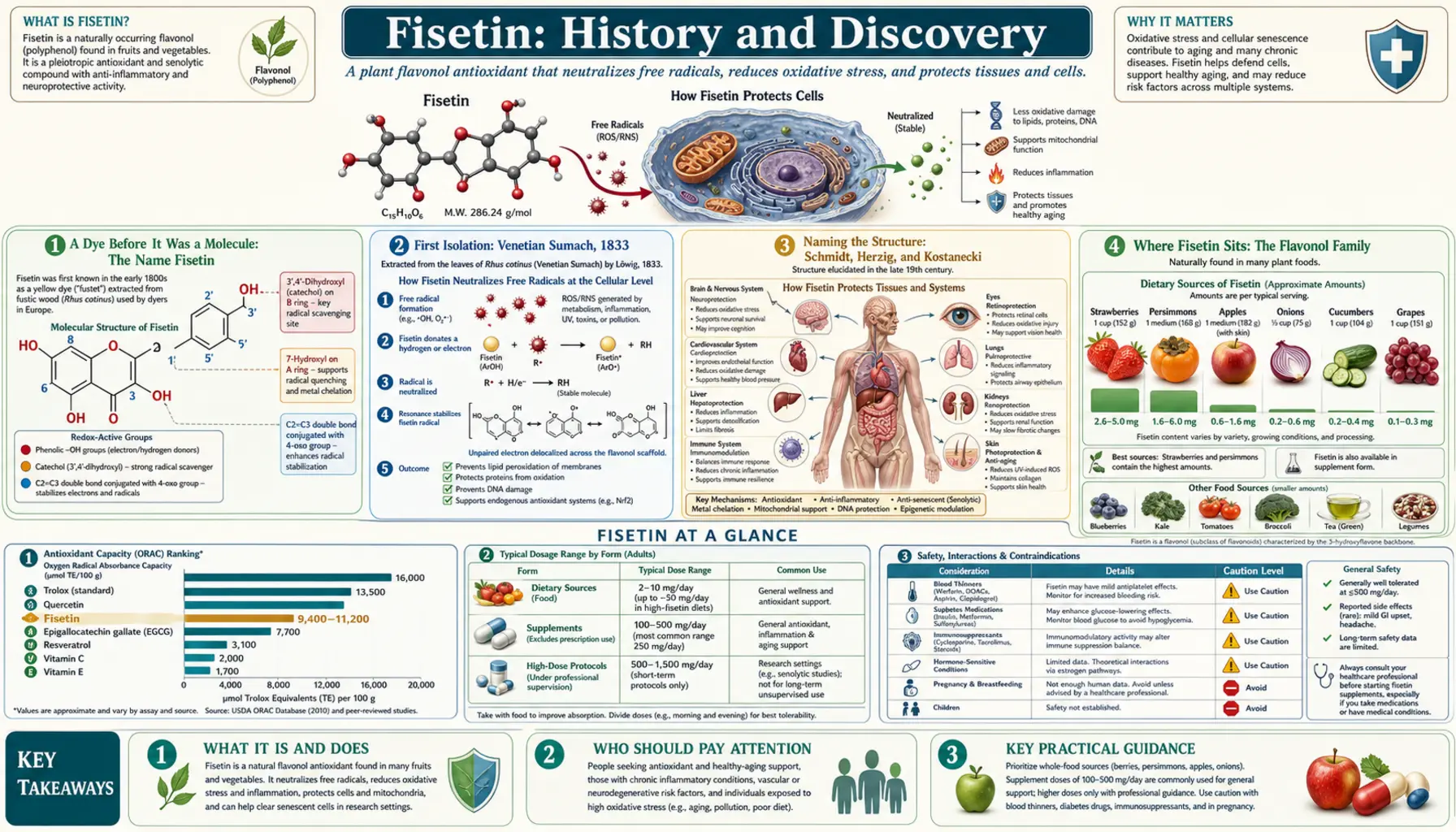
Most of the molecules we now call antioxidants began life as something far more ordinary, and fisetin is a clear example: long before it was a longevity supplement, it was a dye. Its earliest documented history is the story of a yellow colouring extracted from a Mediterranean shrub, slowly pinned down by nineteenth-century chemists who isolated it, weighed it, and finally worked out its structure. Only in the last two decades did the same compound become a serious subject of aging research. This article traces what the record actually supports: where the name comes from, who isolated and characterised fisetin and when, how its chemical identity was settled, where it occurs in food, and the modern experiments — above all a single widely cited 2018 study — that turned an obscure plant pigment into one of the most talked-about compounds in the science of aging. Where a date or a name is firmly documented we give it; where the record is thin or a claim is contested, we say so plainly.
Table of Contents
- A Dye Before It Was a Molecule: The Name Fisetin
- First Isolation: Venetian Sumach, 1833
- Naming the Structure: Schmidt, Herzig, and Kostanecki
- Where Fisetin Sits: The Flavonol Family
- Finding Fisetin in Food: The Strawberry Connection
- From Pigment to Antioxidant and Neuroprotectant
- The 2018 Turning Point: Fisetin as a Senolytic
- From Mice to Clinical Trials
- Research Papers and References
- Connections
- Featured Videos
A Dye Before It Was a Molecule: The Name Fisetin
Fisetin's name comes not from medicine but from the dyer's workshop. Together with another flavonoid, myricetin, fisetin is one of the pigments that give the traditional yellow dye known as young fustic its colour — a dye extracted from the wood of the Eurasian smoketree, historically called Rhus cotinus and today usually placed in the genus Cotinus (the European smoketree, Cotinus coggygria). Young fustic was used to dye textiles in Europe from at least the Middle Ages, valued for its warm orange-yellow shade, and the plant that produced it was also known as Venetian sumach.
The chemical name fisetin grew out of this dye world rather than being coined fresh in a laboratory. It belongs to the same word-family as "fustic" and the older chemical term "fustin," names tied to the fustic dyestuffs; in other words, the molecule was named after the colouring material it was pulled out of, not after a person or a disease. This is a useful thing to keep in mind: the deep history of fisetin is the history of a colour, and its identity as a nutrient or an anti-aging compound is a very recent overlay on a much older story about dyeing cloth.
One honest note on attribution. Several popular write-ups state confidently who first "named" fisetin or fustin; the documented chemical record is clearer about the isolation and the later structural work (below) than about a single tidy naming event, so this page describes the name as derived from the fustic dyestuffs and leaves any claim of one specific person who coined it as not firmly established.
First Isolation: Venetian Sumach, 1833
The first documented record of fisetin as an isolated substance is genuinely old. According to the peer-reviewed review "New Perspectives for Fisetin" by Grzegorz Grynkiewicz and Oleg M. Demchuk (2019), "the first record of fisetin as an isolate from venetian sumach (Rhus cotinus L.) dates back to 1833." That places fisetin's isolation in the same early-nineteenth-century wave of natural-product chemistry that gave us the first isolations of caffeine, quinine, and morphine — an era when chemists were learning, for the first time, to pull single pure substances out of plants.
It is worth being precise about what "isolated in 1833" does and does not mean. It means a yellow crystalline material was separated from the dye wood and recognised as a distinct compound; it does not mean anyone yet knew its molecular structure, how it behaved in the body, or that it had any health effect at all. At that stage fisetin was simply the purified colouring principle of a known dye plant — an object of interest to chemists studying pigments, not to physicians. The leap from "a pigment from a dye tree" to "a molecule with biological activity" would take another century and a half.
Naming the Structure: Schmidt, Herzig, and Kostanecki
Isolating a compound is one thing; knowing what it actually is — its formula and the arrangement of its atoms — is a much harder problem that nineteenth-century chemistry solved only slowly. For fisetin, that work unfolded across several decades and several hands. The Grynkiewicz and Demchuk review records that "a basic chemical characteristics of the compound was provided several decades later by Schmidt (1886)" — that is, the broad chemical properties of fisetin were described in the 1880s, roughly half a century after its first isolation.
The decisive structural work is associated above all with the Polish-born chemist Stanisław Kostanecki. According to the same review, fisetin's "structure was elucidated and eventually confirmed by synthesis by S. Kostanecki, who in [the] 1890s started a massive investigation of yellow plant pigments," with the first full synthesis completed in the early 1900s. Kostanecki's broader project mattered far beyond fisetin alone: it was he who systematised the chemistry of yellow plant pigments and helped give us the now-standard group names — flavones, flavonols, chalcones, and chromones. Confirming a structure by building the molecule from scratch (total synthesis) was, and remains, one of the strongest possible proofs that you have its architecture right.
A second name often appears in this story: the Austrian chemist Josef Herzig, who is credited in some reference sources with first describing fisetin's chemical formula in 1891. The two accounts are not in conflict — an early formula (Herzig) and a fuller structural determination confirmed by synthesis (Kostanecki) are different milestones — but because the secondary sources weight them differently, this page names both and treats the structural credit as shared across this group of late-nineteenth-century chemists rather than belonging to any single person. What is not in doubt is the end result: fisetin was eventually defined as the flavonol now written 3,3′,4′,7-tetrahydroxyflavone.
Where Fisetin Sits: The Flavonol Family
Settling fisetin's structure did more than satisfy chemists' curiosity — it placed the compound in a family, and that family membership is the key to understanding everything that came later. Fisetin is a flavonol, a subclass of the flavonoids, which are themselves part of the large group of plant compounds called polyphenols. Chemically it is described as 3,3′,4′,7-tetrahydroxyflavone, and it is sometimes called 5-deoxyquercetin because it is structurally very close to the far more famous flavonol quercetin — differing essentially by the absence of one hydroxyl group.
That kinship is not a trivia point. The pattern of hydroxyl (–OH) groups on a flavonoid is what largely governs its ability to neutralise reactive molecules, which is the textbook basis for calling such compounds antioxidants. Because fisetin carries a particular arrangement of these groups, nineteenth- and twentieth-century chemistry filed it alongside quercetin, myricetin, and the other dietary flavonols. For most of the twentieth century that classification was the whole story: fisetin was a flavonol pigment, chemically interesting, present in some plants, and otherwise unremarkable. The history that follows is essentially the story of researchers asking what this well-characterised but overlooked molecule might actually do.
Finding Fisetin in Food: The Strawberry Connection
A pigment from a dye tree might never have drawn nutritional attention at all, except that fisetin also turns up — in small amounts — in ordinary food. As analytical methods improved through the twentieth century, dietary surveys began measuring individual flavonols in fruits and vegetables, and fisetin was found scattered across a familiar list: strawberries, apples, persimmons, grapes, kiwi, onions, and cucumbers, among others.
The single most-cited fact about fisetin in food is that strawberries are by far the richest common source, reported at roughly 160 micrograms per gram of fresh fruit in the analyses summarised by later reviews — well above apples (around 26 µg/g), persimmons (around 10 µg/g), onions, and grapes. Even so, the amounts are small in absolute terms: estimates of ordinary dietary fisetin intake are on the order of a fraction of a milligram per day, far below the gram-scale doses used in modern animal and human studies. This gap — a compound that is genuinely a food component, yet present at doses thousands of times smaller than those being tested in the laboratory — becomes one of the central tensions in fisetin's recent history, and it is worth keeping in view: eating strawberries is not the same intervention as taking a concentrated fisetin supplement.
From Pigment to Antioxidant and Neuroprotectant
The modern scientific interest in fisetin built up gradually before it exploded. Through the late twentieth and early twenty-first centuries, fisetin was studied as one of many dietary flavonoid antioxidants — a compound that could mop up reactive oxygen species in test-tube assays and that shared the broad anti-inflammatory and cell-protective behaviours seen across the flavonol family. A useful marker of how the compound was understood in this period is the 2013 review by Naghma Khan and colleagues, plainly titled "Fisetin: a dietary antioxidant for health promotion" — the framing is right there in the name.
The most distinctive early thread, though, came from the laboratory of Pamela Maher and colleagues, who studied fisetin's effects on the brain and nervous system. Maher's 2009 review described how fisetin can act on multiple pathways involved in keeping neurons healthy during aging, including a direct antioxidant effect and the ability to raise levels of the cell's own master antioxidant, glutathione. In 2014, Antonio Currais, Maher, and co-workers reported that oral fisetin given to Alzheimer's-model mice helped preserve learning and memory, linking the effect to reduced inflammation and to changes in a protein-cleavage product (p25) involved in neurodegeneration. These were still animal and laboratory findings — not proof of benefit in people — but they marked fisetin's transition from "a dietary antioxidant" to "a candidate molecule worth serious study," and they set the stage for the discovery that would reframe the whole field.
The 2018 Turning Point: Fisetin as a Senolytic
The single event that transformed fisetin's reputation is well documented and easy to date. In 2018, a large collaborative study — with Matthew Yousefzadeh as lead author and the laboratories of Paul Robbins and Laura Niedernhofer among the senior groups, and involving researchers connected to the Mayo Clinic, Scripps Research, and the University of Minnesota — was published in the journal EBioMedicine under the title "Fisetin is a senotherapeutic that extends health and lifespan." The team screened a panel of flavonoid compounds for the ability to selectively kill senescent cells — worn-out "zombie" cells that stop dividing but linger and secrete inflammatory signals — and reported that fisetin was the most potent of those tested.
Crucially, the study reported that giving fisetin to already-old mice reduced markers of senescence in several tissues, improved measures of tissue health, and extended both median and maximum lifespan. The idea that a cheap, food-derived flavonoid could clear senescent cells and lengthen life in aged animals was striking enough to move fisetin almost overnight from an obscure pigment into a headline compound in longevity science, and it gave currency to a new label for it: a senolytic, a drug that lyses (destroys) senescent cells. It is fair to call this the defining moment in fisetin's modern history.
Two cautions belong right beside that enthusiasm. First, this was a study in mice; impressive lifespan extension in aged animals is a reason to investigate further, not proof that the same happens in humans. Second, the very same paper noted, as the field generally did, that there was at that point no clinical evidence of benefit in people. The 2018 result reset the questions; it did not answer them.
From Mice to Clinical Trials
The years since 2018 have been about taking that mouse result and asking whether anything like it holds in people. The clearest example is the Mayo Clinic trial named AFFIRM — "Alleviation by Fisetin of Frailty, Inflammation, and Related Measures in Older Women" (ClinicalTrials.gov identifier NCT03430037) — which has tested oral fisetin, given as short pulsed courses, in older adults with frailty. This "hit-and-run" dosing pattern, high doses for a couple of days at a time rather than every day, reflects the underlying biology established in the animal work: senescent cells accumulate slowly, so the strategy is to clear them periodically rather than to suppress them continuously. A number of further human studies have explored fisetin in conditions such as osteoarthritis and kidney disease, and the broader senolytic field has run parallel trials of other agents.
The honest state of play, as the modern reviews stress, is that fisetin's human evidence is still early. Trials have generally found it well tolerated at the doses used, and some have reported encouraging changes in markers of senescence and inflammation, but large trials proving that fisetin meaningfully slows aging or treats age-related disease in people are not yet in hand. The detailed clinical evidence, mechanisms, dosing, and cautions are covered in the companion Fisetin Benefits articles and on the main Fisetin page; this history is concerned with how a yellow dye became, almost two centuries after it was first isolated, one of the most closely watched molecules in the study of aging.
That arc is the genuinely remarkable thing about fisetin's story. A pigment pulled from a dye tree in 1833, structurally pinned down by chemists in the 1880s and 1890s, filed for a century as just another dietary flavonol, and then — on the strength of a single 2018 experiment in aged mice — recast as a frontier compound in longevity research. Following that thread carefully, and resisting the urge to read the laboratory promise as a settled human cure, is the point of knowing the history at all.
Research Papers and References
The list below combines key peer-reviewed sources on fisetin's chemistry, history, and modern study with curated PubMed topic-search links. Historical isolation and structural milestones (the 1833 isolation, Schmidt 1886, Herzig 1891, and Kostanecki's 1890s synthesis) are documented within the cited reviews and are named in the article as historical facts. Author names, titles, and journals are given as plain text; only the stable DOI, PMID, or registry link is hyperlinked, and each opens in a new tab.
- Grynkiewicz G, Demchuk OM. New perspectives for fisetin. Frontiers in Chemistry. 2019;7:697. (Reviews the 1833 isolation from Rhus cotinus, Schmidt 1886, and the Kostanecki structural synthesis.) — doi:10.3389/fchem.2019.00697
- Khan N, Syed DN, Ahmad N, Mukhtar H. Fisetin: a dietary antioxidant for health promotion. Antioxidants & Redox Signaling. 2013;19(2):151-162. — doi:10.1089/ars.2012.4901 · PMID: 23121441
- Maher P. Modulation of multiple pathways involved in the maintenance of neuronal function during aging by fisetin. Genes & Nutrition. 2009;4(4):297-307. — doi:10.1007/s12263-009-0142-5 · PMID: 19756810
- Currais A, Prior M, Dargusch R, et al. Modulation of p25 and inflammatory pathways by fisetin maintains cognitive function in Alzheimer's disease transgenic mice. Aging Cell. 2014;13(2):379-390. — doi:10.1111/acel.12185 · PMID: 24341874
- Yousefzadeh MJ, Zhu Y, McGowan SJ, et al. Fisetin is a senotherapeutic that extends health and lifespan. EBioMedicine. 2018;36:18-28. — doi:10.1016/j.ebiom.2018.09.015 · PMID: 30279143
- Alleviation by Fisetin of Frailty, Inflammation, and Related Measures in Older Women (AFFIRM). Mayo Clinic. ClinicalTrials.gov. — NCT03430037
- Fisetin — history, isolation, and chemistry — PubMed: fisetin flavonol chemistry and isolation
- Fisetin — senolytic and aging research — PubMed: fisetin senolytic and aging