Lutein Food Sources and Absorption
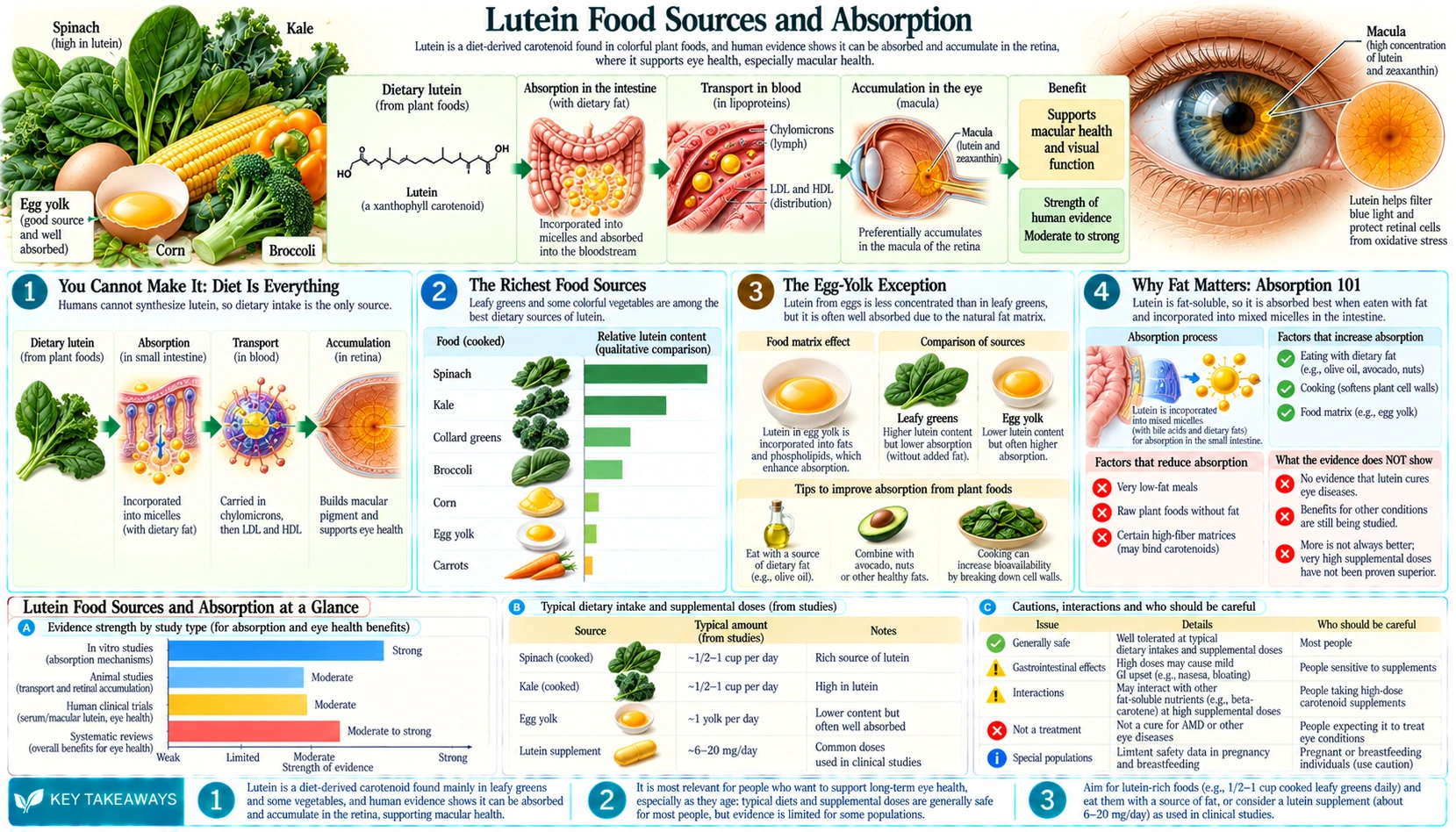
Because the body cannot make lutein or zeaxanthin, every molecule in your eyes and brain came from a plant that could — and how much reaches your tissues depends as much on how you eat these foods as on which ones you choose. Dark leafy greens are the powerhouses, egg yolk is the surprisingly efficient exception, and a little dietary fat is the switch that turns absorption on. This page is the practical companion to the rest of the Lutein hub: which foods deliver the most, why cooking and fat and even your genes change the amount that actually gets in, and how to build a simple, lutein-rich pattern of eating.
Table of Contents
You Cannot Make It: Diet Is Everything
Plants and some microbes synthesize carotenoids; animals, including humans, do not. Every bit of lutein and zeaxanthin in your macula, your skin, and your brain was eaten. That makes these two pigments unusually diet-dependent. There is no official Recommended Dietary Allowance for lutein or zeaxanthin — they are not classed as essential nutrients — but the doses linked to raising macular pigment and used in the major eye trials are in the range of 10 mg of lutein plus 2 mg of zeaxanthin per day. The good news is that this amount is very reachable from food, and often exceeded by a single serving of cooked greens.
The Richest Food Sources
The list below gives approximate lutein-plus-zeaxanthin content for common foods. Treat every number as a ballpark: as Walsh and colleagues documented in 2015, the carotenoid content of kale and other vegetables varies widely with variety, growing conditions, harvest, and storage — two bunches of kale can differ severalfold. For exact, up-to-date values on a specific food, look it up in U.S. Department of Agriculture (USDA) FoodData Central.
- Cooked kale — about 5.9 mg per cooked cup (USDA FoodData Central, kale boiled and drained: 4,980 µg per 100 g; 1 cup = 118 g).
- Cooked spinach — about 20 mg per cooked cup (USDA FoodData Central, spinach boiled and drained: 11,300 µg per 100 g; 1 cup = 180 g), the densest of these greens in USDA's figures. Cooking wilts a large volume of raw leaves into a small, concentrated portion.
- Collard greens, turnip greens, Swiss chard — cooked collards supply about 11.8 mg per chopped cup (USDA FoodData Central, collards boiled and drained: 6,200 µg per 100 g; 1 cup = 190 g); the whole dark-leafy family is rich in lutein.
- Parsley and basil — very high per gram, though usually eaten in small amounts.
- Green peas and broccoli — a few milligrams per serving; solid everyday contributors.
- Yellow corn and orange/yellow peppers — the main sources of zeaxanthin specifically, which is scarcer in greens.
- Pistachios — among the richest nuts for lutein.
- Egg yolk — a small amount per yolk (about 0.19 mg in a large yolk: USDA FoodData Central, raw yolk, 1,090 µg per 100 g; 1 large yolk = 17 g), but, as explained below, absorbed unusually well.
The headline is simple: dark leafy greens dominate. By USDA figures, a single cup of cooked spinach (about 20 mg) exceeds the 10–12 mg used in supplement trials, while a cup of cooked kale supplies about 6 mg. See our pages on Kale, Spinach, Broccoli, and Eggs for more on each.
The Egg-Yolk Exception
Egg yolk contains far less lutein per serving than a pile of kale, yet it earns special mention because of bioavailability — the fraction that actually gets absorbed. Chung and colleagues showed in 2004 that lutein bioavailability was higher from lutein-enriched eggs than from either supplements or spinach in men: ten healthy men took 6 mg of lutein a day for 9 days from each source in turn, and the blood lutein response was significantly higher after the eggs than after the lutein pill, the lutein-ester pill or spinach, which did not differ from one another. The reason is the food matrix: in leafy greens, lutein is locked inside tough chloroplast structures that digestion only partly breaks open. In egg yolk, the lutein is already dissolved in fat and naturally emulsified — essentially pre-packaged for absorption — so a much larger share of it crosses the gut wall.
How much lutein an egg contains depends on the hen's diet: Zurak and colleagues (2024) fed 168 caged laying hens (3 per cage) diets based on two corn hybrids, dried and ground in different ways, for 8 weeks; the yolk carotenoids reflected the corn, the corn hybrid had the main influence on yolk carotenoid content, and on average 27.37% of the lutein the hens ate was deposited in the yolk. Yolk color is a rough visual guide — deeper orange generally means more carotenoid. Eaten together, greens supply the larger quantity of lutein, and eggs supply a well-absorbed dose plus dietary fat that helps the greens' lutein get in. A 2021 meta-analysis of five egg trials (296 people) found that eating eggs raised macular pigment density (+0.037) and blood lutein (+0.150 µmol/L).
Why Fat Matters: Absorption 101
Lutein and zeaxanthin are fat-soluble. To be absorbed, they must dissolve into fat droplets in the gut, be packaged into tiny structures called micelles with the help of bile, and then be taken up by intestinal cells. If there is no fat in the meal, this machinery barely runs, and much of the lutein passes straight through undigested. In the trials below, adding fat to a vegetable meal multiplied lutein absorption.
The evidence is direct. Unlu and colleagues (2005) found that adding avocado or avocado oil to salad and salsa markedly increased carotenoid absorption in humans: in 11 healthy adults, adding 150 g of avocado or 24 g of avocado oil to a salad raised lutein absorption 5.1-fold compared with the same salad without avocado, and 75 g of avocado worked as well as 150 g. Yao and colleagues (2023) showed in a randomized crossover trial in 16 adults that both the type of dietary fat and how it is emulsified change how much carotenoid is absorbed: total carotenoid absorption from a salad was greater with olive oil than with coconut oil, and emulsified fat gave 40% greater absorption than non-emulsified fat. In a study in mice, Bhat and colleagues (2022) found that cow ghee raised the oral bioavailability of lutein 2.02-fold compared with no fat and 1.41-fold compared with olive oil.
Cooking, Chopping, and the Food Matrix
There is a common myth that raw is always best. For carotenoids locked in plant cells, gentle cooking often helps, because heat and mechanical disruption break down the cell walls and chloroplast membranes that trap the pigment. Ryan and colleagues (2008) measured the "micellarisation" of carotenoids — how readily they move into the absorbable micelle fraction — from raw versus cooked vegetables, and found that processing changes carotenoid availability. In that laboratory digestion model (courgette, red pepper and tomato), the result depended on the vegetable, the carotenoid and the cooking method: grilling and microwave-cooking were generally the most damaging to the transfer of xanthophyll carotenoids into micelles, yet cells in culture took up the most lutein from microwave-cooked courgette. Chopping and blending were not tested.
There is a balance, though. Prolonged boiling in lots of water can leach carotenoids into the cooking liquid (which you then pour down the drain) and very high, extended heat can degrade them. Brief, low-water cooking with a little fat — a quick saute of spinach in olive oil, or steamed kale finished with butter — is described as a way to both free the pigment and provide the fat to carry it. Jing and colleagues (2023) further catalogued how processing steps such as saponification affect carotenoid recovery from fruits and vegetables.
Why Two People Absorb Differently
Two people can eat the identical lutein-rich salad and end up with different amounts in their blood and eyes. Part of the reason is genetic. Borel and colleagues (2018) reviewed how common variations in genes governing fat digestion, carotenoid transport proteins, and cleavage enzymes shape the bioavailability of fat-soluble vitamins and phytochemicals from person to person. This individual variability is one reason clinical-trial results scatter, and one reason a "one number fits all" recommendation is unrealistic.
Other factors matter too: overall gut health and fat digestion, the presence of fat-blocking medications, very high-fiber meals (which can modestly trap carotenoids), and simple day-to-day differences in what else is on the plate. Genes are fixed; the other factors — cooking, added fat, and how often these foods are eaten — vary from meal to meal.
Supplements: When and How Much
Commercial lutein supplements are almost always extracted from marigold (Tagetes) flowers, which are exceptionally rich in lutein. The typical dose mirrors the eye trials: 10 mg of lutein with about 2 mg of zeaxanthin. A few honest points:
- Food sources. For people with healthy eyes, a vegetable-rich diet can supply the trial amount (see the USDA figures above), together with fiber, vitamins, and other protective compounds a pill does not contain.
- Where supplements have been tested. The AREDS2 trial tested lutein/zeaxanthin in people with intermediate age-related macular degeneration (AMD). In its 10-year follow-up of 3,882 participants, beta carotene nearly doubled the odds of lung cancer (odds ratio 1.82), while lutein/zeaxanthin showed no significant rise (odds ratio 1.15), and lutein/zeaxanthin compared directly with beta carotene was linked to less progression to late AMD (hazard ratio 0.85). These results are why lutein/zeaxanthin replaced beta carotene in the eye-vitamin formula (Chew 2022). See the Eye and Macular Health page.
- Fat and pills — the same fat-dependent absorption applies to supplements as to food.
- Safety. Lutein and zeaxanthin have a strong safety record at these doses; the only common effect of very high intake is a harmless yellowing of the skin that reverses when intake falls.
Building a Lutein-Rich Diet
The research above points to a few features of a lutein-rich pattern of eating:
- Dark leafy greens on most days — spinach, kale, collards, chard. By USDA figures a cooked cup of spinach (about 20 mg) or collards (about 11.8 mg) is above the 10 mg trial dose; a cooked cup of kale supplies about 6 mg.
- Fat alongside the greens — olive oil, avocado, nuts, cheese, or an egg; avocado added to salad raised lutein absorption 5.1-fold (Unlu 2005).
- Brief cooking — a quick saute or steam, since long boiling in lots of water can leach carotenoids into the cooking water.
- Whole eggs — a small amount per yolk, but well absorbed.
- Zeaxanthin sources — yellow corn, orange peppers, and egg yolk — since greens are lighter on zeaxanthin.
- Mediterranean or MIND-style eating — the eating patterns richest in these foods are the same ones with the best overall evidence for eye, heart, and brain aging.
Key Research Papers
- Chung HY et al. (2004). Lutein bioavailability is higher from lutein-enriched eggs than from supplements and spinach in men. J Nutr — PubMed PMID: 15284371
- Unlu NZ et al. (2005). Carotenoid absorption from salad and salsa by humans is enhanced by the addition of avocado or avocado oil. J Nutr — PubMed PMID: 15735074
- Ryan L et al. (2008). Micellarisation of carotenoids from raw and cooked vegetables. Plant Foods Hum Nutr — PubMed PMID: 18587647
- Walsh RP et al. (2015). Variation in carotenoid content of kale and other vegetables: a review of pre- and post-harvest effects. J Agric Food Chem — PubMed PMID: 26477753
- Borel P et al. (2018). Bioavailability of fat-soluble vitamins and phytochemicals in humans: effects of genetic variation. Annu Rev Nutr — PubMed PMID: 30130464
- Yao Y et al. (2023). Effects of dietary fat type and emulsification on carotenoid absorption: a randomized crossover trial. Am J Clin Nutr — PubMed PMID: 36921903
- Bhat I et al. (2022). Cow ghee as an efficient carrier to improve oral bioavailability of lutein. Food Chem — PubMed PMID: 35487081
- Khalighi Sikaroudi M et al. (2021). A positive effect of egg consumption on macular pigment and healthy vision: a systematic review and meta-analysis of clinical trials. J Sci Food Agric — PubMed PMID: 33491232
- Zurak D et al. (2024). Carotenoid content and deposition efficiency in yolks of laying hens fed with dent corn hybrids differing in grain hardness and processing. Poult Sci — PubMed PMID: 38652952
- Jing H et al. (2023). Identification of carotenoids from fruits and vegetables with or without saponification and evaluation of their antioxidant activities. J Food Sci — PubMed PMID: 37204125
- Chew EY, Clemons TE, Agrón E, et al. (2022). Long-term Outcomes of Adding Lutein/Zeaxanthin and ω-3 Fatty Acids to the AREDS Supplements on Age-Related Macular Degeneration Progression: AREDS2 Report 28. JAMA Ophthalmol, 140(7):692-698 — PubMed PMID: 35653117
PubMed Topic Searches
- PubMed: Lutein bioavailability and dietary fat
- PubMed: Lutein and egg-yolk bioavailability
- PubMed: Cooking effects on lutein in vegetables
- PubMed: Lutein/zeaxanthin content of foods
External Resources
- USDA FoodData Central — look up exact lutein + zeaxanthin content of specific foods.
- Linus Pauling Institute — Carotenoids
- MedlinePlus — Lutein