Aspartic Acid: Food Sources & Daily Intake
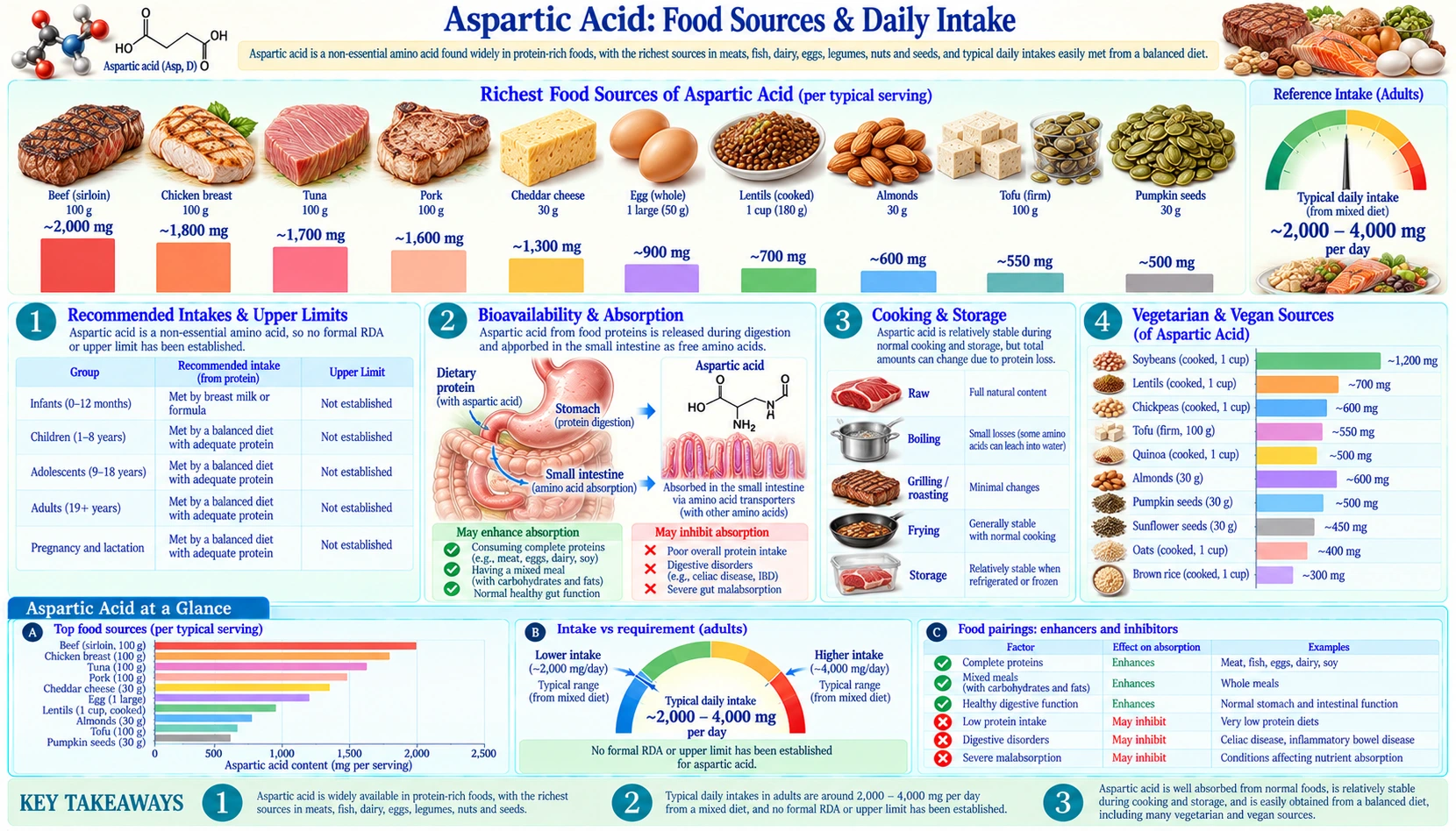
Aspartic acid (aspartate) is a non-essential amino acid — the body builds it from the energy-cycle intermediate oxaloacetate, so you never have to get it from food. It earns its keep inside the cell: it shuttles nitrogen through the urea cycle to clear toxic ammonia, links into the citric-acid (TCA) cycle that produces cellular energy, acts as an excitatory neurotransmitter in the brain, and donates the carbon-nitrogen skeleton used to build DNA and RNA (the pyrimidine nucleotides). You may also recognize it from two other contexts: it is one half of the sweetener aspartame (digested back into ordinary aspartic acid and phenylalanine), and a mirror-image form, D-aspartic acid, is sold as a testosterone supplement. The table below shows grams of aspartic acid per 100 g of food; there is no U.S. Food and Drug Administration (FDA) Daily Value for individual amino acids, so amounts are absolute.
| Aspartic Acid: Food Sources & Daily Intake | |||||
|---|---|---|---|---|---|
| Rank | Food (serving) | Per 100 g | Glucose | Fructose | Notes |
| 1 | Peanuts 1 oz / 28 g | 🟢 3.1 g | — | — | |
| 2 | Pumpkin Seeds 1 oz / 28 g | 🟢 2.9 g | 0.1 | 0.1 | |
| 3 | Chicken Breast 3 oz / 85 g | 🟢 2.8 g | 0 | 0 | |
| 4 | Beef Meat 3 oz / 85 g | 🟢 2.7 g | 0 | 0 | |
| 5 | Salmon 3 oz / 85 g | 🟢 2.7 g | 0 | 0 | |
| 6 | Tuna 3 oz / 85 g | 🟢 2.6 g | 0 | 0 | |
| 7 | Pork 3 oz / 85 g | 🟢 2.6 g | 0 | 0 | |
| 8 | Pork Organ Meats 3 oz / 85 g | 🟢 2.4 g | — | — | Nutrient-dense organ meat. |
| 9 | Cod 3 oz / 85 g | 🟢 2.3 g | 0 | 0 | |
| 10 | Parmesan Cheese 1 oz / 28 g | 🟢 2.2 g | — | — | Concentrated protein. |
| 11 | Cheddar Cheese 1 oz / 28 g | 🟢 2.0 g | 0 | 0 | |
| 12 | Sunflower Seeds 1 oz / 28 g | 🟢 1.9 g | — | — | |
| 13 | Lentil Sprouts 1 cup / 77 g | 🟡 1.4 g | — | — | |
| 14 | Egg 1 large / 50 g | 🟡 1.3 g | — | — | |
| 15 | Chicken Organ Meats 3 oz / 85 g | 🟡 1.0 g | 0 | 0 | Nutrient-dense organ meat (giblets). |
| 16 | Brown Rice 1 cup / 195 g | ⚪ 0.2 g | 0 | 0 | Common staple. |
Table of Contents
How to Read These Tables
- Non-essential amino acid. Your body synthesizes aspartic acid on its own from oxaloacetate, so there is no dietary requirement. It still appears in nearly every protein-containing food because it is one of the twenty building blocks of protein.
- Grams per 100 g, not %DV. There is no U.S. Food and Drug Administration Daily Value for individual amino acids, so this table reports the absolute grams per 100 g of food and ranks foods by that. A typical serving is shown beside each food.
- Tracks total protein. Aspartic acid content rises and falls roughly with a food’s overall protein, so the leaders are protein-dense foods: in the table above, peanuts and pumpkin seeds come first, then chicken, beef, fish, pork and cheese, with sprouts and eggs lower down.
Recommended Intakes & Upper Limits
Aspartic Acid has no Daily Value: the U.S. food-label rules (21 CFR 101.9) set none for it, and the green and yellow marks in the food table above only rank each food against the richest food listed. The table below summarizes its status.
| Reference | Adult value | Notes |
|---|---|---|
| Status | Non-essential | The body makes its own from the TCA-cycle intermediate oxaloacetate, so a dietary supply is not required. |
| Adult requirement | None set | No recommended intake exists for non-essential amino acids; ordinary protein covers it many times over. |
| Main roles | Ammonia detox, energy & nucleotides | Carries nitrogen in the urea cycle, links to the TCA energy cycle, and supplies the backbone for DNA/RNA (pyrimidine) synthesis. |
| Richest in | Protein-dense foods | Beef, poultry, fish, eggs and cheese lead; asparagus (named for it), legumes, sprouts and seeds are strong plant sources. |
Bioavailability & Absorption
Aspartic acid from food is absorbed efficiently as part of dietary protein, and because the body also manufactures its own, supply is essentially never a limiting factor. What matters is simply eating enough total protein; the aspartic acid comes along automatically. Both animal proteins (meat, fish, eggs, dairy) and plant proteins (legumes, seeds, nuts) deliver it in abundance.
Cooking & Storage
Amino acids are stable to ordinary cooking — aspartic acid is not destroyed by normal heat, and cooking makes protein easier to digest. One quirk worth knowing: when protein-rich foods are browned at high heat, free aspartic acid can take part in the Maillard reaction that creates roasted, savory flavors, but the amount bound up in protein is unaffected. No special handling is needed.
Vegetarian & Vegan Sources
Plant-based eaters get aspartic acid easily — plants are naturally rich in it. The plant sources usually named are peanuts, pumpkin and sunflower seeds, sprouted legumes, lentils, chickpeas, white and other beans, and asparagus. USDA data put raw peanuts at 3.15 g and roasted pumpkin seeds at 2.92 g per 100 g, cooked lentils at about 1.0 g and cooked asparagus at about 0.56 g. Asparagus is where the name comes from: asparagine was isolated from asparagus juice in 1806, and aspartic acid was found in 1827 by breaking asparagine down. Because the body also makes its own and every protein food contributes, no special planning is required; ordinary varied plant meals supply plenty.
Who Needs to Pay Attention
Dietary deficiency of aspartic acid is essentially never seen — it is non-essential, the body synthesizes it, and it is present in virtually all protein foods. The ordinary (L-) form is made by the body and supplied by protein foods, and no recommended intake exists for it. The mirror-image D-aspartic acid is marketed as a testosterone and fertility booster; the human evidence is mixed and inconsistent — a few small studies report short-term rises in sedentary men while several others show no effect on testosterone, muscle or strength, A 2017 systematic review (23 animal and 4 human studies) found rises in male animals but inconsistent results in people, from few and poor-quality studies. A 2025 randomized trial recruited 75 infertile men and gave 2,660 mg D-aspartic acid plus 200 mg ubiquinol plus 10 mg zinc daily for 3 months; the treated group’s total testosterone went from 5.06 to 5.89 and progressive sperm motility from 10.63 to 15.21. Because the three were taken together, that trial cannot show what D-aspartic acid did alone. People with the genetic condition phenylketonuria (PKU) are the group named on U.S. labels of foods with aspartame (“PHENYLKETONURICS: CONTAINS PHENYLALANINE”) — not for its aspartic acid, but because aspartame also releases phenylalanine, which they cannot process.
How Aspartame Relates to Aspartic Acid
Aspartame is built from two amino acids, aspartic acid and phenylalanine, and is digested back into them. In July 2023 the International Agency for Research on Cancer classified aspartame as “possibly carcinogenic to humans” (Group 2B), on limited evidence for liver cancer in humans, limited evidence in experimental animals and limited mechanistic evidence. In the same month the Joint FAO/WHO Expert Committee on Food Additives kept its acceptable daily intake at 0–40 mg per kg of body weight. That classification concerns the sweetener aspartame; it is not a classification of the aspartic acid in protein foods. The full account is on the Aspartame page.
Key Research Papers
- NIH MedlinePlus — Amino acids
- National Academies — Dietary Reference Intakes: Protein and Amino Acids (2005), Chapter 10
- PubMed — aspartate, urea cycle and ammonia detoxification. — Search PubMed
- Roshanzamir F, Safavi SM (2017). The putative effects of D-Aspartic acid on blood testosterone levels: A systematic review. Int J Reprod Biomed 15(1):1-10. — PubMed PMID: 28280794
- GamalEl Din SF, A M E, Elkhiat Y, et al. (2025). Evaluation of in vivo supplementation of 2660 mg D-aspartic acid and 200 mg ubiquinol and 10 mg zinc on different semen parameters in idiopathic male infertility: a randomized double blind placebo controlled study. Arch Ital Urol Androl 97(2):13554. — PubMed PMID: 40248985
- Riboli E, Beland FA, Lachenmeier DW, et al. (2023). Carcinogenicity of aspartame, methyleugenol, and isoeugenol. Lancet Oncol 24(8):848-850. — PubMed PMID: 37454664