L-Theanine: Food Sources & Daily Intake
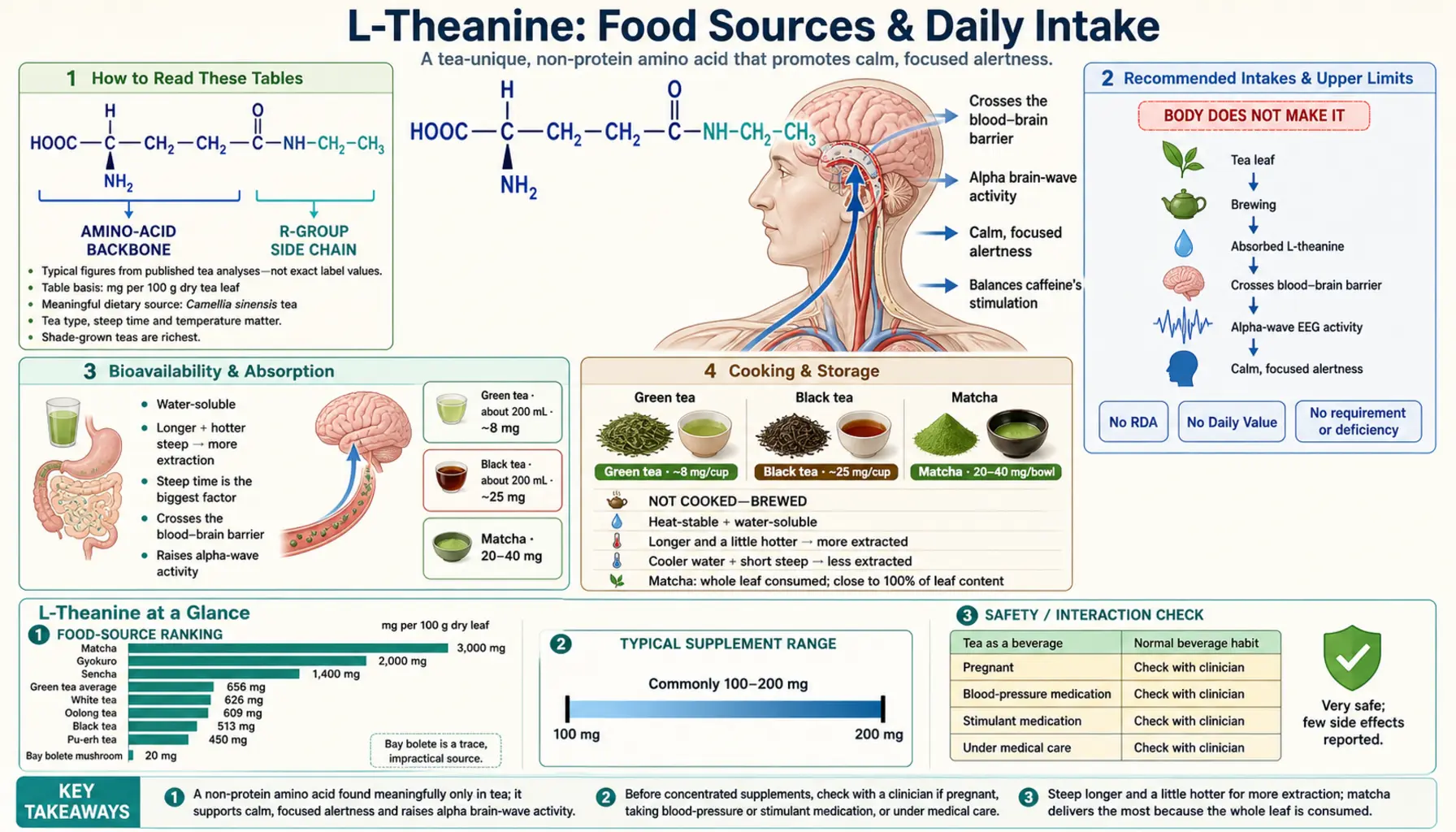
L-theanine is the relaxation compound unique to tea. It is a non-protein amino acid that the body does not make and that occurs almost nowhere else in the diet — only in the leaves of Camellia sinensis (green, black, white, oolong and matcha) and, in trace amounts, in one wild mushroom. L-theanine is what gives tea its distinctive feel of calm, focused alertness: EEG studies show it raises alpha brain-wave activity (the relaxed-but-awake state), and it takes the jittery edge off tea’s caffeine so the lift feels smooth rather than spiky. Because it is not a required nutrient, there is no Daily Value — the table below shows milligrams of L-theanine per 100 g of dry tea leaf, with a realistic brewed cup beside each, ranked from richest to leanest. The honest bottom line: this compound is essentially tea-only.
| L-Theanine: Food Sources & Daily Intake | |||||
|---|---|---|---|---|---|
| Rank | Food (serving) | Per 100 g | Glucose | Fructose | Notes |
| 1 | Matcha 1 bowl / ~2 g powder | 🟢 3,000 mg | — | — | Highest: shade-grown and consumed as whole powdered leaf, so you ingest all of it (a bowl delivers roughly 20–40 mg). |
| 2 | Gyokuro 1 cup brewed / ~2.5 g leaf | 🟢 2,000 mg | — | — | Premium shade-grown Japanese green; first-flush leaves are richest. Shading blocks sunlight that otherwise converts theanine into catechins. |
| 3 | Sencha 1 cup brewed / ~2.5 g leaf | 🟡 1,400 mg | — | — | Standard Japanese steamed green tea; higher than the global green-tea average. |
| 4 | Green Tea (Average) 1 cup brewed / ~2 g leaf | 🟡 656 mg | — | — | Average of 37 commercial teas (6.56 mg/g dry leaf). A brewed cup yields ~8 mg under normal steeping. |
| 5 | White Tea 1 cup brewed / ~2 g leaf | 🟡 626 mg | — | — | Minimally processed; close to green tea in leaf content (6.26 mg/g). |
| 6 | Oolong Tea 1 cup brewed / ~2.5 g leaf | 🟡 609 mg | — | — | Partially oxidized (6.09 mg/g dry leaf); brews release somewhat less than green. |
| 7 | Black Tea 1 cup brewed / ~2 g leaf | 🟡 513 mg | — | — | Fully oxidized (5.13 mg/g dry leaf); a strong cup still delivers ~25 mg because it is steeped hotter and longer. |
| 8 | Pu-Erh Tea 1 cup brewed / ~3 g leaf | 🟡 450 mg | — | — | Fermented/aged dark tea; among the lower theanine teas as fermentation degrades it. |
| 9 | Bay Bolete Mushroom wild mushroom (rare) | ⚪ 20 mg | — | — | Imleria (Boletus) badius — the only documented natural source outside tea; trace amounts, not a practical dietary source. |
Interactive Visualization Caffeine, Adenosine & Why Coffee Stops Working Caffeine doesn’t give you energy — it blocks the tiredness signal while adenosine keeps piling up behind the blockade. Move your coffee to 2 p.m. and watch your deep sleep vanish. Launch →
Table of Contents
- How to Read These Tables
- Recommended Intakes & Upper Limits
- Bioavailability & Absorption
- Cooking & Storage
- Vegetarian & Vegan Sources
- Who Needs to Pay Attention
- Data Sources & References
- Connections
- Featured Videos
How to Read These Tables
- Values from published tea analyses. L-theanine is not catalogued in standard nutrient databases, so these numbers come from peer-reviewed tea chemistry studies (per-gram leaf content and per-cup infusion measurements), not government nutrient tables. They are best read as typical figures, not exact label values.
- Essentially tea-only. Unlike vitamins or other amino acids spread across many foods, L-theanine is found in meaningful amounts only in tea (Camellia sinensis). The single known non-tea source is the bay bolete mushroom, and only in traces — so if you do not drink tea, you get virtually none from food.
- Amount varies hugely with tea type, steep time and temperature. The same leaf can give very different amounts in the cup. Shade-grown teas (matcha, gyokuro) are richest; longer and hotter steeps extract more; and matcha delivers the most per serving because you drink the whole powdered leaf instead of discarding it.
Recommended Intakes & Upper Limits
Your personal target depends on age, sex and pregnancy. The Daily Value used for the %DV column above is a single label figure; the table below is the age-specific guidance.
| Reference | Adult value | Notes |
|---|---|---|
| Status | Non-protein amino acid; not made by the body | There is no requirement and no deficiency — it is a beneficial plant compound, not a nutrient you must obtain. |
| Adult requirement | None (not essential) | No RDA or Daily Value exists; intake comes entirely from what you choose to drink. |
| Found in | Tea (Camellia sinensis) almost exclusively | Green, black, white, oolong and matcha; the only known non-tea source is the bay bolete mushroom (Imleria / Boletus badius). |
| What it does | Promotes calm, focused alertness | Increases alpha-wave EEG activity, balances caffeine’s stimulation, and is the reason a cup of tea feels steadier than coffee. |
Bioavailability & Absorption
L-theanine is water-soluble, so brewing is what releases it from the leaf into your cup. Longer steep times and hotter water extract more — steeping time is the single biggest factor in how much ends up in the cup, far more than whether you add milk or sugar. A typical brewed cup (about 200 mL) provides roughly 8 mg from green tea and ~25 mg from black tea under normal preparation; matcha delivers the most (around 20–40 mg) because the whole powdered leaf is whisked in and consumed rather than strained out. Once absorbed, L-theanine crosses the blood–brain barrier, which is how it can influence brain-wave activity and produce its characteristic calm-but-alert effect.
Cooking & Storage
L-theanine is not cooked — it is brewed, and the steep parameters are everything. To get more into the cup, steep longer and a little hotter; to keep a green tea delicate but lower in extracted theanine, use cooler water and a short steep. Because it is heat-stable and water-soluble, nothing about ordinary brewing destroys it — the variable is simply how much you pull out of the leaf. With matcha there is no steeping or straining at all: the powdered leaf is whisked into water and drunk whole, so you receive close to 100% of what the leaf contains.
Vegetarian & Vegan Sources
Tea is a plant — a leaf — so all dietary L-theanine is naturally vegan, and tea is the only meaningful dietary source. There is no animal source at all; the lone non-tea natural source is a wild mushroom (the bay bolete), also plant-kingdom-adjacent and not a practical food source. Anyone, on any diet, gets their L-theanine the same way: from drinking tea (or, optionally, from a supplement). Shade-grown green teas such as matcha and gyokuro are the richest plant choices.
Who Needs to Pay Attention
L-theanine is regarded as very safe. It has a long history of consumption in tea, is well tolerated, and human studies report few side effects. It is most often paired with caffeine — in tea this happens naturally, and the combination is associated with smoother, more focused alertness than caffeine alone. Beyond tea, L-theanine is also widely sold as a dietary supplement (commonly 100–200 mg), often specifically to take the edge off caffeine or to support relaxation. As with any supplement, people who are pregnant, on blood-pressure or stimulant medication, or otherwise under medical care should check with a clinician before taking concentrated doses; getting it from tea is simply part of a normal beverage habit.
Data Sources & References
- Keenan et al. (2011) — How much theanine in a cup of tea? (Food Chemistry)
- Frontiers in Nutrition (2022) — L-Theanine: a unique functional amino acid in tea
- PubMed — theanine content of tea (Camellia sinensis)
- PubMed — L-theanine caffeine cognition alpha brain waves
Connections
- All Amino Acids
- Caffeine, Adenosine & Why Coffee Stops Working — interactive animation
- L-Theanine (Main Page)
- L-Theanine History
- L-Theanine
- Coffee
- Mushrooms