Lysine: Food Sources & Daily Intake
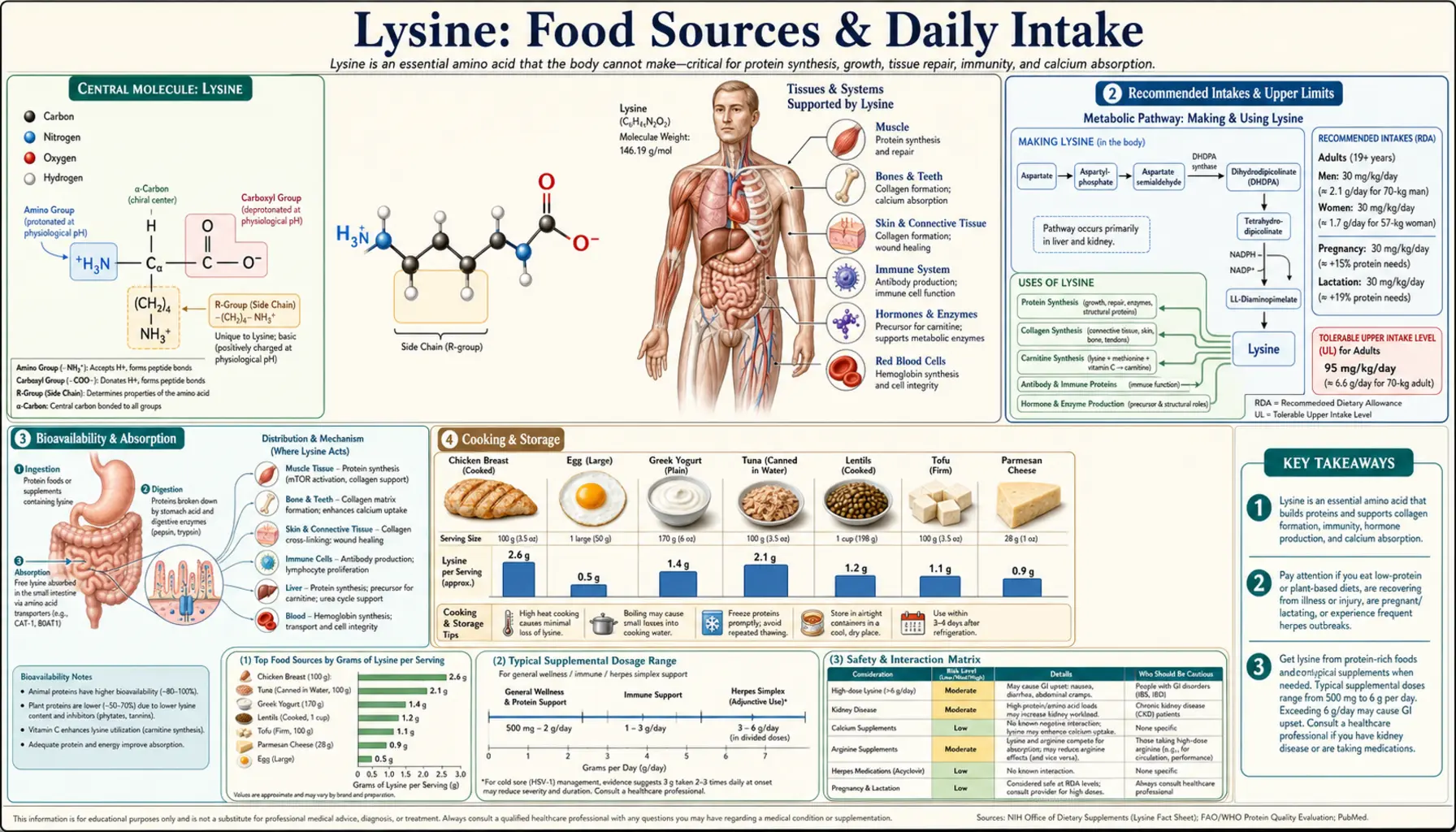
Lysine is an essential amino acid — the body cannot make it, so it has to come from food. It is a building block of collagen and connective tissue, helps the gut absorb calcium and iron, and is needed to make carnitine, the molecule that shuttles fat into cells to be burned for energy. The richest sources are animal proteins — meat, fish, eggs and cheese — followed by legumes such as lentils and beans. Grains are notably low in lysine, which makes it the classic “limiting” amino acid for anyone eating mostly plants. The table below shows grams of lysine per 100 g of food; there is no U.S. Food and Drug Administration (FDA) Daily Value for individual amino acids, so amounts are absolute.
| Lysine: Food Sources & Daily Intake | |||||
|---|---|---|---|---|---|
| Rank | Food (serving) | Per 100 g | Glucose | Fructose | Notes |
| 1 | Parmesan Cheese 1 oz / 28 g | 🟢 3.3 g | — | — | Concentrated protein. |
| 2 | Beef Meat 3 oz / 85 g | 🟢 2.6 g | 0 | 0 | |
| 3 | Salmon 3 oz / 85 g | 🟢 2.6 g | 0 | 0 | |
| 4 | Chicken Breast 3 oz / 85 g | 🟢 2.6 g | 0 | 0 | |
| 5 | Pork 3 oz / 85 g | 🟢 2.5 g | 0 | 0 | |
| 6 | Tuna 3 oz / 85 g | 🟢 2.3 g | 0 | 0 | |
| 7 | Sardines 3 oz / 85 g | 🟢 2.3 g | 0 | 0 | |
| 8 | Shrimp 3 oz / 85 g | 🟢 2.2 g | 0 | 0 | |
| 9 | Cod 3 oz / 85 g | 🟢 2.1 g | 0 | 0 | Lean, lysine-rich. |
| 10 | Cheddar Cheese 1 oz / 28 g | 🟢 2.0 g | 0 | 0 | |
| 11 | Pork Organ Meats 3 oz / 85 g | 🟢 1.8 g | — | — | Nutrient-dense organ meat. |
| 12 | Pumpkin Seeds 1 oz / 28 g | 🟡 1.2 g | 0.1 | 0.1 | |
| 13 | Peanuts 1 oz / 28 g | 🟡 0.9 g | — | — | |
| 14 | Egg 1 large / 50 g | 🟡 0.9 g | — | — | |
| 15 | Chicken Organ Meats 3 oz / 85 g | 🟡 0.8 g | 0 | 0 | Nutrient-dense organ meat (giblets). |
| 16 | Brown Rice 1 cup / 195 g | ⚪ 0.1 g | 0 | 0 | Common staple. |
Table of Contents
How to Read These Tables
- Essential amino acid. Your body cannot synthesize lysine, so a regular dietary supply matters. The nine essential amino acids must come from food; the other eleven the body can build itself.
- Grams per 100 g, not %DV. There is no U.S. Food and Drug Administration Daily Value for individual amino acids, so this table reports the absolute grams per 100 g of food and ranks foods by that. A typical serving is shown beside each food.
- Complete vs incomplete protein. Animal foods are “complete” they carry all the essential amino acids in good proportion. Grains are the main foods low in lysine, so a plant-based plate leans on legumes to supply it; eating a variety across the day covers the gaps.
Recommended Intakes & Upper Limits
Lysine has no Daily Value: the U.S. food-label rules (21 CFR 101.9) set none for it, and the green and yellow marks in the food table above only rank each food against the richest food listed. The table below summarizes its status.
| Reference | Adult value | Notes |
|---|---|---|
| Essential? | Yes — essential | The body cannot make it; it must come from food. |
| Adult requirement | 30 mg/kg/day | WHO/FAO/UNU 2007 estimate. |
| ≈ for a 70 kg adult | ~2.1 g/day | Easily met by a normal protein intake (~0.8 g protein/kg). |
| Richest in | Animal protein & legumes | Meat, fish, eggs, cheese, then lentils, beans, peanuts — but low in grains. |
Bioavailability & Absorption
Lysine from food is well absorbed as part of dietary protein, and animal proteins (meat, fish, eggs, dairy) are both complete and lysine-dense. Among plants, legumes are the standout — lentils, beans and chickpeas carry far more lysine than grains, nuts or seeds. What matters most is total protein quality and quantity: spreading roughly 20–40 g of quality protein across each meal comfortably covers an adult’s lysine needs.
Cooking & Storage
Of all the amino acids, lysine is the one most easily damaged by cooking. Its side chain ends in an exposed amino group that reacts with sugars during high, dry heat — the same Maillard reaction that browns toast, sears meat and forms a crust. That browning locks up some lysine so the body can no longer use it, and the loss can be several times greater than for other amino acids. Moist methods (steaming, poaching, stewing) and lighter browning preserve more lysine than prolonged dry roasting, heavy charring or deep browning.
Vegetarian & Vegan Sources
Lysine is the amino acid plant-based eaters most need to plan for, because grains are low in it — this is the classic “limiting amino acid” story. On a plant-based plate, legumes are the key plant source of lysine. Lentils, black and white beans, chickpeas and peanuts are all rich in it, while grains are low in lysine but higher in methionine. Combining the two — legumes + grains, like beans with rice or lentils with bread — gives a complete amino-acid profile, which is why these pairings show up in traditional diets worldwide. They don’t even need to be eaten in the same meal, just across the day.
Who Needs to Pay Attention
Outright lysine deficiency is rare in anyone eating enough total protein, including most omnivores and well-planned vegetarians. The groups the concern applies to are people relying heavily on grains with few legumes, people with low overall protein intake (some older adults, those recovering from illness or surgery, very-low-calorie dieters), and athletes with high turnover. For these groups the gap is a protein gap: adequate, varied quality protein — with legumes on a plant-based plate — supplies lysine without isolated lysine supplements.
Key Research Papers
- NIH MedlinePlus — Amino acids
- National Academies — Dietary Reference Intakes: Protein and Amino Acids (2005), Chapter 10
- Joint WHO/FAO/UNU Expert Consultation (2007). Protein and amino acid requirements in human nutrition. World Health Organization Technical Report Series 935:1-265 — source of the 30 mg/kg/day adult lysine requirement — PubMed PMID: 18330140
- PubMed — lysine requirements in adult humans
- PubMed — lysine as the limiting amino acid in cereals