Leucine for Sarcopenia Prevention
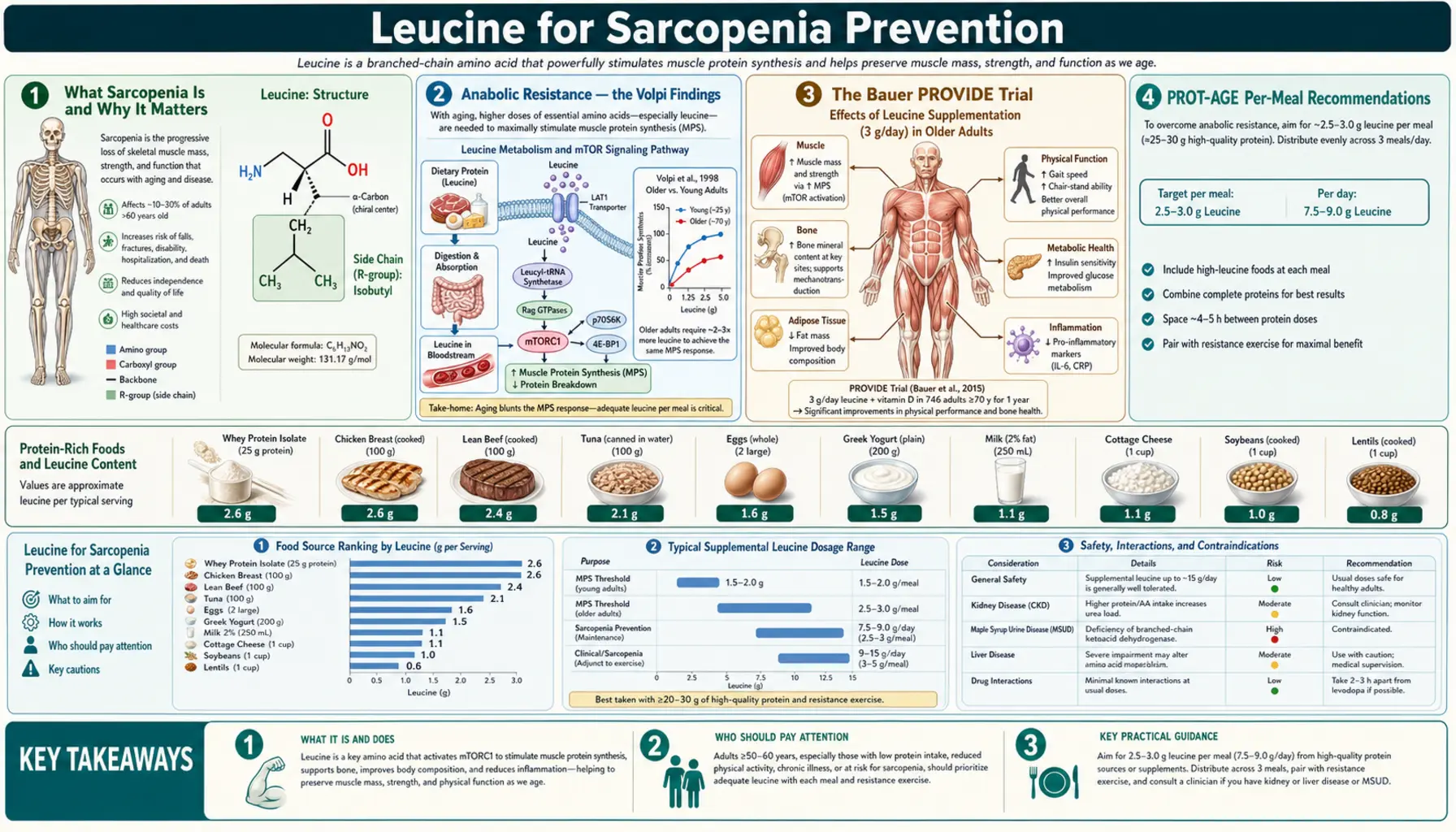
Sarcopenia — the age-related loss of muscle mass, strength, and function — is described by the 2019 European consensus (EWGSOP2) as associated with a higher likelihood of falls, fractures, physical disability, and death. Stable-isotope tracer studies describe “anabolic resistance”: under some test conditions older muscle builds less protein than younger muscle in response to the same amino-acid dose. The 13-week PROVIDE trial (Bauer 2015) gave 380 sarcopenic older adults a vitamin D and leucine-enriched whey protein supplement and found small gains in appendicular muscle mass and chair-stand time, but no between-group difference in its primary outcomes, handgrip strength and physical-performance score. The PROT-AGE Study Group (2013) set out daily protein intakes for people over 65, and trials of leucine on its own have given mixed results. Leucine's metabolite HMB (beta-hydroxy-beta-methylbutyrate) has a separate trial literature of its own. This page summarises what those studies report.
Table of Contents
- What Sarcopenia Is and Why It Matters
- Anabolic Resistance — the Volpi Findings
- The Bauer PROVIDE Trial
- PROT-AGE Per-Meal Recommendations
- Leucine-Enriched Whey for the Elderly
- HMB — Leucine's Anti-Catabolic Metabolite
- HMB Trials in Trained Adults and Older Adults
- Resistance Exercise Alongside Nutrition
- What Guidelines and Trials Describe
- Contraindications and Special Populations
- Key Research Papers
- Connections
- Featured Videos
What Sarcopenia Is and Why It Matters
Sarcopenia is the loss of skeletal muscle mass, strength, and physical performance that accompanies aging. The European Working Group on Sarcopenia in Older People's revised consensus (EWGSOP2, 2019) describes it as a muscle disease that is common in older age but can also occur earlier in life. EWGSOP2 makes low muscle strength the key characteristic (grip strength <27 kg in men or <16 kg in women, or a chair-stand time >15 seconds for five rises), uses low muscle quantity or quality to confirm the diagnosis (for example, appendicular skeletal muscle mass divided by height squared <7.0 kg/m² in men and <5.5 kg/m² in women), and treats poor physical performance (such as gait speed ≤0.8 m/s) as a marker of severe sarcopenia.
EWGSOP2 describes sarcopenia as associated with an increased likelihood of adverse outcomes including falls, fractures, physical disability, and mortality. A 2004 analysis estimated the direct healthcare cost attributable to sarcopenia in the United States in 2000 at $18.5 billion, about 1.5% of total healthcare spending that year, with a sensitivity range of $11.8–26.2 billion (Janssen et al., 2004).
EWGSOP2 describes sarcopenia as rooted in adverse muscle changes that accrue across a lifetime. Very old muscle can still respond to training: in a 1990 study, frail nursing-home residents aged about 90 gained strength, muscle size, and walking speed after eight weeks of high-intensity resistance training (Fiatarone et al., 1990; details in the exercise section below).
Anabolic Resistance — the Volpi Findings
Stable-isotope tracer studies at the University of Texas Medical Branch (Elena Volpi, Robert Wolfe, and colleagues) and at the University of Dundee (Michael Rennie's group) compared how young and older muscle respond to amino acids. Their results depend on the test conditions.
In healthy older adults (about 71 years), an intravenous amino-acid infusion raised muscle protein synthesis and produced a positive net amino-acid balance across the muscle (Volpi et al., 1998). When amino acids were taken by mouth, muscle protein synthesis rose similarly in young (about 30 years) and older (about 71 years) volunteers, even though more of the dose was taken up by the gut and liver on its first pass in the older group (Volpi et al., 1999). When amino acids were given together with glucose, which raises insulin, muscle protein synthesis rose in the young but did not change in the older group (Volpi et al., 2000).
In 44 healthy young and older men given different amounts of essential amino acids with insulin held at basal levels, Cuthbertson and colleagues (2005) found similar basal synthesis rates but lower sensitivity and responsiveness of muscle protein synthesis to amino acids in the older men. This went with lower expression and activation of amino-acid sensing and signalling proteins (mTOR, p70 S6 kinase, 4E-BP1, and eIF2B) and with marked increases in NF-κB, an inflammation-associated transcription factor. Other contributors proposed in the wider literature, such as reduced muscle blood flow and changes in satellite cells and ribosomes, are not tested in the papers cited on this page.
The idea that the amount of leucine in a meal drives this response is a hypothesis drawn from acute studies. In Katsanos et al. (2006), 6.7 g of essential amino acids with a whey-like composition (26% leucine) did not raise muscle protein synthesis in older subjects, while the same amount enriched to 41% leucine did; in young subjects the extra leucine gave no further rise. In Wall et al. (2013), adding 2.5 g of leucine to 20 g of casein increased the post-meal muscle protein synthesis rate over six hours in 24 older men. Per-meal “leucine threshold” figures of about 2.5–3 g come from acute studies of this kind, which measure a few hours of protein synthesis rather than muscle mass or strength over months.
The Bauer PROVIDE Trial
The PROVIDE study (Bauer et al., JAMDA 2015) was a multicentre, randomised, double-blind, placebo-controlled trial in 380 sarcopenic, mostly independent-living older adults with Short Physical Performance Battery (SPPB) scores of 4–9 and a low skeletal muscle mass index. The active group (n = 184) took a vitamin D and leucine-enriched whey protein supplement twice daily for 13 weeks; the control group (n = 196) took an iso-caloric control product twice daily. The authors describe the intervention as nutritional supplementation alone, without an exercise programme. Two of the co-authors were employees of the research division of the company that makes the supplement (author affiliations).
The primary outcomes were handgrip strength and SPPB score. Secondary outcomes were the chair-stand test, gait speed, balance score, and appendicular muscle mass by DXA, measured at baseline, week 7, and week 13.
Handgrip strength and SPPB improved in both groups, with no significant difference between groups. The active group improved more in the chair-stand test (between-group effect −1.01 seconds, 95% CI −1.77 to −0.19, P = .018) and gained more appendicular muscle mass than the control group (between-group effect 0.17 kg, 95% CI 0.004 to 0.338, P = .045).
The authors concluded that the supplement improved muscle mass and lower-extremity function, describing the result as “proof-of-principle” that specific nutritional supplementation alone might benefit geriatric patients, especially those unable to exercise, and called for further studies of the supplement as part of a multimodal approach. The abstract reports no outcomes for falls, fractures, or the longer term.
Trials of leucine on its own, without whey or vitamin D, are summarised in the leucine-enriched whey section below.
PROT-AGE Per-Meal Recommendations
The PROT-AGE Study Group, appointed by the European Union Geriatric Medicine Society in cooperation with other scientific organisations, published evidence-based recommendations on protein intake for people over 65 (Bauer et al., JAMDA 2013). Its abstract states:
- Average daily intake of at least 1.0–1.2 g protein per kg body weight per day to help older people maintain and regain lean body mass and function.
- Higher intake (≥1.2 g/kg/day) for those who are exercising and otherwise active, and 1.2–1.5 g/kg/day for most older adults with acute or chronic disease.
- Endurance- and resistance-type exercise at individualised levels that are safe and tolerated.
- An exception for severe kidney disease — people with an estimated GFR <30 mL/min/1.73 m² who are not on dialysis may need to limit protein intake.
- Protein quality, timing, and other supplements “may be relevant, but evidence is not yet sufficient to support specific recommendations.”
These intakes are higher than the standard adult recommended dietary allowance (RDA) for protein. The group's abstract attributes the higher need to age-related changes in protein metabolism, such as high splanchnic extraction and declining anabolic responses to ingested protein, and to the inflammatory and catabolic conditions that come with common chronic and acute diseases.
A per-meal figure comes from a separate review: Paddon-Jones and Rasmussen (2009) reported that about 25–30 g of protein per meal maximally stimulates muscle protein synthesis in both young and older people, and that synthesis is blunted in the elderly when protein is eaten with carbohydrate or when a meal contains less than about 20 g of protein. They proposed 25–30 g of high-quality protein per meal in place of a large global increase in the RDA. Protein-rich whole foods include eggs, meat, poultry, fish, and dairy foods such as cheese and yogurt.
Leucine-Enriched Whey for the Elderly
Whey protein is the base of several supplements tested in older adults, including those in the PROVIDE and Rondanelli trials. The essential amino acids of whey protein are about 26% leucine (the composition used in the Katsanos 2006 study). Leucine is sensed by the mTORC1 pathway, which helps switch on muscle protein synthesis.
Trials of leucine on its own have given mixed results. In a 12-week randomised trial, 30 healthy older men (mean age 71) took 2.5 g of leucine or placebo with each main meal (7.5 g/day); muscle mass (by CT and DXA) and strength did not change in either group, and insulin sensitivity, HbA1c, and blood lipids did not improve (Verhoeven et al., 2009). A 2015 meta-analysis of 16 studies with 999 participants found that leucine supplementation increased body weight (mean difference 1.02 kg), lean body mass (0.99 kg), and body mass index compared with controls, with larger effects on body weight and lean mass in people with sarcopenia, but no significant effect on muscle strength; the authors pointed to heterogeneity between the trials (Komar et al., 2015).
Dosing in these trials: PROVIDE used two servings a day for 13 weeks, and Verhoeven used leucine with each of three main meals for 12 weeks. None of the studies cited on this page compared once-daily with twice-daily dosing or tested timing relative to exercise.
HMB — Leucine's Anti-Catabolic Metabolite
Beta-hydroxy-beta-methylbutyrate (HMB) is a metabolite of leucine, formed via alpha-ketoisocaproate (KIC). The 2013 International Society of Sports Nutrition (ISSN) position stand states that only about 5% of leucine is converted to HMB, so that a person would need to eat over 600 g of high-quality protein to obtain the leucine needed to make the 3 g daily dose typically used in human studies. HMB trials test the metabolite itself, so their results are separate evidence from the leucine trials above.
The ISSN position stand lists HMB's mechanisms of action as an inhibition of protein breakdown (proteolysis) and an increase in protein synthesis. None of the studies cited on this page tested whether leucine and HMB taken together do better than either alone.
Two forms of HMB have been used in studies: calcium HMB (HMB-Ca) and HMB free acid (HMB-FA). The ISSN states that HMB-FA may increase plasma absorption and retention of HMB more than HMB-Ca, but that research with HMB-FA is “in its infancy” and there is not enough to say whether one form is superior. The position stand also states that 38 mg per kg body mass daily has been shown to enhance muscle hypertrophy, strength, and power in untrained and trained people with an appropriate exercise prescription, that HMB has been shown to increase lean body mass and functionality in elderly, sedentary populations, and that chronic HMB consumption is safe in young and old populations.
Pooled results differ by population. A 2015 meta-analysis of seven randomised trials in people aged 65 and older (147 receiving HMB, 140 controls) found greater muscle-mass gain with HMB and no difference in fat mass (Wu et al., 2015). A 2018 meta-analysis of six randomised trials in trained and competitive athletes (193 participants) found no effect of HMB on strength or body composition (Sanchez-Martinez et al., 2018).
HMB Trials in Trained Adults and Older Adults
A 2014 randomised, double-blind, placebo-controlled trial by Wilson and colleagues (European Journal of Applied Physiology) tested 12 weeks of HMB-FA in resistance-trained individuals: an 8-week periodised training programme, a 2-week overreaching phase, and a 2-week taper. Compared with placebo, the HMB-FA group gained more total strength (bench press, squat, and deadlift combined: 77.1 vs 25.3 kg), vertical-jump power (991 vs 630 W), and lean body mass (7.4 vs 2.1 kg).
These effects are larger than the pooled result of the 2018 meta-analysis of HMB in trained and competitive athletes, which found no effect on strength or body composition (Sanchez-Martinez et al., 2018). An earlier study by Nissen and colleagues (1996), in two experiments with weight-training programmes, reported that 1.5 or 3 g of HMB a day reduced markers of exercise-induced muscle breakdown (urinary 3-methylhistidine and plasma creatine phosphokinase) and increased the weight lifted, and in the second experiment increased fat-free mass.
In older adults, a randomised, double-blind trial gave 24 healthy adults aged 60–76 either 3 g/day of calcium HMB or placebo, starting five days before 10 days of complete bed rest. The control group lost 2.05 kg of lean body mass; with one subject excluded, the HMB group's change (−0.17 kg) was not significant, and the difference between groups was significant. Function measures did not differ, which the authors attributed probably to the small sample, and they called for a larger trial (Deutz et al., 2013). In an open-label trial in 80 healthy women over 65 attending a mild fitness programme, 1.5 g/day of calcium HMB for 8 weeks did not change SPPB score, handgrip strength, or DXA measures, but improved several leg-strength measures, 6-minute walking distance, and handgrip endurance compared with control (Berton et al., 2015).
The older-adult trials above used 3 g/day (Deutz) or 1.5 g/day (Berton) of calcium HMB. None of the cited trials compared leucine-enriched whey plus HMB with either alone.
Resistance Exercise Alongside Nutrition
PROVIDE tested supplementation without an exercise programme; other trials pair nutrition with exercise. In a 12-week randomised, double-blind trial, 130 sarcopenic older adults (mean age 80.3) all took part in a controlled physical-activity programme and received either a supplement of whey protein (22 g), essential amino acids (10.9 g, including 4 g leucine), and vitamin D (100 IU) or a placebo. Compared with physical activity plus placebo, the supplement group gained more fat-free mass (1.7 kg) and improved more in handgrip strength, activities of daily living, and nutritional status, with lower C-reactive protein (Rondanelli et al., 2016).
The PROT-AGE group recommends both endurance- and resistance-type exercise for older people at individualised levels that are safe and tolerated, with higher protein intake (≥1.2 g/kg/day) for those who are exercising. The trials cited on this page do not measure the size of the interaction between exercise and protein.
The 1990 Fiatarone study (JAMA) enrolled ten frail, institutionalised volunteers aged 90 ± 1 years in 8 weeks of high-intensity resistance training. In the nine who completed training, strength gains averaged 174%, mid-thigh muscle area increased 9.0%, and mean tandem gait speed improved 48%. The authors concluded that high-resistance weight training leads to significant gains in muscle strength, size, and functional mobility among frail nursing-home residents up to 96 years of age.
What Guidelines and Trials Describe
The sources on this page describe the following approaches and results:
- Case-finding — EWGSOP2 advises the SARC-F questionnaire to find people with probable sarcopenia, and grip strength and chair-stand measures to identify low muscle strength.
- Daily protein — PROT-AGE: at least 1.0–1.2 g/kg/day for people over 65, ≥1.2 g/kg/day for those who exercise, and 1.2–1.5 g/kg/day for most with acute or chronic disease, with an exception for severe kidney disease not on dialysis.
- Leucine-enriched whey with vitamin D, no exercise — PROVIDE: twice daily for 13 weeks; more appendicular muscle mass and better chair-stand time than control, no difference in handgrip strength or SPPB.
- Supplement plus physical activity — Rondanelli 2016: whey protein, essential amino acids, and vitamin D with a controlled activity programme for 12 weeks; more fat-free mass and handgrip strength than activity plus placebo.
- Leucine alone — Verhoeven 2009: 7.5 g/day for 12 weeks, no change in muscle mass or strength in healthy older men; Komar 2015 meta-analysis: lean-mass gain mainly in people with sarcopenia, no effect on strength.
- HMB during bed rest — Deutz 2013: 3 g/day of calcium HMB preserved lean body mass over 10 days of bed rest in healthy older adults.
Decisions about protein intake, supplements, and exercise for a particular person belong with a clinician.
Contraindications and Special Populations
- Advanced chronic kidney disease — the PROT-AGE group notes that older people with severe kidney disease (estimated GFR <30 mL/min/1.73 m²) who are not on dialysis may need to limit protein intake, which sits in tension with higher-protein approaches to sarcopenia. Ketoacid analogues of essential amino acids have been studied alongside low-protein diets in chronic kidney disease; that literature is not reviewed here.
- Maple syrup urine disease (MSUD) — a rare inborn error of branched-chain alpha-keto acid dehydrogenase. Its treatment is tight dietary restriction of leucine and the other branched-chain amino acids, so leucine supplements are contraindicated.
- Hepatic encephalopathy — a 2026 Cochrane review of 18 randomised trials (934 adults, mostly with cirrhosis) found that branched-chain amino acid supplements (which include leucine) may reduce hepatic encephalopathy, with low-certainty evidence, and could not determine any effect on mortality (Aamann et al., 2026).
- Active cancer — mTORC1 signalling is active in many cancers, while cancer cachexia also wastes muscle. None of the studies cited on this page tested leucine in people with cancer; this is a question for the oncology team.
- Cognitive impairment that affects eating — here the main nutritional problem is often getting enough food eaten at all, rather than the leucine content of meals.
- Severe dysphagia — swallowing difficulty limits which food textures and liquids can be swallowed safely; texture-modified foods, thickened liquids, speech-pathology assessment, and tube feeding are used in this setting.
- End-stage frailty or terminal illness — in palliative care the aim of nutrition shifts from rebuilding muscle to comfort.
Key Research Papers
- Bauer JM et al. (2015). Effects of a vitamin D and leucine-enriched whey protein nutritional supplement on measures of sarcopenia in older adults, the PROVIDE study: a randomized, double-blind, placebo-controlled trial. Journal of the American Medical Directors Association 16(9):740-747. — PubMed PMID: 26170041
- Bauer J et al. (2013). Evidence-based recommendations for optimal dietary protein intake in older people: a position paper from the PROT-AGE Study Group. Journal of the American Medical Directors Association 14(8):542-559. — PubMed PMID: 23867520
- Volpi E, Ferrando AA, Yeckel CW, Tipton KD, Wolfe RR (1998). Exogenous amino acids stimulate net muscle protein synthesis in the elderly. Journal of Clinical Investigation 101(9):2000-2007. — PubMed PMID: 9576765
- Cuthbertson D et al. (2005). Anabolic signaling deficits underlie amino acid resistance of wasting, aging muscle. FASEB Journal 19(3):422-424. — PubMed PMID: 15596483
- Cruz-Jentoft AJ et al. (2019). Sarcopenia: revised European consensus on definition and diagnosis. Age and Ageing 48(1):16-31. — PubMed PMID: 30312372
- Wilson JM et al. (2014). The effects of 12 weeks of beta-hydroxy-beta-methylbutyrate free acid supplementation on muscle mass, strength, and power in resistance-trained individuals: a randomized, double-blind, placebo-controlled study. European Journal of Applied Physiology 114(6):1217-1227. — PubMed PMID: 24599749
- Wilson JM et al. (2013). International Society of Sports Nutrition Position Stand: beta-hydroxy-beta-methylbutyrate (HMB). Journal of the International Society of Sports Nutrition 10(1):6. — PubMed PMID: 23374455
- Nissen S et al. (1996). Effect of leucine metabolite beta-hydroxy-beta-methylbutyrate on muscle metabolism during resistance-exercise training. Journal of Applied Physiology 81(5):2095-2104. — PubMed PMID: 8941534
- Fiatarone MA, Marks EC, Ryan ND, Meredith CN, Lipsitz LA, Evans WJ (1990). High-intensity strength training in nonagenarians. Effects on skeletal muscle. JAMA 263(22):3029-3034. — PubMed PMID: 2342214
- Deutz NE et al. (2013). Effect of β-hydroxy-β-methylbutyrate (HMB) on lean body mass during 10 days of bed rest in older adults. Clinical Nutrition 32(5):704-712. — PubMed PMID: 23514626
- Paddon-Jones D, Rasmussen BB (2009). Dietary protein recommendations and the prevention of sarcopenia. Current Opinion in Clinical Nutrition and Metabolic Care 12(1):86-90. — PubMed PMID: 19057193
- Rondanelli M et al. (2016). Whey protein, amino acids, and vitamin D supplementation with physical activity increases fat-free mass and strength, functionality, and quality of life and decreases inflammation in sarcopenic elderly. American Journal of Clinical Nutrition 103(3):830-840. — PubMed PMID: 26864356
- Volpi E, Mittendorfer B, Wolf SE, Wolfe RR (1999). Oral amino acids stimulate muscle protein anabolism in the elderly despite higher first-pass splanchnic extraction. American Journal of Physiology 277(3):E513-E520. — PubMed PMID: 10484364
- Volpi E, Mittendorfer B, Rasmussen BB, Wolfe RR (2000). The response of muscle protein anabolism to combined hyperaminoacidemia and glucose-induced hyperinsulinemia is impaired in the elderly. Journal of Clinical Endocrinology and Metabolism 85(12):4481-4490. — PubMed PMID: 11134097
- Katsanos CS, Kobayashi H, Sheffield-Moore M, Aarsland A, Wolfe RR (2006). A high proportion of leucine is required for optimal stimulation of the rate of muscle protein synthesis by essential amino acids in the elderly. American Journal of Physiology – Endocrinology and Metabolism 291(2):E381-E387. — PubMed PMID: 16507602
- Wall BT et al. (2013). Leucine co-ingestion improves post-prandial muscle protein accretion in elderly men. Clinical Nutrition 32(3):412-419. — PubMed PMID: 23043721
- Verhoeven S et al. (2009). Long-term leucine supplementation does not increase muscle mass or strength in healthy elderly men. American Journal of Clinical Nutrition 89(5):1468-1475. — PubMed PMID: 19321567
- Komar B, Schwingshackl L, Hoffmann G (2015). Effects of leucine-rich protein supplements on anthropometric parameter and muscle strength in the elderly: a systematic review and meta-analysis. Journal of Nutrition, Health and Aging 19(4):437-446. — PubMed PMID: 25809808
- Wu H et al. (2015). Effect of beta-hydroxy-beta-methylbutyrate supplementation on muscle loss in older adults: a systematic review and meta-analysis. Archives of Gerontology and Geriatrics 61(2):168-175. — PubMed PMID: 26169182
- Sanchez-Martinez J, Santos-Lozano A, Garcia-Hermoso A, Sadarangani KP, Cristi-Montero C (2018). Effects of beta-hydroxy-beta-methylbutyrate supplementation on strength and body composition in trained and competitive athletes: a meta-analysis of randomized controlled trials. Journal of Science and Medicine in Sport 21(7):727-735. — PubMed PMID: 29249685
- Berton L et al. (2015). Effect of oral beta-hydroxy-beta-methylbutyrate (HMB) supplementation on physical performance in healthy old women over 65 years: an open label randomized controlled trial. PLoS One 10(11):e0141757. — PubMed PMID: 26529601
- Janssen I, Shepard DS, Katzmarzyk PT, Roubenoff R (2004). The healthcare costs of sarcopenia in the United States. Journal of the American Geriatrics Society 52(1):80-85. — PubMed PMID: 14687319
- Aamann L et al. (2026). Branched-chain amino acids for people with cirrhosis and hepatic encephalopathy. Cochrane Database of Systematic Reviews 1:CD001939. — PubMed PMID: 41542879