Beta-Alanine Safety and Stacking
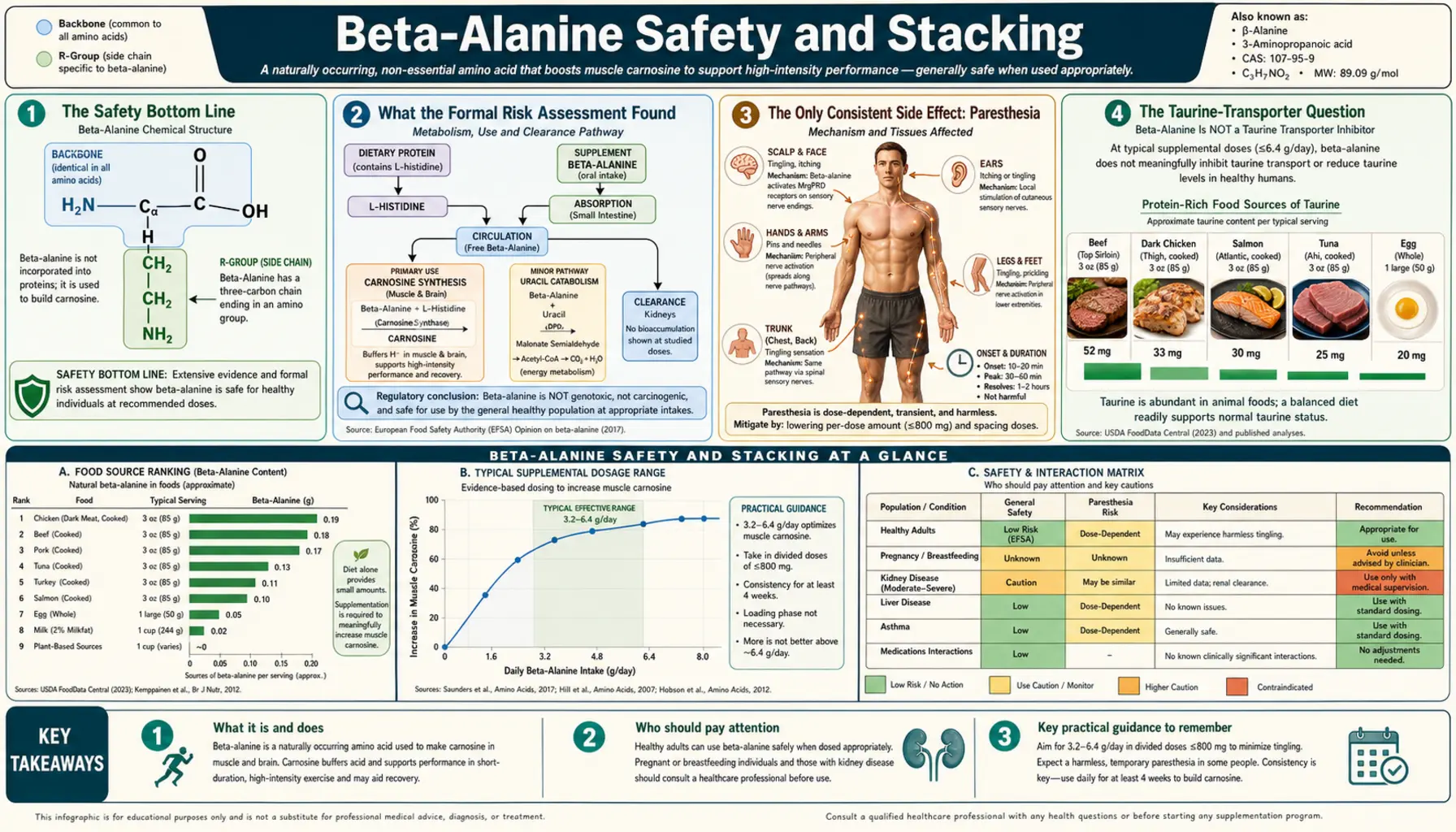
Safety reviews of beta-alanine report one consistent side effect: a temporary skin tingling called paresthesia. A 2019 systematic risk assessment and meta-analysis of 101 human and 50 animal studies found paresthesia to be the only reported side effect, a small rise in the liver enzyme alanine aminotransferase that stayed within clinical reference ranges, and no effect on muscle taurine in the pooled human data. The often-raised concern that beta-alanine competes with taurine for the same cell transporter rests on laboratory work and on rodent studies, in which taurine fell only at high doses given in drinking water. Beta-alanine has also been studied in combination with creatine and with sodium bicarbonate. This page reports what the safety reviews and the combination studies found.
Table of Contents
- The Safety Bottom Line
- What the Formal Risk Assessment Found
- The Only Consistent Side Effect: Paresthesia
- The Taurine-Transporter Question
- Combined with Creatine: What Trials Found
- Combined with Bicarbonate and Other Supplements
- Special Populations: What Has Been Studied
- Drug Interactions: What Is Known
- Quality, Purity, and Tested Athletes
- Key Research Papers
- External Authoritative Resources
- Connections
- Featured Videos
The Safety Bottom Line
The International Society of Sports Nutrition (ISSN) 2015 position stand on beta-alanine (Trexler et al.) lists among its conclusions that beta-alanine supplementation “currently appears to be safe in healthy populations at recommended doses,” that the only reported side effect is paraesthesia (tingling), and that 4 to 6 g daily for at least 2 to 4 weeks has been shown to improve exercise performance. The tingle itself is covered on the Dosing & the Tingle page.
These conclusions reach only as far as the research does. The 2019 risk assessment by Dolan and colleagues states its finding for beta-alanine “within the doses used in the available research designs,” and the longest controlled human safety trial cited on this page lasted 24 weeks (Saunders et al. 2020). Very high doses, longer use, and groups that have not been studied fall outside that evidence — a gap in the data, not a known danger.
What the Formal Risk Assessment Found
The most comprehensive safety review is the systematic risk assessment and meta-analysis by Dolan and colleagues (2019) in Advances in Nutrition. It included all the human and animal studies of isolated oral beta-alanine supplementation the authors found — 101 human and 50 animal studies — and graded the quality of the evidence with the GRADE framework. Its findings:
- Paraesthesia was the only reported side effect, with an estimated odds ratio of 8.9 (95% credible interval 2.2 to 32.6) for supplementation compared with placebo.
- Dropout rates were similar in the beta-alanine and placebo groups.
- Beta-alanine caused a small increase in circulating alanine aminotransferase (effect size 0.274), although mean values remained well within clinical reference ranges.
- The pooled human data showed no effect of beta-alanine on skeletal-muscle taurine or histidine concentrations.
- In mice and rats, an effect on taurine concentration was reported only when the daily dose was 3% or more beta-alanine in drinking water.
The authors concluded that beta-alanine supplementation “within the doses used in the available research designs, does not adversely affect those consuming it.” The review was built to look for harm rather than benefit. The ISSN position stand reached a compatible conclusion for healthy people at the doses it describes.
The Only Consistent Side Effect: Paresthesia
The tingling sensation (paresthesia) is the one effect that shows up consistently. Liu and colleagues (2012) showed in mice that beta-alanine triggers itch-related behaviour through MrgprD, a receptor carried by a subset of sensory neurons that supply the skin. In people, beta-alanine injected into the skin caused itch without the wheal or flare that histamine produces, suggesting a histamine-independent pathway.
Décombaz and colleagues (2012) compared 1.6 g of beta-alanine taken as a pure solution, the same amount as slow-release tablets, and a placebo, in a randomized three-arm trial in 11 healthy adults. After the solution, “pins and needles” appeared on the skin of the arms and trunk, peaked about 15 minutes after the dose, and followed the rise and fall of blood beta-alanine. The slow-release tablets gave a lower blood peak (82 vs 248 µmol/L), a later peak (1.0 vs 0.5 hours), less beta-alanine lost in urine, and sensory symptoms that could not be told apart from placebo. The ISSN position stand likewise states that the tingling can be attenuated by divided lower doses (1.6 g) or a sustained-release formula. In the 24-week Saunders trial, which used a sustained-release form at 6.4 g per day, participants reported no side-effects.
None of the studies cited here links experiencing, or not experiencing, the tingle to any other health outcome.
The Taurine-Transporter Question
This is the concern most often raised. Beta-alanine and the amino acid taurine are both beta-amino acids. When Ramamoorthy and colleagues (1994) cloned the human taurine transporter (TauT) from placenta, they found that it carries taurine and other beta-amino acids, including beta-alanine, and that its main transcript is abundant in skeletal muscle. Because the two compete for that transporter, a large amount of beta-alanine could in principle reduce taurine uptake.
In rodents this has been observed: the Dolan 2019 review found an effect of beta-alanine on taurine concentration in murine studies, but only when the daily dose was 3% or more beta-alanine in drinking water.
In humans it has not been observed. The same review's meta-analysis of human data found no effect on skeletal-muscle taurine (effect size 0.156; 95% credible interval −0.38 to 0.72). In a 24-week trial, Saunders and colleagues (2020) gave 25 healthy men 6.4 g per day of sustained-release beta-alanine or a placebo and took muscle biopsies at 0, 12 and 24 weeks; beta-alanine did not significantly affect muscle taurine content, and blood markers of kidney, liver and muscle function did not change.
What follows from this evidence:
- No human study cited here found taurine depletion from beta-alanine at the doses studied.
- None of the sources cited here tested taking taurine alongside beta-alanine as a way to prevent depletion, so there is no trial evidence either way on that practice.
- The human data are limited: the longest trial measuring muscle taurine cited here lasted 24 weeks, enrolled only healthy men, and analysed taurine in 12 beta-alanine and 6 placebo participants.
Combined with Creatine: What Trials Found
Beta-alanine and creatine act on different parts of a hard effort:
- Creatine supports the phosphagen system — the rapid energy supply for very short, explosive efforts lasting a few seconds — and its replenishment between bouts.
- Beta-alanine raises muscle carnosine, an intracellular pH buffer. The ISSN position stand reports more pronounced effects in open end-point tasks and time trials lasting 1 to 4 minutes, and the 2012 meta-analysis by Hobson and colleagues found improvements in exercise lasting 60–240 seconds but no benefit for exercise lasting under 60 seconds, as covered on the High-Intensity Performance page.
The ISSN position stand states that combining beta-alanine with other single or multi-ingredient supplements “may be advantageous” when beta-alanine intake is high enough (4 to 6 g daily) and long enough (a minimum of 4 weeks). Two trials tested creatine with beta-alanine directly:
- Hoffman and colleagues (2006) randomized 33 male collegiate football players to placebo, creatine, or creatine plus beta-alanine during a 10-week resistance-training program. Both creatine groups gained more strength than placebo, and changes in lean body mass and percent body fat were greater with creatine plus beta-alanine than with creatine alone or placebo. The trial had no beta-alanine-only group.
- Kresta and colleagues (2014) randomized 32 recreationally active women to beta-alanine, creatine, both, or placebo for 28 days (beta-alanine averaged 6.1 g per day). Changes in muscle carnosine did not differ significantly among the groups, and the authors reported no consistent additive benefits of the combination.
These two small trials give mixed results on whether the combination adds to either supplement alone. Neither abstract reports adverse effects, and none of the sources cited here describes a harmful interaction between the two.
Combined with Bicarbonate and Other Supplements
Sodium bicarbonate. Bicarbonate taken by mouth raises blood bicarbonate, an extracellular buffer, whereas carnosine buffers acid inside the muscle cell. Studies combining the two have found:
- Sale and colleagues (2011), in 20 men cycling to exhaustion at 110% of maximum power, found that 6.4 g per day of beta-alanine for 4 weeks significantly improved time to exhaustion. Adding bicarbonate gave a further increase of about 6 seconds (about 4%) that was not statistically significant (P = 0.74); the authors' magnitude-based analysis put the probability of a meaningful positive difference at about 70%.
- Hobson and colleagues (2013), in 20 well-trained rowers over 2,000 m, found positive effects from beta-alanine alone and from bicarbonate alone, and a small (1.1 second) but “possibly beneficial” additional effect from combining them.
- Saunders and colleagues (2014), testing repeated sprints during simulated football match play in low-oxygen conditions, found no effect of beta-alanine or of beta-alanine combined with bicarbonate in 16 participants.
- A 2017 meta-analysis by Saunders and colleagues (40 studies, 1,461 participants) found an overall effect size for beta-alanine of 0.18; co-supplementation with sodium bicarbonate gave the largest effect size compared with placebo, 0.43 (95% CI 0.22 to 0.64).
- A 2024 meta-analysis by Curran-Bowen and colleagues (10 studies, 243 individuals) found no significant effect for beta-alanine alone or bicarbonate alone, but a significant effect for the combination (shown below). One author declared past research funding from a beta-alanine manufacturer.
Figure: pooled standardized mean differences (SMD) with 95% confidence intervals from Curran-Bowen et al. 2024: beta-alanine alone 0.18 (−0.06 to 0.43), sodium bicarbonate alone 0.17 (−0.08 to 0.41), combined 0.32 (0.07 to 0.57).
Bicarbonate has its own common side effect, gastrointestinal upset. In a crossover study of 13 physically active people testing eight ways of taking 0.3 g/kg of sodium bicarbonate, Carr and colleagues (2011) found the lowest incidence of gastrointestinal symptoms when it was taken with food, and the greatest incidence 90 minutes after taking it as a solution.
Citrulline, caffeine, and pre-workout blends. Beta-alanine is a common ingredient in multi-ingredient pre-workout products alongside citrulline, caffeine, and others. None of the sources cited here studied such blends. The tingle felt soon after such a product reflects beta-alanine acting on skin sensory neurons as its blood level peaks (see the paresthesia section above); the rise in muscle carnosine that the ISSN links to performance builds over at least 2 to 4 weeks.
Special Populations: What Has Been Studied
- Women. Stout and colleagues (2007) found that 28 days of beta-alanine in women delayed the onset of neuromuscular fatigue and the ventilatory threshold and increased time to exhaustion in cycling, with no change in maximal oxygen uptake; Kresta and colleagues (2014, above) also studied women. In a study of 149 healthy people, Everaert and colleagues (2011) found that men had 36%, 28% and 82% higher carnosine concentrations than women in three leg muscles (soleus, gastrocnemius and tibialis anterior). The Dolan 2019 abstract does not report safety results separately by sex.
- Older adults. Stout and colleagues (2008) gave 26 men and women aged 55–92 either 800 mg of beta-alanine three times a day or a placebo for 90 days; physical working capacity at the fatigue threshold rose 28.6% with beta-alanine and did not change with placebo. McCormack and colleagues (2013) gave 60 older adults an oral nutritional supplement alone or fortified with 800 or 1,200 mg of beta-alanine, twice a day for 12 weeks; physical working capacity at the fatigue threshold rose 17.8% and 13.6% in the two beta-alanine groups. Everaert and colleagues found that soleus carnosine was lower with increasing age. These trial abstracts report performance outcomes, not detailed safety data.
- Pregnancy, breastfeeding, and children. The sources cited on this page report no safety data for pregnancy, breastfeeding or children. The absence of data is a gap, not evidence of harm or of safety.
- People with medical conditions. The ISSN conclusion refers to healthy populations, and the 24-week Saunders trial enrolled healthy men. People with kidney disease, liver disease or another chronic condition, or who take medication, fall outside that evidence; decisions about supplements in those situations belong with a clinician.
Drug Interactions: What Is Known
None of the sources cited on this page report a drug interaction with beta-alanine. Beta-alanine is not a stimulant. It is often included in pre-workout products that also contain caffeine or other stimulants; those are separate ingredients with effects of their own.
The interaction most often raised is the taurine-transporter competition discussed above; in the human data cited here, beta-alanine did not lower muscle taurine.
Quality, Purity, and Tested Athletes
Dietary supplements are not reviewed for safety and effectiveness before sale in the way medicines are, and product quality varies. Two points bear on beta-alanine products:
- Third-party certification. Independent testing programs certify supplements as screened for substances prohibited in sport. They are aimed mainly at athletes in tested sports, for whom contamination of a product with a banned substance is the anti-doping concern.
- Single-ingredient products and blends. A single-ingredient product allows the daily amount to be divided into smaller doses — the approach the ISSN describes for reducing the tingle — whereas a fixed blend sets the beta-alanine amount per serving.
Beta-alanine itself is not a banned substance in sport; the anti-doping concern is contamination of products, not beta-alanine per se. The mechanism and the performance evidence are covered on the Exercise & Carnosine and High-Intensity Performance pages.
Key Research Papers
- Dolan E, et al. (2019). A systematic risk assessment and meta-analysis on the use of oral beta-alanine supplementation. Advances in Nutrition — PubMed PMID: 30980076
- Trexler ET, et al. (2015). International Society of Sports Nutrition position stand: Beta-Alanine. Journal of the International Society of Sports Nutrition — PubMed PMID: 26175657
- Liu Q, et al. (2012). Mechanisms of itch evoked by beta-alanine. Journal of Neuroscience — PubMed PMID: 23077038
- Hoffman J, et al. (2006). Effect of creatine and beta-alanine supplementation on performance and endocrine responses in strength/power athletes. International Journal of Sport Nutrition and Exercise Metabolism — PubMed PMID: 17136944
- Balshaw TG, et al. (2013). The effect of acute taurine ingestion on 3-km running performance in trained middle-distance runners. Amino Acids — PubMed PMID: 22855206
- Stout JR, et al. (2007). Effects of beta-alanine supplementation on the onset of neuromuscular fatigue and ventilatory threshold in women. Amino Acids — PubMed PMID: 17136505
- Stout JR, et al. (2008). The effect of beta-alanine supplementation on neuromuscular fatigue in elderly (55–92 years): a double-blind randomized study. Journal of the International Society of Sports Nutrition — PubMed PMID: 18992136
- McCormack WP, et al. (2013). Oral nutritional supplement fortified with beta-alanine improves physical working capacity in older adults. Experimental Gerontology — PubMed PMID: 23832078
- Hoffman JR, et al. (2015). Beta-alanine ingestion increases muscle carnosine content and combat specific performance in soldiers. Amino Acids — PubMed PMID: 25510839
- Saunders B, et al. (2017). Beta-alanine supplementation to improve exercise capacity and performance: a systematic review and meta-analysis. British Journal of Sports Medicine — PubMed PMID: 27797728
- Décombaz J, Beaumont M, Vuichoud J, Bouisset F, Stellingwerff T (2012). Effect of slow-release β-alanine tablets on absorption kinetics and paresthesia. Amino Acids 43(1):67-76 — PubMed PMID: 22139410 (erratum: Amino Acids 2013;45(4):1015)
- Saunders B, Franchi M, de Oliveira LF, da Eira Silva V, da Silva RP, de Salles Painelli V, Costa LAR, Sale C, Harris RC, Roschel H, Artioli GG, Gualano B (2020). 24-Week β-alanine ingestion does not affect muscle taurine or clinical blood parameters in healthy males. European Journal of Nutrition 59(1):57-65 — PubMed PMID: 30552505
- Ramamoorthy S, Leibach FH, Mahesh VB, Han H, Yang-Feng T, Blakely RD, Ganapathy V (1994). Functional characterization and chromosomal localization of a cloned taurine transporter from human placenta. Biochemical Journal 300(Pt 3):893-900 — PubMed PMID: 8010975
- Hobson RM, Saunders B, Ball G, Harris RC, Sale C (2012). Effects of β-alanine supplementation on exercise performance: a meta-analysis. Amino Acids 43(1):25-37 — PubMed PMID: 22270875
- Kresta JY, Oliver JM, Jagim AR, Fluckey J, Riechman S, Kelly K, Meininger C, Mertens-Talcott SU, Rasmussen C, Kreider RB (2014). Effects of 28 days of beta-alanine and creatine supplementation on muscle carnosine, body composition and exercise performance in recreationally active females. Journal of the International Society of Sports Nutrition 11(1):55 — PubMed PMID: 25505854
- Sale C, Saunders B, Hudson S, Wise JA, Harris RC, Sunderland CD (2011). Effect of β-alanine plus sodium bicarbonate on high-intensity cycling capacity. Medicine & Science in Sports & Exercise 43(10):1972-1978 — PubMed PMID: 21407127
- Hobson RM, Harris RC, Martin D, Smith P, Macklin B, Gualano B, Sale C (2013). Effect of beta-alanine, with and without sodium bicarbonate, on 2000-m rowing performance. International Journal of Sport Nutrition and Exercise Metabolism 23(5):480-487 — PubMed PMID: 23535873
- Saunders B, Sale C, Harris RC, Sunderland C (2014). Effect of sodium bicarbonate and beta-alanine on repeated sprints during intermittent exercise performed in hypoxia. International Journal of Sport Nutrition and Exercise Metabolism 24(2):196-205 — PubMed PMID: 24225816
- Curran-Bowen T, Guedes da Silva A, Barreto G, Buckley J, Saunders B (2024). Sodium bicarbonate and beta-alanine supplementation: is combining both better than either alone? A systematic review and meta-analysis. Biology of Sport 41(3):79-87 — PubMed PMID: 38952910
- Carr AJ, Slater GJ, Gore CJ, Dawson B, Burke LM (2011). Effect of sodium bicarbonate on [HCO3-], pH, and gastrointestinal symptoms. International Journal of Sport Nutrition and Exercise Metabolism 21(3):189-194 — PubMed PMID: 21719899
- Everaert I, Mooyaart A, Baguet A, Zutinic A, Baelde H, Achten E, Taes Y, De Heer E, Derave W (2011). Vegetarianism, female gender and increasing age, but not CNDP1 genotype, are associated with reduced muscle carnosine levels in humans. Amino Acids 40(4):1221-1229 — PubMed PMID: 20865290