Vitamin B5 Dosage and Supplement Forms
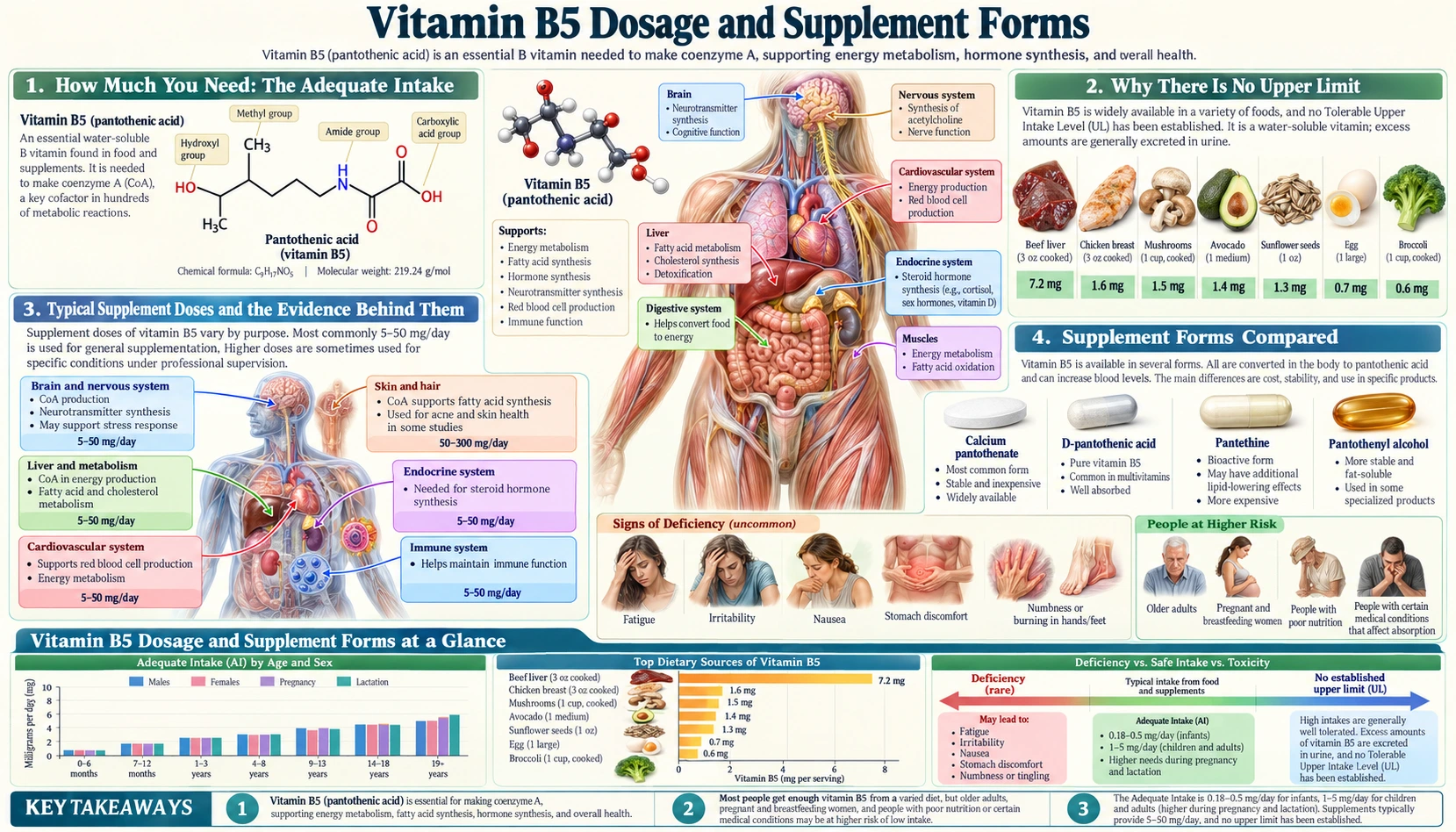
Most adults need about 5 mg of vitamin B5 (pantothenic acid) a day, and an ordinary whole-food diet supplies it. Supplements range from that 5 mg up to 1,000 mg or more, yet the only higher doses with real trial evidence are pantethine for blood fats and a single acne trial. B5 is one of the least toxic vitamins known — no upper limit has ever been set — but "safe" is not the same as "useful", and this page sorts the two apart, form by form and dose by dose.
Table of Contents
- How Much You Need: The Adequate Intake
- Why There Is No Upper Limit
- Typical Supplement Doses and the Evidence Behind Them
- Supplement Forms Compared
- Absorption, Saturation and the Shared Transporter
- Checking Common Dose Claims
- Safety, Interactions and Lab Tests
- Food First, Then a Sensible Supplement
- Key Research Papers
- Connections
- Featured Videos
How Much You Need: The Adequate Intake
Most vitamins have a Recommended Dietary Allowance (RDA) — a number built from experiments that measured how much people actually need. Vitamin B5 does not, because nobody has ever had enough data to calculate a true requirement. Instead, the U.S. Institute of Medicine (now the National Academies) set an Adequate Intake (AI) in 1998: the amount healthy people were already eating with no sign of deficiency. Think of it as "what healthy people eat", not "the minimum to avoid illness".
The Adequate Intake values are:
- Infants 0–6 months: 1.7 mg a day
- Infants 7–12 months: 1.8 mg a day
- Children 1–3 years: 2 mg a day
- Children 4–8 years: 3 mg a day
- Children 9–13 years: 4 mg a day
- Teens 14–18 and all adults: 5 mg a day
- Pregnancy: 6 mg a day
- Breastfeeding: 7 mg a day — raised because pantothenic acid passes into breast milk
Europe arrived at almost the same place. The European Food Safety Authority (EFSA) set an adequate intake of 5 mg a day for adults and children over 11, and raised it to 7 mg during breastfeeding; a 2023 scoping review prepared for the Nordic Nutrition Recommendations summarised both sets of figures and found no new health concerns (scoping review). The U.S. figures are reproduced in the NIH Office of Dietary Supplements pantothenic acid fact sheet for health professionals.
Because the AI describes typical intake rather than a measured requirement, it is honest to say two things at once: 5 mg is not a carefully proven minimum, and there is also no evidence that healthy people need many times more. For how deficiency was actually produced in volunteers, see Human Deficiency Experiments; for who runs low, see Risk Factors and Depleters.
Why There Is No Upper Limit
For many vitamins, expert panels also set a Tolerable Upper Intake Level (UL) — the most you can take every day without expecting harm. Vitamin A, vitamin D, niacin and vitamin B6 all have one. Pantothenic acid does not, and the reason matters.
A UL is built from a dose–response curve: researchers find the lowest dose that causes a problem and then divide by a safety factor. For pantothenic acid there is no such curve. The Institute of Medicine found no reports of adverse effects from oral pantothenic acid on which to base a limit, and Europe's Scientific Committee on Food likewise declined to set one because systematic oral dose–response studies were lacking (summarised in the 2023 Nordic review). The same review notes that clinical studies using up to 2 g a day have not shown a health risk for the general population.
So "no UL" means "no harmful dose has been pinned down", not "proven harmless at any dose". The difference is like a road with no posted speed limit because nobody has measured where cars start crashing — most drivers are fine, but it is not an invitation to floor it.
Why is B5 so forgiving? It is water-soluble, so the body does not build up a store of it the way it stores vitamin A; whatever the tissues do not use is mostly filtered by the kidneys and leaves in the urine, largely unchanged. That is also why urinary pantothenate is the standard way researchers measure intake and status — see Testing Vitamin B5 Status.
Typical Supplement Doses and the Evidence Behind Them
Supplement doses of B5 span more than a thousandfold, so it helps to see them on one ladder. The figure below uses a log scale: each tick mark — 1 mg, 10 mg, 100 mg, 1 g and 10 g — is ten times the one before, the way a ruler for earthquakes or sound works. Solid violet bars are doses tested in human trials; dashed bars are doses that are widely sold or recommended without trial evidence for the purpose claimed.
Reading the ladder from left to right:
- 5 mg — the adequate intake (6 mg in pregnancy, 7 mg breastfeeding). This is a dietary reference, not a trial result.
- About 5–10 mg — a typical multivitamin or B-complex. Enough to cover the AI on its own. Evidence tier: dietary reference; no trial needed to show it meets needs.
- 100–1,000 mg — single-ingredient B5 products. These are the doses most commonly sold, and they are well tolerated, but there are no good human trials showing a health benefit in people who are not deficient. Evidence tier: none for general benefit.
- 600–1,200 mg — pantethine for cholesterol. This is a different molecule (see the forms section) with small randomised controlled trials (RCTs) behind it. In two North American triple-blinded RCTs, 600 mg a day for 8 weeks and then 900 mg a day for 8 more lowered LDL ("bad") cholesterol by about 4% in 120 adults on a heart-healthy diet, and by about 11% in a 32-person trial where the placebo group rose 3%. An older Italian double-blind trial gave 300 mg three times daily (900 mg) and saw total and LDL cholesterol fall about 13.5% in people with mixed high cholesterol and triglycerides; an uncontrolled series used 900–1,200 mg daily for 3 to 6 months. Evidence tier: small RCTs plus case series; modest effect. More on the Pantethine and Cholesterol page.
- 2.2 g a day — one acne trial. In a 12-week double-blind RCT, adults with mild to moderate facial acne took two tablets twice a day with food; the four tablets together held 2.2 g of pantothenic acid. Of 48 people enrolled, 41 were analysed, and the supplement group had fewer total and inflammatory lesions than placebo, with no changes in blood counts or liver tests. It is a single small trial of a multi-ingredient product built around pantothenic acid, sponsored by its marketer — promising, not proof. See Acne and Skin.
- 500–2,000 mg — the "stress dose" you will often hear about. No controlled human trial has tested pantothenic acid at these doses for stress, fatigue or so-called adrenal fatigue (more in the claims section below).
- 10–20 g a day — where problems appear. Intakes this high have been linked to occasional diarrhea and water retention. That is roughly 2,000 to 4,000 times the AI.
Supplement Forms Compared
Every B5 supplement ends up delivering the same vitamin, or something the body turns into it. What differs is stability, how much of the label weight is actually active vitamin, and — most importantly — what each form has been tested for.
The forms, one at a time:
- Calcium D-pantothenate is the workhorse. Pure pantothenic acid is a sticky, unstable oil, so manufacturers bind it to calcium to make a stable white powder. Because two pantothenate molecules share one calcium atom, the salt is about 92% pantothenic acid by weight — 100 mg of calcium pantothenate gives you roughly 92 mg of the vitamin. It is the form used in most multivitamins and in the intake research.
- Sodium D-pantothenate is the same vitamin on a sodium carrier, used in some multivitamins and liquid products. There is no reason to think it behaves differently once dissolved.
- D versus DL. Pantothenic acid comes in two mirror-image shapes, like left and right hands. Only the D-form (also written (R)-pantothenic acid) fits the enzymes that build coenzyme A; the L-form is biologically inactive. A "DL" or racemic product is half and half, so 100 mg of DL-calcium pantothenate supplies only about half the vitamin activity of 100 mg of the D-form. Check the label for "D-" or "dexpanthenol" / "D-panthenol".
- Pantethine is not simply "strong B5". It is two pantetheine units (pantothenic acid joined to cysteamine) held together by a sulfur–sulfur bridge — one step closer to coenzyme A. It is the only oral form with RCTs for a specific outcome (blood lipids, at 600–1,200 mg). Plain pantothenic acid has not been shown to copy that effect, so a calcium pantothenate capsule is not a substitute for pantethine in those trials.
- Panthenol and dexpanthenol are the alcohol form; the body converts them to pantothenic acid. Dexpanthenol is the D-version. Its big use is topical: creams and ointments for dry skin, nappy rash, minor wounds and skin after procedures. A 2017 review of roughly 70 years of use concluded that topical dexpanthenol moisturises, supports the skin barrier and helps superficial wounds heal — supported by many small trials (review). See Pantothenic Acid and Wound Healing.
- Dexpanthenol injections were tried from the early 1960s, including a 1962 report in JAMA, to restart a gut that stalls after abdominal surgery (postoperative ileus). The evidence never grew beyond small, older studies, and it is not a standard part of modern ileus care. Evidence tier: weak.
Absorption, Saturation and the Shared Transporter
In food, most B5 arrives already built into coenzyme A and related molecules. Digestive enzymes in the small intestine trim these back to free pantothenic acid, which is then carried into the gut lining by a protein called the sodium-dependent multivitamin transporter (SMVT). The 1998 cloning study that identified it showed it carries three cargoes: pantothenate, biotin (vitamin B7) and lipoate (alpha-lipoic acid) (in vitro). Roughly 40–60% of the pantothenic acid in a typical American diet is thought to be absorbed, though food bioavailability has been little studied.
A transporter is like a ticket gate: it can only let so many people through per minute. At ordinary intakes the gate does nearly all the work. At high supplement doses the gate is saturated, and extra vitamin crosses more slowly by simple diffusion. Practical meaning: a 1,000 mg capsule does not deliver 200 times the benefit of a 5 mg one; a growing share is never absorbed, and much of what is absorbed above need goes out in the urine. Splitting a dose through the day is more efficient than one large dose, if you take a supplement at all.
Does high-dose B5 crowd out biotin? Because the two share SMVT, it is a reasonable question. In the original cell experiments the transporter carried both, and lipoate blocked uptake of each (in vitro). But in human intestinal and liver cells exposed to near-physiological amounts, adding pantothenic acid did not reduce biotin uptake (in vitro). No human study has shown that B5 supplements lower biotin status. The honest answer: competition is possible in theory at very high doses, unproven in people, and not a reason for worry at multivitamin doses. If you take gram doses of B5 for long periods, a B-complex that also contains biotin is a sensible hedge.
Checking Common Dose Claims
A widely viewed clinician Q&A on vitamin B5 makes three dose claims that circulate widely. Here is how each one stands up.
Claim 1: "5 mg is the bare minimum to avoid deficiency." Partly right, partly not. It is right that 5 mg is not an optimal dose proven by trials. But it is not a minimum either: it is an Adequate Intake, set at what healthy people already eat. In the 1950s volunteer experiments, deficiency appeared only when a B5-free diet was combined with a drug that blocks the vitamin; ordinary diets almost never cause it. So 5 mg is better read as "comfortably enough for most people", not "the edge of the cliff".
Claim 2: "Start at 500 mg a day." A 500 mg dose is about 100 times the AI. It is well tolerated — nothing in the literature suggests harm there — but there is no human trial showing that 500 mg of plain pantothenic acid improves energy, mood or stress in people who are not deficient. If the goal is cholesterol, the trials used pantethine, not pantothenic acid, at 600–1,200 mg.
Claim 3: "Up to 2,000 mg a day for people under heavy stress." This rests on biochemistry that is real — coenzyme A is needed to make adrenal steroid hormones, and B5-deficient animals develop adrenal damage — plus an inference that more B5 means better stress handling. That inference has not been tested in a controlled human trial. "Adrenal fatigue" is also not a recognised medical diagnosis; persistent exhaustion has many causes worth checking (thyroid, iron, sleep, depression and genuine adrenal disease among them). What can be said fairly: 2,000 mg a day sits within the range where no harm has been documented — 2 g a day has not shown risk in clinical studies — so the issue is lack of proven benefit, not danger. See Adrenal Support and Stress for the full evidence.
Claim 4: "Only GI side effects, even up to about 20 g." Broadly consistent with the record. European reviewers linked daily intakes of 10–20 g to water retention and occasional diarrhea. The one serious event — the pleuropericardial case below — occurred at supplement doses with biotin, which is why "very hard to overdose" is fair but "nothing can happen" is not.
Safety, Interactions and Lab Tests
Pantothenic acid has one of the cleanest safety records of any vitamin. Here is everything worth knowing in one place.
- Gut upset at very high doses. Diarrhea and sometimes water retention at 10–20 g a day. Lower the dose and it resolves.
- One rare serious reaction (case report). In 2001, French doctors described a 76-year-old woman with no allergy history who developed chest pain and breathlessness from fluid around the lungs and heart (pleurisy and pericardial tamponade) after two months of taking vitamins B5 and H (biotin) together. Her fluid and blood were full of eosinophils, a white cell linked to drug and allergic reactions, and every other cause was ruled out. She recovered after the vitamins were stopped. It is a single case, the doses are not given in the abstract, and it cannot say whether B5, biotin or the pair was responsible — but it is the reason chest pain or breathlessness while taking high-dose B vitamins deserves prompt medical attention.
- Pantethine was described as safe and well tolerated in its lipid trials. If you already take a cholesterol medicine, talk it over with your prescriber, since the effects could add up.
- Topical dexpanthenol is generally gentle, though calcium pantothenate in cosmetics has occasionally caused allergic contact dermatitis.
- The lab-test warning is about biotin, not B5. Many hospital blood tests use a biotin–streptavidin "glue". In a 2017 study, six healthy adults who took 10 mg of biotin a day for a week produced falsely high or falsely low results on several thyroid and other hormone tests. B5 does not do this. But B5 is often sold in B-complex and "hair, skin and nails" or "adrenal" blends that contain biotin — read the label, and tell the lab about biotin before blood work. For B5 testing itself, see Testing Vitamin B5 Status.
- Pregnancy and breastfeeding. The AI rises to 6 and 7 mg. High-dose supplements have not been studied for safety in pregnancy, so a prenatal vitamin is the sensible ceiling unless a clinician advises otherwise.
For the fuller toxicity picture see Vitamin B5 Toxicity.
Food First, Then a Sensible Supplement
The name pantothenic acid comes from the Greek pantothen, "from everywhere", because it is found in almost every whole food. Rich everyday sources include liver and other organ meats, eggs, chicken, beef, salmon, shiitake and other mushrooms, avocado, sunflower seeds, sweet potatoes, lentils, whole grains and brown rice. Refining strips some of it from grains, and freezing, canning and long cooking lose more — one more reason to favour whole, minimally processed foods. Exact amounts per serving are on the Vitamin B5 Sources page.
A practical way to decide:
- Eating a varied whole-food diet? You almost certainly meet the 5 mg AI. A supplement adds little.
- Want insurance? A B-complex or multivitamin with about 5–10 mg of calcium D-pantothenate covers it, alongside the other B vitamins that work in the same energy pathways.
- Trying to lower LDL cholesterol? The trial-backed option is pantethine at 600–1,200 mg a day, which gave modest drops in small RCTs — smaller than prescription drugs. Recheck a lipid panel after 8–16 weeks to see whether it is working for you.
- Acne? One small RCT used 2.2 g a day. Reasonable to try for a few months given the safety record, but keep expectations modest.
- Dry skin or minor wounds? Topical dexpanthenol has the better evidence; swallowing B5 for skin has much less.
- Choosing a product: pick a D-form (D-pantothenate, D-panthenol, dexpanthenol), not DL; split larger doses through the day; and check whether biotin is also in it before any blood test.
For the biochemistry behind all of this, see Coenzyme A Synthesis and Energy and Fat Metabolism.
Key Research Papers
- Institute of Medicine, Standing Committee on the Scientific Evaluation of Dietary Reference Intakes (1998). Dietary Reference Intakes for Thiamin, Riboflavin, Niacin, Vitamin B6, Folate, Vitamin B12, Pantothenic Acid, Biotin, and Choline. National Academies Press. — doi:10.17226/6015
- EFSA Panel on Dietetic Products, Nutrition and Allergies (2014). Scientific Opinion on Dietary Reference Values for pantothenic acid. EFSA Journal. 12(2):3581. — doi:10.2903/j.efsa.2014.3581
- Freese R, Aarsland TE, Bjørkevoll M (2023). Pantothenic acid - a scoping review for Nordic Nutrition Recommendations 2023. Food & Nutrition Research. 67. — PubMed PMID: 38187802
- Prasad PD, Wang H, Kekuda R, Fujita T, Fei YJ, Devoe LD, et al. (1998). Cloning and functional expression of a cDNA encoding a mammalian sodium-dependent vitamin transporter mediating the uptake of pantothenate, biotin, and lipoate. The Journal of Biological Chemistry. 273(13):7501-6. — PubMed PMID: 9516450
- Balamurugan K, Ortiz A, Said HM (2003). Biotin uptake by human intestinal and liver epithelial cells: role of the SMVT system. American Journal of Physiology. Gastrointestinal and Liver Physiology. 285(1):G73-7. — PubMed PMID: 12646417
- Yang M, Moclair B, Hatcher V, Kaminetsky J, Mekas M, Chapas A, et al. (2014). A randomized, double-blind, placebo-controlled study of a novel pantothenic acid-based dietary supplement in subjects with mild to moderate facial acne. Dermatology and Therapy. 4(1):93-101. — PubMed PMID: 24831048
- Debourdeau PM, Djezzar S, Estival JL, Zammit CM, Richard RC, Castot AC (2001). Life-threatening eosinophilic pleuropericardial effusion related to vitamins B5 and H. The Annals of Pharmacotherapy. 35(4):424-6. — PubMed PMID: 11302404
- Gaddi A, Descovich GC, Noseda G, Fragiacomo C, Colombo L, Craveri A, et al. (1984). Controlled evaluation of pantethine, a natural hypolipidemic compound, in patients with different forms of hyperlipoproteinemia. Atherosclerosis. 50(1):73-83. — PubMed PMID: 6365107
- Bertolini S, Donati C, Elicio N, Daga A, Cuzzolaro S, Marcenaro A, et al. (1986). Lipoprotein changes induced by pantethine in hyperlipoproteinemic patients: adults and children. International Journal of Clinical Pharmacology, Therapy, and Toxicology. 24(11):630-7. — PubMed PMID: 3098691
- Rumberger JA, Napolitano J, Azumano I, Kamiya T, Evans M (2011). Pantethine, a derivative of vitamin B5 used as a nutritional supplement, favorably alters low-density lipoprotein cholesterol metabolism in low- to moderate-cardiovascular risk North American subjects: a triple-blinded placebo and diet-controlled investigation. Nutrition Research. 31(8):608-15. — PubMed PMID: 21925346
- Evans M, Rumberger JA, Azumano I, Napolitano JJ, Citrolo D, Kamiya T (2014). Pantethine, a derivative of vitamin B5, favorably alters total, LDL and non-HDL cholesterol in low to moderate cardiovascular risk subjects eligible for statin therapy: a triple-blinded placebo and diet-controlled investigation. Vascular Health and Risk Management. 10:89-100. — PubMed PMID: 24600231
- Proksch E, de Bony R, Trapp S, Boudon S (2017). Topical use of dexpanthenol: a 70th anniversary article. The Journal of Dermatological Treatment. 28(8):766-773. — PubMed PMID: 28503966
- Watne AL, Mendoza C, Rosen R, Nadler S, Case R (1962). The role of dexpanthenol in postoperative ileus. JAMA. 181:827-30. — PubMed PMID: 14005261
- Li D, Radulescu A, Shrestha RT, Root M, Karger AB, Killeen AA, et al. (2017). Association of biotin ingestion with performance of hormone and nonhormone assays in healthy adults. JAMA. 318(12):1150-1160. — PubMed PMID: 28973622
PubMed Topic Searches
Connections
- All Vitamins
- Vitamin B5 (Pantothenic Acid)
- Vitamin B5 Sources
- Vitamin B5 Toxicity
- Testing Vitamin B5 Status
- Pantethine and Cholesterol
- B5 for Acne and Skin
- Adrenal Support and Stress
- B5 Risk Factors and Depleters
- Pantothenic Acid and Wound Healing
- Vitamin B7 (Biotin)
- Vitamin B3 (Niacin)
- Alpha-Lipoic Acid
- Cholesterol Management
- Acne
- Lipid Panel