Senolytics
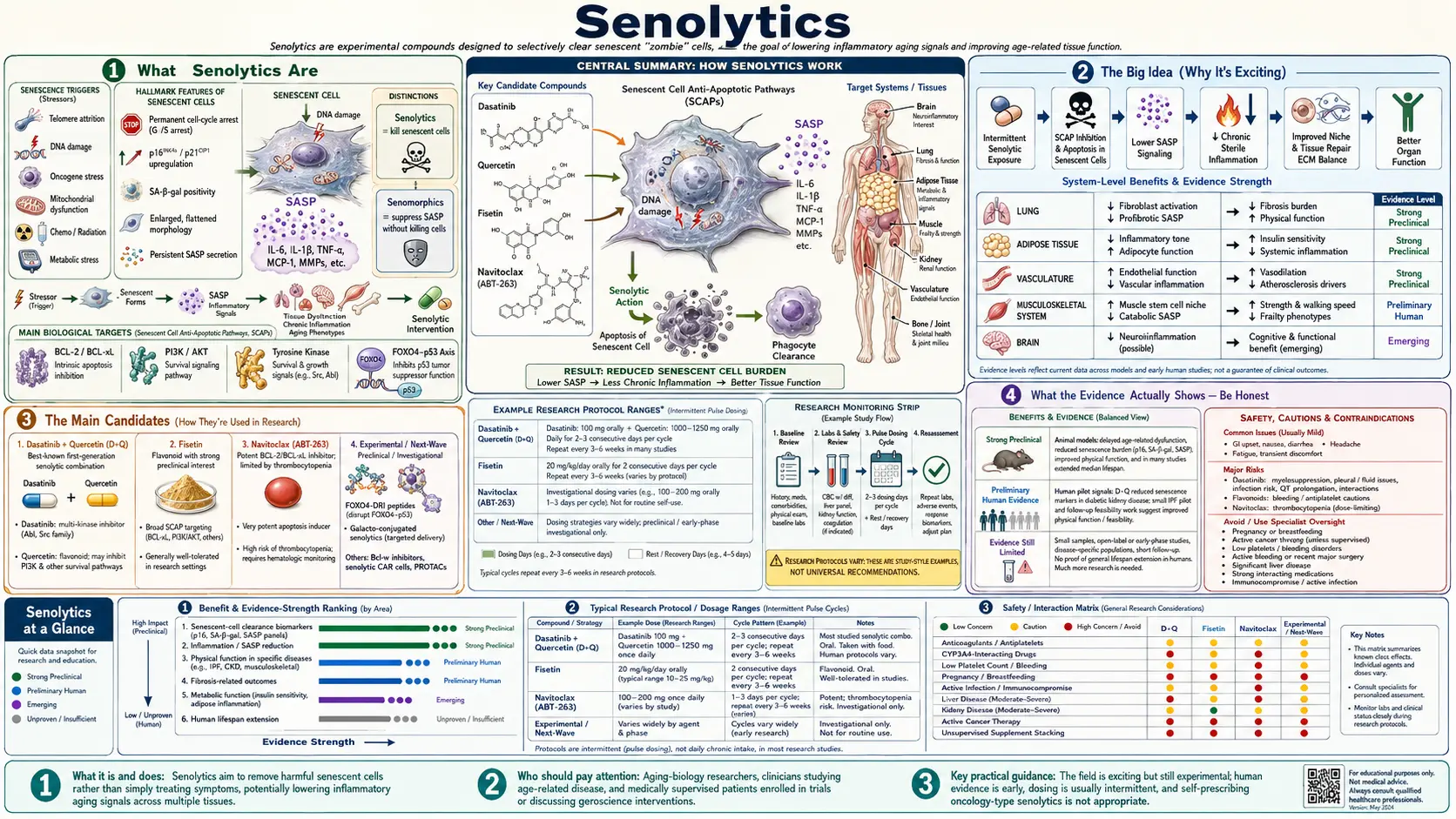
Senolytics are an exciting and genuinely promising area of aging research — a class of drugs designed to hunt down and destroy the worn-out "zombie cells" that build up in our bodies as we get older. The science behind them is real, and in mice the results have been striking. But here is the honest truth you will not always hear from supplement marketers: senolytics are not a proven anti-aging treatment in humans. The dramatic lifespan and healthspan results come almost entirely from animal studies. Human trials are still very early, very small, and have not shown that these compounds slow aging or extend human life. This page explains the real science — and why caution and skepticism are warranted before anyone spends money or takes risks based on it.
Table of Contents
- What Senolytics Are
- The Big Idea (Why It's Exciting)
- The Main Candidates
- What the Evidence Actually Shows
- The Hype and the Supplement Problem
- The Bottom Line
- Research Papers
- Connections
- Featured Videos
What Senolytics Are
"Senolytics" is a name built from two parts: senescent (old, worn-out cells) and -lytic (to break apart or kill). They are a class of compounds designed to selectively kill senescent cells — sometimes nicknamed "zombie cells."
Here is what a senescent cell is. Normally, when a cell becomes old, damaged, or stressed, one of two things happens: it repairs itself, or it dies through an orderly self-destruct process. Senescent cells do neither. They stop dividing — so they cannot become cancerous or pass on damage — but they also refuse to die. They linger in our tissues like cells stuck in limbo, which is exactly why "zombie cells" is such a fitting nickname.
The problem is that these cells are not quietly inert. They are metabolically active and they constantly leak a toxic mixture of inflammatory chemicals, signaling proteins, and enzymes into the surrounding tissue. Scientists call this the SASP — the senescence-associated secretory phenotype. Through the SASP, a relatively small number of senescent cells can inflame and damage the healthy tissue around them, and can even nudge nearby normal cells into becoming senescent themselves. A handful of "bad apples" can spoil the neighborhood.
Senescent cells accumulate slowly as we age. The idea behind senolytics is straightforward in concept: if these cells drive damage and refuse to die on their own, perhaps a drug can selectively flip their self-destruct switch and clear them out — without harming the healthy cells around them.
The Big Idea (Why It's Exciting)
What makes senolytics genuinely exciting is the strategy, not just the individual drugs. Most medicine treats one disease at a time — a pill for high blood pressure, a different pill for arthritis, another for diabetes. Senolytics come from a different and ambitious idea: target one of the underlying hallmarks of aging itself, and you might push back against many age-related problems at once.
Cellular senescence — the buildup of those zombie cells — is one of these recognized hallmarks. Because senescent cells and their inflammatory SASP have been linked to a long list of age-related conditions (frailty, osteoarthritis, heart and blood-vessel disease, lung fibrosis, kidney decline, and the general low-grade inflammation researchers sometimes call "inflammaging"), the hope is that clearing them could reduce age-related inflammation and dysfunction broadly, rather than chasing each disease separately.
This is a legitimately promising direction, and serious scientists at respected institutions are pursuing it. That is precisely why it deserves to be described accurately — the promise is real, but promise is not the same thing as proof.
The Main Candidates
Several compounds are being studied for senolytic activity. The most prominent ones include:
- Dasatinib + quercetin (often written "D+Q") — the most-studied senolytic combination in early human trials. Dasatinib is a prescription chemotherapy drug, originally approved to treat certain leukemias, that turns out to help kill some types of senescent cell. Quercetin is a plant flavonoid found in onions, apples, and capers, and sold as a dietary supplement. The two are used together because they target different kinds of senescent cell, and the pairing was more effective in the lab than either alone. You can read more about quercetin on our Quercetin page.
- Fisetin — a flavonoid found in strawberries (and smaller amounts in apples, persimmons, and onions), also sold as a supplement. It showed senolytic activity in laboratory and animal studies and is being investigated in human trials. See our Fisetin page for more.
- Navitoclax (ABT-263) and related compounds — drugs developed in cancer research that block "survival" proteins senescent cells rely on. Navitoclax can clear senescent cells effectively in the lab, but it also causes a significant drop in blood platelets, which limits its use in people. It illustrates a recurring theme: a compound can be a powerful senolytic and still be too toxic for everyday use.
It is worth flagging the obvious tension right away: two of these candidates (quercetin and fisetin) are sold over the counter as supplements, while the others are serious prescription drugs. That gap is the root of the "supplement problem" described below.
What the Evidence Actually Shows — Be Honest
This is the most important section on the page, so it will be blunt. The dramatic, headline-grabbing results for senolytics come from mice, not humans.
The landmark work — much of it from the Mayo Clinic and collaborators — has shown that clearing senescent cells from aged mice can produce remarkable benefits. In genetically engineered mice where senescent cells could be switched off, and in normal old mice given senolytic drugs, researchers observed improved physical function, healthier organs, delayed onset of age-related disease, and in several studies a longer lifespan. These are real, peer-reviewed, repeatedly replicated findings, and they are the reason the field is taken seriously.
But mice are not people, and a result in a mouse is a hypothesis in a human — not a promise. The history of aging and longevity research is full of interventions that extended life in animals and then did nothing comparable in humans.
In humans, the evidence is genuinely early-stage:
- The first human studies were small pilot and phase-1 trials — the earliest, smallest kind of clinical study, designed mainly to check whether a treatment is feasible and tolerable, not whether it works.
- A 2019 first-in-human pilot study gave dasatinib plus quercetin to 14 patients with idiopathic pulmonary fibrosis (a serious scarring lung disease) and found the regimen was feasible, with some hints of improved physical function. It was not designed to prove the drugs slow aging.
- Another 2019 study in 9 patients with diabetic kidney disease found that a short course of D+Q measurably reduced the number of senescent cells in fat and skin samples. This is an important proof-of-concept — it suggests the drugs do in humans what they do in mice at the cellular level — but reducing a biomarker is not the same as making people live longer or healthier.
So here is the honest bottom line for this section, stated plainly: there is currently no proof that senolytics slow human aging, prevent age-related disease, or extend human life. What we have is compelling animal data plus a few tiny human studies showing the approach is feasible and biologically plausible. Larger, longer, properly controlled clinical trials are underway, and until they report, anyone claiming senolytics are a proven anti-aging therapy in people is getting ahead of the evidence.
The Hype and the Supplement Problem
Because quercetin and fisetin are inexpensive, legal supplements, a whole market has sprung up selling them as do-it-yourself "senolytics" with bold anti-aging promises. This is where excitement outruns evidence, and where ordinary people can get misled or hurt.
A few things deserve a healthy dose of skepticism:
- The doses are not established. The amount of fisetin or quercetin needed to actually clear senescent cells in a person — if it works at all — is unknown. Supplement label doses are not based on proven human senolytic effects.
- The timing is not established. In animal studies, senolytics are often given in short, intermittent "hit-and-run" courses (a few days at a time, occasionally), not as a daily pill forever. The popular supplement habit of daily long-term dosing does not match how these compounds were tested.
- Long-term safety in healthy people is unknown. Senescent cells are not purely villains — they play useful roles in wound healing and in suppressing cancer. Clearing them carelessly, indefinitely, in an otherwise healthy person could carry risks we do not yet understand.
- Dasatinib is not a supplement. It is a prescription chemotherapy drug with serious potential side effects, including fluid around the lungs, bleeding risk, and heart rhythm problems. It is used in trials under careful medical supervision. It is absolutely not something to obtain online and self-experiment with.
The marketing often blurs the line between "this extended lifespan in mice" and "this will make you live longer." Those are not the same claim. Be skeptical of any product that quietly relies on mouse data, cell-culture data, or a single tiny pilot trial to sell you on human anti-aging benefits.
The Bottom Line
Senolytics are one of the most promising and interesting areas of modern aging research. The core idea — clearing the body's accumulated "zombie cells" to reduce age-related damage — is biologically sound, and the animal results are real and impressive. This is a field genuinely worth watching over the coming years.
But "promising" and "proven" are very different words. Today, senolytics remain investigational. The strong evidence is in mice. The human evidence is a handful of small, early trials that show feasibility and some biological effects — not longer or healthier human lives. There is no senolytic drug or supplement regimen with proven anti-aging benefits in people, and the safe long-term dosing for healthy individuals is unknown.
The sensible stance is patience and skepticism. Don't spend significant money, and don't take real health risks — least of all with prescription chemotherapy drugs — on the basis of mouse data and marketing claims. If you are interested, the most reasonable thing you can do is follow the results of the ongoing human clinical trials and discuss any supplement decisions with a doctor who knows your full health picture. The science is exciting precisely because it is unfinished — and honest science means saying so.
Research Papers
The studies below are real, peer-reviewed publications. Notice how the pattern lines up with the cautions above: the strongest lifespan and healthspan results are in mice, while the human studies are small, early-stage pilot trials. Each is labeled accordingly.
- Zhu Y, Tchkonia T, Pirtskhalava T, et al. The Achilles' heel of senescent cells: from transcriptome to senolytic drugs. Aging Cell. 2015;14(4):644–658. doi:10.1111/acel.12344 — Preclinical (cells + mice). The foundational paper that introduced the term "senolytics" and identified dasatinib and quercetin as the first drugs able to selectively kill senescent cells.
- Baker DJ, Childs BG, Durik M, et al. Naturally occurring p16Ink4a-positive cells shorten healthy lifespan. Nature. 2016;530(7589):184–189. doi:10.1038/nature16932 — Mouse. Genetically clearing senescent cells from normally aging mice delayed age-related decline in multiple organs and extended median lifespan.
- Yousefzadeh MJ, Zhu Y, McGowan SJ, et al. Fisetin is a senotherapeutic that extends health and lifespan. EBioMedicine. 2018;36:18–28. doi:10.1016/j.ebiom.2018.09.015 — Mouse. The flavonoid fisetin reduced senescent-cell burden and extended health and lifespan when given to aged mice late in life.
- Xu M, Pirtskhalava T, Farr JN, et al. Senolytics improve physical function and increase lifespan in old age. Nature Medicine. 2018;24(8):1246–1256. doi:10.1038/s41591-018-0092-9 — Mouse. Dasatinib plus quercetin improved physical function and increased post-treatment survival even when first given to very old mice.
- Justice JN, Nambiar AM, Tchkonia T, et al. Senolytics in idiopathic pulmonary fibrosis: results from a first-in-human, open-label, pilot study. EBioMedicine. 2019;40:554–563. doi:10.1016/j.ebiom.2018.12.052 — Human pilot (n=14). A small first-in-human study showing D+Q was feasible in this lung disease, with preliminary hints of improved physical function — not designed to prove anti-aging effects.
- Hickson LJ, Langhi Prata LGP, Bobart SA, et al. Senolytics decrease senescent cells in humans: preliminary report from a clinical trial of dasatinib plus quercetin in individuals with diabetic kidney disease. EBioMedicine. 2019;47:446–456. doi:10.1016/j.ebiom.2019.08.069 — Human pilot (n=9). A short course of D+Q measurably reduced senescent-cell markers in human fat and skin — proof the drugs hit their cellular target in people, but not evidence of longer or healthier lives.