Natural Nosebleed Relief: What Stops It, What Prevents It
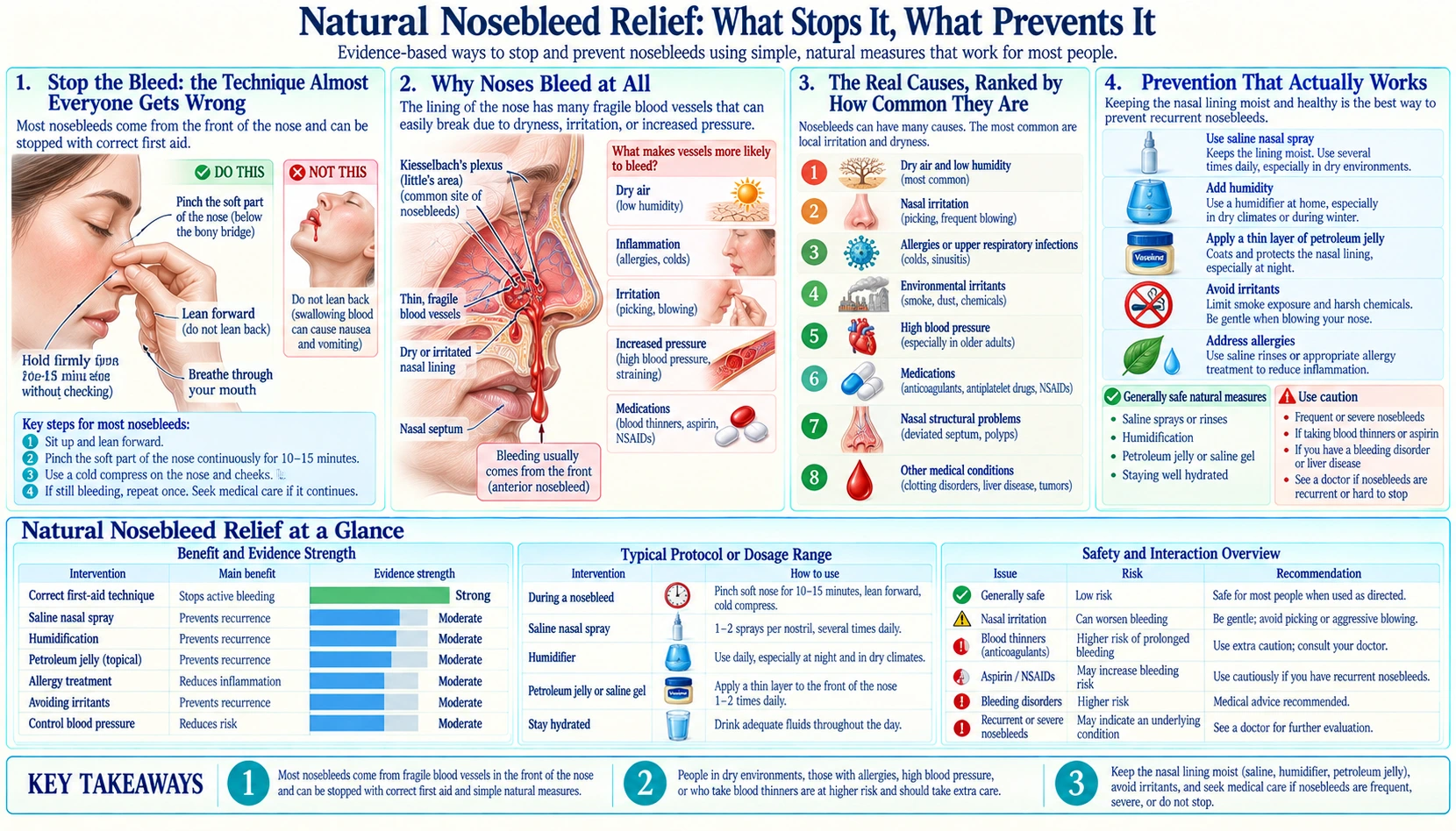
Nearly everyone stops a nosebleed the wrong way — head tilted back, a wad of tissue jammed up the nostril, pressure released every thirty seconds to check. All three of those make it worse. The single most useful thing on this page is the standard technique, and it is in the first section: sitting up, leaning forward, pinching the soft part of the nose, and holding for a full ten to fifteen minutes without letting go. Everything after that is prevention — humidity, saline, a smear of petrolatum, aiming a nasal spray away from the septum — because the nosebleed that never happens is the easiest one to handle. This page also gives an honest verdict on the natural remedies people ask about, including vitamin C: vitamin C fixes the nosebleeds that a lack of it caused, and none of the others.
Table of Contents
- How a Nosebleed Is Stopped: the Technique Almost Everyone Gets Wrong
- Why Noses Bleed at All
- The Real Causes, Ranked by How Common They Are
- Prevention That Actually Works
- Where Vitamin C Fits — and Where It Does Not
- Other Natural Remedies, Rated
- Children
- Anticoagulants and Bleeding Disorders
- When It Is Not a Simple Nosebleed
- Key Research Papers
- Connections
- Featured Videos
How a Nosebleed Is Stopped: the Technique Almost Everyone Gets Wrong
A nosebleed stops when a clot forms and is left alone. The technique has two jobs: squeezing the bleeding vessel shut, and leaving the clot undisturbed. The standard first-aid steps, as the 2020 guideline and first-aid sources describe them: The usual approach fails at both — people pinch the hard bridge, which compresses nothing, and let go every half minute to look, which peels the new clot away.
- Sitting up and leaning forward from the waist. Sitting drops the pressure in the nasal vessels; leaning forward lets blood run out where it can be seen. Tilting the head back sends blood down the throat, where it is swallowed, irritates the stomach and very often comes back up as vomiting. That vomited blood is what turns a harmless nosebleed into an emergency-room visit.
- Pinching the soft part — not the bridge. A finger run down from between the eyes finds the upper third is bone; squeezing it does nothing. Further down, the nose gives under the finger. Beneath that soft lower two-thirds, on the septum about a centimetre inside the nostril, is where more than nine in ten nosebleeds come from. The pinch is firm, so both nostrils are flattened completely shut.
- Holding continuously for 10 to 15 minutes, without peeking. This is the step that decides everything. A release of even three seconds disturbs the half-built clot and the clock starts over. A timer helps — ten minutes with a bleeding nose feels like thirty, and almost everyone lets go early. Fifteen minutes is the usual figure for people on a blood thinner.
- Breathing through the mouth. Both nostrils are shut, so there is no other way. Slow mouth-breathing also keeps people calmer, and a panicking person is a person who lets go of their nose.
- Spitting the blood out rather than swallowing it. Swallowed blood causes nausea and vomiting an hour later.
- Optional: a cold pack on the bridge of the nose or the cheek. Cold constricts small vessels and is soothing. It is comfort, not treatment — and holding it is no reason to stop pinching.
- Optional: a topical decongestant spray. Oxymetazoline nasal spray (the ingredient in common over-the-counter decongestant nasal sprays) constricts vessels in the nasal lining and is a recognised adjunct in the 2020 nosebleed guideline, which lists topical vasoconstrictors among first-line treatments. The usual home use is two sprays into the bleeding nostril, then pinching as above — spray only, with no cotton, tissue or pledget put into the nose. The soaked-pledget version of this is a clinic technique, because the material has to be removed by someone who can re-treat the vessel if the clot lifts with it. It is not a daily-use product — the label limits use to 3 days, because longer use causes rebound congestion. The over-the-counter label tells people with heart disease, high blood pressure, diabetes, thyroid disease or trouble urinating due to an enlarged prostate gland to ask a doctor before use, and for children under 6 years of age the label says to ask a doctor.
- Protecting the clot for the rest of the day. The usual 24-hour list: no nose-blowing, no picking, no heavy lifting or straining, no hot showers, no hot drinks or alcohol, and sneezing with the mouth open.
Common mistakes
- Tilting the head back. The most common mistake, and the one that causes the vomiting.
- Packing tissue or cotton wool up the nose. Household tissue is fibrous; the clot grows into it, and pulling the wad out tears the clot off the vessel and restarts the bleed. Medical nasal packing is a purpose-made, non-adherent material placed and removed by a clinician — not the same thing.
- Keys or ice down the back of the neck. No mechanism connects cold metal on the neck to a vessel on the nasal septum. It is folklore.
- Lying flat. It raises venous pressure in the head and sends blood into the throat.
- Checking every 30 seconds. Worth saying twice: it is why most correctly-pinched noses still fail to stop.
Urgent care or the emergency department treats these as reasons to come in: bleeding that continues after two full rounds of correct pressure (about 30 minutes total), blood pouring down the throat while both nostrils are pinched shut, heavy bleeding or feeling faint, bleeding after a blow to the face or head, or a bleed on an anticoagulant that is not settling. The full list is in When It Is Not a Simple Nosebleed.
Why Noses Bleed at All
The nose warms and humidifies roughly 20,000 breaths a day, and to do that it needs a rich blood supply running very close to the surface. On the front of the septum — the wall dividing the nostrils — branches of both the internal and external carotid systems converge into a dense network called Kiesselbach's plexus, about a centimetre inside the nostril, on tissue that is thin, dried by every breath, and easily reached by a fingernail. That one patch accounts for roughly 90 to 95 percent of nosebleeds, which is why a correctly placed pinch works so reliably. The rest come from higher and further back, near Woodruff's plexus, and behave completely differently.
| Anterior (front) | Posterior (back) | |
|---|---|---|
| Source | Kiesselbach's plexus, ~1 cm inside the nostril | Higher and further back, near Woodruff's plexus |
| Share | About 90–95% | About 5–10% |
| Typical person | Any age; especially children and adults under 50 | Older adults; anticoagulated; after facial trauma |
| What is seen | One nostril; blood out the front; source often visible | Often both nostrils; blood down the throat; source hidden |
| Response to pinching | Usually stops in 10–15 minutes | Keeps bleeding despite correct, sustained pressure |
| What it needs | Home first aid; sometimes clinic cautery | Emergency assessment; packing, balloon, or an ear, nose and throat (ENT) procedure |
This is why first aid matters so much: the overwhelming majority of nosebleeds are reachable by a person's own thumb and forefinger. It is also the reason for the 30-minute rule — a bleed that ignores correct pressure is a sign of where it is coming from.
The Real Causes, Ranked by How Common They Are
People reach for exotic explanations when the honest ranking is dominated by two boring items: dry air and fingers. Roughly in order of how often each is the answer:
- Dry indoor air, especially winter heating. Forced-air heating drops indoor humidity to 10–20 percent. The lining dries, tiny cracks open over Kiesselbach's plexus and crust over, the crust itches, gets rubbed off, and takes a scab and a vessel with it. Desert and high-altitude climates, long flights and over-heated bedrooms do the same.
- Digital trauma — nose-picking. The leading cause in children by a wide margin, and commoner in adults than anyone admits. It is usually a response to that crusting, and the same spot is re-injured before it heals — which is why these bleeds arrive in clusters.
- Nasal sprays aimed at the septum. Very common and almost entirely fixable. Steroid sprays (fluticasone, mometasone, budesonide) and antihistamine sprays are excellent drugs, but the instinctive same-hand, pointing-inward technique puts them straight onto the septum, thinning the mucosa where it is already thinnest. The usual fix is a change of aim, not of drug — see Prevention.
- Allergic rhinitis, colds and sinus infections. Inflamed lining is engorged and friable; add hard nose-blowing twenty times a day and vessels give way. Anyone who bleeds only in hay-fever season has their answer.
- Septal deviation, spurs and perforations. A crooked septum disturbs airflow so one side dries faster, and the prominent edge takes the brunt. Clue: bleeds always from the same nostril.
- Anticoagulants, antiplatelets and nonsteroidal anti-inflammatory drugs (NSAIDs). Warfarin, apixaban, rivaroxaban, dabigatran, clopidogrel and aspirin rarely cause a nosebleed — they make an ordinary small one longer, heavier and likelier to recur. Regular ibuprofen and naproxen do the same to a smaller degree.
- High-dose fish oil and other antiplatelet supplements. Fish oil at multiple grams of eicosapentaenoic acid (EPA) plus docosahexaenoic acid (DHA) daily modestly prolongs bleeding time in the laboratory, although randomized trials have not shown a clear rise in serious bleeding; the same, less predictably, is said of high-dose vitamin E, ginkgo, garlic extract and concentrated curcumin. They are a possible contributor rather than an established cause.
- Alcohol. Dilates vessels, mildly impairs platelet function, and in heavy chronic use damages clotting more broadly.
- Vitamin C deficiency. Uncommon, but real, mechanistically clear, and worth knowing about because it is cheap to check and completely reversible. Severe deficiency degrades the collagen in vessel walls, and nosebleeds belong to that bleeding picture alongside bleeding gums, easy bruising and corkscrew hairs. It does not explain the winter nosebleed in someone who eats fruit; it can absolutely explain nosebleeds in someone whose diet has held essentially no fruit or vegetables for months. See Where Vitamin C Fits.
- Hereditary haemorrhagic telangiectasia (HHT, Osler–Weber–Rendu). An inherited disorder in which fragile vessel malformations form on the nasal lining, lips, tongue and fingertips. Frequent, hard-to-stop nosebleeds from childhood, plus small red spots on lips or fingers, plus an affected parent or sibling, is the classic picture. It is under-diagnosed and it matters, because HHT also involves the lungs, brain and liver — see the Second International HHT Guidelines.
- Bleeding disorders. Von Willebrand disease, haemophilia, platelet disorders, low platelets. These are the likely causes when nosebleeds come with heavy periods, prolonged bleeding after dental work, or a family history.
- Tumours. Rare, and last for a reason — but persistent one-sided bleeding with one-sided blockage, facial numbness or a lump is the pattern that leads clinicians to examine the inside of the nose.
How high blood pressure relates to nosebleeds
Almost everyone believes hypertension causes nosebleeds, and the evidence is far weaker than the belief. The guideline authors addressed it directly in Hypertension and Epistaxis: Why Is There Limited Guidance in the Nosebleed Clinical Practice Guidelines? — the relationship is not established well enough to make recommendations about. What usually happens is the reverse of what people assume: bleeding from the face is frightening, fear and pain raise blood pressure sharply, and the high reading is taken after the bleed started. Severely raised blood pressure with symptoms is an emergency in its own right regardless of the nose — but taking an extra dose of a blood-pressure pill during a nosebleed is unsupported and can cause harm.
Prevention That Actually Works
Recurrent nosebleeds are a moisture-and-trauma problem in most people, and the fixes are correspondingly humble. Ranked by expected benefit, with the evidence tier stated honestly — most rest on mechanism and long practice rather than large randomized trials.
- Bedroom humidity at 40–50% relative humidity. Mechanistically strong, formally under-studied — and the highest-yield change most people can make. Eight hours a night breathing 15%-humidity air is what cracks the septum. A cheap hygrometer shows the level; a cool-mist humidifier closes the gap. Above about 55% humidity encourages mould and dust mites, and a dirty reservoir grows microbes.
- Saline spray or gel, two to three times daily. Good evidence; universally recommended. Isotonic saline re-wets the mucosa, softens crusts so they come away without a scab attached, and clears allergens. Gel lasts longer and is best at bedtime. Home-made: half a teaspoon of non-iodised salt plus a pinch of baking soda in a cup (240 mL) of previously boiled and cooled, or distilled, water — not straight tap water.
- A thin smear of petrolatum or nasal emollient at bedtime. Reasonable by mechanism; the one randomized trial found it inferior to cautery. A pea-sized dab wiped just inside the nostril along the septum holds moisture in overnight. In a randomized controlled trial in recurrent epistaxis, liquid paraffin plus antiseptic cream was tested head-to-head against Nd:YAG laser photocoagulation and lost: at 12 weeks, 40% of the emollient group were free of bleeding against 85% of the laser group, and the authors concluded laser was the preferable treatment. So an emollient is a near-free first step that worked for a substantial minority — not a substitute for cautery once bleeding keeps recurring. A thin smear is the usual amount; repeated use raises a concern for anyone at risk of breathing it into the lungs (aspiration).
- Re-aiming the nasal spray. Good evidence, and free. The trick ear, nose and throat (ENT) clinics teach: spraying the right nostril with the left hand and the left nostril with the right, aiming outward toward the same-side ear rather than straight back or inward. That puts the drug on the outer wall, where it is meant to act, and away from the septum, where the bleeding is. Clinics also teach a gentle sniff rather than a hard one while spraying.
- Treating the itch that drives the picking, and short nails. Obvious mechanism, especially in children. Nobody picks a comfortable nose. Moisture breaks the cycle at one end and short nails blunt the damage at the other. Scolding is not a treatment.
- Treating the underlying rhinitis. Good evidence. Controlling allergy reduces both the fragility and the hard nose-blowing. Gentle blowing, one nostril at a time, puts less strain on the vessels.
- Protecting a fresh clot for 24 hours. No forceful blowing, picking, straining, hot showers or alcohol. Most "it came back" stories are a clot disturbed within hours.
- Stopping an anticoagulant without a plan risks a stroke or clot, far worse than a nosebleed. What can change instead is a dose that needs adjusting, an international normalized ratio (INR) range that has drifted, or a high-dose fish-oil supplement that is not needed.
- Cautery for the stubborn ones. Good evidence; a clinic procedure, not a home remedy. When one visible vessel keeps reopening, an ear, nose and throat clinician seals it with silver nitrate or electrocautery in minutes under local anaesthetic. The 2021 New England Journal of Medicine review lays out this stepwise escalation.
For children, the practice guideline on epistaxis in children makes the same case: humidification, emollient or antiseptic ointment, nail care and reassurance are the mainstays.
Where Vitamin C Fits — and Where It Does Not
Natural-health writing usually goes wrong here in one of two directions — promising that vitamin C fixes nosebleeds, or dismissing the connection outright. Neither is right. The accurate version is narrow and genuinely useful.
The part that is true
Vitamin C is the required cofactor for prolyl hydroxylase and lysyl hydroxylase, the enzymes that modify collagen as it is built — the modifications that let three collagen chains twist into a stable triple helix. Without vitamin C the chains are made but under-hydroxylated, the helix is unstable, and the result is broken down instead of built into tissue. Collagen is the structural rope of blood-vessel walls, so when it fails, small vessels become fragile and rupture under stresses healthy vessels shrug off.
That is why bleeding is the signature of scurvy: bleeding gums, unexplained bruises, blood under the skin around hair follicles — and nosebleeds. That picture is still documented in modern case reports of unrecognised scurvy in adults. Deficiency is also still found in children: a children's-hospital series identified 32 cases, all in children with an underlying condition such as transfusional iron overload, a neurological disorder or recent chemotherapy rather than a poor diet — and found the diagnosis was repeatedly missed. And the correction is dramatic: when a genuinely deficient person gets vitamin C back, the bleeding tendency reverses within days to a few weeks, because collagen synthesis restarts as soon as the cofactor is available. It costs almost nothing.
The part that is not true
None of that says anything about the ordinary nosebleed, and vitamin C deficiency is an uncommon cause of epistaxis — nothing like one in twenty. The overwhelming majority of nosebleeds are dry air and trauma to a septum whose collagen is perfectly normal. When a nose bleeds because winter heating dried the septum, because of picking at a crust, because a steroid spray points at the wrong wall, because of a septal spur, because of apixaban, or because of HHT, the collagen is fine and vitamin C has nothing to correct. Three things deserve to be said plainly:
- Vitamin C does not stop an active nosebleed. Nothing supports that, and no plausible mechanism works on a timescale of minutes. Pressure stops nosebleeds.
- Vitamin C is not in the 2020 American Academy of Otolaryngology–Head and Neck Surgery Foundation (AAO-HNSF) nosebleed guideline — not as treatment, not as prevention. It is absent because there is no modern trial evidence to put in.
- The only published reports that ever gave vitamin C or citrus bioflavonoids for nosebleeds are uncontrolled case series from the 1950s — a 1956 series of a citrus flavonoid plus vitamin K, and a 1959 series of hesperidin plus ascorbic acid. They are history, not current practice.
The historic bioflavonoid trials, and why they settle nothing
In the two decades after vitamin C was isolated there was an energetic research programme around "capillary fragility" — the idea that ascorbic acid plus citrus bioflavonoids (hesperidin, rutin) strengthened small vessels. Studies gave the combination to people with easy bruising and nosebleeds and reported improvement, including a 1956 report on epistaxis treated with a citrus flavonoid compound plus vitamin K and a 1959 report on hesperidin and ascorbic acid in menopausal patients.
Read them as historical documents. They predate randomization, blinding, placebo control, pre-specified outcomes and modern statistics — typically small, uncontrolled series in which a physician gave a supplement and recorded that patients seemed better. That is exactly the design that mistakes the natural course of a recurring, self-limiting condition for a treatment effect: nosebleeds come in clusters and then stop, the heating goes off in spring, and anything given during a bad patch appears to work. No modern randomized trial of vitamin C or bioflavonoids for ordinary nosebleeds exists. Not a negative one — none at all.
The practical point
The honest one-line version: vitamin C fixes the nosebleeds that a lack of it caused, and none of the others. So the useful question is whether a person is actually deficient. The test is a plasma ascorbate level — deficiency is a value below about 11.4 µmol/L (0.2 mg/dL), and roughly 11.4–23 µmol/L counts as low — and deficiency is most likely when nosebleeds come packaged with any of these:
- Swollen, purplish gums that bleed on brushing.
- Bruises appearing without remembered injury, especially on shins and forearms.
- Tiny red-purple dots around hair follicles, or body hairs growing out coiled and corkscrew-shaped.
- Old scars reopening, or new cuts healing badly; deep aching in the legs; unexplained fatigue.
- A diet with almost no fruit or vegetables for months — food insecurity, alcohol use disorder, restrictive eating disorders, food selectivity in autistic children, isolated older adults, severe inflammatory bowel disease, after bariatric surgery.
Without any of that, vitamin C is unlikely to be the answer, and humidity, saline and spray technique address the usual causes. The mechanism, diagnosis, repletion dosing and scurvy differential are covered in full on the companion page: Vitamin C Deficiency: Nosebleeds and Capillary Fragility.
Getting vitamin C from food
About 10 mg a day prevents scurvy outright, and the adult Recommended Dietary Allowance (RDA) of 75–90 mg (smokers need about 35 mg more) is met by a single serving of most foods below. The depletion–repletion work behind that Recommended Dietary Allowance showed stores approach saturation around 100–200 mg a day, with absorption falling off sharply above that — a good argument for food over large pills. Whole foods also supply the bioflavonoids the 1940s researchers were chasing, free and with no claims attached. Large supplemental doses are not harmless. Above roughly 1,000–2,000 mg a day the unabsorbed remainder draws water into the gut and causes bloating, cramping and diarrhoea, and because ascorbate is metabolised in part to oxalate, high doses raise urinary oxalate and can raise kidney-stone risk in people who already form stones or have reduced kidney function. The adult tolerable upper intake level is 2,000 mg a day, and correcting a genuine deficiency needs nothing remotely close to that.
| Food | Typical serving | Approx. vitamin C |
|---|---|---|
| Guava | 1 cup, raw | ~377 mg |
| Red bell pepper | 1 cup, raw chopped | ~190 mg |
| Kiwifruit | 2 medium | ~130 mg |
| Blackcurrants | 1/2 cup | ~100 mg |
| Broccoli | 1 cup, cooked | ~100 mg |
| Brussels sprouts | 1 cup, cooked | ~95 mg |
| Strawberries | 1 cup, halved | ~90 mg |
| Orange | 1 medium | ~70 mg |
| Kale | 1 cup, cooked | ~50 mg |
| Parsley | 1/2 cup, chopped raw | ~40 mg |
| Lemon | 1 medium | ~30 mg |
Vitamin C is water-soluble and heat-sensitive, so raw and lightly cooked servings retain the most. A red pepper, a kiwi or a handful of strawberries most days makes deficiency essentially impossible.
Other Natural Remedies, Rated
Four ratings: Helpful (supported by guidelines or good evidence), Plausible (modest or comfort-level benefit), No Good Evidence (traditional or historic, unproven — not necessarily harmful), and Counterproductive (makes bleeding worse).
| Remedy | Rating | The honest assessment |
|---|---|---|
| Saline spray or gel, and humidification | Helpful | The single most effective natural approach — it addresses the actual cause in most people. Cheap, safe, in the guidelines. |
| Petrolatum or nasal emollient at bedtime | Plausible | A thin barrier that holds overnight moisture in, and the 2020 guideline does list moisturizing agents among first-line options. But in the one head-to-head randomized trial it was clearly beaten by laser cautery — 40% versus 85% bleed-free at 12 weeks. |
| Cold compress on the bridge or cheek | Plausible | Constricts superficial vessels and is comforting. Never shown to stop a bleed alone, and no reason to interrupt the pinch. |
| Vitamin C | Helpful if deficient; No Good Evidence otherwise | Corrects fragile vessels in genuine deficiency, and fast — but deficiency is an uncommon cause, and vitamin C does nothing for the ordinary dry-air-and-trauma nosebleed that accounts for the overwhelming majority. Absent from the 2020 guideline. See above. |
| Vitamin K from leafy greens | Plausible only if actually deficient | Vitamin K makes several clotting factors, so true deficiency does cause bleeding — but it is uncommon in adults who eat, and not a typical cause of nosebleeds. Warning: vitamin K directly opposes warfarin, so a sudden jump in kale, spinach or greens powders while on it swings the international normalized ratio (INR) and can cause a clot or a bleed. Consistency matters more than quantity. Does not apply to apixaban, rivaroxaban, edoxaban or dabigatran. |
| Citrus bioflavonoids, rutin, hesperidin | No Good Evidence | Historic only — two uncontrolled nosebleed reports from the 1950s, inside a wider 1940s–50s "capillary fragility" literature that measured bruising rather than epistaxis. Nothing modern confirms a benefit. Citrus, berries and peppers give the same compounds with real nutrition attached. |
| Nettle (Urtica dioica) | No Good Evidence | A traditional astringent with no clinical evidence in epistaxis. Its vitamin K content raises the same warfarin concern as leafy greens. |
| Yarrow (Achillea millefolium) | No Good Evidence | An old folk name is "nosebleed plant," and the practice was to roll a leaf and insert it — which puts a foreign object in the nose, exactly what the packing warning is about. No trials. |
| Shepherd's purse (Capsella bursa-pastoris) | No Good Evidence | Traditional haemostatic, studied a little for heavy menstrual bleeding, not for nosebleeds. Not a substitute for pressure. |
| Cayenne / capsaicin | Counterproductive | A potent irritant; on an already raw lining it causes pain, inflammation and sneezing — and the sneezing alone tears the clot off. |
| Tissue or cotton wool stuffed up the nose | Counterproductive | Household material adheres to the forming clot and rips it off on removal, restarting the bleed. Medical packing is a different, purpose-made material. |
| Ice in the mouth; ice or keys on the neck | No Good Evidence | Sucking ice is harmless. Cold objects on the neck have no plausible mechanism at all. Neither is a reason to release the pinch. |
| Tranexamic acid | A real drug — belongs to a clinician | Often mistaken for a supplement. A genuine antifibrinolytic with real evidence in selected patients — particularly HHT and some bleeding disorders — and real clotting-risk considerations. Not a home remedy. |
Children
Nosebleeds in children are so common they are close to normal. They peak in the preschool and early school years, cluster in winter, and are overwhelmingly the same boring combination: a dry, crusted septum plus a curious finger. Most children outgrow them by the mid-teens. The standard technique is identical, scaled down and made calmer:
- A calm adult. Children take their cue from the adult, and crying raises venous pressure in the head, which makes bleeding worse.
- The child sits upright on an adult's lap, leaning forward over a bowl or towel. Not lying down, not head-back.
- The adult does the pinching. Children cannot hold steady pressure. The pinch goes on the soft part below the bony bridge, firmly, both nostrils flattened shut.
- 10 minutes by the clock, without peeking. Distraction is the whole trick — a screen, a story or a song buys the cooperation.
- Spitting, not swallowing — swallowed blood is why so many children vomit an hour later and frighten everybody.
- Afterwards: quiet activity for the day, no blowing or picking, and the prevention routine from that night.
Prevention is nail care plus moisture, and it works: trimmed, smooth nails, saline two or three times daily, a pea-sized dab of petrolatum or antiseptic ointment at bedtime, a bedroom humidifier over the heating season, and treatment for hay fever if it is there. Scolding does not stop the picking — once the nose feels comfortable, the picking mostly stops on its own.
When a child's nosebleed does warrant a workup
- Under 2 years old — genuinely unusual at this age; trauma or a foreign body are the usual concerns.
- Always the same nostril with blockage, foul one-sided discharge or a bad smell — classic for an object pushed up the nose.
- Frequent, heavy or hard-to-stop bleeds, or bleeding beyond 20–30 minutes of correct pressure.
- Nosebleeds with easy bruising, bleeding gums, prolonged bleeding after dental work, or heavy periods in an adolescent — the pattern that leads to testing for von Willebrand disease.
- A family history of frequent nosebleeds, or small red spots on lips or fingertips — the pattern of HHT.
- A pale or tired child — see Iron, because repeated blood loss from the nose really can cause iron-deficiency anaemia.
- An adolescent boy with recurrent heavy one-sided bleeding and nasal obstruction — uncommon, but this pattern is assessed with imaging and an ear, nose and throat specialist.
- Any suspicion that the injury pattern does not fit the story.
Anticoagulants and Bleeding Disorders
For people on a blood thinner, one fact outranks everything else here: stopping it because of a nosebleed trades a small risk for a large one. Anticoagulants prevent strokes in atrial fibrillation, treat deep vein thrombosis and pulmonary embolism, and protect mechanical heart valves. Stopping abruptly trades a risk measured in disability and death for one usually measured in an inconvenient evening. The 2020 guideline treats anticoagulation as something the clinician manages, not something the patient interrupts.
- Same technique, longer. Fifteen uninterrupted minutes rather than ten, repeated once if needed. It will take longer to stop — that is the drug working, not a catastrophe.
- The topical decongestant early. Two sprays of oxymetazoline nasal spray into the bleeding nostril before pinching is often used as a first move here rather than a last resort — sprayed only, with nothing packed into the nose.
- More thorough prevention. Humidifier, saline two or three times daily, nightly emollient, no picking, gentle blowing.
- What can be adjusted. The usual points reviewed: whether an international normalized ratio on warfarin has drifted above range; whether a direct oral anticoagulant dose matches current kidney function, weight and age; whether a person is on an anticoagulant and an antiplatelet when only one is needed; whether a regular nonsteroidal anti-inflammatory drug (NSAID) can be swapped for something gentler; whether a high-dose fish-oil supplement still earns its place.
- Cautery. Sealing the culprit vessel is often the definitive answer, and it lets the anticoagulant continue untouched.
- A bleed that is not settling. Thirty minutes without control, blood down the throat, faintness or a racing heart are signs emergency departments treat as urgent.
The same principles apply to inherited bleeding disorders, with one addition: for von Willebrand disease, haemophilia, a platelet disorder or a low platelet count, a haematology team's individual plan is built around the specific disorder. Nosebleeds are often the first and most frequent symptom of von Willebrand disease, and nosebleeds that come with heavy periods, prolonged bleeding after dental extractions and affected relatives are the pattern that leads to testing. And because repeated blood loss adds up, frequent or heavy nosebleeds can lower the blood count and iron stores, which a blood count and iron studies measure.
When It Is Not a Simple Nosebleed
Most nosebleeds need a technique, not a doctor. These are the situations where that is not true.
Signs hospitals treat as emergencies
- Bleeding that does not stop after two complete rounds of correct 10–15 minute pressure.
- Heavy, fast bleeding, or a large volume lost.
- Blood running down the back of the throat while both nostrils are pinched shut — the signature of a posterior bleed.
- Feeling faint, dizzy, breathless, clammy, or a racing heart.
- A nosebleed after significant head or facial injury, especially with visible deformity or clear watery fluid mixed with the blood.
- Difficulty breathing, or choking on blood.
- A nosebleed on an anticoagulant that is not coming under control.
Signs that usually lead to a clinic assessment
- Nosebleeds more than once a week, or a run of them over a few weeks despite good prevention.
- Bleeding always from the same nostril, especially with one-sided blockage, facial pain, numbness or a lump.
- Nosebleeds plus bleeding elsewhere — gums, easy bruising, blood in urine or stool, heavy periods, prolonged bleeding after minor cuts or dental work.
- Nosebleeds plus anaemia symptoms: unusual fatigue, pallor, breathlessness on stairs.
- Nosebleeds in a child under 2 years old.
- Nosebleeds plus unexplained weight loss, fevers, night sweats or swollen lymph nodes.
- Nosebleeds plus the deficiency cluster — bleeding gums, easy bruising, corkscrew hairs, poor wound healing, and a diet with essentially no fruit or vegetables. A plasma ascorbate level measures it; see Vitamin C Deficiency: Nosebleeds and Capillary Fragility.
- Recurrent nosebleeds plus telangiectasias plus family history. Frequent spontaneous nosebleeds, small red or purple spider-like spots on the lips, tongue, face or fingertips, and a first-degree relative with the same pattern is the classic picture of hereditary haemorrhagic telangiectasia. HHT is diagnosed on those clinical criteria and confirmed genetically, and screening for lung, brain and liver vascular malformations is part of the Second International HHT Guidelines. Many people with HHT spend decades being told their nosebleeds are nothing.
Key Research Papers
Epistaxis: clinical care and guidelines
- Tunkel DE, et al. Clinical Practice Guideline: Nosebleed (Epistaxis). Otolaryngology–Head and Neck Surgery. 2020 Jan — the current American guideline. Vitamin C does not appear in it. — doi:10.1177/0194599819890327
- Epistaxis. New England Journal of Medicine. 2021 Mar 11 — clinical review; escalation from pressure to cautery to packing. — doi:10.1056/NEJMcp2019344
- Hypertension and Epistaxis: Why Is There Limited Guidance in the Nosebleed Clinical Practice Guidelines? Otolaryngology–Head and Neck Surgery. 2020 Jan — why blood pressure is not established as a cause. — doi:10.1177/0194599819889972
- Practice Guideline: Epistaxis in Children. Journal of Pediatric Health Care. 2015 Sep-Oct — the conservative paediatric approach. — doi:10.1016/j.pedhc.2015.06.002
- A prospective randomised controlled trial of Nd:YAG laser photocoagulation versus liquid paraffin plus antiseptic cream in the treatment of recurrent epistaxis. Clinical Otolaryngology. 2012 Aug — laser was superior at 12 weeks (85% vs 40% bleed-free); the emollient arm is nonetheless the only randomized data there is on a simple emollient regimen. — doi:10.1111/j.1749-4486.2012.02509.x
- Second International Guidelines for the Diagnosis and Management of Hereditary Hemorrhagic Telangiectasia. Annals of Internal Medicine. 2020 Dec 15 — nosebleeds with telangiectasias and family history. — doi:10.7326/M20-1443
Vitamin C deficiency and bleeding
- Unrecognised scurvy. BMJ. 2009 Sep 17 — how deficiency still presents, and how easily it is missed. — doi:10.1136/bmj.b3580
- Modern American scurvy — experience with vitamin C deficiency at a large children's hospital. Pediatric Radiology. 2017 Feb — 32 paediatric cases, all with a predisposing medical condition and none from poor diet alone; imaging findings, and how often the diagnosis is missed. — doi:10.1007/s00247-016-3726-4
- Vitamin C pharmacokinetics in healthy volunteers: evidence for a recommended dietary allowance. Proceedings of the National Academy of Sciences USA. 1996 Apr 16 — the work behind the modern RDA. — doi:10.1073/pnas.93.8.3704
- Regulation of collagen biosynthesis by ascorbic acid: a review. Yale Journal of Biology and Medicine. 1985 Nov-Dec. — ascorbate as cofactor for prolyl and lysyl hydroxylase. — PubMed PMID: 3008449
The historic bioflavonoid literature (context only — pre-modern methods)
- Epistaxis; treatment with a new citrus flavinoid compound combined with vitamin K. Eye, Ear, Nose & Throat Monthly. 1956 Nov. — one of very few papers ever to test a citrus-bioflavonoid preparation for nosebleeds, and it was given with vitamin K rather than vitamin C. Uncontrolled and unblinded. — PubMed PMID: 13365640
- Nocturnal leg cramps, easy bruisability and epistaxis in menopausal patients: treated with hesperidin and ascorbic acid. Delaware State Medical Journal. 1959 Jan. — the "capillary fragility" era. History, not evidence. — PubMed PMID: 13619318
PubMed Topic Searches
- PubMed: Epistaxis management, randomized trials
- PubMed: Epistaxis in children — prevention
- PubMed: Intranasal corticosteroid spray and epistaxis
- PubMed: Epistaxis and direct oral anticoagulants
- PubMed: Hereditary haemorrhagic telangiectasia and epistaxis
- PubMed: Ascorbic acid deficiency and capillary fragility
Connections
- All Remedies
- Epistaxis (Nosebleed) — the clinical condition page: types, workup and medical treatment
- Ear, Nose & Throat Conditions — the wider ENT section, including rhinitis and sinus disease
- Vitamin C Deficiency: Nosebleeds and Capillary Fragility — the deep dive on the one nutritional cause worth checking
- Vitamin C Deficiency (Scurvy) — the full deficiency picture, from bleeding gums to poor wound healing
- Vitamin C — requirements, food sources, absorption and supplementation
- Vitamin K — the clotting-factor vitamin, and why it interacts with warfarin
- Iron — repeated nosebleeds are a real cause of iron-deficiency anaemia
- Hydration — whole-body moisture, and why mucous membranes complain first
- Wound Healing — collagen, clotting and the nutrients tissue repair depends on