Liver Detox
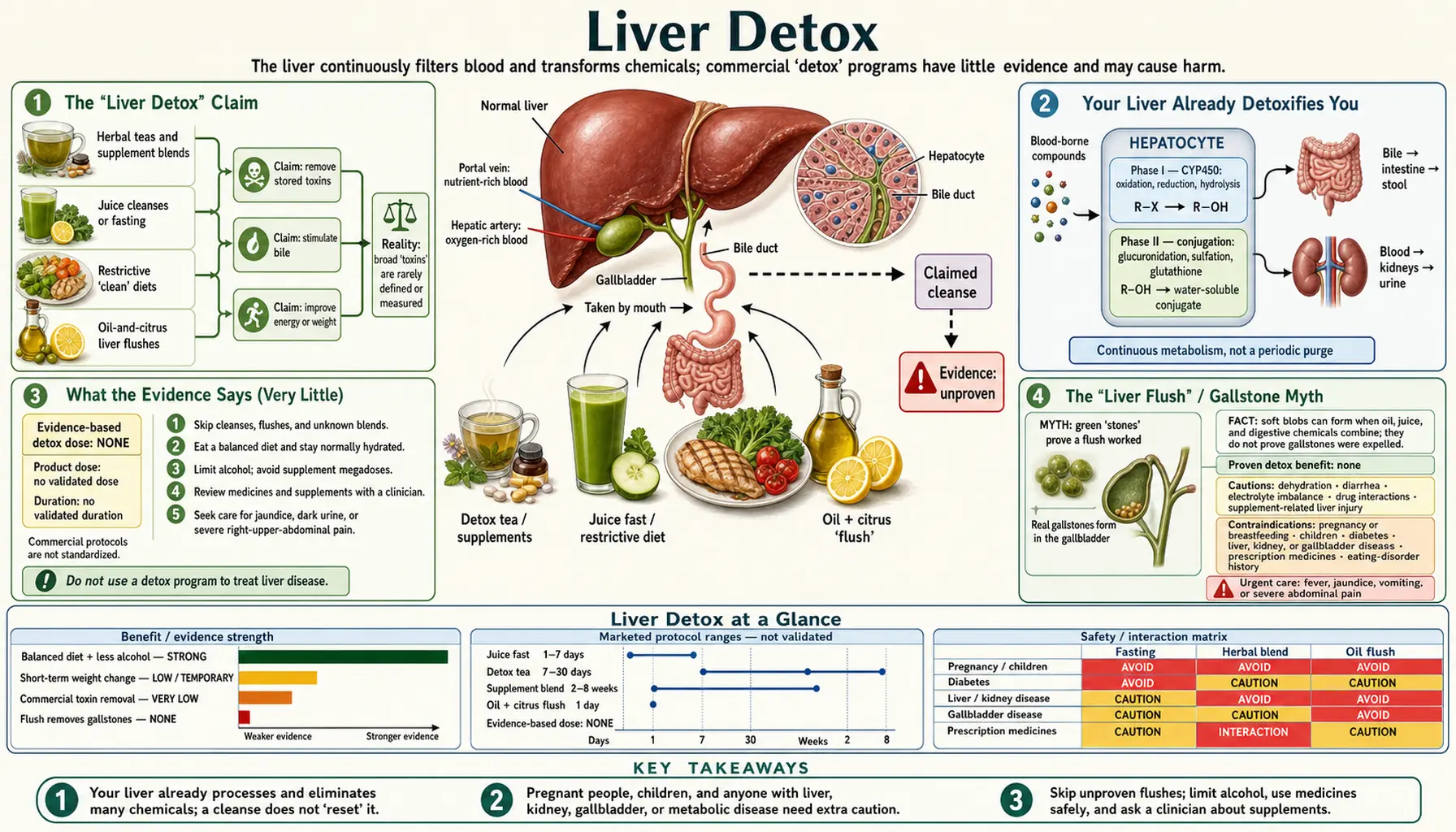
Shelves of "liver detox," "liver cleanse" and "liver flush" products suggest that the liver needs periodic help. The research describes something different: a healthy liver processes and clears chemicals continuously, and there is very little clinical evidence that commercial detox programs remove toxins or improve health. In medicine, "detoxification" refers to specific treatments for poisoning, drug overdose or alcohol withdrawal, which is not what wellness "detox" products are. Some supplements, including products sold as cleanses, have themselves been linked to liver injury. This page covers what the products claim, what the research shows, and the factors that research links to liver health.
Table of Contents
The "Liver Detox" Claim
"Liver detox" is an umbrella term for a wide range of products and programs. The U.S. National Center for Complementary and Integrative Health (NCCIH) lists the approaches such programs use, including fasting, juice-only or restricted diets, dietary supplements and herbs, colon cleansing with enemas or laxatives, and saunas. Products aimed at the liver come in several forms:
- Pills and capsules blending milk thistle, dandelion, turmeric, artichoke, and similar botanicals.
- "Detox" teas and other herbal products; NCCIH notes that detox programs may include laxatives.
- Juice "cleanses" and multi-day liquid-only programs.
- "Liver flush" or "gallbladder flush" regimens that combine olive oil and citrus juice, often with Epsom salts (magnesium sulfate).
The marketing claims typically include flushing out toxins, cleansing and "resetting" the liver, boosting energy, clearing up skin and jump-starting weight loss. The sections below set those claims against what the liver does on its own and what studies of detox programs have found.
Your Liver Already Detoxifies You
The premise behind most cleanses is that "toxins" build up in the liver and need to be purged from time to time. Physiology describes a continuous process instead: the liver works, in effect, as a chemical-processing plant that never shuts down, and neutralizing harmful compounds is its everyday job — not a special event that requires a product.
Working alongside the kidneys, the liver constantly:
- Breaks down alcohol and the byproducts of normal metabolism.
- Transforms drugs and other foreign chemicals into more water-soluble forms that can be eliminated, for example in urine. "Phase I" enzymes such as the cytochrome P450 family oxidize, reduce or hydrolyze these molecules, and "phase II" enzymes conjugate them (attach another molecule); some chemicals are instead turned into more toxic metabolites along the way (Grant 1991).
- Processes the nitrogen waste from protein into urea, which the kidneys then clear in urine.
- Packages waste into bile, which carries it out through the digestive tract.
In other words, detoxification is not something done to the liver; it is something the liver does continuously. The cleanse premise — a stored backlog of "sludge" that a product releases — has not been demonstrated in trials (see the evidence below). Liver failure, from cirrhosis, hepatitis or poisoning, is a serious medical condition treated in hospitals, and no cleanse has been shown to treat it. The factors that research does link to liver damage are covered in the last section.
What the Evidence Says (Very Little)
This is the heart of the matter: there is very little clinical evidence that commercial "detox" or "cleanse" programs remove toxins from the body or improve health in healthy people. A 2015 critical review found no randomized controlled trials of commercial detox diets in humans (Klein & Kiat 2015).
NCCIH, part of the U.S. National Institutes of Health, summarizes the research this way: only a small number of studies have tested "detoxification" programs in people, and while some reported positive results on weight and fat loss, insulin resistance and blood pressure, the studies were of low quality, with design problems, few participants or no peer review. NCCIH reports that a 2015 review concluded there is no compelling research to support "detox" diets for weight management or for eliminating toxins from the body, and that a 2017 review found juicing and "detox" diets can cause initial weight loss because of low calorie intake but tend to lead to weight gain once a normal diet resumes. There have been no studies of the long-term effects of these programs.
A few things are worth holding in mind together:
- "Detox" on a product label is not the medical meaning of the word. In medicine, detoxification refers to treating poisoning, drug overdose or alcohol withdrawal, and NCCIH notes that CDC recommends chelation therapy, a chemical detoxification procedure, for removing toxic metals in some specific serious cases. Wellness "detox" products are not these treatments.
- The few studies that measured toxins were weak. Klein and Kiat’s 2015 review found that a handful of clinical studies reported enhanced liver detoxification or the elimination of persistent organic pollutants with commercial detox diets, but judged them hampered by flawed methods and small sample sizes; the preliminary evidence that certain foods have detoxifying properties comes mostly from animal studies.
- Regulators have taken action. According to NCCIH, the U.S. Food and Drug Administration and the Federal Trade Commission have acted against several companies selling detox or cleansing products because the products contained hidden ingredients that may pose a significant health risk, were marketed with false claims that they could treat serious diseases, or, for colon-cleansing devices, were marketed for unapproved uses.
- The programs carry their own risks. NCCIH notes that detox programs may include laxatives, which can cause diarrhea and, in turn, dehydration; that drinking large amounts of water and herbal tea while eating nothing for days could lead to dangerous electrolyte imbalances; that colon-cleansing procedures may have side effects, some of them serious, with harmful effects more likely in people with a history of gastrointestinal disease, colon surgery, severe hemorrhoids, kidney disease or heart disease; that unpasteurized juices can cause illness that can be serious in children, older people and people with weakened immune systems; and that juices made from high-oxalate foods such as leafy greens and beets can be a health threat for people prone to kidney stones.
Where short-term changes in weight or other measures have been reported, there is an ordinary explanation: a 2017 review of popular weight-loss strategies attributes the short-term weight loss of juicing and detox diets to extremely low calorie intake (Obert 2017). And because no randomized trial has tested a commercial detox diet, any effect of a product itself cannot be separated from the other changes these programs involve, such as fasting or eating only certain foods.
The "Liver Flush" / Gallstone Myth
One claim deserves its own section, because it comes with visible "proof." In the "liver and gallbladder flush," a person drinks olive oil and citrus juice, often together with Epsom salts (magnesium sulfate, a laxative). Afterward, soft, stone-like lumps appear in the stool. These are presented as gallstones and toxins flushed out of the liver, and patients may see them that way (van Hooft 2010).
Those lumps are not gallstones.
A 2005 case letter in The Lancet, titled "Could these be gallstones?", reported a laboratory analysis of the lumps passed after an olive-oil-and-juice flush and found that they were not gallstones (Sies & Brooker 2005). A 2010 review in the Dutch medical journal Nederlands Tijdschrift voor Geneeskunde summarizes the literature: these soft "liver stones" are understood to develop from the olive oil taken with the laxatives, passing them is not associated with any reduction in gallstones, and purging with laxatives is not effective in removing gallstones (van Hooft 2010).
In plain terms, the "stones" did not come out of the liver; they formed in the digestive tract from the oil that was swallowed. Real gallstones form in the gallbladder or bile ducts and are diagnosed with imaging such as ultrasound.
Flush ingredients have also caused harm through error. A 2012 forensic case report described a 50-year-old man who died within 72 hours after taking Epsom salts during a liver-cleansing diet: the supplier had mistakenly prepared the salts with manganese sulfate instead of magnesium sulfate, and other patients who had taken the same salt were treated successfully in intensive care (Sánchez 2012).
A Word on the Ingredients
Skepticism about "cleanses" does not mean every ingredient in them is worthless. A few individual components have been studied for specific liver conditions. But "has been tested in a liver disease" is a very different claim from "detoxes a healthy person," and none of the studies below tested a cleanse product.
Two examples:
- Milk thistle (silymarin) is, in the words of the authors of a 2012 U.S. trial, "commonly used by patients to treat chronic liver disease, despite scant and conflicting evidence of its efficacy." A Cochrane systematic review of 18 randomized trials in 1,088 patients with alcohol-related or hepatitis B/C liver disease found no significant effect on mortality, complications of liver disease or liver histology; a reduction in liver-related deaths seen across all trials was not present in the high-quality trials, and the authors highlighted the lack of high-quality evidence (Rambaldi 2007). The 2012 placebo-controlled trial, in 154 people with chronic hepatitis C whose interferon treatment had failed, found that silymarin at higher-than-customary doses (420 mg or 700 mg three times a day for 24 weeks) did not lower ALT, a liver enzyme, significantly more than placebo (Fried 2012). In both, adverse events with milk thistle were comparable to those in the comparison groups. Neither tested milk thistle as a "detox" for healthy people.
- Coffee is a different kind of case. Meta-analyses of observational studies link higher coffee intake with a lower risk of cirrhosis (pooled relative risk 0.56 for each extra two cups a day; Kennedy 2016) and of liver cancer (hepatocellular carcinoma: a 35% lower risk for each extra two cups a day; Kennedy 2017), and in people with fatty liver disease, all four studies that reported fibrosis scores found less severe fibrosis with more coffee (Marventano 2016). These are associations, not trial results: the liver-cancer meta-analysis rated the quality of the evidence "very low" under GRADE criteria because of a lack of randomized trials, possible publication bias and no accepted definition of coffee. The signal also comes from an ordinary beverage drunk as part of daily life, not from a "cleanse" protocol, and it does not mean coffee "flushes toxins."
Results for a single ingredient in people with liver disease, or associations seen with an everyday drink, are not evidence about what a multi-ingredient "liver detox" product does for an otherwise healthy person.
The Real Risk: Supplements Can Harm the Liver
A "liver detox" product is not only unlikely to help: some supplements, including products sold as cleanses, have been linked to injury to the very organ they claim to cleanse.
Herbal and dietary supplements are a recognized and growing cause of drug-induced liver injury (DILI). In the U.S. Drug-Induced Liver Injury Network (DILIN), which studies patients referred to its U.S. liver centers, the share of liver-injury cases attributed to supplements rose from 7% to 20% over its 2004–2013 study period. Liver transplantation was needed in 13% of cases caused by supplements other than bodybuilding products, compared with 3% of cases caused by conventional medicines; the cases that ended in death or transplantation included products marketed for weight loss and, in one patient who needed a transplant, a set of "cleanse" products (Navarro 2014). A 2017 review from a research symposium put supplements at 20% of U.S. liver-toxicity cases in research data and named anabolic steroids sold as bodybuilding supplements, green tea extract and multi-ingredient nutritional supplements as the main agents implicated; it counted more than 50 published reports since 2006 of acute liver injury with jaundice attributed to green tea extracts (Navarro 2017).
Turmeric, one of the botanicals found in such blends, has its own DILIN case series: 10 cases of turmeric-associated liver injury among the cases enrolled between 2004 and 2022, all of them since 2011 and 6 since 2017. Five patients were hospitalized and one died of acute liver failure; 3 of the 7 products tested also contained piperine (black pepper), and 7 patients carried the immune-gene variant HLA-B*35:01. The authors concluded that liver injury from turmeric appears to be increasing in the United States (Halegoua-DeMarzio 2023).
Part of the problem is structural. Under U.S. law, the FDA does not have the authority to approve dietary supplements for safety and effectiveness, or to approve their labeling, before they are sold to the public (FDA). When DILIN chemically analyzed 272 supplement products collected from its patients, 51% did not match their labels; appearance-enhancement, sexual-performance and weight-loss products were the most often mislabeled (Navarro 2019). Products sold as a "liver cleanse" or "detox" supplement fall under these same rules, and the cases above show that "natural" products can cause serious harm.
What Research Links to Liver Health
The factors that large studies and clinical guidelines link to liver disease are ordinary ones:
- Alcohol. Alcohol is an established risk factor for cirrhosis; a 2010 meta-analysis of 17 studies found that the same average intake carried a higher risk of cirrhosis in women than in men (Rehm 2010).
- Weight and metabolic health. Fatty liver disease was renamed metabolic dysfunction-associated steatotic liver disease (MASLD, formerly NAFLD) in a 2023 multisociety consensus; it is defined as fat in the liver together with at least one cardiometabolic risk factor, without harmful alcohol intake (Rinella 2023; EASL–EASD–EASO 2024). A 2023 meta-analysis of population studies, using the earlier NAFLD definition, put global prevalence at 30% and rising (Younossi 2023). For adults with MASLD, the 2024 European guideline advises lifestyle modification — weight loss, dietary changes, physical exercise and discouraging alcohol consumption — along with optimal management of comorbidities such as type 2 diabetes and obesity.
- Acetaminophen (paracetamol). In a U.S. study of 662 people with acute liver failure at 22 centers over six years, acetaminophen caused 42% of cases, and the authors concluded that "acetaminophen hepatotoxicity far exceeds other causes of acute liver failure in the United States." Unintentional overdoses made up 48% of those cases, and 38% of the unintentional group had taken two or more acetaminophen preparations at the same time (Larson 2005). The FDA-required label warns that severe liver damage may occur with more than the maximum daily amount in 24 hours, with other drugs containing acetaminophen, or with 3 or more alcoholic drinks every day while using the product (21 CFR 201.326).
- Supplements. Herbal and dietary supplements, including products sold as cleanses, are among the recorded causes of drug-induced liver injury described above (Navarro 2014).
- Viral hepatitis. Hepatitis A and B can be prevented by vaccination: the CDC's Advisory Committee on Immunization Practices (ACIP) recommends hepatitis A vaccine routinely for children aged 12–23 months and for adults at risk (Nelson 2020), and hepatitis B vaccine for all adults aged 19–59 (Weng 2022). No vaccine exists for hepatitis C, which CDC describes as a major source of illness and death in the United States; since 2020 CDC has recommended hepatitis C screening at least once in a lifetime for all adults aged 18 and older, except where prevalence is below 0.1%, and testing for anyone with risk factors (Schillie 2020).
- Diabetes, blood pressure and cholesterol. These are part of the definition of MASLD itself: the qualifying cardiometabolic risk factors include type 2 diabetes, blood pressure and HDL cholesterol, along with body mass index or waist circumference (Rinella 2023).
- Smoking. The International Agency for Research on Cancer (IARC) concluded that the evidence linking cigarette smoking to liver cancer is sufficient; a 2009 meta-analysis of 38 cohort and 58 case-control studies found a relative risk of 1.51 for current smokers compared with never smokers (Lee 2009).
Each of these rests on large studies or formal guidelines; commercial detox diets, by contrast, had not been tested in any randomized controlled trial in humans as of the 2015 review (Klein & Kiat 2015).
Key Research Papers
- National Center for Complementary and Integrative Health (NIH). "Detoxes" and "Cleanses": What You Need To Know. nccih.nih.gov — The U.S. government's plain-language verdict: no compelling evidence that "detox"/cleanse programs remove toxins or aid weight management, plus documented safety risks.
- Sies CW, Brooker J. Could these be gallstones? Lancet. 2005;365(9468):1388. — Case letter reporting a laboratory analysis of the "stones" passed after an olive-oil/juice "liver flush," which were found not to be gallstones. — doi:10.1016/S0140-6736(05)66373-8
- Navarro VJ, Khan I, Björnsson E, Seeff LB, Serrano J, Hoofnagle JH. Liver injury from herbal and dietary supplements. Hepatology. 2017;65(1):363–373. — Herbal/dietary supplements (including green tea extract and weight-loss products) account for a large and growing share of U.S. drug-induced liver injury. — doi:10.1002/hep.28813
- Rambaldi A, Jacobs BP, Gluud C. Milk thistle for alcoholic and/or hepatitis B or C virus liver diseases. Cochrane Database of Systematic Reviews. 2007;(4):CD003620. — Systematic review finding the evidence does not support a clear benefit of milk thistle/silymarin; calls for higher-quality trials. — doi:10.1002/14651858.CD003620.pub3
- Kennedy OJ, Roderick P, Buchanan R, Fallowfield JA, Hayes PC, Parkes J. Coffee, including caffeinated and decaffeinated coffee, and the risk of hepatocellular carcinoma: a systematic review and dose-response meta-analysis. BMJ Open. 2017;7(5):e013739. — Higher coffee intake was associated with lower risk of liver cancer; the authors rated the quality of evidence "very low" under GRADE. An ordinary-beverage signal, not a "detox" effect. — doi:10.1136/bmjopen-2016-013739
- Marventano S, Salomone F, Godos J, et al. Coffee and tea consumption in relation with non-alcoholic fatty liver and metabolic syndrome: a systematic review and meta-analysis of observational studies. Clinical Nutrition. 2016;35(6):1269–1281. — In people with NAFLD, all four studies that reported fibrosis scores found less severe fibrosis with higher coffee intake (not pooled); coffee and tea intake were each associated with lower odds of metabolic syndrome. — doi:10.1016/j.clnu.2016.03.012
- Grant DM. Detoxification pathways in the liver. Journal of Inherited Metabolic Disease. 1991;14(4):421–430. — Review of the phase I (oxidation, reduction, hydrolysis) and phase II (conjugation) enzymes that convert fat-soluble chemicals into water-soluble metabolites for elimination; some chemicals become more toxic in the process. — PubMed PMID: 1749210
- Klein AV, Kiat H. Detox diets for toxin elimination and weight management: a critical review of the evidence. Journal of Human Nutrition and Dietetics. 2015;28(6):675–686. — Very little clinical evidence for detox diets; the few clinical studies were small and methodologically flawed; no randomized controlled trials of commercial detox diets in humans. — PubMed PMID: 25522674
- Obert J, Pearlman M, Obert L, Chapin S. Popular Weight Loss Strategies: a Review of Four Weight Loss Techniques. Current Gastroenterology Reports. 2017;19(12):61. — Juicing and detox diets produce short-term weight loss through extremely low calorie intake and tend to lead to weight gain once a normal diet resumes. — PubMed PMID: 29124370
- van Hooft J, Oude Elferink R, Seppen J. [Gluttony and penance—laxatives and 'liver stones'] (article in Dutch, English abstract). Nederlands Tijdschrift voor Geneeskunde. 2010;154(51-52):A2645. — The soft "liver stones" passed after liver-cleansing purges are understood to develop from the olive oil taken with the laxatives; passing them is not associated with a reduction in gallstones. — PubMed PMID: 21211072
- Sánchez B, Casalots-Casado J, Quintana S, Arroyo A, Martín-Fumadó C, Galtés I. Fatal manganese intoxication due to an error in the elaboration of Epsom salts for a liver cleansing diet. Forensic Science International. 2012;223(1-3):e1–e4. — Case report: a 50-year-old man died after taking Epsom salts for a liver-cleansing diet that the supplier had mistakenly prepared with manganese sulfate. — PubMed PMID: 22884574
- Fried MW, Navarro VJ, Afdhal N, et al. Effect of silymarin (milk thistle) on liver disease in patients with chronic hepatitis C unsuccessfully treated with interferon therapy: a randomized controlled trial. JAMA. 2012;308(3):274–282. — 154 participants; silymarin 420 mg or 700 mg three times daily for 24 weeks did not reduce ALT more than placebo. — PubMed PMID: 22797645
- Kennedy OJ, Roderick P, Buchanan R, Fallowfield JA, Hayes PC, Parkes J. Systematic review with meta-analysis: coffee consumption and the risk of cirrhosis. Alimentary Pharmacology & Therapeutics. 2016;43(5):562–574. — Five cohort and four case-control studies; pooled relative risk of cirrhosis 0.56 for each extra two cups of coffee a day. — PubMed PMID: 26806124
- Navarro VJ, Barnhart H, Bonkovsky HL, et al. Liver injury from herbals and dietary supplements in the U.S. Drug-Induced Liver Injury Network. Hepatology. 2014;60(4):1399–1408. — Supplement-caused liver injury rose from 7% to 20% of DILIN cases over the 2004–2013 study period; non-bodybuilding supplements led to liver transplantation more often than conventional medicines (13% vs 3%). — PubMed PMID: 25043597
- Halegoua-DeMarzio D, Navarro V, Ahmad J, et al. Liver Injury Associated with Turmeric—A Growing Problem: Ten Cases from the Drug-Induced Liver Injury Network [DILIN]. The American Journal of Medicine. 2023;136(2):200–206. — Ten turmeric-associated cases, one fatal; strong linkage to HLA-B*35:01. — PubMed PMID: 36252717
- U.S. Food and Drug Administration. FDA 101: Dietary Supplements. fda.gov — Under existing law the FDA does not have the authority to approve dietary supplements for safety and effectiveness, or to approve their labeling, before they are sold.
- Navarro V, Avula B, Khan I, et al. The Contents of Herbal and Dietary Supplements Implicated in Liver Injury in the United States Are Frequently Mislabeled. Hepatology Communications. 2019;3(6):792–794. — 51% of 272 assayed products did not match their labels. — PubMed PMID: 31168513
- Rehm J, Taylor B, Mohapatra S, et al. Alcohol as a risk factor for liver cirrhosis: a systematic review and meta-analysis. Drug and Alcohol Review. 2010;29(4):437–445. — Seventeen studies; the same average alcohol intake was linked to a higher risk of cirrhosis in women than in men. — PubMed PMID: 20636661
- Rinella ME, Lazarus JV, Ratziu V, et al. A multisociety Delphi consensus statement on new fatty liver disease nomenclature. Hepatology. 2023;78(6):1966–1986. — Replaces NAFLD with metabolic dysfunction-associated steatotic liver disease (MASLD), defined by steatosis plus at least one of five cardiometabolic risk factors; also published in Journal of Hepatology and Annals of Hepatology. — PubMed PMID: 37363821
- European Association for the Study of the Liver (EASL), European Association for the Study of Diabetes (EASD), European Association for the Study of Obesity (EASO). EASL-EASD-EASO Clinical Practice Guidelines on the management of metabolic dysfunction-associated steatotic liver disease (MASLD). Journal of Hepatology. 2024;81(3):492–542. — Advises lifestyle modification (weight loss, dietary changes, physical exercise, discouraging alcohol) and management of comorbidities for adults with MASLD. — PubMed PMID: 38851997
- Younossi ZM, Golabi P, Paik JM, Henry A, Van Dongen C, Henry L. The global epidemiology of nonalcoholic fatty liver disease (NAFLD) and nonalcoholic steatohepatitis (NASH): a systematic review. Hepatology. 2023;77(4):1335–1347. — 92 population-based studies; global NAFLD prevalence 30%, rising over 1990–2019. — PubMed PMID: 36626630
- Larson AM, Polson J, Fontana RJ, et al. Acetaminophen-induced acute liver failure: results of a United States multicenter, prospective study. Hepatology. 2005;42(6):1364–1372. — Acetaminophen caused 42% of 662 acute liver failure cases at 22 U.S. centers; 38% of the unintentional overdoses involved two or more acetaminophen preparations. — PubMed PMID: 16317692
- U.S. Code of Federal Regulations. 21 CFR 201.326: Over-the-counter drug products containing internal analgesic/antipyretic active ingredients; required warnings and other labeling. ecfr.gov — Sets the "Liver warning" required on over-the-counter acetaminophen labels.
- Nelson NP, Weng MK, Hofmeister MG, et al. Prevention of Hepatitis A Virus Infection in the United States: Recommendations of the Advisory Committee on Immunization Practices, 2020. MMWR Recommendations and Reports. 2020;69(5):1–38. — Routine hepatitis A vaccination for children aged 12–23 months, catch-up through age 18, and vaccination for adults at risk. — PubMed PMID: 32614811
- Weng MK, Doshani M, Khan MA, et al. Universal Hepatitis B Vaccination in Adults Aged 19–59 Years: Updated Recommendations of the Advisory Committee on Immunization Practices — United States, 2022. MMWR Morbidity and Mortality Weekly Report. 2022;71(13):477–483. — Expands universal hepatitis B vaccination to all adults aged 19–59. — PubMed PMID: 35358162
- Schillie S, Wester C, Osborne M, Wesolowski L, Ryerson AB. CDC Recommendations for Hepatitis C Screening Among Adults — United States, 2020. MMWR Recommendations and Reports. 2020;69(2):1–17. — Hepatitis C screening at least once for all adults aged 18 and older and during each pregnancy, except where prevalence is below 0.1%. — PubMed PMID: 32271723
- Lee YC, Cohet C, Yang YC, Stayner L, Hashibe M, Straif K. Meta-analysis of epidemiologic studies on cigarette smoking and liver cancer. International Journal of Epidemiology. 2009;38(6):1497–1511. — 38 cohort and 58 case-control studies; relative risk 1.51 for current smokers vs never smokers, supporting the IARC conclusion. — PubMed PMID: 19720726