Thirteen Glasses a Day: The Gerson Juice Schedule
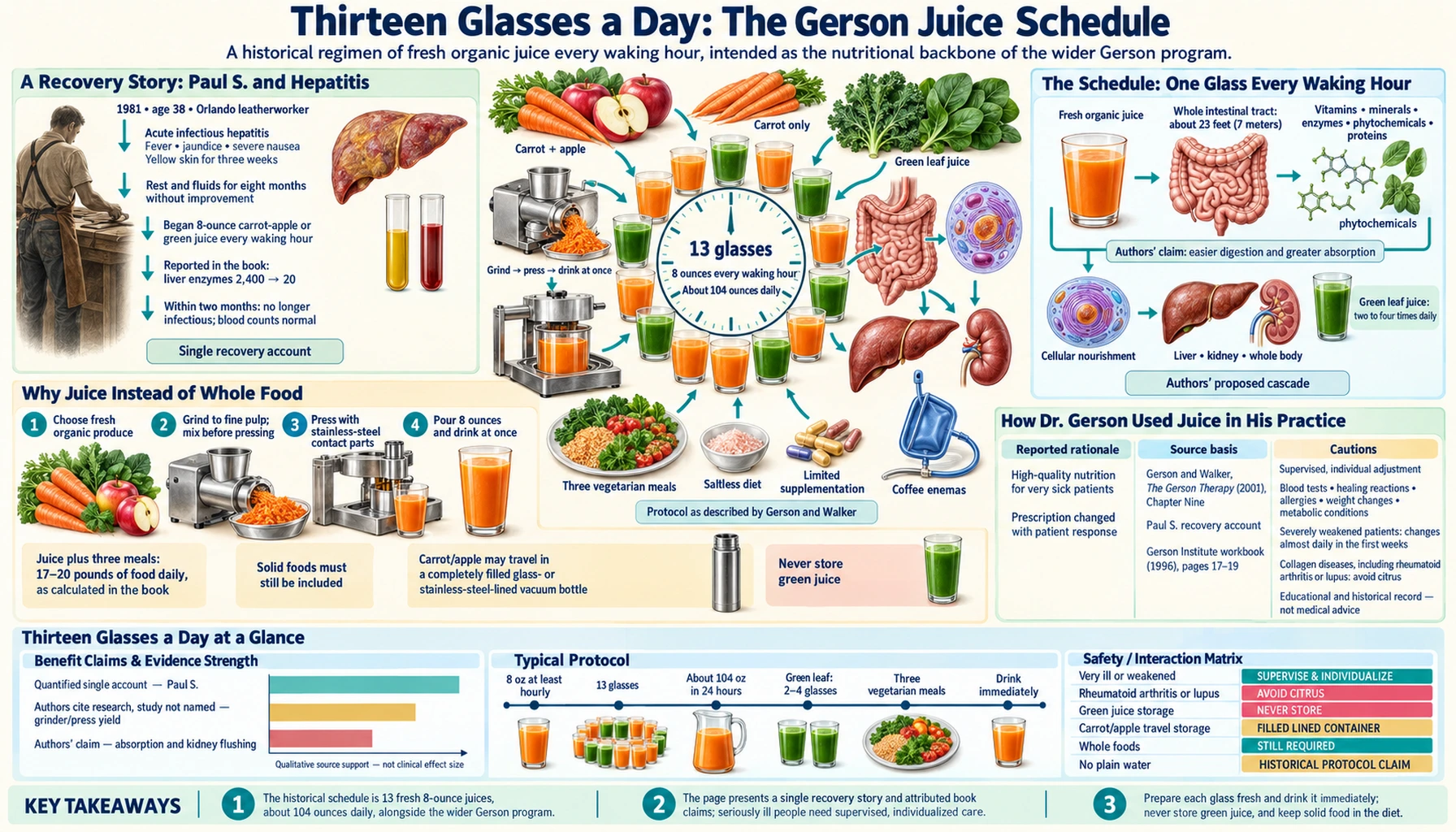
Chapter Nine of The Gerson Therapy by Charlotte Gerson and Morton Walker, D.P.M., is titled simply “Thirteen Glasses.” It sets out the backbone of the Gerson program as the authors state it: an 8-ounce glass of fresh-made organic juice every waking hour — thirteen glasses, about 104 ounces, every day — alongside three vegetarian meals, the saltless diet, limited supplementation and coffee enemas.
This page follows the chapter closely: the recovery story that opens it, the reasons Dr. Max Gerson gave for so much juice, the authors’ questions and answers about timing and storage, their two-part rule for freshness, the comparison of six kinds of juicing machine, and the practical household tips for keeping the schedule going without, in the book’s words, “undergoing a nervous breakdown.” Equipment is described here by type only. For the juice recipes themselves see the sibling Juicing Recipes page.
Table of Contents
- 1. A Recovery Story: Paul S. and Hepatitis
- 2. The Schedule: One Glass Every Waking Hour
- 3. Why Juice Instead of Whole Food
- 4. How Dr. Gerson Used Juice in His Practice
- 5. Questions and Answers About Drinking Juices
- 6. The Two-Part Freshness Rule and Water
- 7. Six Types of Juicing Machine
- 8. The Preferred Machine: Grinder Plus Press
- 9. Juicing Without a Nervous Breakdown
- 10. Cleaning, Cloths and Juice on the Road
- Key Research Papers
- Connections
- Featured Videos
1. A Recovery Story: Paul S. and Hepatitis
The chapter opens with Paul S. of Orlando, Florida, a leatherworker who made and sold saddles, belts, hats and luggage. In 1981, at thirty-eight, he was struck by acute infectious hepatitis — fever, jaundice and severe nausea. He had to give up his craft and his shop, and day after day felt weak to the point of collapse. His skin stayed markedly yellow for three weeks.
The book explains that hepatitis is an inflammation of the liver, and that viral hepatitis is marked by destruction of liver cells, leading to loss of appetite, jaundice and an enlarged liver. It notes that more than 70,000 cases are reported each year in the United States and that five types (A through E) are recognized today, though they were unknown in 1981. Of these, the authors write, types B and C are the most dangerous because of their high risk of developing into liver cancer, and one of them most likely infected Paul.
According to the book, the only advice he received at the time was to rest, nap and drink fluids. He did so for no less than eight months without improving. A massage therapist then suggested he read Dr. Gerson’s A Cancer Therapy: Results of Fifty Cases. The ideas seemed right and logical to him, so he bought a hydraulic press juicer and began the Gerson Therapy on his own, drinking an 8-ounce glass of carrot-and-apple or green juice every waking hour — a minimum of thirteen glasses, sometimes more.
“I immediately began to feel better. My liver enzyme test readings improved. They moved down from a pathological high of 2,400 to the normal range of 20. Within two months, when my physician reexamined me, his verdict was that I no longer remained infectious; my blood counts were normal.” — Paul S., as quoted in the book
For several years afterward he occasionally had flu-like symptoms. Each time, he says, he went straight back to the full juicing schedule for a week, and sometimes a few days — or even one day of thirteen glasses — was enough for his body, “especially my liver,” to feel better. The book reports that he is now happy and thriving, that the symptoms no longer come on, and that he knows he can banish them quickly with fresh organic juices.
2. The Schedule: One Glass Every Waking Hour
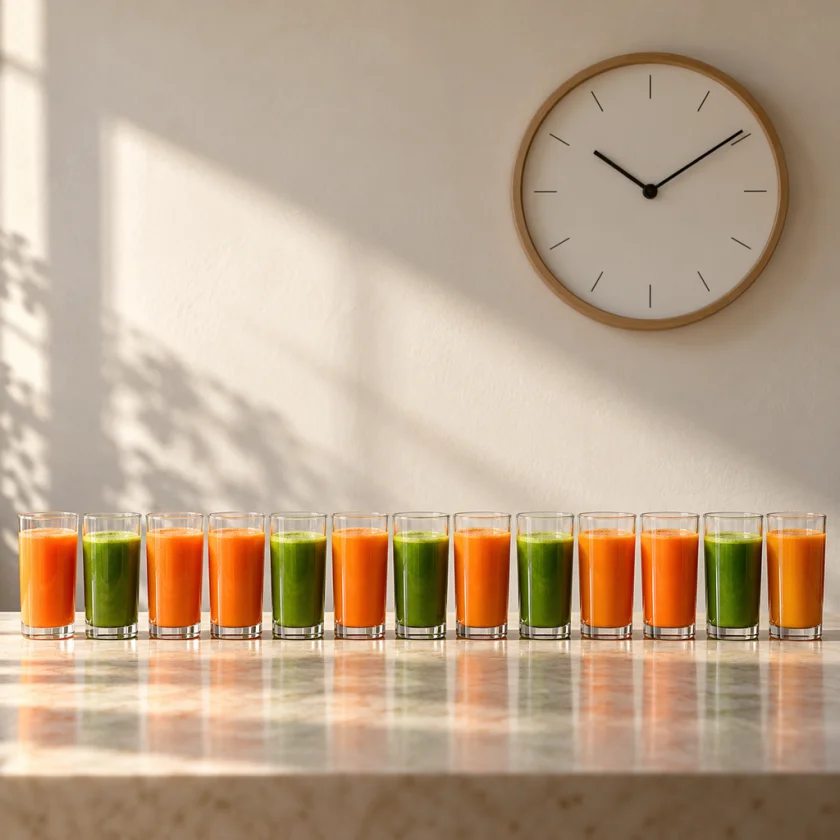
The chapter’s title is its prescription. The authors state that a person following the Gerson Therapy protocol consumes thirteen 8-ounce glasses — about 104 ounces of juice daily. Dr. Gerson advised that an ill person take 8 ounces at least once every hour.
- Amount: thirteen 8-ounce glasses, about 104 ounces in twenty-four hours.
- Frequency: one glass at least once every waking hour.
- Kinds of juice: Dr. Gerson urged specific combinations — carrot and apple, carrot only, and juice made from various greens. The book says to avoid other juiced produce. The green leaf juice is recommended two to four times every day.
- Citrus: Dr. Gerson regarded citrus as the least important juice therapeutically and added it mainly as a convenient start to the patient’s day (see section 7).
- Timing after pressing: drink it “At once!”
The authors are candid that the hourly regimen is often hard to keep. Their compromise for anyone who cannot follow it exactly: “Drink as much as you can, but keep trying to ingest more. In this situation for juicing and drinking, more is better.”
They also stress that juicing is one part of a whole. The chapter places the juices together with the therapeutic saltless diet (chapter 10), appropriate limited nutritional supplementation (chapter 11) and coffee enemas (chapters 12 and 13), and states that the combination results in renewed wellness that is long-lasting, natural and safe.
3. Why Juice Instead of Whole Food
The coauthors “unconditionally” reaffirm that, for an ill person or a healthy one, drinking fresh-made juices from organically grown fruits and vegetables frequently through each day is critical to renewing or maintaining wellness. Their reasons, as stated in the chapter:
- Near-complete nourishment. Along with fluid, fresh juices furnish nearly all of the nutrients — vitamins, minerals, enzymes, phytochemicals and other vital food substances, even proteins — that the body needs to heal itself.
- Easier to absorb. Juices are food, but in a much more assimilable form for the gastrointestinal tract, allowing better digestion and greater absorption. The authors hold that juice drinking is even more important for healing degenerative disease than eating the same nutrients in whole food.
- Sheer quantity. The 104 ounces of juice plus three vegetarian meals, the book says, equal between 17 and 20 pounds of food a day — more solid food than anyone could eat in waking hours. Juice allows massive nourishment in a short time.
- For those who cannot eat. Degenerative disease often brings poor digestion, decreased stomach acid and loss of appetite — even an inability to eat or hold food (cachexia). The book reports that such patients can often stay rather well nourished by drinking fresh juices.
The authors add one balancing point: the juiced nutrients are far more vital than the fiber of whole foods, “nevertheless, solid foods must be added to the patient’s total intake.”
On the word organic, the book notes there were no federal standards for the term “organically grown” at the time; it usually meant produce grown without chemical pesticides, herbicides or synthetic fertilizers, on land free of such chemicals for three to seven years.
4. How Dr. Gerson Used Juice in His Practice
The chapter describes how Max Gerson, M.D., treating tubercular, cardiovascular, cancerous, diabetic, arthritic and other degenerative-disease patients, looked for ways to overcome what he saw as their subclinical malnutrition — noting that even obese people can lack nutrients. Juicing at home was his answer. Juices made from raw foods, the authors write, were the easiest and most effective way to give very sick people the highest-quality nutrition, and the method he developed over roughly thirty-five years, from 1923 to 1958, produced in their words “the best clinical results ever witnessed in medical practice by that midpoint in the twentieth century.”
The “juice prescription” was not fixed. During his thirty years of active practice, the book says, Dr. Gerson repeatedly changed his juice prescriptions in response to each patient’s blood tests, healing reactions, allergies, weight changes and other metabolic conditions. For severely damaged or weakened patients he often changed medications and juices almost daily, especially in the first weeks — and the authors state that the same is true for patients today. This is why the book points readers toward supervised, individual adjustment rather than a one-size schedule.
The coauthors say they are reluctant to change a protocol they consider extremely effective, yet not closed-minded: if a better method of delivering high-dose nutrition came along, it would be adopted.
5. Questions and Answers About Drinking Juices
The authors admit that juicing raises many questions “for which there are few answers,” and offer their observations and opinions on the most common ones:
- How often?
- At least 8 ounces once every hour, per Dr. Gerson — though many find it hard.
- How much?
- Aim for 104 ounces of fresh organic juice in twenty-four hours.
- How soon after juicing?
- “At once!”
- Can juice be stored?
- The uncompromising answer is “No!” But for someone working away from home who cannot carry a 70-pound juicing machine, carrying carrot/apple juice in a glass- or stainless-steel-lined vacuum bottle, or in 8-ounce mason jars filled to the top, is “not all that bad” if it is the only way to get the day’s juices. Green juices should never be kept, because they oxidize quickly and lose their value.
- Which produce combines well?
- Almost all plant produce is compatible, the authors observe, but Dr. Gerson urged carrot and apple, carrot only, and the greens juice — avoid other juiced produce.
- Where is juice absorbed?
- The whole intestinal tract — about 23 feet (7 meters) — works on the juices, though not much absorption takes place in the stomach, large intestine and rectum.
- Is there a “vital force” in juice?
- Strictly their opinion: “Yes!” The live enzymes may invigorate body, mind and spirit — “At least, we hope so.”
- Do juices flush the kidneys?
- Yes, the book says: juice enzymes act as cleansing, sometimes truly diuretic, agents. Juice from large white asparagus is offered as a test, with celery juice nearly as good — you will urinate a lot, flushing the kidneys and urinary tract.
6. The Two-Part Freshness Rule and Water
Because, as the authors state, the therapeutic enzymes in fresh plant juices oxidize out of existence on prolonged exposure to air, they give a two-part rule drawn from the telephone advisers at the Gerson Institute:
- If at all possible, freshly prepare each 8-ounce glass and drink it immediately — especially important for the very ill patient.
- Do not make all of the day’s juices in the morning to store for later, because by day’s end you will probably be drinking deficient juice with many nutrients missing.
Dr. Gerson himself, the book recounts, told recovering patients always to prepare fresh juices from organic produce and never to try to make the whole day’s juice in the morning. From a quarter-century of advising on the therapy, the authors report that patients who make and drink juices throughout the day have a higher rate of healing success than those who regularly prepare juices several hours ahead.
No plain water. Another of Dr. Gerson’s tips: do not drink water. The full capacity of the stomach is needed for the juices and the special Hippocrates vegetable soup (chapter 8), and water filling the stomach tends to dilute its gastric acids and digestive enzymes. The thirteen glasses themselves supply the fluid.
7. Six Types of Juicing Machine
Dr. Gerson, partly by intuition but mostly from watching his patients, presumed that the method of extraction affected how many nutrients reached them. The authors say later juice analyses and patient results support him. They describe six kinds of machine, least preferred first:
- Masticating juicers chew the produce and extract juice in one step. Juice quality is fairly good and richer than centrifugal juice, but too much pulp — and enzymes — is left behind, and the grinding chamber heats up, which the book says damages enzyme quality.
- Centrifugal juicers are the most common and least expensive, and the least desirable for a Gerson patient. A toothed spinning disk shreds the produce and flings the pulp against a screen. The book lists three problems: leafy greens are not ground finely enough; spinning extracts less than pressing, leaving minerals and phytochemicals in the pulp; and Dr. Gerson held that the grinding wheel produces an electrical exchange that “kills the oxidizing enzymes and renders the juice deficient.” He reported that patients using centrifugal juicers did not have healing successes. Angled-basket models are described as less of a problem than vertical-wall ones, but still lower in nutrients and yield.
- Wheatgrass juicers are small specialty devices. The therapy does not use wheatgrass, because most patients find it extremely harsh on the stomach and its desirable components are already in the Gerson green leaf juice, which is much easier to digest.
- Citrus juicers are reamers for oranges and grapefruit only; never use one that presses the skin. The authors suggest apple or carrot juice may be better than citrus, which nutritionists have described as causing too much mucus in large amounts. Caution from the book: citrus juices should not be used by patients with collagen diseases such as rheumatoid arthritis or lupus erythematosus.
- Blender/liquefiers are powerful blenders, not juicers: they make a fine pulp but extract nothing. To match 104 ounces of juice, the authors calculate, a person would need at least 6 pounds of carrots, 8 pounds of apples and four heads of lettuce a day on top of three meals — far too much bulk, especially for very ill people with little appetite.
- The grinder (triturator)/press combination — the authors’ preference, described in the next section.
Two balancing points from the chapter: any juicer is better than none, since even a weaker machine gives more nutrients than the same quantity of produce eaten. But price should not decide the choice. The Gerson Institute reports that some patients rigorously following the therapy with a lower-cost centrifugal juicer saw neither tumor reductions nor healing reactions after many weeks, and that when they switched to a grinder/press juicer their healing reactions came rapidly and many improved dramatically. “The choice of an appropriate juicer,” the authors warn, “may be a life-or-death matter.”
8. The Preferred Machine: Grinder Plus Press
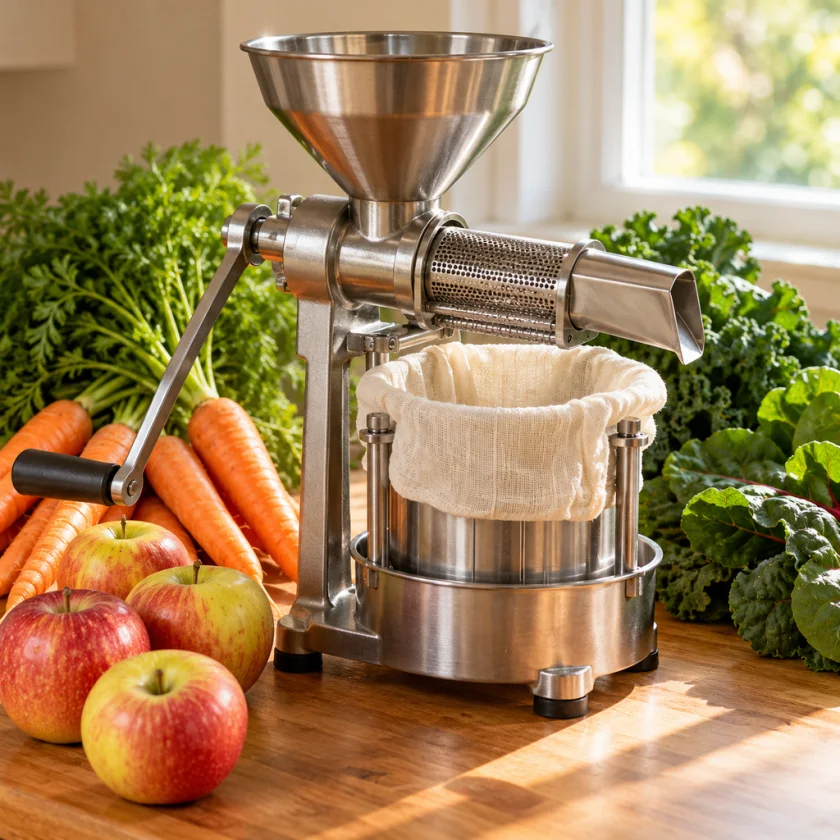
Dr. Gerson recommended two separate steps — a grinder (triturator) and a press — with every part touching the ground food made of stainless steel. The machine type favored today combines both: it grinds produce into a fine, juicy pulp, then squeezes the pulp in a hydraulic press at as much as 2,000 pounds per square inch.
What the book says for it:
- Dr. Gerson recommended this type above all others, and advised mixing the pulp of different vegetables or fruits thoroughly before pressing to improve extraction — possible only when grinding and pressing are separate.
- The authors cite research that grinder/press extraction yields as much as fifty times more of certain nutrients, such as lycopene from ripe tomatoes or proanthocyanidin from grape seed membranes.
- The juice is fuller-bodied, free of pulp, and about 35 percent greater in quantity from the same produce — more still with green leafy vegetables.
- Both authors own and use such a machine many times daily, and their survey found that no fewer than four out of five Gerson patients chose one.
The drawback is cost: the book gives a retail range of U.S.$800 to U.S.$2,095, the most expensive of all juicer types (masticating and centrifugal machines are described as moderately priced, masticators at U.S.$225 to U.S.$700). Given how much produce a Gerson patient uses, the authors judge the more expensive juicer will probably pay for itself in less than a year by producing more juice from less produce.
9. Juicing Without a Nervous Breakdown
The book is frank that the patient or support person will spend three to five hours of each waking day at the juicer, especially in the first weeks. Its practical hints for setting up the kitchen:
- Put the machine somewhere pleasant — a picture window, music, favorite photographs.
- Place it near the sink, since it needs washing regularly.
- Stand it on a large cafeteria tray to catch stray juice and save the countertop.
- Pulp (especially carrot and greens) can end up on the ceiling in the early weeks; hold the flat of your hand over the feed tube to stop splatter — without letting your fingers near the grinder.
- Wear a large apron.
- Work out in advance how many carrots, apples, greens, peppers, chard, red cabbage and other produce each day needs; scrub, wash, cut and bag them per session.
- Spin the day’s greens dry in a mesh bag on the washing machine’s damp-dry cycle for twenty seconds, and keep them crisp in small pillowcases inside a large garbage bag.
- Buy produce several times a week so it is fresh, especially greens. You may need a second refrigerator.
- Buy only organically grown produce and avoid anything that has touched pesticides or herbicides; the authors call chemicals on produce a major reason degenerative diseases cause disability and death.
- For seasonal items such as apples, arrange with your produce distributor to pre-buy a couple of months’ supply held in their cooler (greens will not keep) — or, if affordable, install your own walk-in cooler.
10. Cleaning, Cloths and Juice on the Road
Hygiene matters when the machine runs thirteen times a day. The chapter’s advice:
- After each juicing, take the machine apart and wash its parts. It is tempting to wait until every third or fourth juicing, but bacteria and other microorganisms may lodge on food debris.
- A sink disposal unit and sprayer hose make cleaning easier.
- For a press-type juicer, rinse pulp from the pressing cloths, wring them out, seal them in plastic freezer bags and store them in the freezer to keep them microorganism-free.
- Once a week, boil the pressing cloths in purified water.
- If juice starts to taste “off” or “pulp explosions” become frequent, the cloths are probably worn and clogged with fiber — replace them.
When work or travel interferes: fill a glass-lined or stainless-steel vacuum bottle completely with juice to avoid air. Carrot/apple juice may be carried this way; green juice should not be stored.
The chapter closes by pointing to the many recipes — carrot/apple, carrot alone, citrus, green leaf and more — collected in the book’s chapter 22; see our Juicing Recipes page.
Key Research Papers
- Gerson C, Walker M. The Gerson Therapy: The Proven Nutritional Program for Cancer and Other Illnesses. New York: Kensington Publishing; 2001. Chapter Nine, “Thirteen Glasses” — primary source for this page.
- Gerson M. A Cancer Therapy: Results of Fifty Cases. — the book Paul S. read before starting the therapy; the original source of the juicing method.
- The Gerson Institute. Gerson Therapy Practitioner’s Training Seminar Workbook. Chula Vista, Calif.; 1996, pp. 17–19. — cited by the chapter on juice prescriptions and centrifugal juicers.