Gerson Therapy Recipes
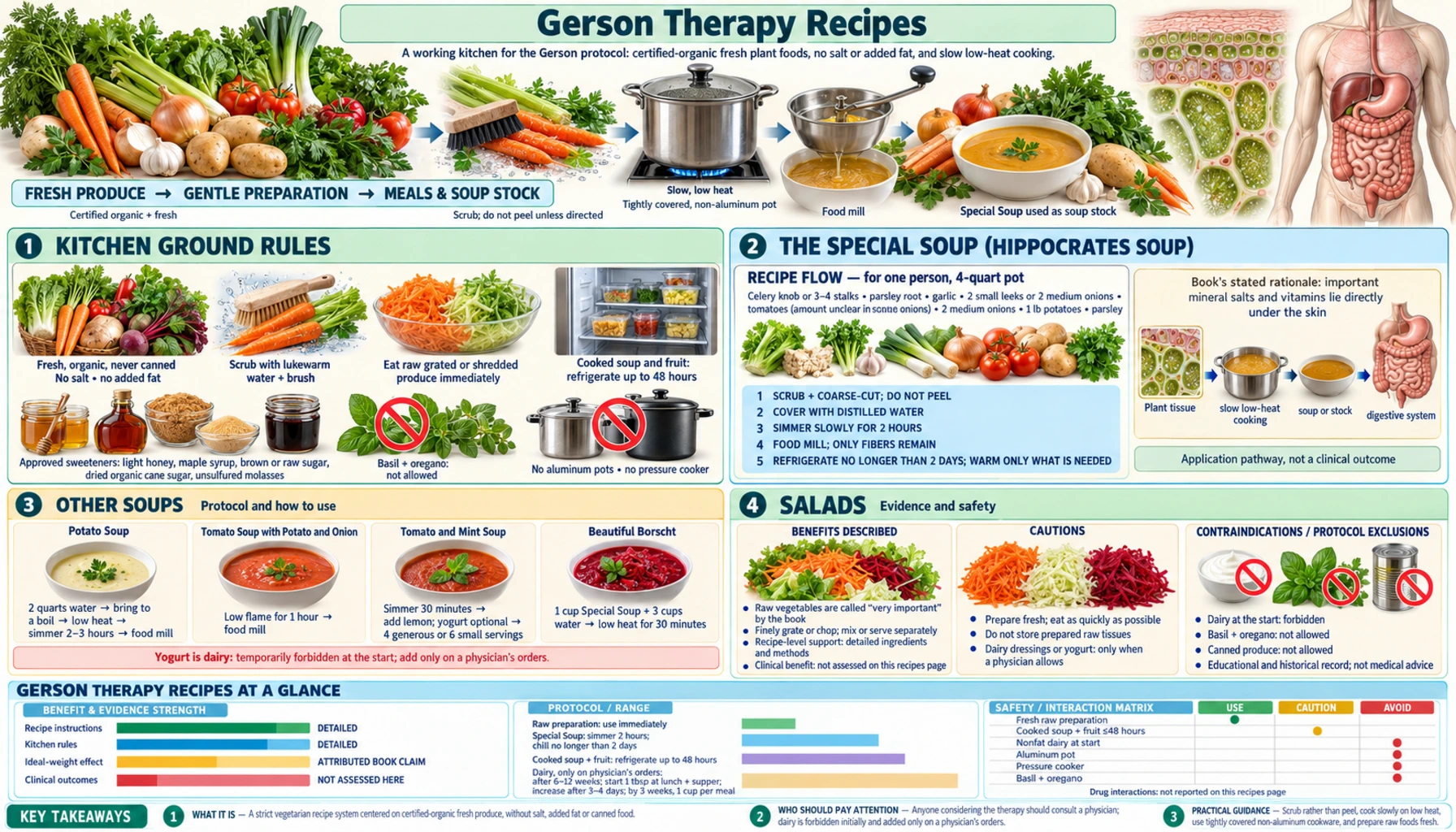
The final chapter of The Gerson Therapy, “Recipes,” turns the protocol into a working kitchen. Every dish is made only from certified organically grown fresh fruits, dried fruits, vegetables, grains and sweeteners — with no salt, no added fat, no canned food, and no aluminum pots. The book describes a vegetarian diet “ingested in huge quantities,” and states that eaten in the recommended amounts it lets a person reach an ideal weight and stay there.
Below is a representative selection of the chapter’s recipes, grouped by course, with the book’s quantities and methods. The centrepiece is the Special Soup (Hippocrates Soup) that Dr. Gerson recommended in the first edition of his book. Juices are covered separately on Gerson Juicing Recipes. Recipes containing dairy are marked; the book says dairy is temporarily forbidden at the start of the therapy and is added only on a physician’s orders.
Table of Contents
- 1. Kitchen Ground Rules
- 2. The Special Soup (Hippocrates Soup)
- 3. Other Soups
- 4. Salads
- 5. Dressings, Sauces and Dips
- 6. How to Cook Vegetables
- 7. Cooked Vegetable Dishes
- 8. Potatoes
- 9. Grains, Loaves and Stuffed Dishes
- 10. Fruits and Desserts
- 11. Dairy (When Allowed)
- 12. Breads
- Key Research Papers
- Connections
- Featured Videos
1. Kitchen Ground Rules
The book sets three conditions before any recipe:
- Organic and fresh only. Use certified organically grown fresh fruits, dried fruits, vegetables, grains and sweeteners. “We repeat: Use strictly fresh fruits and vegetables and absolutely no canned fruits or vegetables.”
- Do not peel or scrape unless a recipe says so. Clean produce with lukewarm water and a brush only. The book explains that important mineral salts and vitamins lie directly under the skin.
- Approved sweeteners only: light honey, maple syrup, or sugar — brown or raw sugar, dried organic cane sugar (which has a molasses flavor), or unsulfured molasses.
Herbs are used in small amounts. The book notes that basil and oregano are not allowed on the Gerson Therapy “owing to the aromatic oils they contain.” Herbs that appear throughout the recipes include dill, tarragon, savory, thyme, sage, marjoram, rosemary, bay leaf, parsley, chives, mace, allspice and coriander.
Raw grated or shredded fruit and vegetables must be eaten as quickly as possible; the book states that raw living tissues may not be stored after any kind of preparation. Cooked soup and fruit may be kept in the refrigerator for 48 hours.
2. The Special Soup (Hippocrates Soup)
This is the soup Dr. Gerson recommended in the first edition of his book, and its liquid is the “soup stock” called for in many other recipes.
Special Soup (Hippocrates Soup)
For one person use a 4-quart pot, assemble the following vegetables, then cover with distilled water:
- 1 medium celery knob (or 3 to 4 stalks of celery)
- 1 medium parsley root (if available)
- garlic as desired
- 2 small leeks (if not available, replace with 2 medium onions)
- Tomatoes (amount unclear in the scanned text)
- 2 medium onions
- 1 lb potatoes
- a little parsley
Method: Do not peel any of the soup vegetables; wash and scrub them well and cut them coarsely. Simmer slowly for 2 hours, then put them through a food mill in small portions — only fibers should be left. Vary the water to taste and desired consistency. Keep well covered in the refrigerator no longer than 2 days, and warm up only as much as needed each time.
3. Other Soups
Potato Soup
- 1 large onion, a small celery knob, parsley
- 2 large potatoes, 1 leek, 2 stalks celery
- 2 quarts water
Method: Clean and dice all vegetables. Place in a covered saucepan with the water, bring to a boil, lower the heat, cover and simmer 2–3 hours. Mash through a food mill.
Tomato Soup with Potato and Onion
- 2 large tomatoes, 1 medium onion, 2 medium potatoes
- 1 tsp brown sugar, 1 tsp wine vinegar
- a small piece of bay leaf
Method: Wash and dice all vegetables. Place everything except the sugar in a covered saucepan with water to cover. Cook over a low flame for 1 hour. Mash through a food mill and add sugar to taste.
Tomato and Mint Soup
- 2 lbs tomatoes (Roma preferably), 5 green onions (scallions)
- 2 small cooking apples, 5 tbsp cider vinegar, 1 tsp brown sugar
- 2 large lemons, 6 or 8 sprigs fresh mint
- 200 g (6–8 oz) nonfat yogurt (optional; dairy)
Method: Chop tomatoes, slice the onions, core and slice the apples. Simmer with the vinegar and sugar for 30 minutes after bringing to a boil, then put through a food mill. Add the lemon juice (and beat in the yogurt, if used). Just before serving, add the chopped mint, leaving some scattered on top. Makes 4 generous or 6 small servings.
Beautiful Borscht
- 1 onion, 3 garlic cloves, 1 cup Special Soup
- 6 small beets with tops, 1 large potato, 1 carrot
- 4 red cabbage leaves, 2 bay leaves, 3 cups water, tomatoes
Method: Run all the vegetables through a grinder and add the water and bay leaves. Cook for 30 minutes on low heat. Serve with a dab of nonfat yogurt.
4. Salads
The book lists vegetables it calls very important to eat raw, finely grated or chopped, mixed or separate: knob celery, tomatoes, escarole, cauliflower, romaine, chives, green peppers, apples, carrots, lettuce (all types), chicory, watercress, radishes, scallions and endives.
Celery Root (Knob) Salad
Remove loose roots from 2 celery knobs and scrub clean. Boil the knobs in their jackets about 1 hour; peel and slice. Add 1 medium chopped raw onion and scallions. Toss with Herb or Garlic and Onion Dressing.
Eggplant Salad
- 1 eggplant, baked for one hour at 350° F (180° C)
- 1 small onion chopped, 1 tbsp cider vinegar, chopped parsley
- 2 sliced tomatoes, flax oil
Method: Let the baked eggplant cool, chop into bite-sized pieces, and combine with the remaining ingredients.
Potato Salad, Basic
Boil potatoes in their jackets until soft (1 hour); peel and slice. Add onions, scallions, celery, green peppers, and Herb or Garlic and Onion Dressing.
Rice Salad
Mix cooked organic brown rice (cooked with a bay leaf and a little rosemary) with plenty of chopped vegetables — tomatoes, celery, zucchini, radishes, fresh garden herbs — and a lemon and garlic dressing (equal parts lemon juice and water, a little brown sugar and crushed garlic). The book suggests rose, borage or marigold petals sprinkled on top, and soaked, chopped apricots if desired.
Red and Green Salad
- 1 head romaine lettuce, 2 cups shredded savoy or green cabbage
- 3 green onions, 1 cup sunflower greens
- 2 kohlrabi cut in shoestring strips (or peeled broccoli stems)
- 1 thinly sliced yellow crookneck squash
- 1 pint cherry tomatoes or 1 large sweet red pepper cut in strips
Method: Combine and serve with Spinach Dressing.
Tomato and Pepper Salad
1 green pepper cut into thin rings and 2 tomatoes, firm but ripe, sliced or chopped. Dress with lemon juice and crushed garlic, fresh herbs and chopped celery leaves. Add flax oil to taste.
Beet Salad
Boil beets in water for 1 hour. Peel, cut the tips off and slice thin. Add chopped onions and either Herb or Garlic and Onion Dressing.
5. Dressings, Sauces and Dips
Herb Dressing
Mix apple cider vinegar, 1 tsp brown sugar and 2/3 cup water. Add some or all of these herbs and leave them to infuse: tarragon, finely chopped shallots or spring onions, 2 cloves garlic peeled and crushed, and 1 fresh bay leaf.
Garlic and Onion Dressing
Lemon juice or wine vinegar, 2 tsp water, 1 tsp brown sugar, a little diced onion, 1 clove garlic and a small amount of permitted herbs. Mix, allow time for the flavors to mingle, and serve on salad.
Baba Ghanoush
- 1 large eggplant, 2 cloves garlic
- 1 tsp lemon juice, 1 tbsp chopped parsley, lemon wedges
Method: Bake the eggplant for 1 hour; when cool enough, peel and drain off excess liquid, squeezing gently. Blend with the garlic until fairly smooth, then add lemon juice and parsley. Serve with raw dipping vegetables such as celery, carrots, cauliflower and peppers.
Golden Sauce
Combine in a covered casserole 1 small sweet potato or yam quartered, 2–3 carrots coarsely chopped, 1 small onion diced, soup stock, tangerine or orange juice, and a pinch of thyme and rosemary. Bake in a low oven until tender (approx. 2 hours). Put through a food mill or blender, adding juice to the desired consistency. Add 2 tsp parsley and serve.
Tomato Salsa
- 1 medium tomato finely chopped
- green onions or 1 medium red onion
- 2 tbsp fresh coriander leaves (cilantro) chopped, 3 tbsp lemon juice
Method: Combine (the book says “don’t overdo the lemon juice”), cover and chill. Best eaten fresh but can be kept for up to 2 days in the refrigerator.
No-Wait Tomato Sauce (raw)
1 lb Roma tomatoes cut into pieces, 3–4 cloves garlic, 3 sprigs parsley and 1 tsp linseed oil. Start the blender with the oil and add the tomato and other ingredients a little at a time; whip for a minute or so. Yields about 2–3 cups.
6. How to Cook Vegetables
The book is emphatic that the cooking method matters as much as the ingredients:
- All vegetables are cooked slowly, over a low flame, with little or no added water, until done and tender. The book states that fast cooking with excessive heat bursts the cells, the minerals “go out of their colloidal composition” and become harder to absorb.
- A stainless steel flame tamer may be used to prevent burning. A little Special Soup, or tomatoes, apple slices or chopped onion at the bottom of the pan, adds fluid and often improves flavor.
- Spinach water is too bitter, contains too much oxalic acid, and must be discarded.
- Tomatoes, leeks, zucchini and onions are stewed in their own juices. Red beets are cooked like potatoes, in their peel, in water.
- The pot must not be aluminum and must close tightly; lids must be heavy and fit well. Do not use a pressure cooker. Wax paper under the lid can help the seal.
- Baked vegetables are slow-cooked in a “low” oven (180–190° F; use an oven thermometer) in a covered casserole — a virtually waterless method.
- Bring liquids to a boil only if the recipe specifically calls for it.
7. Cooked Vegetable Dishes
Broccoli and Herbs
2 bunches of broccoli, 4–6 cloves of garlic, sliced onion, dill and a little Special Soup broth. Wash the broccoli and peel the stems. Cook the garlic and onion until the onion becomes translucent, then add the cut crowns and stems, dill and broth. Cook on low heat until tender.
Cauliflower
Wash cauliflower and break into sections. Add 2–3 tomatoes, sliced and cut into chunks. Stew together for approximately 45 minutes (or until tender) on low heat.
Red Cabbage
Combine shredded cabbage, 3 tsp vinegar, 3 large chopped onions, 2 bay leaves and a little soup stock. Stew over low heat approximately 1 hour. For the last half hour add 3 apples peeled and grated plus 1 tsp raw sugar.
Spinach
After cutting off the roots, wash 3–4 times. Put in a large, tightly covered pot with a layer of onions on the bottom. Do not add water. Stew over a low flame until the spinach wilts. Pour off the excess juice and serve chopped with a slice of lemon.
Eggplant, Stewed
Combine in a stew pot 1 eggplant cut into cubes, 2 onions chopped, and 3 tomatoes (peeled and chopped). Stew approximately 30 minutes until tender. Do not add water.
Fennel Treat
- 1 bulb of fennel
- 1 large tomato, sliced
- 2–3 cloves garlic peeled and sliced thin
Method: Cut off the stalks and leaves, slice the bulb in half lengthwise, rinse away sand, and set the halves cut side up in a baking dish. Cover with tomato slices and top with garlic. Cover and bake at 250° for 1–2 hours. Serve with a baked potato and grated carrots on a bed of greens.
String Beans
1 lb green beans (tips cut, washed, cut to any size). Add 1 onion chopped and just enough soup stock to keep the beans moist. Stew approximately 50 minutes until tender.
Zucchini and Tomatoes
6 small zucchini sliced, 1 medium or large onion chopped, 2–3 tomatoes chopped, plus garlic and herbs to taste (thyme, mace, marjoram). Sauté the onion, tomatoes and seasonings in a little water; add the zucchini when half done and simmer. Serve as a vegetable or potato topping.
Stir-Steamed Snow Peas Medley
- 1 lb snow peas, 1 bunch bok choy, 1 medium zucchini
- 1 medium crookneck yellow squash, 1 small red onion, 1 carrot, 1 leek
- 1 cup orange juice, 1 tbsp honey, 1 tbsp vinegar, 1 tsp allspice
Method: Clean and slice the vegetables thinly. Blend the orange juice, honey, allspice and vinegar and pour into a steam pot. Cover with the vegetables and simmer 15–20 minutes until tender.
8. Potatoes
Potatoes are a daily staple of the therapy. The book says they are most often boiled slowly in a covered pot over medium-low heat, approximately 1 hour until tender.
Baked Potatoes
Wash thoroughly; do not scrape or peel. Bake in a low-heat oven for 2 to 2½ hours or, alternatively, for 50 minutes to 1 hour at 350° F.
Parsley Potatoes
Boil several potatoes in their skins until done. Remove the peel and roll in chopped parsley after slightly brushing with flaxseed oil.
Mashed Potatoes and Chard
Wash and shred one bunch of chard, green or red, and put it in a pan with 4–5 tbsp of water or soup stock; bring to a boil, then simmer. Peel 3 large or 4 medium potatoes, cube and place on top of the chard. Simmer until the potatoes are soft. Remove any remaining water and mash with approximately 6–8 oz nonfat yogurt (dairy, when allowed). The same recipe works with kale, stems stripped.
Scalloped Potatoes
Place one whole chopped onion in the bottom of a glass baking dish. Layer sliced potatoes, then sliced tomato, then another layer of sliced or chopped onion. Sprinkle with marjoram and/or thyme and bake in a low oven 1–2 hours or until done.
Potatoes and Carrots, Westphalian Style
- 6–8 small carrots sliced or 4–5 large carrots sliced
- 3 medium potatoes or 2 large potatoes
- 1 large onion, 3–4 tbsp soup stock
Method: Slice the carrots into the pan; peel and slice the potatoes and chop the onion. Add all together with the soup stock and simmer until done, adding a bit more stock if necessary. When done, no water should remain.
Potato Puffs
The book flags this as “marginal food; eat rarely.” Cut a baking potato into thin slices, place them directly on the oven rack, and bake at 425° F to puff; turn over, lower to 325° F with the oven door cracked open, and bake another 20 minutes until shiny brown on both sides.
9. Grains, Loaves and Stuffed Dishes
Veggie Loaf
Grind germinated lentils (2 cups), fresh parsley and diced eggplant (or parsnips or yams). Add 1 cup onions diced fine, grated beets and carrots, 1 cup celery diced fine, 3 cloves garlic minced, cooked brown rice, a pinch each of thyme, rubbed sage and tarragon, and 1 tsp lemon juice. Bake in a covered pan in a low oven approximately 2 hours, then uncover, baste with Golden Sauce or Tomato Sauce, and bake another 30 minutes to 1 hour.
Spaghetti Squash with Beetballs
Halve 1 medium spaghetti squash, scoop out the seeds, and bake cut side down in a low oven for 2 hours or until tender. For the beetballs, mix 2 tsp minced parsley, 1 small onion minced, 1 medium beet grated, and 3–4 medium carrots grated with saltless, fatless rye bread crumbs and germinated lentils; form into 2″ balls on a sheet sprinkled with oat or rye meal, bake covered in a low oven 1 hour, then uncovered 1 hour more. Serve over the squash with a slow-cooked tomato sauce.
Stuffed Squash
Slice 3–4 acorn squash lengthwise and remove the seeds. Fill with diced onion, celery and carrot, cooked brown rice, sprouted lentils, soaked raisins or prunes, 3 tsp minced parsley, rubbed sage, thyme and 1 large clove of garlic crushed. Cover and bake at 300–325° F until the squash is tender. The book notes that whole uncut garlic cloves give a much milder flavor than crushed garlic.
Sweet Rice
Wash organic brown rice and put it in a pot with 4 cups water. When the water begins to boil, add 1 cup organic brown sugar and 1 cup organic raisins and reduce the heat. Keep on low heat until the rice is tender.
10. Fruits and Desserts
The book says the fruit recipes are taken from Dr. Max Gerson’s personal files. Most fresh fruits can be eaten unpeeled when ripe (oranges and bananas peeled). Dried fruits must be unsulfured, washed in lukewarm distilled water, soaked overnight, and cooked in the same water. Desserts “should never replace the meals or juices of the therapy,” and never contain ice cream, fat, white flour, baking soda, candy, chocolate, cream or salt.
Apples, Baked
2 medium apples, 1 tsp raisins and 2 tbsp water. Wash, core and halve the apples; bake with the raisins about 15 minutes until done, then broil until golden brown, about 5 minutes. Honey may be added to the raisins to taste.
Applesauce, Cooked
3 medium apples pared, cored and sliced, half covered with cold water in a saucepan. Boil until soft, about 15 minutes. Put through a food mill and mix with honey or brown sugar to taste.
Banana and Figs
1 banana, 3 fresh figs and the juice of 1 orange. Chop the banana and figs fine, mix well with the orange juice, and serve in the orange peel.
Cherries (Stewed)
1 lb cherries (washed, stemmed), 1 tsp potato starch and 2 tsp brown sugar. Cook the cherries in water to cover for 10 minutes over a low flame. Add the potato starch dissolved in 2 tsp cold water and cook 2 minutes longer. Chill and serve.
Glazed Pear Halves
4–5 ripe pears and 4 tbsp honey or dried cane sugar. Halve and core the pears. Mix about 4 oz of water into the sweetener, pour over the pears in a baking dish, and bake in a slow oven (275° F) until done, basting if necessary.
Plums
1 lb plums and 2 tsp brown sugar. Wash, halve and pit the plums (or cook whole). Cook in water to cover for 15 minutes. Cool, add sugar and serve chilled.
Sweet Potato and Apple Bake
12 oz sweet potatoes, 3 eating apples, allspice, a little brown sugar and a little water. Cook the sweet potatoes gently in their skins until tender and cool. Slice and layer with apple in a baking dish, sprinkling each layer with water, sugar and allspice. Bake covered 20 minutes at 350° F, then uncovered 10 minutes more.
Stewed Fruit Combinations
Pears and plums, plums and applesauce, peaches and plums, apricots and plums, apricots and sliced apples, or peaches and pears. The book suggests serving stewed fruit thickly spread on toasted rye bread and allowed to soak in before serving.
11. Dairy (When Allowed)
The book states that dairy is temporarily forbidden at the beginning of the Gerson Therapy, and that patients should consult their Gerson-trained health professional or physician before adding any. After 6 to 12 weeks on the therapy, upon doctor’s orders, animal proteins are cautiously added as pot cheese, yogurt, cottage cheese and churned (not cultured) buttermilk — all made from nonfat milk (preferably raw) and without salt.
- Start with just one tablespoon of the solid proteins at lunch and supper, plus a small amount of buttermilk per meal.
- After 3 to 4 days the amounts can be increased until, at 3 weeks, one cup of yogurt or churned buttermilk per meal has been added.
- Watch for intolerance: indigestion, flatulence and nasal mucus are, the book says, signs that enzyme activity cannot yet handle dairy. The patient should reduce or, after consulting the physician, eliminate the proteins for several more weeks.
Yogurt Cheese
Hang nonfat yogurt in a muslin sack over a sink or bowl, or in a muslin-lined strainer, until it thickens to the consistency of cream cheese without the fat — about 6 to 8 hours.
Cottage Cheese Sour Cream
Blend yogurt, 1 tbsp lemon juice and 1 cup dry curd cottage cheese. Add any of: pressed garlic, grated horseradish, chives or green onion, fresh mint or dried dill weed. Use on baked potatoes or as a dip for vegetables.
12. Breads
Bread is a snack, an after-breakfast food, or an addition to a meal when appetite is good — the book says it must not replace potatoes and vegetables. Breads are unsalted and made mainly from organic rye; for Gerson patients, rye sourdough is the recommended starter. The book notes that Dr. Gerson allowed 1/3 wheat to 2/3 rye flour.
Sourdough Starter
Dissolve 1 tsp active dry yeast in 3 cups warm water (105°–115° F) and set aside about 5 minutes. Gradually stir in rye flour until smooth with a wooden spoon. Cover with cheesecloth in a warm, draft-free place; in about 24 hours it begins to ferment. Cover tightly and leave another 2 to 3 days, stirring 2 or 3 times a day, until foamy. Store in a glass, stoneware or plastic container (never metal — the book says wild-yeast acids corrode metal and kill the starter), loosely covered in the refrigerator, and feed it every week or 10 days.
Bread Crumbs
Toast leftover bread in the oven, run it through the food grinder, and store covered in the refrigerator. The book warns never to use commercial bread crumbs.
Bread Snack
1 slice of bread spread with cottage cheese (when allowed) and topped with tomatoes and radishes or sprouts — or 1 slice of bread topped with honey.
Key Research Papers
- Gerson C, Walker M. The Gerson Therapy: The Proven Nutritional Program for Cancer and Other Illnesses. Chapter Twenty-Two, “Recipes.” — primary source for every recipe, quantity and kitchen rule on this page.
- Gerson M. The cure of advanced cancer by diet therapy: a summary of 30 years of clinical experimentation. Physiol Chem Phys. 1978;10(5):449–64. PubMed PMID: 751079