Whole-Food Copper Sources: Beef Liver, Oysters, Seeds & Cacao
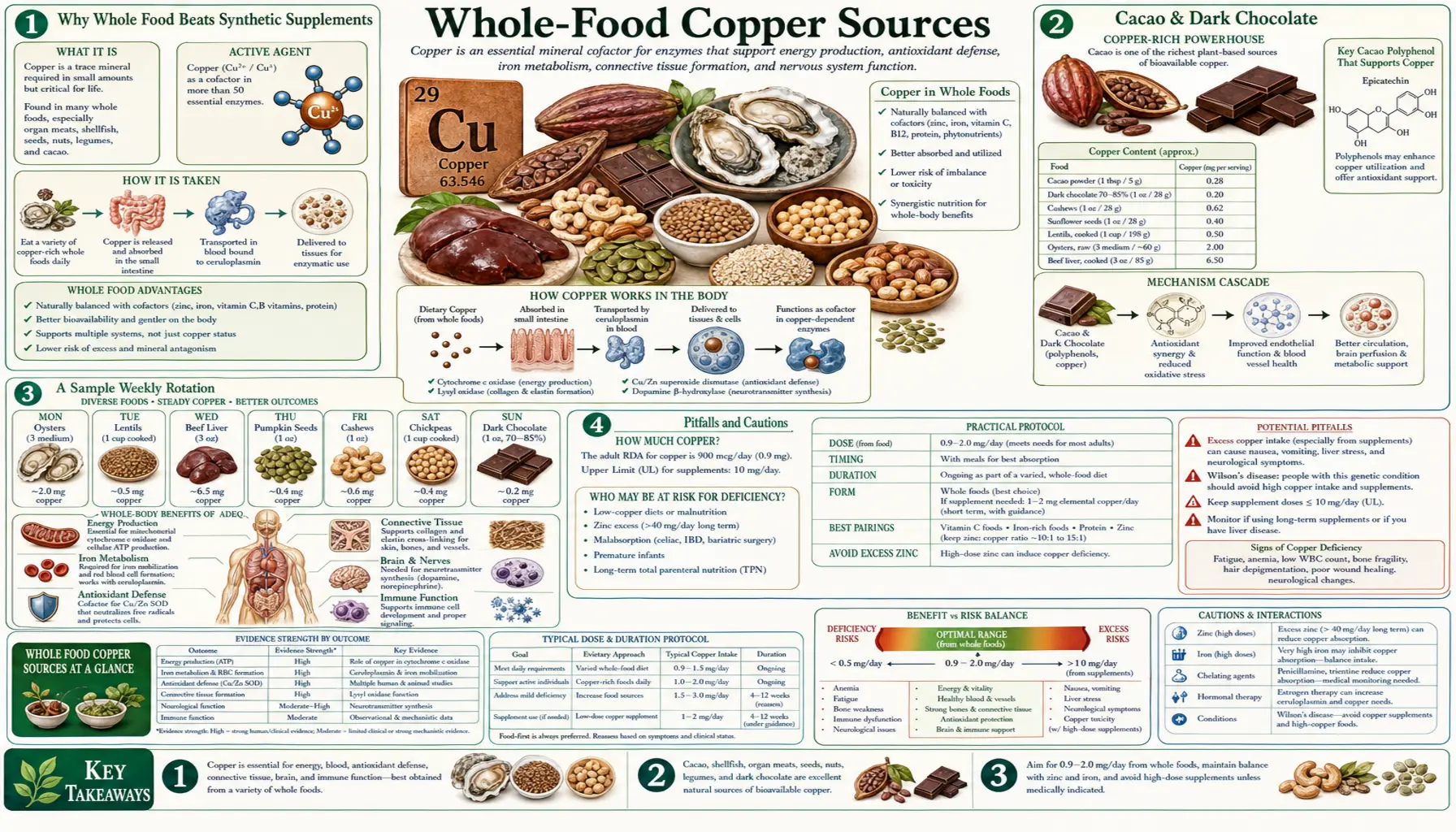
The Root Cause Protocol does not lead with a copper supplement — it leads with a grocery list. Morley Robbins teaches that the body did not evolve to receive copper as an isolated salt in a capsule; it evolved to extract copper out of the same foods that carry the cofactors copper needs to actually do its job — retinol (true vitamin A), riboflavin, B12, choline, magnesium, the full B-complex, and the protein scaffolding for ceruloplasmin synthesis. This page is the practical food list: what to eat, how much, where to source it, and how to fold it into a normal weekly rotation without making your kitchen look like a survivalist’s pantry.
Each food below is profiled for copper content, the cofactors that travel with it, the realistic serving size a human will actually eat, and the cautions that matter (vitamin A toxicity from too much liver; Vibrio risk in raw oysters; bee allergy from pollen; oxalates from sesame and almonds for kidney-stone formers). At the end you’ll find a sample weekly rotation, sourcing guidance by product category, and four practical recipes that are easier than they sound.
Table of Contents
- Why Whole Food Beats Synthetic Supplements
- Beef Liver: Top of the List
- Oysters & Other Shellfish
- Cacao & Dark Chocolate
- Bee Pollen
- Mushrooms (Shiitake, Crimini, Maitake)
- Sesame Seeds, Cashews & Other Plant Sources
- A Sample Weekly Rotation
- Sourcing Guide
- Practical Recipes
- Pitfalls and Cautions
- Key Research Papers
- Connections
- Featured Videos
1. Why Whole Food Beats Synthetic Supplements
Robbins’s argument for food over pills is biochemical, not ideological. Copper from a supplement is copper sulfate, copper gluconate, copper bisglycinate, or copper amino-acid chelate — a single ion bonded to a single carrier. Copper from beef liver arrives bundled with retinol, riboflavin, B12, choline, selenium and zinc. In Robbins’s model the retinol is critical: he teaches that ceruloplasmin synthesis in the liver is retinol-dependent, so that without enough retinol, absorbed copper stays as loosely bound “non-ceruloplasmin” copper instead of being loaded into the ferroxidase enzyme. Evidence check: that copper is needed for iron handling through ceruloplasmin is well established; that dietary retinol is the limiting step for ceruloplasmin in people is plausible but unproven — it rests on mechanistic reasoning and animal work, not human trials.
The second argument is tolerance, and here the human data are more specific than the slogan. In a Chilean trial, 61 healthy adults drank 200 mL of water containing graded amounts of copper sulfate: mild nausea began at 4 mg/L — only about 0.8 mg of copper in that glass — and vomiting at 6 mg/L. When the same copper came in an orange-flavoured drink, nausea started only at 8 mg/L and nobody vomited up to 12 mg/L (Olivares 2001). So the food matrix really does buffer copper’s effect on the stomach. Capsules are a different case again: in a small double-blind trial, 10 mg/day of copper gluconate for 12 weeks caused no more nausea, diarrhoea or heartburn than placebo (Pratt 1985). Robbins frames GI distress from copper salts as the body’s warning sign; the evidence supports that for copper dissolved in water on an empty stomach, not for every supplement.
The third argument is the natural cap — and the cap is real, but it is not the one usually described. Food can easily exceed the 10 mg/day adult Tolerable Upper Intake Level (UL) set by the US National Academies (Trumbo 2001): a single 3-oz (85 g) serving of pan-fried beef liver carries about 12.4 mg of copper on its own. The UL is a limit on habitual daily intake, which is why liver belongs in a weekly rotation rather than on the daily plate. The real brake is the gut. In a 90-day metabolic-ward study using the stable isotope copper-65, young men absorbed 55.6% of the copper from a low-copper diet (0.785 mg/day), 36.3% from an adequate diet (1.68 mg/day) and only 12.4% from a high-copper diet (7.53 mg/day) (Turnlund 1989). Multiplying those averages out, intake rose 9.6-fold while the copper absorbed rose only about 2.1-fold — from roughly 0.44 to 0.61 to 0.93 mg/day. Typical diets let people absorb 30–40% of their copper (Wapnir 1998).
Source: Turnlund et al. 1989 (stable isotope copper-65, young men, 90 days); Turnlund et al. 1985; Hoffman et al. 1988 — full citations under Key Research Papers.
Most people are not eating anywhere near the UL. In a US national food survey of adults aged 60 and over, average copper intake was 1.3 mg/day for men and 1.0 mg/day for women, mainly from legumes, potatoes, nuts and seeds, and beef (Ma & Betts 2000). Balance studies suggest net copper losses below about 0.8 mg/day (Bost 2016) — consistent with the adult RDA of 0.9 mg (900 mcg).
None of this means a copper supplement is poison. RCP Consultants will sometimes use a small dose of food-derived copper (a whole-food multimineral, oyster extract, or beef-liver capsules) for a person who genuinely cannot tolerate organ meat. But the default is food, and the foods are the ones below.
2. Beef Liver: Top of the List
Beef liver is the densest common food source of copper. A single 3-oz (85 g) serving of pan-fried beef liver contains (USDA FoodData Central, FDC 168627, scaled from its per-100 g values):
- ~12.4 mg copper (~1,400% of the 0.9 mg adult RDA, and above the 10 mg/day upper limit in a single serving)
- ~6,600 mcg RAE of preformed vitamin A (about 22,000 IU of retinol — more than twice the 3,000 mcg RAE (10,000 IU) adult Tolerable Upper Intake Level, so portion size matters)
- ~70 mcg vitamin B12 (~3,000% of the 2.4 mcg RDA)
- ~355 mg choline (acetylcholine and phospholipid synthesis)
- ~2.9 mg riboflavin (B2)
- ~28 mcg selenium
- ~4.4 mg zinc
- ~5.2 mg iron (heme iron, in a copper-rich matrix)
Every bar above, with its serving size: 3 oz (85 g) pan-fried beef liver 12.4 mg; 3 oz (85 g) cooked eastern oysters 4.9 mg; 3 oz (85 g) cooked Pacific oysters 2.3 mg; 3 oz (85 g) cooked lobster 1.3 mg; 1 oz (28 g) whole sesame seeds 1.1 mg; 100 g cooked shiitake 0.9 mg; 1 oz (28 g) raw cashews 0.6 mg; 1 oz (28 g) of 70–85% dark chocolate 0.5 mg; 1 oz (28 g) sunflower seeds 0.5 mg; 1 tbsp (15 g) tahini 0.24 mg. The adult RDA is 0.9 mg and the upper limit 10 mg a day (Trumbo 2001).
The standard Robbins recommendation is 1–3 oz of fresh beef liver per week, or the dried equivalent: 4–6 capsules of desiccated grass-fed beef liver per day from a desiccated-liver supplement maker that publishes its sourcing and testing. A correction to a figure that circulates widely: six 500 mg capsules are 3 g of dried liver, and because liver is mostly water (even pan-fried liver is 62% water per USDA), 3 g of dry matter corresponds to roughly 8 g — under a third of an ounce — of cooked liver, not 1 oz. That is about 1 mg of copper a day from the capsules.
The vitamin A content is the headline caution. The Tolerable Upper Intake Level for preformed vitamin A in adults, including in pregnancy, is 3,000 mcg RAE (10,000 IU) a day (Trumbo 2001). In a cohort of 22,748 pregnant women, those taking more than 10,000 IU a day of supplemental vitamin A had a higher prevalence of birth defects of cranial-neural-crest origin, with an apparent threshold near 10,000 IU a day (Rothman 1995). A single 3-oz serving of liver therefore uses up more than two days of retinol budget. Robbins’s practical answer is simple: rotate. Eat liver twice a week at most, or use 4–6 capsules daily — not both. Pregnancy maximum is 1 oz of fresh liver per week. Track total weekly retinol if you also take a cod-liver-oil “Start.”
Cooking matters less than you would think. Pan-seared liver, slow-cooked liver pâté, and even raw frozen-then-thawed liver (some practitioners use this with appropriate sourcing) all preserve the copper and retinol — copper is a heat-stable mineral and retinol is moderately heat-stable when shielded by fat. The flavor changes, however; pâté is the easiest entry point.
3. Oysters & Other Shellfish
Oysters are the second-highest copper-density whole food and they bring an entirely different cofactor matrix — marine zinc, B12, selenium, iodine, and long-chain omega-3 fats. A 3-oz (85 g) serving of cooked wild eastern oyster meat — roughly a half-dozen medium oysters — supplies (USDA FDC 171980):
- ~4.9 mg copper (~540% of the RDA)
- ~67 mg zinc (about six times the 11 mg men’s RDA, and above the 40 mg/day adult upper limit for zinc — oysters are the densest natural zinc source)
- ~15 mcg vitamin B12
- ~34 mcg selenium
- ~300 mg EPA + ~230 mg DHA
- Marine-source iodine
Pacific oysters are lower in copper and zinc but richer in omega-3s: per 3 oz cooked, ~2.3 mg copper, ~28 mg zinc, ~131 mcg selenium, ~745 mg EPA and ~425 mg DHA (USDA FDC 174250). The zinc matters for this protocol: oysters carry roughly 14 times more zinc than copper, and sustained zinc excess is a recognised cause of copper deficiency (see Pitfalls) — one more reason to treat oysters as a weekly food.
Other shellfish per 3 oz cooked (USDA): lobster ~1.3 mg copper (FDC 174209), Alaska king crab ~1.0 mg (FDC 174202), blue crab ~0.7 mg (FDC 174205), clams ~0.6 mg (FDC 171975), and blue mussels only ~0.13 mg (FDC 174217). East Coast varieties (Bluepoint, Wellfleet) and Pacific varieties (Kumamoto, Olympia) all qualify; copper varies with the water the shellfish grew in.
Cautions: shellfish allergy is real and dangerous — if you have it, this category is closed. Mercury is far less of an issue with shellfish than with predatory fish (oysters are filter-feeders low on the food chain), but heavy-metal contamination can still occur near industrial outfalls; choose sources that publish water-quality testing. Vibrio vulnificus is the bigger concern with raw oysters: it is rare in healthy adults but potentially fatal in the immunocompromised, in late-stage liver disease, in pregnancy, and in those on iron-overload pathways. Cook oysters (steam, broil, or roast) if any of those apply.
4. Cacao & Dark Chocolate
Cacao is the surprise on the list — a daily food that doubles as a copper source. Per serving (USDA):
- 70–85% dark chocolate, 1 oz (28 g): ~0.5 mg copper, ~64 mg magnesium (FDC 170273)
- Unsweetened cocoa powder, 1 tbsp (5.4 g): ~0.2 mg copper, ~27 mg magnesium (FDC 169593)
- Raw cacao nibs and 100% baking chocolate: more per ounce than a 70–85% bar, because no sugar dilutes the cocoa solids; no figure is given here because neither was checked against FoodData Central for this page.
The cofactor profile is striking: cacao is one of the densest food sources of magnesium (the “master mineral” of the RCP), it carries the polyphenols epicatechin and catechin (vasodilatory and mitochondrial), it contains theobromine (a longer-acting and gentler relative of caffeine), and it brings small amounts of anandamide and PEA (mood-active lipids). Cacao iron is non-heme and is balanced by the copper, so it does not contribute to iron-overload risk in the way isolated iron supplements do.
Robbins endorses 1–2 oz/day of high-cacao dark chocolate as a permanent fixture of the diet — about 0.5–1.0 mg of copper. The trick is getting the sugar load under control: aim for 70% cacao or higher, ideally 80–88%. A 70% bar is roughly 30% sugar; an 85% bar is closer to 13% sugar; a 100% bar is sugar-free but bitter. Many people who think they don’t like dark chocolate tried 70% expecting milk-chocolate sweetness; the trick is to start at 70%, work up to 85% over a few weeks, and keep a 100% bar around for cooking and the occasional bracing cocoa-with-cream evening drink.
5. Bee Pollen
Bee pollen is the granular yellow-orange product bees pack onto their hind legs as they forage; beekeepers harvest it from hive entrances with a pollen trap. Its copper contribution is small and variable: USDA FoodData Central’s SR Legacy table has no bee-pollen entry, and published analyses vary with the plants the bees visited, so no per-tablespoon copper figure is given here. What it reliably brings is B vitamins, 21–30% protein by dry weight, provitamin-A carotenoids (plants make carotenoids, not preformed retinol), vitamin E, the flavonoids rutin and quercetin, and trace minerals including manganese, iron, zinc, and selenium.
Robbins lists bee pollen as one of the five RCP “Starts.” The reasoning is partly nutritional and partly heuristic: he wants people getting their micronutrients out of food, and he regards bee pollen as the most condensed multinutrient food available. Evidence check: as a copper source specifically, bee pollen is minor next to liver, oysters, seeds or cacao. A typical RCP starting dose is 1/4 tsp on day one, watching for any allergic reaction (itching, swelling, or hives — rare but serious in those with bee or pollen allergies), then ramping up to 1–2 tbsp/day sprinkled on yogurt, blended into smoothies, or stirred into honey.
Sourcing is non-negotiable. Bee pollen reflects everything in its environment, including pesticide residue. Robbins and most RCP Consultants steer toward pesticide-free regions and small regional apiaries that state where the pollen was collected. Look for whole pollen pellets (not granules processed with heat — heat destroys the enzymes and B-complex), and pass on pollen with no stated country of origin or residue testing.
6. Mushrooms (Shiitake, Crimini, Maitake)
Mushrooms are the workhorse plant-kingdom copper source — cheap, accessible, easy to cook, and capable of carrying a lot of cofactor freight beyond copper itself. Per 100 g (USDA):
- Shiitake, cooked: ~0.9 mg copper (FDC 170097)
- White button, boiled: ~0.5 mg copper (FDC 168537)
- Portabella (a mature crimini), grilled: ~0.4 mg copper (FDC 169243)
- Maitake (hen-of-the-woods), raw: ~0.25 mg copper (FDC 169403)
Beyond copper, mushrooms are essentially the only meaningful dietary source of ergothioneine, an amino-acid antioxidant that concentrates in mitochondria and red blood cells and has emerged in the literature as a candidate “longevity vitamin.” Mushrooms also supply beta-glucans (immune-modulating polysaccharides used in oncology adjunct protocols), selenium, B-vitamins (especially riboflavin and niacin), and modest amounts of vitamin D2 if sun-exposed.
Always cook mushrooms. Raw mushrooms contain agaritine and other compounds that are deactivated by heat — cooking does not lose meaningful nutrient density and substantially improves both safety and digestibility. Sauté in pastured butter or ghee with a pinch of sea salt; the fat helps absorb the carotenoids and the salt draws out the moisture so the mushrooms brown rather than steam. A simple shiitake-and-crimini sauté with eggs covers copper, choline, B-vitamins, and selenium in one easy plate.
7. Sesame Seeds, Cashews & Other Plant Sources
For vegetarians, vegans, or anyone who cannot eat liver or shellfish, the seed-and-nut category is the second-tier whole-food copper source. Per 1 oz (28 g) unless stated (USDA):
- Sesame seeds, whole: ~1.1 mg copper (FDC 170150)
- Cashews, raw: ~0.6 mg copper (FDC 170162)
- Sunflower seeds: ~0.5 mg copper (FDC 170562)
- Hazelnuts: ~0.5 mg copper (FDC 170581)
- Pumpkin seeds (pepitas): ~0.4 mg copper (FDC 170556)
- Almonds: ~0.3 mg copper (FDC 170567)
- Tahini (sesame paste), 1 tbsp (15 g): ~0.24 mg copper (FDC 168604)
The plant-source caveat in Robbins’s framework is the absence of retinol. A diet that gets its copper from sesame and cashews but no retinol-rich animal foods will absorb the copper but, in his model, lack the cofactor for ceruloplasmin synthesis. Vegetarians on the RCP path either take preformed retinol via cod-liver oil (a vegetarian compromise) or add eggs and dairy for retinol; vegans face a harder problem and should work with an RCP-trained practitioner.
The second caveat usually given is phytic acid, and here the evidence for copper is weaker than for zinc and iron. In a stable-isotope study in young men, adding 2.34 g of phytate to the diet left copper absorption almost unchanged — 35.0% on the basal diet versus 31.4% with phytate (Turnlund 1985) — and a review of copper bioavailability concluded that phytate, zinc and iron have little influence on copper absorption at physiologic intakes (Lönnerdal 1996). Soaking, sprouting, roasting and traditional sourdough fermentation still reduce phytate and help zinc and iron, so they remain good kitchen practice. Cashews are typically “raw” in name only — commercial cashews are steamed during processing.
The third caveat is oxalates. Sesame, almonds, and (less so) cashews are high-oxalate foods. People with a personal or family history of calcium-oxalate kidney stones, or with an established oxalate-sensitivity pattern, should not lean on these as primary copper sources.
8. A Sample Weekly Rotation
The RCP food list is more sustainable as a weekly rotation than a daily checklist. Here is a Robbins-style week:
- Monday: 6 desiccated beef-liver capsules with breakfast + 1 oz of 85% dark chocolate after dinner.
- Tuesday: 1 oz pumpkin seeds in a salad + 1 tbsp bee pollen on whole-milk yogurt with honey.
- Wednesday: Shiitake-and-crimini sauté (4 oz cooked mushrooms) with 2 pastured eggs and grass-fed butter.
- Thursday: 1.5 oz fresh beef liver pâté on sourdough toast at lunch or 6 capsules if you are not in a pâté mood.
- Friday: 3 oz of oysters (about six medium) on the half-shell with lemon and a glass of dry wine, or broiled with butter and parsley if pregnant or immunocompromised.
- Saturday: Cacao mineral smoothie — 1 cup whole milk, 1 tbsp raw cacao, 1 tbsp tahini, 1 banana, 1 tsp bee pollen, ice.
- Sunday: 6 desiccated beef-liver capsules + 1 oz cashews as an afternoon snack.
Total weekly copper from food on this rotation, added up from the USDA values above: roughly 16 mg with the Thursday pâté and eastern oysters (about 11 mg if Thursday is capsules), or about 2.3 mg a day on average — above the 0.9 mg/day RDA and well below the 10 mg/day upper limit as a daily average, although the pâté day alone reaches about 6 mg. The biggest contributors are the liver (about 6.2 mg in 1.5 oz) and the oysters (about 4.9 mg); each capsule day adds about 1 mg. The week also delivers the retinol, magnesium, B12, choline, and zinc that copper works alongside.
9. Sourcing Guide
Beef liver, fresh: grass-fed, pasture-raised, ideally USDA-organic. The liver is the body’s detoxification organ; you do not want feedlot liver. Reliable sources are direct-to-consumer grass-fed ranches that ship frozen, regenerative farms that sell organ meats, and your local farmer’s market. A whole grass-fed beef liver runs $20–$40 and yields 8–12 servings; freeze what you don’t use immediately in 1.5-oz portions wrapped in parchment.
Desiccated beef-liver capsules: choose a maker that names the country and farming system the livers come from (grass-fed, pasture-raised), and publishes third-party heavy-metal testing. Choose among those by price and capsule count. Cost ranges roughly $40–$60 for a 30-day supply at 6 caps/day.
Oysters: ask the fishmonger for the source farm, harvest date, and last-fed date (oysters are kept alive in saltwater tanks; “last fed” tells you the meat will be plump). East Coast Bluepoint, Wellfleet, and Malpeque are accessible and reliable. Pacific Kumamoto and Olympia are sweeter and smaller. Online, buy from shellfish shippers that name the farm and harvest date and ship on ice overnight.
Bee pollen: look for whole pellets, refrigerated shipping, country-of-origin transparency, and no “heat-treated” processing. Small regional apiaries and pesticide-free regions are the typical sources.
Cacao & dark chocolate: for raw cacao nibs and powder, look for single-ingredient organic cacao with no added sugar or alkalising (“Dutch process”). For bars, choose 85–100% cacao for the least sugar, or a stevia-sweetened bar if you are sugar-conscious. Look for “cocoa mass” or “cocoa solids” first on the ingredient list, not sugar.
10. Practical Recipes
Recipe 1: Beef Liver Pâté
Ingredients: 1 lb grass-fed beef liver (rinsed, patted dry, cubed); 4 tbsp pastured butter; 1 yellow onion (diced); 4 cloves garlic (minced); 1 tsp sea salt; 1/2 tsp dried thyme; 1/2 tsp black pepper; 2 tbsp brandy or balsamic vinegar (optional).
Method: Sauté onion and garlic in 2 tbsp butter over medium heat until translucent (5 min). Add the cubed liver and cook, stirring, until just barely pink in the center (8–10 min — do not overcook). Deglaze with brandy or vinegar. Transfer the entire pan contents plus the remaining 2 tbsp butter, salt, thyme, and pepper to a food processor and blend until silky. Pack into 4-oz ramekins, smooth the tops, top each with a thin layer of melted butter to seal. Refrigerate 2 hours. Spread on sourdough toast, grain-free crackers, or sliced cucumber. Keeps 5 days refrigerated, 2 months frozen.
Recipe 2: “Hidden Liver” Burgers
Ingredients: 4 oz raw grass-fed beef liver, 12 oz ground grass-fed beef (80/20), 1 tsp sea salt, 1/2 tsp garlic powder, 1/2 tsp onion powder, 1/4 tsp black pepper.
Method: Pulse the raw liver in a food processor until smooth (or grind through a meat grinder). Knead the liver paste into the ground beef along with the seasonings. Form into 4 patties. Cook on a hot cast-iron skillet 3–4 minutes per side to medium. The liver flavor disappears entirely; what you taste is a richer, more umami-dense burger. This is the easiest gateway for liver-skeptics in the household.
Recipe 3: Cacao “Mineral Milk”
Ingredients: 8 oz raw or whole milk (or unsweetened canned coconut milk); 1 tbsp raw cacao powder; 1 tsp raw honey; pinch of sea salt; 1/4 tsp cinnamon; optional: 1 tsp tahini for extra copper, 1/4 tsp ashwagandha for evening calm.
Method: Warm the milk in a small saucepan over low heat (do not boil). Whisk in the cacao until smooth. Stir in the honey, salt, and cinnamon. Pour into a mug. Drink in the evening as a magnesium- and copper-rich nightcap. Total mineral load (USDA, with whole milk): ~0.25 mg copper (~0.35 mg with the tahini), ~50 mg magnesium, full B-complex (if raw milk), tryptophan from the honey-milk combination.
Recipe 4: Bee Pollen Yogurt Bowl
Ingredients: 1 cup whole-milk plain yogurt (grass-fed if available); 1 tbsp bee pollen; 1 tbsp pumpkin seeds (pepitas); 1/2 tbsp raw honey; 1 tbsp blueberries or pomegranate arils; optional dusting of cinnamon.
Method: Spoon the yogurt into a bowl. Drizzle with honey. Sprinkle the bee pollen, pumpkin seeds, and berries on top. Eat immediately; the bee pollen retains its enzymes and B-complex best when not heated or pulverized. Total mineral load: copper, manganese, zinc, calcium, magnesium, plus the full B-spectrum and natural probiotic flora from the yogurt.
11. Pitfalls and Cautions
- Vitamin A toxicity from too much beef liver. 3 oz of pan-fried beef liver contains about 6,600 mcg RAE (roughly 22,000 IU) of preformed retinol — more than two days of the 3,000 mcg RAE (10,000 IU) adult upper limit. In pregnancy the limit is the same, and birth defects rose with supplemental vitamin A above about 10,000 IU a day (Rothman 1995). Pregnancy maximum: 1 oz of fresh liver per week. Track your total weekly retinol if you also use cod-liver oil.
- Copper above the upper limit. The adult UL is 10 mg/day from all sources (Trumbo 2001), and one 3-oz serving of liver is about 12.4 mg. Keep liver to the weekly amounts above, and do not stack a copper supplement on top of a liver-heavy week.
- Wilson’s disease. An inherited fault in the ATP7B copper transporter makes copper accumulate in the liver, brain and other organs (Członkowska 2018); it is commonly estimated to affect roughly 1 in 30,000 people. They must avoid copper-rich foods, including everything on this page. If you have unexplained liver disease, neurological or psychiatric symptoms, or Kayser-Fleischer rings on eye exam — rule out Wilson’s before adopting an RCP-style diet.
- Zinc excess causes copper deficiency. Months of high-dose zinc tablets can block copper absorption and produce an anemia with low white-cell counts that does not respond to iron (Hoffman 1988). The same deficiency, after gastric or bariatric surgery or with malabsorption, can damage the spinal cord (“copper deficiency myelopathy”), with a gait and sensory picture resembling B12 deficiency (Kumar 2006); copper deficiency after bariatric surgery is documented, though prevalence studies are mostly low quality (Lewis 2020). If you have anemia, find its cause — true iron-deficiency anemia needs a source such as gastrointestinal blood loss ruled out, not just iron withheld or copper added.
- Heavy metals in desiccated liver capsules. Low-cost products have been reported to carry lead and cadmium. Choose makers that publish third-party heavy-metal testing.
- Bee pollen allergies. Anyone with bee venom, royal jelly, or hay-fever pollen allergies should test 1/4 tsp on day one. If any itching, swelling, or breathing change occurs, stop. Keeping an epinephrine auto-injector on hand is reasonable for the first week if you have any allergic history.
- Vibrio vulnificus and raw oysters. Cook oysters if pregnant, immunocompromised, on chemotherapy, in late-stage liver disease, or on the higher-iron-overload pathways. The raw-oyster experience is not worth a sepsis admission.
- Oxalates. Sesame, almonds, and (to a lesser degree) cashews are high-oxalate. Calcium-oxalate kidney-stone formers should choose low-oxalate alternatives (sunflower seeds, hazelnuts, pumpkin seeds) or stick to the animal-source copper foods.
- Mercury from fish. The shellfish on this page are low-mercury; do not generalize the “eat seafood for copper” rule to predatory fish like swordfish, marlin, or large tuna, which are mercury-contaminated regardless of copper content.
- Phytic acid in raw seeds. Lowers zinc and iron absorption; for copper, a human isotope study found little effect (Turnlund 1985). Soaking, sprouting, or fermenting still helps the other minerals.
Key Research Papers
- Trumbo P, Yates AA, Schlicker S, Poos M (2001). Dietary reference intakes: vitamin A, vitamin K, arsenic, boron, chromium, copper, iodine, iron, manganese, molybdenum, nickel, silicon, vanadium, and zinc. J Am Diet Assoc. — PubMed PMID: 11269606
- Turnlund JR, Keyes WR, Anderson HL, Acord LL (1989). Copper absorption and retention in young men at three levels of dietary copper by use of the stable isotope 65Cu. Am J Clin Nutr. — PubMed PMID: 2718922
- Turnlund JR, King JC, Gong B, Keyes WR, Michel MC (1985). A stable isotope study of copper absorption in young men: effect of phytate and alpha-cellulose. Am J Clin Nutr. — PubMed PMID: 2990188
- Wapnir RA (1998). Copper absorption and bioavailability. Am J Clin Nutr. — PubMed PMID: 9587151
- Lönnerdal B (1996). Bioavailability of copper. Am J Clin Nutr. — PubMed PMID: 8615369
- Ma J, Betts NM (2000). Zinc and copper intakes and their major food sources for older adults in the 1994-96 continuing survey of food intakes by individuals (CSFII). J Nutr. — PubMed PMID: 11053529
- Bost M, Houdart S, Oberli M, Kalonji E, Huneau JF, Margaritis I (2016). Dietary copper and human health: Current evidence and unresolved issues. J Trace Elem Med Biol. — PubMed PMID: 27049134
- Hoffman HN 2nd, Phyliky RL, Fleming CR (1988). Zinc-induced copper deficiency. Gastroenterology. — PubMed PMID: 3335323
- Kumar N (2006). Copper deficiency myelopathy (human swayback). Mayo Clin Proc. — PubMed PMID: 17036563
- Lewis CA, de Jersey S, Seymour M, Hopkins G, Hickman I, Osland E (2020). Iron, Vitamin B12, Folate and Copper Deficiency After Bariatric Surgery and the Impact on Anaemia: a Systematic Review. Obes Surg. — PubMed PMID: 32785814
- Członkowska A, Litwin T, Dusek P, Ferenci P, Lutsenko S, Medici V, et al. (2018). Wilson disease. Nat Rev Dis Primers. — PubMed PMID: 30190489
- Olivares M, Araya M, Pizarro F, Uauy R (2001). Nausea threshold in apparently healthy individuals who drink fluids containing graded concentrations of copper. Regul Toxicol Pharmacol. — PubMed PMID: 11407930
- Pratt WB, Omdahl JL, Sorenson JR (1985). Lack of effects of copper gluconate supplementation. Am J Clin Nutr. — PubMed PMID: 2931973
- Rothman KJ, Moore LL, Singer MR, Nguyen US, Mannino S, Milunsky A (1995). Teratogenicity of high vitamin A intake. N Engl J Med. — PubMed PMID: 7477116
PubMed Topic Searches
- PubMed: Copper content of food — beef liver
- PubMed: Oyster copper and zinc bioavailability
- PubMed: Cacao flavanols (epicatechin)
- PubMed: Bee pollen nutritional composition
- PubMed: Ergothioneine in mushrooms
- PubMed: Phytic acid and mineral absorption
- PubMed: Heme vs. non-heme iron absorption
- PubMed: Pasture-raised beef nutritional profile
- PubMed: Copper supplementation GI tolerance
- PubMed: Vitamin A toxicity in pregnancy
External Authoritative Resources
- NIH Office of Dietary Supplements: Copper fact sheet
- The Root Cause Protocol (official site)
- USDA FoodData Central 168627: Beef liver, pan-fried
- USDA FoodData Central 171980: Eastern oyster, wild, cooked
- USDA FoodData Central 174250: Pacific oyster, cooked
- USDA FoodData Central 174209: Lobster, northern, cooked
- USDA FoodData Central 174202: Alaska king crab, cooked
- USDA FoodData Central 174205: Blue crab, cooked
- USDA FoodData Central 171975: Clams, cooked
- USDA FoodData Central 174217: Blue mussels, cooked
- USDA FoodData Central 170273: Dark chocolate, 70–85% cacao
- USDA FoodData Central 169593: Cocoa powder, unsweetened
- USDA FoodData Central 170097: Shiitake, cooked
- USDA FoodData Central 168537: White mushrooms, boiled
- USDA FoodData Central 169243: Portabella, grilled
- USDA FoodData Central 169403: Maitake, raw
- USDA FoodData Central 170150: Sesame seeds, whole
- USDA FoodData Central 170162: Cashews, raw
- USDA FoodData Central 170562: Sunflower seed kernels
- USDA FoodData Central 170581: Hazelnuts
- USDA FoodData Central 170556: Pumpkin seed kernels
- USDA FoodData Central 170567: Almonds
- USDA FoodData Central 168604: Tahini
- USDA FoodData Central 171265: Whole milk
- USDA FoodData Central 173944: Banana
Connections
- All Remedies
- Morley Robbins
- Root Cause Protocol
- Copper-Iron Dysregulation
- Ceruloplasmin and Bioavailable Copper
- Iron Overload and Hidden Toxicity
- Magnesium Replenishment
- Vitamin D Controversy
- Adrenal Cortisol and Mineral Connection
- Cure Your Fatigue
- Copper
- Vitamin A
- Bee Pollen
- Dark Chocolate
- Beef
- Eggs
- Zinc
- Selenium
- Iron
- Beef Liver — the densest whole-food source of bioavailable copper, packaged with the retinol ceruloplasmin synthesis requires.