 — April 1, 2026
· A Last-Resort Resistance Gene Turns Up in the U.S. Food Supply
— April 1, 2026
· A Last-Resort Resistance Gene Turns Up in the U.S. Food Supply
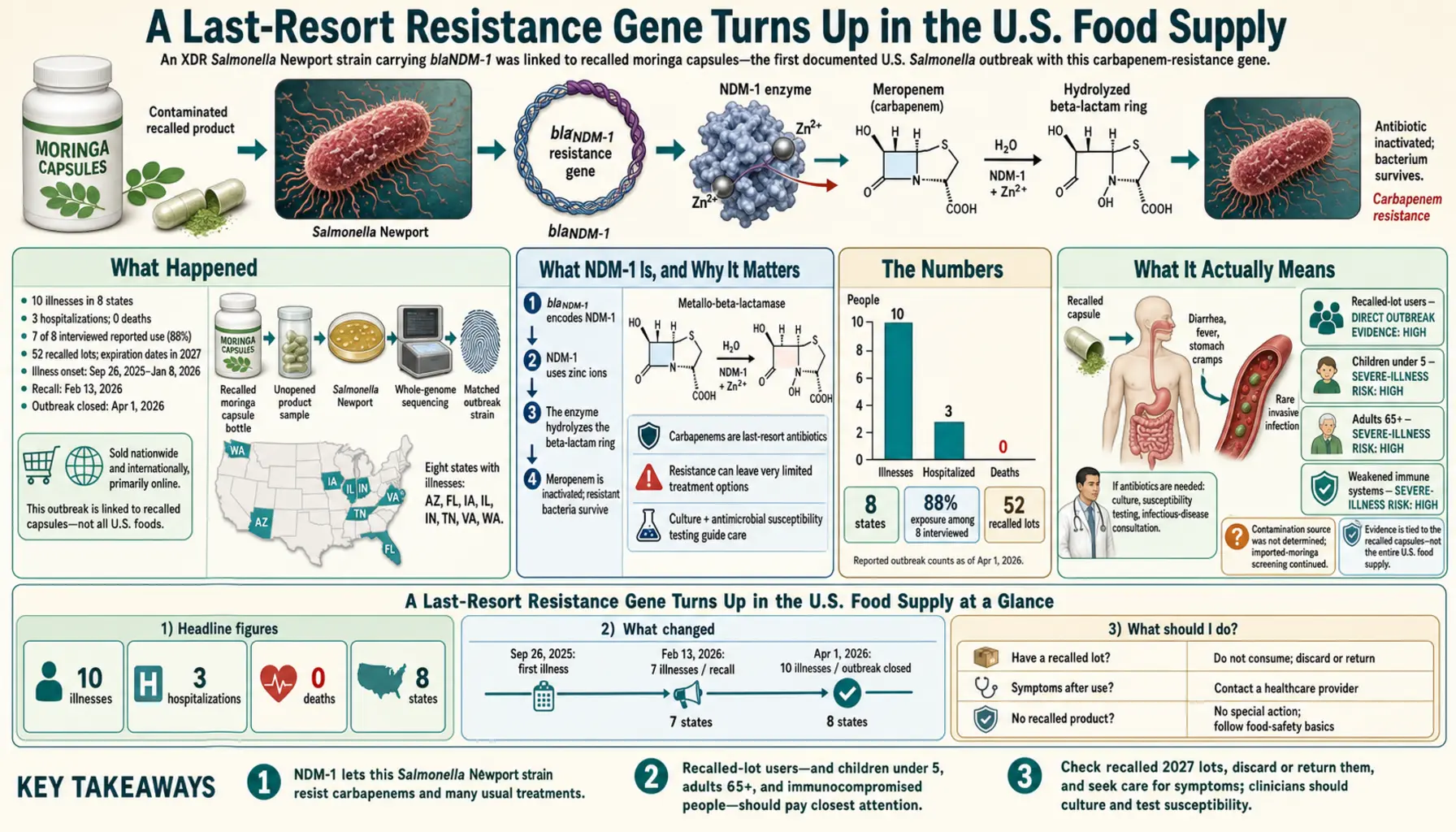
On April 1, 2026, the U.S. Centers for Disease Control and Prevention (CDC) declared a small foodborne outbreak over — one the agency describes as a first for the country. An extensively drug-resistant (XDR) strain of Salmonella, carrying a resistance gene called NDM-1 that disables carbapenems, a class of last-resort antibiotics, had been linked to a contaminated dietary supplement: moringa powder capsules. The outbreak was small, and no one died; what set it apart was the gene.
Table of Contents
- 1. What Happened
- 2. What NDM-1 Is, and Why It Matters
- 3. The Numbers
- 4. What It Actually Means
- 5. Honest Caveats
- 6. Key Points
- Sources
- Key Research Papers
- Featured Videos
1. What Happened
Between late September 2025 and early January 2026, 10 people in 8 states fell ill with one of two outbreak strains: Salmonella Newport (8 people) and Salmonella Kentucky (2 people). Of the 8 people interviewed, 7 (88%) reported taking moringa powder capsules of a single brand, sold as a nutritional supplement, and an unopened product sample that the Indiana Department of Health collected from a sick person’s home carried the outbreak strain of Salmonella Newport by whole-genome sequencing. On February 13, 2026, the product’s distributor recalled certain lots (52 lot codes, all with 2027 expiration dates), and the FDA and CDC announced their outbreak investigation. By April 1, 2026, the CDC had declared the outbreak over. Its clinical overview for physicians, dated April 1, 2026, states: “This is the first documented outbreak of Salmonella with an NDM-1 gene in the United States.” The word “outbreak” matters: an NDM-producing Salmonella isolate had already been identified in the United States, one of nine NDM-producing isolates that a CDC laboratory characterized from eight patients between April 2009 and March 2011, all of whom had recently been in India or Pakistan.
2. What NDM-1 Is, and Why It Matters
NDM-1 stands for New Delhi metallo-β-lactamase-1, an enzyme first described in 2009 in a carbapenem-resistant Klebsiella pneumoniae isolate from a Swedish patient of Indian origin who had traveled to New Delhi and developed a urinary tract infection there. It belongs to a family called carbapenemases — enzymes that break down carbapenems, the powerful β-lactam antibiotics (such as meropenem) that doctors hold in reserve for the most dangerous infections. The 2009 paper found that NDM-1 can break down every β-lactam antibiotic except aztreonam. When a common foodborne germ carries a carbapenemase, one of medicine’s last lines of defense no longer works against it.
The outbreak strain lived up to the “extensively drug-resistant” label. The CDC’s clinical overview states that infection with the Salmonella Newport strain “may not be treatable with” amoxicillin-clavulanic acid, ampicillin, azithromycin, ceftriaxone, ciprofloxacin, meropenem, and trimethoprim-sulfamethoxazole, and the FDA describes the outbreak strains as resistant to all first-line and alternative antibiotics commonly recommended for Salmonella infections. NDM-1 is usually carried on plasmids: small, mobile loops of DNA that bacteria can pass to one another. In the 2009 report the gene sat on a transferable stretch of DNA in the Klebsiella isolate and on a plasmid in an E. coli strain from the same patient’s stool; a 2010 study of isolates from India, Pakistan and the UK found that most carried NDM-1 on plasmids; and plasmids carrying NDM-1 have since been found in Acinetobacter baumannii and transferred from it to E. coli in the laboratory. That mobility is why a carbapenemase gene in a foodborne germ draws attention: a gene on a plasmid can move into other species, such as E. coli or Klebsiella, carrying last-resort resistance with it.
3. The Numbers
As of the April 1 close-out, the tally was small: 10 people infected across 8 states (Arizona, Florida, Illinois, Indiana, Iowa, Tennessee, Virginia and Washington), 3 hospitalized, and no deaths. Illness-onset dates ran from September 26, 2025 through January 8, 2026. Outbreaks linked to contaminated produce or poultry can sicken hundreds, so by case count this was a minor event; the attention it drew came from the resistance profile rather than the number of cases.
4. What It Actually Means
It helps to separate two very different questions: what this means for a sick individual, and what it means for public health.
For the individual patient, antibiotics usually are not the point. The CDC notes that most patients with Salmonella diarrheal illness need only supportive care and that most recover completely within a week (the FDA puts typical symptoms at four to seven days). A Cochrane review of 12 trials (767 participants) found no evidence of benefit from antibiotics for nontyphoidal Salmonella diarrhea in otherwise healthy people, and people given antibiotics were almost twice as likely to still be passing the same Salmonella a month later. CDC guidance describes antibiotics as an option for people with severe diarrhea, bloodstream infection or infection outside the gut, and for people at higher risk of invasive disease: infants, adults 50 and older with atherosclerosis, and people with immunosuppression, heart disease or major joint disease. For that vulnerable minority, an XDR strain is a real problem, because the familiar drugs fail. The CDC’s fallback list is short — for uncomplicated infection it points clinicians to existing information on oral fosfomycin, and for complicated or invasive infection to guidance on NDM-producing bacteria that discusses cefiderocol alone or aztreonam-avibactam — and the agency states that “CDC and professional societies do not have evidence-based recommendations for treating infection with XDR Salmonella with carbapenemase genes.” The CDC’s whole-genome analysis predicted that the second outbreak strain, Salmonella Kentucky, was resistant to fosfomycin, though not to meropenem.
For public health, the significance lies in where the gene turned up. The first NDM-producing bacteria identified in the United States came from patients who had received health care abroad: in the CDC laboratory’s 2009–2011 series, all eight patients had recently been in India or Pakistan, and six had been hospital inpatients there. In this outbreak a carbapenemase gene reached people by way of a dietary supplement sold in online stores, outside any hospital setting.
5. Honest Caveats
A few things are worth stating plainly, so this is neither dismissed nor overblown:
- It was small, and it is over. Ten reported cases, three hospitalizations and no deaths. The significance lies in the mechanism and the vehicle, not in the harm this particular outbreak caused.
- The finding concerns a contaminated product, not the plant. Moringa oleifera is a nutrient-rich tree with a long history of use as food and traditional medicine. The FDA traced the affected moringa powder to a single supplier but could not determine the source of contamination; every product of the recalled brand made with powder from that supplier was recalled, and the FDA continues to screen imported moringa through sample collection. Dietary supplements in the U.S. are not reviewed by the FDA for safety before they are sold.
- “Untreatable by antibiotics” does not equal “untreatable.” Because most Salmonella infections are managed with supportive care and never call for antibiotics, an XDR strain changes the outcome for relatively few people. The risk is concentrated in the vulnerable minority who do need drugs.
- The lasting concern is spread, not this outbreak. The longer-term risk described in the research on NDM-1 is its movement between bacteria on plasmids; the 2010 study of isolates from India, Pakistan and the UK concluded that NDM-1’s potential to become a worldwide public health problem is great. That spread is a slow, largely invisible process that a recall does not end.
6. Key Points
Three points stand out in the agencies’ reports. First, the recall: the recalled lots were sold nationwide and internationally through online stores, and both the CDC and the FDA note that the product has a long shelf life, so recalled bottles may still be in homes. Second, prevention: the FDA’s response paired the recall with continued screening of imported moringa, and its consumer notice covers cleaning and sanitizing surfaces and containers the recalled product touched — measures that do not depend on any antibiotic working, which matters more when the usual antibiotics no longer work. Third, scale: the arrival of a last-resort resistance gene in a U.S. foodborne outbreak is a milestone in the record of infectious disease and antimicrobial resistance, and it came in an outbreak with ten reported cases and no deaths.
Sources
- Centers for Disease Control and Prevention. Clinical Overview of Extensively Drug-Resistant Salmonella Newport with an NDM-1 Gene. Page dated April 1, 2026. cdc.gov/salmonella/hcp/clinical-overview/xdr-salmonella-ndm1.html
- Centers for Disease Control and Prevention (Newsroom). Extensively Drug-Resistant Salmonella Outbreak Linked to Moringa Powder Capsules. February 13, 2026. cdc.gov/media/releases/2026
- U.S. Food and Drug Administration. Outbreak Investigation of Extensively Drug-Resistant Salmonella: Moringa Powder (February 2026). fda.gov/food/outbreaks-foodborne-illness
- American Academy of Pediatrics, Red Book Online. Extensively Drug-Resistant Salmonella Outbreak Linked to Moringa Powder Capsules. 2026. publications.aap.org/redbook
- Yong D, Toleman MA, Giske CG, et al. Characterization of a new metallo-β-lactamase gene, bla(NDM-1), and a novel erythromycin esterase gene carried on a unique genetic structure in Klebsiella pneumoniae sequence type 14 from India. Antimicrob Agents Chemother. 2009;53(12):5046–5054. doi:10.1128/AAC.00774-09 · PMID 19770275
Key Research Papers
Primary papers behind the background in this article, each checked against its PubMed record and Crossref. The outbreak figures come from the CDC and FDA pages listed under Sources.
- Yong D, Toleman MA, Giske CG, Cho HS, Sundman K, Lee K, Walsh TR (2009). Characterization of a new metallo-beta-lactamase gene, bla(NDM-1), and a novel erythromycin esterase gene carried on a unique genetic structure in Klebsiella pneumoniae sequence type 14 from India. Antimicrobial Agents and Chemotherapy 53(12):5046-5054. — PubMed PMID: 19770275
- Kumarasamy KK, Toleman MA, Walsh TR, Bagaria J, Butt F, Balakrishnan R, et al. (2010). Emergence of a new antibiotic resistance mechanism in India, Pakistan, and the UK: a molecular, biological, and epidemiological study. Lancet Infectious Diseases 10(9):597-602. — PubMed PMID: 20705517
- Chen Y, Zhou Z, Jiang Y, Yu Y (2011). Emergence of NDM-1-producing Acinetobacter baumannii in China. Journal of Antimicrobial Chemotherapy 66(6):1255-1259. — PubMed PMID: 21398294
- Rasheed JK, Kitchel B, Zhu W, Anderson KF, Clark NC, Ferraro MJ, et al. (2013). New Delhi metallo-β-lactamase-producing Enterobacteriaceae, United States. Emerging Infectious Diseases 19(6):870-878. — PubMed PMID: 23731823
- Onwuezobe IA, Oshun PO, Odigwe CC (2012). Antimicrobials for treating symptomatic non-typhoidal Salmonella infection. Cochrane Database of Systematic Reviews 11:CD001167. — PubMed PMID: 23152205