Shiitake for Cholesterol and Heart Health
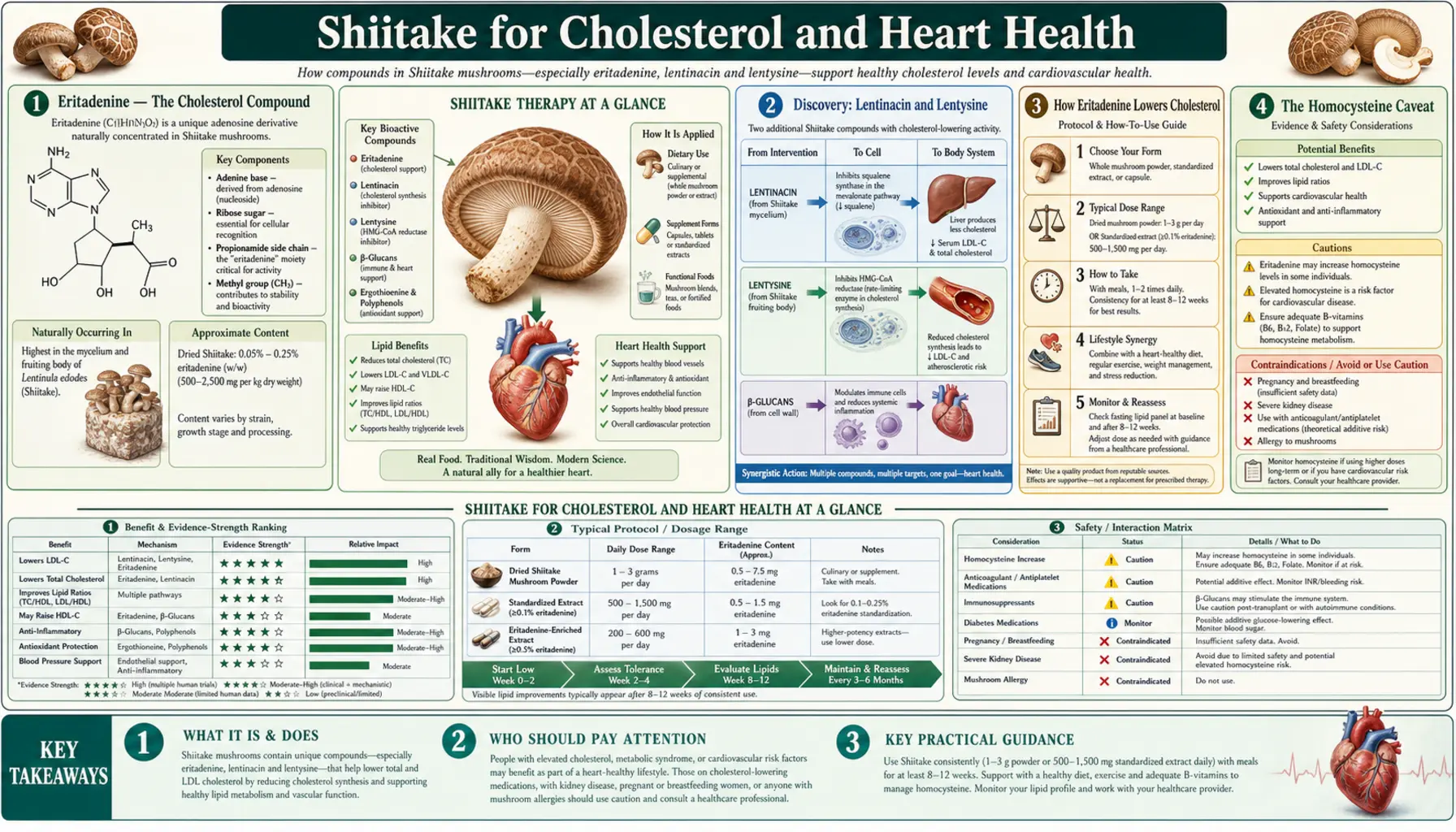
Shiitake is unusual among foods in containing a specific molecule — eritadenine — that lowers blood cholesterol through a defined biochemical mechanism. Discovered in 1969 and first named lentinacin, eritadenine reliably reduces plasma cholesterol in animal experiments by interfering with how the liver processes phospholipids. That is a genuine, reproducible laboratory finding. It is also where honesty has to enter: the strong evidence is in rats, the human cardiovascular trials are few and small, and eritadenine carries a real caveat — in rats fed diets low in choline it caused fatty liver. On homocysteine, a marker linked to cardiovascular risk, the two rat studies that measured it found that eritadenine suppressed a raised level. This page explains eritadenine, the beta-glucan fiber that adds a second cholesterol-lowering pathway, the value of shiitake simply as a low-calorie replacement for fattier foods, and a candid accounting of how much (and how little) the human evidence supports.
Table of Contents
- Eritadenine — The Cholesterol Compound
- Discovery: Lentinacin and Lentysine
- How Eritadenine Lowers Cholesterol
- Eritadenine Lowers Raised Homocysteine in Rats
- Beta-Glucan Fiber and Bile Acids
- Low Energy Density and Food Substitution
- What the Human Evidence Actually Shows
- Shiitake as Food: What the Evidence Supports
- Cautions
- Key Research Papers
- Connections
- Featured Videos
Eritadenine — The Cholesterol Compound
Eritadenine is a small molecule — chemically, 2(R),3(R)-dihydroxy-4-(9-adenyl)-butyric acid — built around an adenine base, the same base found in DNA and in the energy carrier adenosine triphosphate (ATP). It is present in shiitake at meaningful levels (a 2007 study by Enman and colleagues found that the amount varies by strain: the four strains it tested contained up to 10 times more eritadenine than previously reported for other shiitake strains). Unlike lentinan, the immune beta-glucan discussed on the Immune Support page, eritadenine is small, water-soluble, and readily absorbed — which is part of why its cholesterol effect shows up so consistently in feeding studies.
What makes eritadenine notable is that it is one of the very few naturally occurring food constituents with a specific, identified cholesterol-lowering mechanism rather than a vague "heart-healthy" association. Most cholesterol advice about food concerns broad patterns — fiber, saturated fat, plant sterols. Eritadenine is a discrete compound with a known enzyme target, which is why it has drawn decades of biochemical attention out of proportion to its practical footprint.
Discovery: Lentinacin and Lentysine
The cholesterol-lowering substance in shiitake was discovered independently by two Japanese groups around 1969–1970, which is why it briefly carried two names. Chibata and colleagues reported it in Experientia in 1969 as "lentinacin," describing it as a new hypocholesterolemic substance from Lentinus edodes. Rokujo and colleagues, publishing in Life Sciences in 1970, isolated the same active principle and called it "lentysine," describing it as a new hypolipidemic agent from a mushroom. The name that stuck — eritadenine — came into standard use as the chemistry was worked out.
These original reports established the core finding that has held up ever since: feeding the compound, or feeding shiitake itself, lowers plasma cholesterol in animals, and does so rapidly — measurable reductions appear within days, not weeks. The effect does not depend on the animal being cholesterol-loaded; it appears in normal diets and is amplified in high-cholesterol diets.
How Eritadenine Lowers Cholesterol
The mechanism, worked out largely by Kimikazu Sugiyama and colleagues through the 1990s, is unusual and worth understanding because it explains both the benefit and the side effect seen in rats. Eritadenine is not a fiber and does not simply block cholesterol absorption in the gut. Instead, it acts inside the liver on the enzyme S-adenosylhomocysteine hydrolase (SAH hydrolase).
SAH hydrolase sits in the methylation cycle, the pathway cells use to transfer single-carbon (methyl) groups. One important customer of that pathway in the liver is the conversion of phosphatidylethanolamine (PE) into phosphatidylcholine (PC) — a reaction that requires three sequential methylations. By inhibiting SAH hydrolase, eritadenine alters the ratio and molecular species of these phospholipids in the liver. Because phospholipids form the surface coat of the lipoprotein particles that carry cholesterol through the blood, changing hepatic phospholipid metabolism changes how cholesterol is packaged, secreted, and cleared. The net result in animals is a fall in plasma total cholesterol, driven mainly by a drop in the cholesterol carried on non-HDL lipoproteins.
The Sugiyama work is careful and mechanistic: it showed that eritadenine shifts the phosphatidylcholine molecular-species profile, that the effect interacts with the type of dietary fat, and that it is genuinely mediated through phospholipid metabolism rather than through cholesterol synthesis or absorption. This distinguishes eritadenine from statins (which block cholesterol synthesis) and from plant sterols or soluble fiber (which block absorption) — it is a third, distinct mechanism.
The 1995 study also supplies the timing. In rats fed eritadenine (50 mg/kg diet), the liver's phosphatidylcholine-to-phosphatidylethanolamine (PC:PE) ratio and its S-adenosylmethionine-to-S-adenosylhomocysteine (SAM:SAH) ratio fell significantly before plasma cholesterol fell (1 day vs 2 days after the start), and plasma cholesterol tracked the liver PC:PE ratio — supporting the idea that the change in liver phospholipid metabolism is a cause of the cholesterol drop. The same study found the documented downside: eritadenine caused fatty liver when added to diets containing 0 or 2 g/kg choline chloride, while a high level of choline chloride (8 g/kg) fully prevented the fatty liver without reducing the cholesterol-lowering effect.
Eritadenine Lowers Raised Homocysteine in Rats
The same methylation cycle that eritadenine perturbs also governs homocysteine, an amino acid whose elevation in blood has been associated with cardiovascular risk. Two 2006 rat studies measured what eritadenine does to it, and both found that it lowered a raised level. In the first, rats were given guanidinoacetic acid to raise their blood homocysteine; adding eritadenine (50 mg/kg diet) significantly suppressed that rise and restored the liver's S-adenosylmethionine level and the activity of the enzyme cystathionine beta-synthase, while it further increased liver S-adenosylhomocysteine. In the second, a methionine injection raised blood homocysteine; the rise was significantly suppressed in rats that had been fed eritadenine (50 mg/kg diet) for 10 days, the effect lasted up to 8 hours after the injection, liver homocysteine fell, and liver cystathionine beta-synthase activity rose. The authors suggest that eritadenine works in two ways: it slows the production of homocysteine from S-adenosylhomocysteine and speeds its removal through cystathionine beta-synthase. Both studies were in rats.
The documented animal downside lies elsewhere: in the 1995 rat study described above, eritadenine caused fatty liver in rats on diets low in choline, which a high-choline diet fully prevented. Whether either effect occurs at the modest eritadenine doses obtained from eating ordinary amounts of shiitake — as opposed to purified feeding in rodents — is not established in humans. The step from "eritadenine lowers cholesterol in rats" to "shiitake supplements protect the human heart" has not been tested: eritadenine remains a well-characterized compound studied mainly in animals rather than a proven cardiovascular therapy, and the whole-food reasons below are where shiitake's heart value is best supported.
Beta-Glucan Fiber and Bile Acids
Eritadenine is not the only route by which shiitake could influence blood lipids. Like oats and barley, mushrooms contain beta-glucan soluble fiber, along with chitin and other cell-wall polysaccharides. Soluble fibers are among the best-established dietary tools for lowering low-density lipoprotein (LDL) cholesterol: in the gut they form a viscous gel that binds bile acids, forcing the liver to draw on circulating cholesterol to make replacement bile acids, which lowers blood cholesterol. This bile-acid-sequestration mechanism is the same one behind the cholesterol claims for oat beta-glucan.
The amount and type of beta-glucan in shiitake differ from oats, and mushroom beta-glucans are studied more for immune signaling than for cholesterol binding, so it would be wrong to equate a serving of shiitake with a bowl of oats for low-density lipoprotein reduction. But the fiber content is real, contributes to the overall picture, and is one more reason mushrooms fit comfortably within a heart-healthy dietary pattern. The general fiber-and-lipid relationship is discussed in the context of atherosclerosis, the underlying disease process that cholesterol management aims to slow.
Low Energy Density and Food Substitution
Perhaps the most reliable cardiovascular benefit of shiitake has nothing to do with eritadenine or beta-glucan at all: it is a low-calorie, nutrient-dense, intensely savory food that can replace higher-calorie, higher-saturated-fat ingredients. Shiitake's meaty texture and rich umami make it an excellent partial substitute for red and processed meat — the "blended burger" approach of replacing part of the ground meat with chopped mushrooms cuts calories, saturated fat, and sodium while keeping flavor and satiety.
From a whole-diet perspective, this substitution effect may do more for cardiovascular risk than any single mushroom molecule. Diets that replace saturated-fat-rich animal foods with vegetables, whole grains, legumes, and mushrooms are consistently associated with lower cardiovascular risk. Shiitake earns its place in a heart-healthy kitchen primarily as a delicious, filling, low-energy-density ingredient — a role explored further on the Nutrition & Metabolic Health page.
What the Human Evidence Actually Shows
It is important to state plainly how thin the human cardiovascular evidence for shiitake is. The great majority of the cholesterol data — the eritadenine mechanism, the dose-response, the phospholipid shifts, the triglyceride reductions — comes from rodent studies such as those by Sugiyama and by Handayani and colleagues (who showed dietary shiitake prevented fat deposition and lowered triglycerides in rats on a high-fat diet). Rodent hypocholesterolemia does not automatically translate to humans, and the net cardiovascular effect in people is unknown.
Direct human trials of shiitake for cholesterol are sparse and small, and they do not add up to a convincing body of evidence. Two randomized, double-blind, placebo-controlled trials appeared in 2021:
- Shiitake bars. 68 adults with borderline-high cholesterol, low-density lipoprotein or triglycerides ate either shiitake bars (36 people) or placebo bars (32 people). After 66 days the shiitake group showed a 10% reduction in triglycerides (P = 0.0352); its reduced glutathione, the body's main built-in antioxidant, rose and lipid peroxidation fell. Eating the mushroom triggered dermatitis in 10% of individuals sensitive to it.
- A shiitake beta-glucan extract. 52 adults aged 18 to 65 with untreated mild high cholesterol took a beta-glucan-enriched shiitake mixture (10.4 g/day, providing 3.5 g/day of fungal beta-glucans) or a placebo for eight weeks. The mixture had lowered cholesterol in test-tube and animal studies, but in these people no significant differences in lipid- or cholesterol-related parameters were found compared with placebo. It was safe, and it changed the gut bacteria differently from placebo.
There is no large, well-controlled randomized trial demonstrating that eating shiitake, or taking shiitake or eritadenine supplements, meaningfully lowers low-density lipoprotein cholesterol or reduces cardiovascular events in people. Describing shiitake as a proven natural cholesterol treatment goes beyond the data.
The defensible summary: shiitake contains a real, well-characterized cholesterol-lowering compound and useful soluble fiber; the mechanism is fascinating and the animal data robust; the human evidence is not yet there; and shiitake's best-supported heart role is as a nutritious, low-calorie food that can take the place of foods that genuinely raise cardiovascular risk. The trials so far have not tested it as a replacement for established measures such as diet pattern, physical activity, not smoking, and, when indicated, statin therapy. Blood cholesterol is measured with a lipid panel.
Shiitake as Food: What the Evidence Supports
- A food within a heart-healthy pattern, not a drug. Its best-supported cardiovascular value is as a low-calorie, savory replacement for fattier ingredients within an overall good diet.
- A way to displace saturated fat. Replacing part of the meat in burgers, meatballs, chili, and pasta sauces with finely chopped shiitake cuts saturated fat and calories while keeping umami depth.
- Not a substitute for prescribed cholesterol medication. No shiitake product has been shown to substitute for statins or other prescribed lipid therapy. Decisions about reducing medication belong with a clinician, guided by lipid panel results.
- Eritadenine and "cholesterol mushroom" supplements. Concentrated products lean on rodent data, and in rats on low-choline diets eritadenine caused fatty liver. The safety record is for whole cooked mushrooms in ordinary culinary amounts.
- Cooking. Raw or lightly cooked shiitake can cause shiitake dermatitis, and thorough cooking is reported to prevent it (see the Nutrition & Metabolic Health page).
Cautions
- Cardiovascular benefit is unproven in humans. The cholesterol-lowering data are overwhelmingly from animals; shiitake is not a validated cardiovascular therapy.
- Fatty liver in rats. Eritadenine caused fatty liver in rats fed diets containing 0 or 2 g/kg choline chloride; 8 g/kg choline chloride fully prevented it. On homocysteine, two rat studies found that eritadenine suppressed a raised level.
- Not a statin replacement. The shiitake trials so far did not test the mushroom in place of lipid-lowering medication.
- Whole food over extract. The safety record is for shiitake as ordinary cooked food; concentrated eritadenine supplements have no established human safety or efficacy profile.
- Raw shiitake. Raw or undercooked shiitake can cause shiitake (flagellate) dermatitis; in the 2021 shiitake-bar trial, dermatitis appeared in 10% of individuals sensitive to the mushroom.
Key Research Papers
- Chibata I, Okumura K, Takeyama S, Kotera K (1969). Lentinacin: a new hypocholesterolemic substance in Lentinus edodes. Experientia. — PubMed PMID: 5391883
- Rokujo T, Kikuchi H, Tensho A, et al. (1970). Lentysine: a new hypolipidemic agent from a mushroom (Lentinus edodes). Life Sciences 9(7):379-85. — PubMed PMID: 5463059
- Sugiyama K, Akachi T, Yamakawa A (1995). Hypocholesterolemic action of eritadenine is mediated by a modification of hepatic phospholipid metabolism in rats. Journal of Nutrition 125(8):2134-44. — PubMed PMID: 7643248
- Sugiyama K, Yamakawa A, Kawagishi H, Saeki S (1997). Dietary eritadenine modifies plasma phosphatidylcholine molecular species profile in rats fed different types of fat. Journal of Nutrition. — PubMed PMID: 9109610
- Sugiyama K, Yamakawa A (1996). Dietary eritadenine-induced alteration of molecular species composition of phospholipids in rats. Lipids 31(4):399-404. — PubMed PMID: 8743052
- Enman J, Rova U, Berglund KA (2007). Quantification of the bioactive compound eritadenine in selected strains of shiitake mushroom (Lentinus edodes). Journal of Agricultural and Food Chemistry. — PubMed PMID: 17256958
- Handayani D, Chen J, Meyer BJ, Huang XF (2011). Dietary shiitake mushroom (Lentinus edodes) prevents fat deposition and lowers triglyceride in rats fed a high-fat diet. Journal of Obesity. — PubMed PMID: 22028957
- Yoon KN, Alam N, Lee JS, Cho HJ, Kim HY, Shim MJ, Lee MW, Lee TS (2011). Antihyperlipidemic Effect of Dietary Lentinus edodes on Plasma, Feces and Hepatic Tissues in Hypercholesterolemic Rats. Mycobiology 39(2):96-102. — PubMed PMID: 22783084
- Fukada S, Setoue M, Morita T, Sugiyama K (2006). Dietary eritadenine suppresses guanidinoacetic acid-induced hyperhomocysteinemia in rats. Journal of Nutrition 136(11):2797-802. — PubMed PMID: 17056803
- Sekiya A, Fukada S, Morita T, Kawagishi H, Sugiyama K (2006). Suppression of methionine-induced hyperhomocysteinemia by dietary eritadenine in rats. Bioscience, Biotechnology, and Biochemistry 70(8):1987-91. — PubMed PMID: 16880595
- Spim SRV, Pistila AMH, Pickler TB, Silva MT, Grotto D (2021). Effects of Shiitake Culinary-Medicinal Mushroom, Lentinus edodes (Agaricomycetes), Bars on Lipid and Antioxidant Profiles in Individuals with Borderline High Cholesterol: A Double-Blind Randomized Clinical Trial. International Journal of Medicinal Mushrooms 23(7):1-12. — PubMed PMID: 34375514
- Morales D, Shetty SA, López-Plaza B, Gómez-Candela C, Smidt H, Marín FR, Soler-Rivas C (2021). Modulation of human intestinal microbiota in a clinical trial by consumption of a β-D-glucan-enriched extract obtained from Lentinula edodes. European Journal of Nutrition 60(6):3249-3265. — PubMed PMID: 33580297
PubMed Topic Searches
- PubMed: Eritadenine and cholesterol
- PubMed: Eritadenine / homocysteine
- PubMed: Shiitake and blood lipids
- PubMed: Mushroom beta-glucan and cholesterol