⚠ Evidence warning: Clinical trials or other evidence do not support the claim that celery juice heals chronic illness, restores "unproductive" stomach acid, kills Epstein-Barr virus and other pathogens, detoxifies the liver and contains "cluster salts". This page keeps it as a report of what people, websites or other media say.
The Celery Juice Claims: What the Evidence Shows
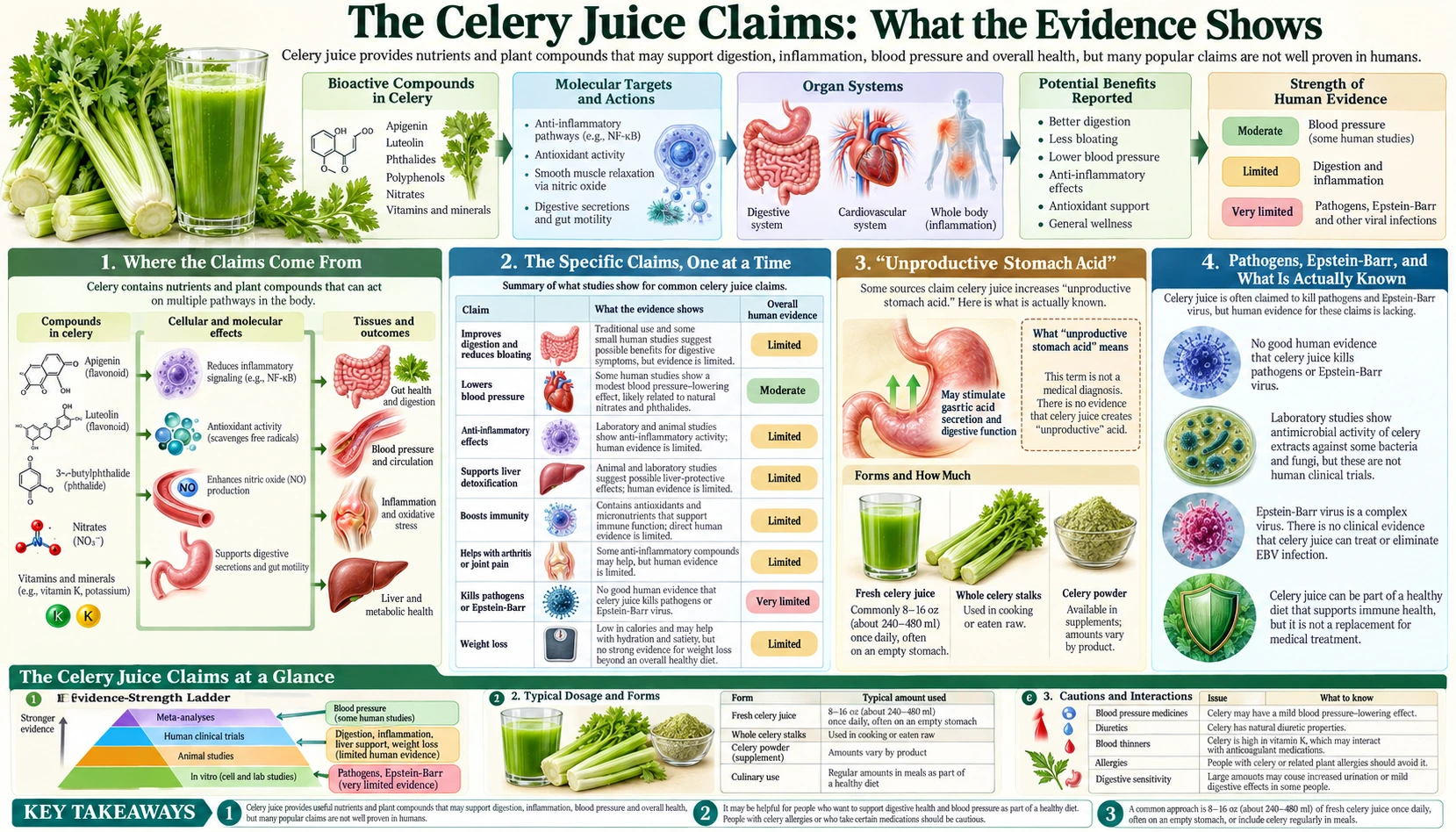
A great many people arrive at a page about celery because of one thing: the morning glass of celery juice, and the claim that it heals chronic illness. If that is you, you deserve a straight answer rather than either an enthusiastic endorsement or a sneer. Here it is. The specific medical claims made by the celery juice movement — that it repairs “unproductive” stomach acid, that it kills the pathogens behind most chronic disease, that it detoxifies the liver and reverses named illnesses — come from a single popular wellness author whose books describe the information as coming from a spiritual source, not from research. There are no clinical trials behind them. That is worth knowing before you rearrange your morning around it. What celery juice does contain is genuinely worth knowing too: water, potassium, a real load of dietary nitrate, some vitamin K and folate, the flavones apigenin and luteolin, and — because juicing throws the pulp away — almost none of celery’s fibre. This page separates the two.
Table of Contents
- Where the Claims Come From
- The Specific Claims, One at a Time
- “Unproductive Stomach Acid”
- Pathogens, Epstein-Barr, and What Is Actually Known
- “Detox” and What the Liver and Kidneys Do
- What Celery Juice Actually Provides
- Juicing Throws Away the Fibre
- Why People Genuinely Feel Better on It
- The Real Risks
- What Changes the Value of the Same Morning Habit
- How to Judge the Next Claim
- Key Research Papers
- Connections
- Featured Videos
Where the Claims Come From
The modern celery juice movement traces to one source: a popular wellness author and social-media personality. Beginning around 2018 the author’s books and social media accounts promoted drinking sixteen ounces of straight celery juice on an empty stomach every morning, and the practice spread rapidly enough to move retail celery prices.
The important fact about the source is not hidden or disputed — it is stated in the author’s books and interviews. The health information is described there as coming from a spiritual source, and the claims are not presented as derived from research. Read on its own terms, the celery juice protocol is not a scientific claim that happens to lack evidence; it is a claim of a different kind altogether, offered as revelation.
People find that either obviously disqualifying or beside the point, and it is worth being fair about why. Someone with a chronic illness that medicine has handled badly — long diagnostic delays, dismissive appointments, treatments that did not work — is not being foolish when they try something a lot of people say helped them. Being failed by a system is a reasonable thing to respond to. The problem is not the person trying it; it is that the claims themselves, when examined, do not describe how the body works, and following them can mean spending money and hope on the wrong thing.
So the rest of this page does the examination rather than the arguing.
The Specific Claims, One at a Time
The protocol comes with a defined set of claims. In summary form, celery juice is said to:
- contain undiscovered mineral salts — described as “cluster salts” — that are not known to chemistry;
- restore or strengthen hydrochloric acid in a stomach whose acid has become “unproductive”;
- destroy or weaken viruses and bacteria, particularly Epstein-Barr virus, held to be the hidden cause of a long list of chronic conditions;
- detoxify the liver of heavy metals, pesticides and “viral waste”;
- thereby improve or resolve autoimmune thyroid disease, eczema and psoriasis, chronic fatigue, fibromyalgia, migraine, acne, digestive disease and more.
Two things are true of every item on that list. No randomised controlled trial supports any of them. And several of them describe mechanisms that are not merely unproven but inconsistent with well-established physiology, which is a stronger objection than simply lacking data. “Cluster salts” is the clearest example: it is not a recognised class of compound, it has no analytical definition, and no laboratory has reported isolating it from celery or anything else. A named substance that only exists inside the author’s books is not an unstudied discovery; it is an unfalsifiable claim.
“Unproductive Stomach Acid”
This claim deserves individual attention because it sounds plausible and sits next to something real.
What is real: stomach acid genuinely can be too low. Hypochlorhydria and achlorhydria are recognised conditions, caused by autoimmune atrophic gastritis, long-term proton-pump inhibitor use, Helicobacter pylori infection, gastric surgery, and ageing. Low stomach acid genuinely does impair the absorption of vitamin B12, iron and calcium, and genuinely does raise the risk of small intestinal bacterial overgrowth. This is diagnosable — by gastric pH testing, gastrin levels, parietal cell antibodies and endoscopy — and it is treatable.
What is not real: the idea that stomach acid becomes chemically weak or “unproductive” while still being present, and that a vegetable juice can restore its potency. Gastric acid is hydrochloric acid, secreted by parietal cells. There is one kind. It is either being secreted or it is not, and how much is being secreted is measurable. There is no recognised state in which the acid is present but has lost its power, and no mechanism by which drinking celery juice would strengthen it. If anything, a large volume of a low-acid liquid on an empty stomach transiently dilutes and raises gastric pH rather than lowering it.
Bloating, early fullness, B12 deficiency, iron deficiency without an obvious cause, and years on acid-suppressing medication are the situations in which low stomach acid is suspected, and it is diagnosed by gastric pH testing, gastrin levels, parietal cell antibodies and endoscopy. Juice is not a substitute for that testing; delaying the investigation is the part that costs something. See gastroesophageal reflux disease (GERD) and Gut Health.
Pathogens, Epstein-Barr, and What Is Actually Known
The pathogen claim has two halves, and being accurate means separating them, because one half is nearly right.
Epstein-Barr virus is a real and important virus. More than ninety percent of adults worldwide carry it for life after infection. It causes glandular fever, it is causally linked to several cancers including Burkitt lymphoma and nasopharyngeal carcinoma, and — in a major 2022 study in Science by Kjetil Bjornevik and colleagues, using two decades of stored serum samples from more than ten million US military personnel — the risk of multiple sclerosis rose 32-fold after Epstein-Barr infection (955 of the cohort were diagnosed with multiple sclerosis during service), and the authors concluded that their findings suggest the virus as the leading cause of multiple sclerosis. Serious researchers do think a common latent virus can be behind a chronic disease. That idea is not fringe.
What does not follow. The claim in the celery juice literature is far broader: that Epstein-Barr virus (EBV), plus heavy metals, drives the great majority of chronic illness — thyroid disease, fibromyalgia, chronic fatigue, and much else — and that celery juice weakens or kills it. Neither part has support. There is no trial showing celery juice affects Epstein-Barr virus viral load, Epstein-Barr virus reactivation, or any clinical outcome in any Epstein-Barr virus-associated disease. There is no plausible mechanism by which a vegetable juice would suppress a herpesvirus that persists inside memory B cells; the antiviral drugs that do act on Epstein-Barr virus are specific nucleoside analogues, and even they perform poorly against latent infection. And the attribution of most chronic disease to a single virus is not what the evidence on those diseases shows.
The pattern here is common in health misinformation and worth recognising: take a real and genuinely under-appreciated scientific finding, stretch it to explain everything, and attach a simple product to it. The first step earns credibility that the second and third steps then spend.
“Detox” and What the Liver and Kidneys Do
“Detox” is the most durable idea in commercial wellness and one of the emptiest. A critical review of the evidence by Alice Klein and Hosen Kiat, published in the Journal of Human Nutrition and Dietetics, found very little clinical evidence to support detox diets: a handful of clinical studies reported that commercial detox diets enhance liver detoxification and eliminate persistent organic pollutants, but those studies were hampered by flawed methods and small sample sizes, and to the authors’ knowledge no randomised controlled trial had tested a commercial detox diet in humans.
Your body already runs a continuous, sophisticated detoxification system. The liver converts fat-soluble compounds into water-soluble ones through two coordinated phases of enzymatic processing; the kidneys filter and excrete; the gut, lungs and skin contribute. That system does not stall and does not need starting. Where it can be genuinely overwhelmed — paracetamol overdose, alcoholic liver disease, real heavy-metal poisoning — the treatment is specific antidotes and chelating agents given under medical care, not vegetable juice.
Two things a “detox” regimen does reliably do, and they explain a great deal of the testimony: it displaces alcohol, ultra-processed food and sugar, and it comes with a strong sense of taking control. Both are real and both are worth having. Neither requires the theory.
What Celery Juice Actually Provides
Setting the claims aside entirely, here is what is genuinely in a large glass of celery juice.
- Water — a lot of it. Celery is around ninety-five percent water. A sixteen-ounce glass is close to half a litre of hydration first thing in the morning, which is not nothing for people who habitually start the day dehydrated.
- Potassium. Juicing concentrates the potassium of several stalks into one glass. Potassium genuinely lowers blood pressure and helps the kidney handle sodium; the evidence for that is solid. See Potassium.
- Dietary nitrate — and this is the most interesting one. Celery is in the top nitrate tier of vegetables, and dietary nitrate is converted via mouth bacteria into nitrite and then nitric oxide, which relaxes blood vessels. A large glass of celery juice is a substantial nitrate dose. Of everything on this page, this is the mechanism with the best claim to producing a measurable physiological effect, and it is explained fully on the Blood Pressure and Dietary Nitrate page. It is also, notably, not a claim the movement makes.
- Vitamin K and folate in useful amounts, plus modest vitamin C and vitamin A precursors.
- Apigenin and luteolin, celery’s flavones, at real but small concentrations — see Flavones and Phthalides for what that does and does not mean.
- Some sodium, because celery is a salt-marsh plant and contains more of it than most vegetables. Irrelevant in ordinary amounts; worth knowing if you are on a strict sodium restriction and drinking large volumes daily.
- Almost no fibre, which is the subject of the next section.
That is a decent list. It describes a hydrating, mineral-rich, nitrate-rich vegetable drink — a reasonable thing to enjoy. It does not describe a treatment.
The closest the research comes to a measured celery effect is a 2025 meta-analysis by Liu and colleagues of ten randomised controlled trials with 511 participants. Celery preparations lowered systolic blood pressure (standardised mean difference −1.0) and diastolic blood pressure (−0.93), as well as fasting blood glucose and triglycerides, with no significant difference in adverse events from placebo; celery seeds or celery preparations exceeding 1,000 mg/day were more effective than other parts of celery. The authors noted substantial heterogeneity and limited sample sizes, and called for further high-quality trials with longer follow-up.
Juicing Throws Away the Fibre
This is the concrete, unarguable downside, and it is the one thing about celery juice that is clearly worse than eating celery.
A juicer separates liquid from pulp and discards the pulp. The pulp is the fibre. Celery’s fibre is one of its genuinely good features — it is the reason a stalk is filling for almost no calories, and it is food for the bacteria in your colon, which ferment it into short-chain fatty acids that feed the cells of the gut lining.
The evidence for dietary fibre is among the strongest in all of nutrition. A large series of systematic reviews and meta-analyses led by Andrew Reynolds and published in The Lancet in 2019 found that higher fibre intake was associated with substantially lower all-cause mortality, coronary heart disease, stroke, type 2 diabetes and colorectal cancer, with a clear dose-response relationship. Most people eat well under the recommended amount. Removing fibre from a vegetable and drinking the rest is moving in the wrong direction.
Blending instead of juicing keeps the fibre: a blender keeps everything the juicer keeps and adds back the fibre. It is thicker and less elegant, and it is nutritionally better in every respect.
Why People Genuinely Feel Better on It
The testimony is real. Large numbers of people report feeling better after starting celery juice, and dismissing that as imaginary is both rude and inaccurate. Several ordinary explanations account for it, and they are worth knowing because they point at what to keep.
- Hydration. Half a litre of fluid on waking corrects mild dehydration, which genuinely affects headache, concentration and fatigue.
- Displacement. The protocol requires an empty stomach, so the juice replaces whatever the morning used to involve — often a pastry, a sugary coffee, or nothing at all. That change alone can improve how someone feels.
- Nitrate and potassium. These are real, measurable effects on blood pressure and vascular function. They do not need the theory to work.
- The rest of the protocol. People who take up celery juice usually also cut alcohol, cut ultra-processed food, sleep more and pay attention to what they eat. Attributing the combined result to the juice is the classic confounding problem.
- Regression to the mean. Chronic conditions fluctuate. People start new regimens when they feel worst, and what follows a worst point is usually improvement, whatever they did.
- Expectation. Placebo effects are largest exactly where celery juice claims its wins — pain, fatigue, mood, bloating, self-rated wellbeing. This is a genuine physiological phenomenon, not a synonym for imaginary.
- Ritual and agency. Having something deliberate to do each morning, for your own health, is psychologically real and helps people follow through on other changes.
Notice that almost everything on that list is worth keeping. The habit is fine. It is the explanation that is wrong, and the cost of the wrong explanation is what the next section is about.
The Real Risks
Celery juice is not dangerous for most people. The risks are specific and mostly indirect.
- Delayed diagnosis and treatment. This is by far the biggest one. Attributing symptoms to “viral load” or “unproductive acid” and treating them with juice means not investigating what is actually happening. Autoimmune thyroid disease, coeliac disease, inflammatory bowel disease and many cancers present with exactly the vague fatigue-and-digestion picture the protocol claims to address, and all of them have effective treatments that work better the earlier they start.
- Allergy, concentrated. Celery is a recognised cause of anaphylaxis and a mandatory labelled allergen across the European Union. Juicing concentrates several stalks into one glass, which for a sensitised person is a large allergen dose taken on an empty stomach. See Allergy and Photosensitivity.
- Furanocoumarins, also concentrated. Celery contains psoralens, which cause a sunlight-triggered skin burn at high enough exposure and which increase in stored or spoiled celery. Reported cases of severe phytophotodermatitis after very large celery intakes exist and are the reason this is worth a line. The reported cases involve very large intakes combined with sun exposure, not occasional juice.
- Potassium load in kidney disease. Kidneys that are not working well may not be able to remove extra potassium, and a high blood potassium level (hyperkalaemia) can cause palpitations, a slow, weak or irregular pulse, and sudden collapse when the heartbeat becomes too slow or stops — signs hospitals treat as an emergency. Juicing concentrates the potassium of several stalks into one glass, which is why daily large-volume vegetable juice matters for people with advanced kidney disease or on a potassium-restricted diet.
- Blood-thinning medication. Celery carries vitamin K. The issue with warfarin is not celery but inconsistency — suddenly adding or stopping a daily large green juice can shift the international normalized ratio (INR). The warfarin label states that the amount of vitamin K in food may affect warfarin therapy and advises patients to keep a consistent amount of vitamin K in their diet.
- Cost and waste. Sixteen ounces of juice takes roughly a large bunch of celery per day. That is a meaningful weekly grocery cost and a lot of discarded pulp, for a drink you could substantially replicate by eating the vegetable.
What Changes the Value of the Same Morning Habit
For people who keep the morning ritual, these are the known ways the content and effect of the drink change.
- Blending keeps the fibre. Celery blended with a squeeze of lemon and a little water keeps the fibre as well as the potassium and the nitrate, and takes the same two minutes.
- The leaves are the most flavone-rich part of the plant and are usually thrown away.
- Other vegetables share the nitrate. Rocket, beetroot, spinach and chard are all in the same top nitrate tier; rotating them widens the range of compounds in the glass.
- The empty-stomach requirement comes from the theory, not from physiology. A drink that displaces actual food is a loss, not a gain; eggs, oats, brown rice porridge, plain yoghurt, fruit and nuts are fuller breakfasts than a glass of anything.
- Antiseptic mouthwash blunts the nitrate pathway. The bacteria on the tongue perform its first step. In Kapil and colleagues’ 2013 study of 19 healthy volunteers, seven days of a chlorhexidine antiseptic mouthwash cut oral nitrite production by 90% and plasma nitrite by 25%, and systolic and diastolic blood pressure rose by 2–3.5 mmHg.
- The juice does not replace investigation. For a chronic illness, the appointments, tests and treatment are what find and treat the cause. A vegetable drink added to them is fine; replacing them is the failure mode.
How to Judge the Next Claim
Celery juice will be replaced by something else, and probably soon. A few questions handle most of these cases, and they take about a minute.
- Where did the claim come from? Research, or a single author’s revelation, book or product line? This is not a trick question and the answer is usually stated openly.
- Does it name a substance or state that science does not recognise? “Cluster salts”, “unproductive acid”, “viral waste”. A genuinely new discovery is published and then argued about; it does not live only inside the book that sells it.
- Does one thing explain too much? A single cause for thyroid disease, fatigue, eczema, migraine and acne is the signature of a story rather than a finding.
- Is the evidence testimony? Before-and-after accounts are the weakest form of evidence and the most persuasive form of writing. That mismatch is the whole problem.
- What does it want you to stop doing? A claim that adds a vegetable is low-risk. A claim that tells you to stop your medication, skip your appointment or distrust your diagnosis has raised the stakes enormously.
- Would the ordinary explanation cover the result? More water, less alcohol, more vegetables, more sleep and a sense of control will produce a lot of testimonials on their own.
Celery has been here before, incidentally. The 1890s had a celery tonic craze built on the same shape of claim, and a celery soda from that era is still sold as a soft drink. That story is on the History page, and it is a useful reminder that this is a recurring pattern rather than a modern aberration.
Key Research Papers
Author names, titles and journals are plain text; only the DOI is a link, and each opens in a new tab. Note what is missing from this list: there are no trials of celery juice for any of the conditions the movement names, because none have been done. The papers below establish what is known about the underlying questions instead.
- Klein AV, Kiat H. Detox diets for toxin elimination and weight management: a critical review of the evidence. Journal of Human Nutrition and Dietetics. 2015;28(6):675-686. — the critical review of detox regimens, and what it failed to find. — doi:10.1111/jhn.12286
- Reynolds A, Mann J, Cummings J, et al. Carbohydrate quality and human health: a series of systematic reviews and meta-analyses. The Lancet. 2019;393(10170):434-445. — the fibre evidence that juicing discards. — doi:10.1016/s0140-6736(18)31809-9
- Bjornevik K, Cortese M, Healy BC, et al. Longitudinal analysis reveals high prevalence of Epstein-Barr virus associated with multiple sclerosis. Science. 2022;375(6578):296-301. — what a serious EBV-and-chronic-disease finding actually looks like. — doi:10.1126/science.abj8222
- Suarez-Lledo V, Alvarez-Galvez J. Prevalence of health misinformation on social media: systematic review. Journal of Medical Internet Research. 2021;23(1):e17187. — doi:10.2196/17187
- Illes J, Rodrigues J. The influence of celery (Apium graveolens) juice on hypertension. In: Reference Series in Phytochemistry. 2024:501-523. — the one celery-juice question that has a real literature behind it. — doi:10.1007/978-3-031-38663-3_72
- Liu D, Zhao H, Xu H, Hu J. Effects of celery (Apium graveolens) on blood pressure, glycemic and lipid profile in adults: a systematic review and meta-analysis of randomized controlled trials. Frontiers in Nutrition. 2025;12:1597680. — doi:10.3389/fnut.2025.1597680
- Kapil V, Haydar SM, Pearl V, Lundberg JO, Weitzberg E, Ahluwalia A. Physiological role for nitrate-reducing oral bacteria in blood pressure control. Free Radical Biology and Medicine. 2013;55:93-100. — doi:10.1016/j.freeradbiomed.2012.11.013
- Lundberg JO, Weitzberg E, Gladwin MT. The nitrate–nitrite–nitric oxide pathway in physiology and therapeutics. Nature Reviews Drug Discovery. 2008;7(2):156-167. — the mechanism by which celery juice plausibly does something real. — doi:10.1038/nrd2466
- Hord NG, Tang Y, Bryan NS. Food sources of nitrates and nitrites: the physiologic context for potential health benefits. The American Journal of Clinical Nutrition. 2009;90(1):1-10. — doi:10.3945/ajcn.2008.27131
- Aburto NJ, Hanson S, Gutierrez H, Hooper L, Elliott P, Cappuccio FP. Effect of increased potassium intake on cardiovascular risk factors and disease: systematic review and meta-analyses. BMJ. 2013;346:f1378. — doi:10.1136/bmj.f1378
- Kooti W, Daraei N. A review of the antioxidant activity of celery (Apium graveolens L). Journal of Evidence-Based Complementary & Alternative Medicine. 2017;22(4):1029-1034. — doi:10.1177/2156587217717415
- Ballmer-Weber BK, Vieths S, Lüttkopf D, et al. Celery allergy confirmed by double-blind, placebo-controlled food challenge: a clinical study in 32 subjects with a history of adverse reactions to celery root. Journal of Allergy and Clinical Immunology. 2000;106(2):373-378. — why a concentrated celery dose is not trivial for everyone. — doi:10.1067/mai.2000.107196
- Chaudhary SK, Ceska O, Warrington PJ, Ashwood-Smith MJ. Increased furocoumarin content of celery during storage. Journal of Agricultural and Food Chemistry. 1985;33(6):1153-1157. — doi:10.1021/jf00066a032
PubMed Topic Searches
- PubMed: celery juice, human clinical trials — a short list, and that is the point.
- PubMed: low stomach acid — diagnosis and consequences
- PubMed: Epstein-Barr virus, chronic disease and autoimmunity
- PubMed: juicing versus whole fruit and vegetables
- PubMed: placebo response in chronic fatigue and fibromyalgia trials. — Search PubMed
Connections
- All Food
- Celery
- Celery Benefits Deep Dive
- Celery: History and Origins — including the 1890s celery tonic craze
- Blood Pressure and Dietary Nitrate
- Apigenin, Luteolin and the Celery Phthalides
- Celery Allergy and Photosensitivity
- Celery Juice
- Gastroesophageal Reflux Disease
- Gut Health
- Potassium
- Vitamin K
- Beets
- Spinach
- Fermented Foods