Beets: Nutrient Profile
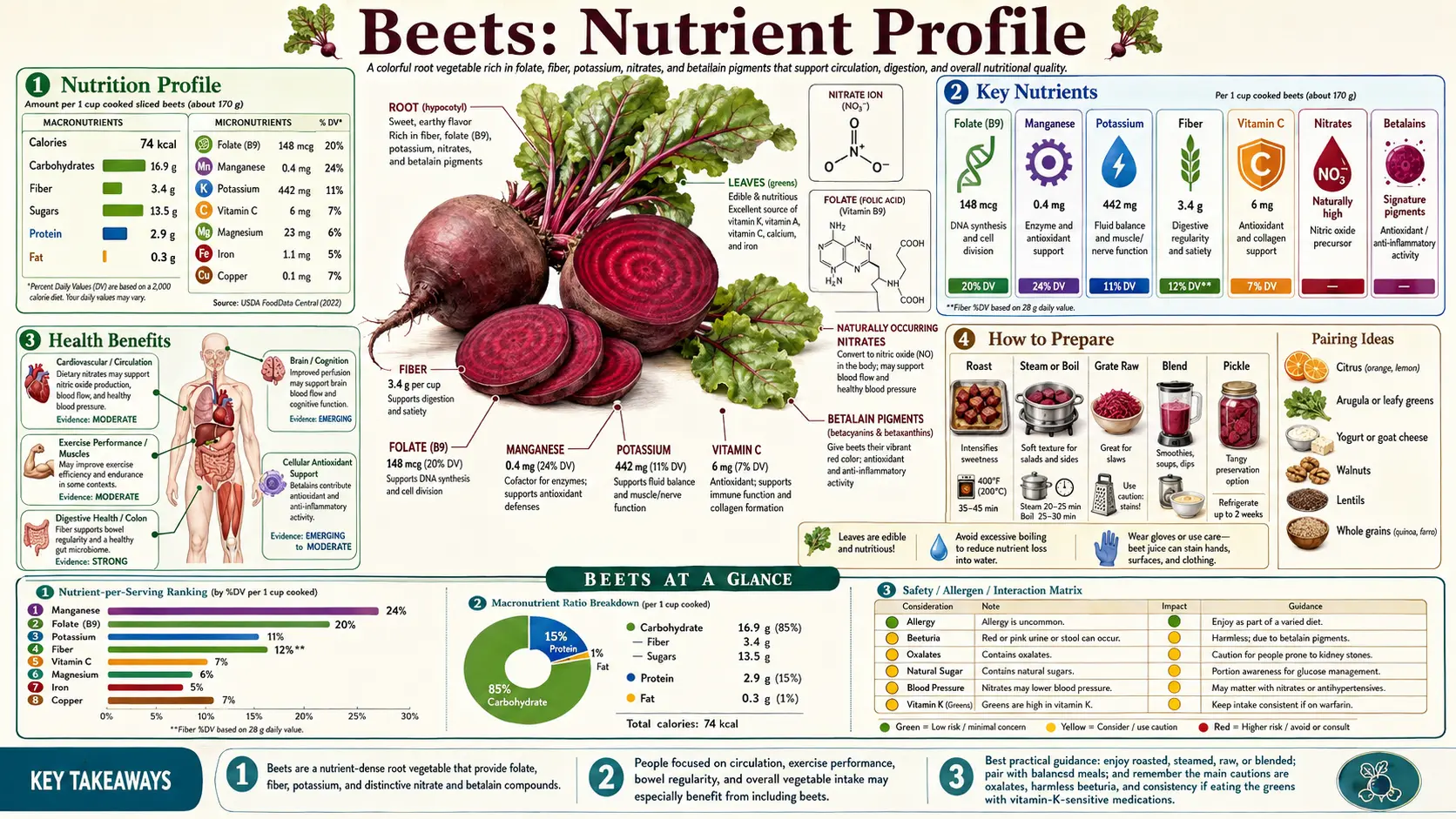
What is Beets richest in? Below are the vitamins, minerals and amino acids that 100 g of Beets delivers in the highest amounts. Each one links to that nutrient’s own page listing the best foods to get it from.
| Beets: Richest Nutrients (per 100 g) | ||||
|---|---|---|---|---|
| Rank | Nutrient | Per 100 g | %DV / 100g | Purpose |
| Vitamins | ||||
| 1 | Vitamin B9 (Folate) | 80 mcg DFE | 🟡 20% | Cell division; pregnancy |
| Minerals | ||||
| 1 | Manganese | 0.3 mg | 🟡 14% | Bone & metabolism |
Values are per 100 g of the U.S. Department of Agriculture (USDA) FoodData Central record FDC 169146, “Beets, cooked, boiled, drained” (SR Legacy). %DV is the amount per 100 g divided by the adult Daily Value in 21 CFR 101.9.
Beets, Nitrate and Blood Pressure
Beetroot juice is rich in natural nitrate. A 2024 pooled analysis (meta-analysis) of 11 randomized trials with 349 people with high blood pressure found that nitrate-rich beetroot juice lowered clinic systolic pressure by 5.31 mmHg compared with placebo, with no significant effect on clinic diastolic pressure or on 24-hour readings. The trials used 200–800 mg of nitrate a day from the juice, and the authors rated the certainty of the evidence as low.
A 2026 pooled analysis of six placebo-controlled trials of sodium nitrate supplements (181 adults; beetroot-juice studies were excluded) found no significant reduction in systolic or diastolic blood pressure. The authors note that few trials exist and that more research is needed.
Key Research Papers
- Grönroos R, Eggertsen R, Bernhardsson S, Praetorius Björk M. “Effects of beetroot juice on blood pressure in hypertension according to European Society of Hypertension Guidelines: A systematic review and meta-analysis.” Nutr Metab Cardiovasc Dis. 2024;34(10):2240–2256. — PubMed PMID: 39069465
- Forster D, Waclawovsky G, Stefani GP. “Effects of chronic nitrate supplementation on blood pressure in adults: a systematic review and meta-analysis of randomized clinical trials.” Nutr Res. 2026;146:111–120. — PubMed PMID: 41619653