Beef — Benefits Deep Dive
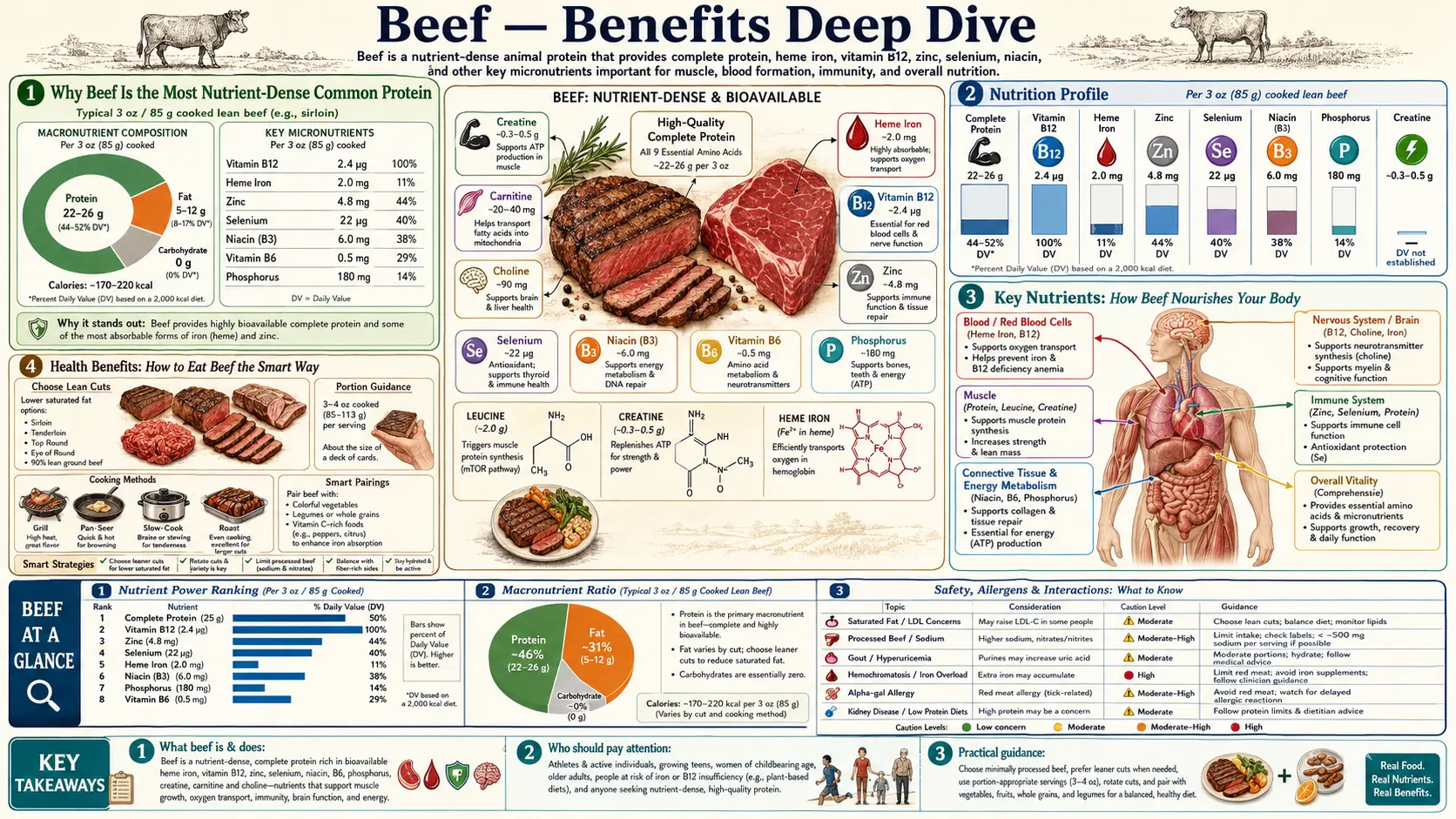
Beef is the most nutrient-dense common protein in the human diet on a per-calorie basis, supplying complete protein with all nine essential amino acids in optimal ratios, the highly bioavailable heme form of iron, vitamin B12 in quantities no plant food can match, zinc with the same absorption advantage as iron, plus muscle-tissue-only nutrients like creatine, carnosine, and taurine that vegetarian diets cannot supply at meaningful concentrations. Four benefit pages below explore the science behind beef's most consequential nutritional contributions — the bioavailability gap between heme and non-heme iron that explains why iron-deficiency anemia is concentrated in low-meat populations, the muscle-performance nutrients exclusive to animal tissue, the measurable differences between grass-fed and grain-fed beef, and the omega-6 to omega-3 ratio question that drives much of the popular discussion around red meat.
Deep-Dive Articles
Bioavailable Iron and B12
Heme iron from beef is absorbed at 15-35% efficiency versus 2-20% for non-heme plant iron, with absorption that is not suppressed by phytates or polyphenols, although calcium lowers it. A 3-oz (85 g) serving of broiled 85%-lean ground beef supplies about 2.2 mg of total iron (part of it heme iron) and about 2.2 µg of vitamin B12, close to the adult Recommended Dietary Allowance (RDA) of 2.4 µg. Why iron-deficiency anemia and B12 deficiency are more common in vegetarian and vegan populations, and what clinical studies report about beef in the diet.
Read the deep dive →Creatine and Carnosine
Beef supplies approximately 2 g of creatine and 1.5 g of carnosine per pound of raw muscle tissue — nutrients present in only trace amounts in plant foods. Creatine supports the phosphocreatine energy system, lean muscle mass, and cognitive function. Carnosine acts as an intracellular pH buffer and as a scavenger of reactive carbonyl species. Why vegetarians have lower brain and muscle creatine stores and what creatine supplementation trials in vegetarians measured.
Read the deep dive →Grass-Fed vs Grain-Fed
Grass-finished beef contains roughly 2-3 times more omega-3 fatty acids, 2-3 times more conjugated linoleic acid (CLA), and 4-5 times more carotenoids and vitamin E than grain-finished beef from feedlot operations. Protein and mineral content are similar. The clinically meaningful differences are concentrated in the fat fraction. Cost, labeling claims (100% grass-fed vs grass-fed/grain-finished), and the practical question of whether the nutritional difference justifies the price premium.
Read the deep dive →CLA and Omega-3 Ratio
Conjugated linoleic acid (CLA) is a family of naturally occurring trans fatty acids produced by ruminant bacteria from linoleic acid. Grass-fed beef contains roughly 2-3 times more CLA than grain-fed, although a 2010 review notes that people eating higher-fat grain-fed portions may reach similar CLA intakes. The omega-6 to omega-3 ratio in beef ranges from approximately 2:1 in grass-finished to 8:1 in grain-finished — both substantially better than the 15:1 ratio of the modern industrial diet. What the human evidence actually shows for CLA on body composition, insulin sensitivity, and inflammation markers.
Read the deep dive →Table of Contents
- Deep-Dive Articles
- Why Beef Is the Most Nutrient-Dense Common Protein
- Research Papers: Iron and B12 Bioavailability
- Research Papers: Creatine, Carnosine, and Taurine
- Research Papers: Grass-Fed vs Grain-Fed
- Research Papers: CLA and Fatty Acid Ratios
- Research Papers: Cross-Cutting (Protein Quality, DIAAS, Sarcopenia)
- External Authoritative Resources
- Connections
- Featured Videos
Why Beef Is the Most Nutrient-Dense Common Protein
The case for beef as the single most nutrient-dense common protein rests on three independent biological facts that combine in ruminant muscle tissue and nowhere else in the food supply:
- Complete protein with a high quality score. Beef scores high on the Digestible Indispensable Amino Acid Score (DIAAS), a measure of how well a protein supplies the essential amino acids people need after digestion. A 2018 study that fed beef topside to growing pigs (the animal model used for human digestion) measured a DIAAS of 97-99% (0.97-0.99) for raw, boiled and pan-fried beef, 91% for roasted and 80% for grilled beef, so the cooking method changes the score; the authors concluded that beef is a high-quality protein source across cooking methods (Hodgkinson 2018). By comparison, wheat protein scores around 0.43, rice protein around 0.59, and even pea protein only reaches 0.65. The amino acid leucine, which triggers muscle protein synthesis through the mechanistic target of rapamycin (mTOR) pathway, is present in beef at concentrations that reliably push older adults past the leucine threshold (~2.5 g per meal) needed to overcome anabolic resistance.
- Heme iron and protein-bound B12, which few plant foods supply. The iron in beef is contained in myoglobin (the muscle oxygen-carrying protein), in the chemical form of heme — the same porphyrin ring that carries oxygen in human hemoglobin. Heme iron is absorbed by different mechanisms than non-heme iron, but a 2008 review describes these mechanisms as still poorly understood (West and Oates 2008); the protein first reported as a heme carrier (heme carrier protein 1, HCP1) was later shown to work mainly as a folate transporter (Qiu 2006). Heme iron is less affected by phytates and polyphenols than non-heme iron, but calcium lowers both: in a 1991 study of 126 people, 165 mg of calcium given as milk, cheese or calcium chloride cut iron absorption from a meal by 50-60%, and the same amount of calcium also significantly reduced heme-iron absorption (Hallberg 1991). Vitamin B12 is synthesized only by bacteria, and the bacteria that produce it in usable quantity live in ruminant rumens — cattle, sheep, goats, and deer. Plants do not make B12 themselves; a 2014 review found that a few plant-based foods do contain substantial amounts, and named dried purple laver (nori) the most suitable B12 source presently available for vegetarians (Watanabe 2014). See the dedicated deep-dive page for the absorption data and clinical implications.
- Muscle-tissue nutrients that vegetarian diets cannot supply. Creatine, carnosine, taurine, and anserine are all present in beef at clinically meaningful concentrations because they are stored in animal muscle tissue. They are present in only trace amounts in plants. Vegetarians and vegans have measurably lower tissue stores of all four, with documented effects on muscle creatine content, brain creatine content, and exercise performance. See the creatine and carnosine deep dive.
The complications are concentrated in two areas: the production system (grass-fed pasture-raised vs grain-fed concentrated animal feeding operations produce meaningfully different products in the fat fraction, though the protein and mineral content is similar), and the fatty acid composition (the omega-6 to omega-3 ratio, the conjugated linoleic acid content, and the saturated fat profile all vary with feed and breed). The grass-fed vs grain-fed deep dive and the CLA and omega-3 ratio deep dive address both questions with the clinical-trial evidence.
The historic concerns about red meat and cardiovascular disease have been substantially revised over the last decade. The 2019 NutriRECS meta-analysis of cohort studies (Annals of Internal Medicine, 55 cohorts, more than 4 million people) found the association between red and processed meat and cardiometabolic outcomes very small and the evidence of low certainty, listing inadequate adjustment for confounders among its limitations; the NutriRECS guideline panel then suggested that adults continue their current unprocessed red meat consumption (a weak recommendation based on low-certainty evidence). A 2020 Harvard cohort study published in the BMJ, which followed 43,272 US men for up to 30 years (1986-2016), found each daily serving of unprocessed red meat associated with a modestly higher risk of coronary heart disease (hazard ratio 1.11, about 11% higher), and replacing one daily serving of red meat with nuts, legumes or soy associated with about 13% lower risk (hazard ratio 0.87) (Al-Shaar 2020). Processed meat (bacon, deli meat, hot dogs) shows clearer signal for adverse outcomes.
Research Papers: Iron and B12 Bioavailability
- Hallberg L, Hulthén L (2000). Prediction of dietary iron absorption: an algorithm for calculating absorption and bioavailability of dietary iron. American Journal of Clinical Nutrition — PubMed PMID: 10799377
- West AR, Oates PS (2008). Mechanisms of heme iron absorption: current questions and controversies. World Journal of Gastroenterology — PubMed PMID: 18636652
- Hallberg L, Brune M, Erlandsson M, Sandberg AS, Rossander-Hultén L (1991). Calcium: effect of different amounts on nonheme- and heme-iron absorption in humans. American Journal of Clinical Nutrition — PubMed PMID: 1984335
- Qiu A, Jansen M, Sakaris A, Min SH, Chattopadhyay S, Tsai E, Sandoval C, Zhao R, Akabas MH, Goldman ID (2006). Identification of an intestinal folate transporter and the molecular basis for hereditary folate malabsorption. Cell — PubMed PMID: 17129779
- Pawlak R, Lester SE, Babatunde T (2014). The prevalence of cobalamin deficiency among vegetarians assessed by serum vitamin B12: a review of literature. European Journal of Clinical Nutrition — PubMed PMID: 24667752
- Pawlak R, Parrott SJ, Raj S, et al. (2013). How prevalent is vitamin B(12) deficiency among vegetarians? Nutrition Reviews — PubMed PMID: 23356638
- Allen LH (2009). How common is vitamin B-12 deficiency? American Journal of Clinical Nutrition — Search PubMed
- Hurrell R, Egli I (2010). Iron bioavailability and dietary reference values. American Journal of Clinical Nutrition — PubMed PMID: 20200263
- Pasricha SR, Tye-Din J, Muckenthaler MU, Swinkels DW (2021). Iron deficiency. The Lancet — Search PubMed
- Stabler SP (2013). Vitamin B12 deficiency. NEJM — PubMed PMID: 23301732
- Watanabe F, Yabuta Y, Bito T, Teng F (2014). Vitamin B12-containing plant food sources for vegetarians. Nutrients — PubMed PMID: 24803097
- Cook JD, Reddy MB (2001). Effect of ascorbic acid intake on nonheme-iron absorption from a complete diet. American Journal of Clinical Nutrition — Search PubMed
Research Papers: Creatine, Carnosine, and Taurine
- Burke DG, Chilibeck PD, Parise G, et al. (2003). Effect of creatine and weight training on muscle creatine and performance in vegetarians. Medicine and Science in Sports and Exercise — PubMed PMID: 14600563
- Solis MY, Artioli GG, Otaduy MCG, et al. (2017). Effect of age, diet, and tissue type on PCr response to creatine supplementation. Journal of Applied Physiology — PubMed PMID: 28572496
- Rae C, Digney AL, McEwan SR, Bates TC (2003). Oral creatine monohydrate supplementation improves brain performance: a double-blind, placebo-controlled, cross-over trial. Proceedings of the Royal Society B — PubMed PMID: 14561278
- Boldyrev AA, Aldini G, Derave W (2013). Physiology and pathophysiology of carnosine. Physiological Reviews — PubMed PMID: 24137022
- Harris RC, Tallon MJ, Dunnett M, et al. (2006). The absorption of orally supplied beta-alanine and its effect on muscle carnosine synthesis in human vastus lateralis. Amino Acids — PubMed PMID: 16554972
- Laidlaw SA, Shultz TD, Cecchino JT, Kopple JD (1988). Plasma and urine taurine levels in vegans. American Journal of Clinical Nutrition — Search PubMed
- Ripps H, Shen W (2012). Review: taurine: a "very essential" amino acid. Molecular Vision — PubMed PMID: 23170060
- Kreider RB, Kalman DS, Antonio J, et al. (2017). International Society of Sports Nutrition position stand: safety and efficacy of creatine supplementation in exercise, sport, and medicine. Journal of the International Society of Sports Nutrition — PubMed PMID: 28615996
- Avgerinos KI, Spyrou N, Bougioukas KI, Kapogiannis D (2018). Effects of creatine supplementation on cognitive function of healthy individuals: a systematic review. Experimental Gerontology — PubMed PMID: 29704637
- Hobson RM, Saunders B, Ball G, et al. (2012). Effects of beta-alanine supplementation on exercise performance: a meta-analysis. Amino Acids — PubMed PMID: 22270875
Research Papers: Grass-Fed vs Grain-Fed
- Daley CA, Abbott A, Doyle PS, et al. (2010). A review of fatty acid profiles and antioxidant content in grass-fed and grain-fed beef. Nutrition Journal. — PubMed PMID: 20219103
- Davis H, Magistrali A, Butler G, Stergiadis S (2022). Nutritional benefits from fatty acids in organic and grass-fed beef. Foods. — Search PubMed
- Provenza FD, Kronberg SL, Gregorini P (2019). Is grassfed meat and dairy better for human and environmental health? Frontiers in Nutrition. — PubMed PMID: 30941351
- Van Elswyk ME, McNeill SH (2014). Impact of grass/forage feeding versus grain finishing on beef nutrients and sensory quality. Meat Science. — Search PubMed
- Wood JD, Enser M, Fisher AV, et al. (2008). Fat deposition, fatty acid composition and meat quality: a review. Meat Science. — PubMed PMID: 22062452
- Duckett SK, Neel JP, Fontenot JP, Clapham WM (2009). Effects of winter stocker growth rate and finishing system on beef tissues. Journal of Animal Science. — Search PubMed
- Descalzo AM, Sancho AM (2008). A review of natural antioxidants and their effects on oxidative status, odor and quality of fresh beef. Meat Science. — Search PubMed
- Realini CE, Duckett SK, Brito GW, et al. (2004). Effect of pasture vs. concentrate feeding with or without antioxidants on carcass characteristics, fatty acid composition, and quality of Uruguayan beef. Meat Science. — Search PubMed
- Ponnampalam EN, Mann NJ, Sinclair AJ (2006). Effect of feeding systems on omega-3 fatty acids, conjugated linoleic acid and trans fatty acids in Australian beef cuts. Asia Pacific Journal of Clinical Nutrition. — PubMed PMID: 16500874
- Garcia PT, Pensel NA, Sancho AM, et al. (2008). Beef lipids in relation to animal breed and nutrition in Argentina. Meat Science. — Search PubMed
Research Papers: CLA and Fatty Acid Ratios
- Whigham LD, Watras AC, Schoeller DA (2007). Efficacy of conjugated linoleic acid for reducing fat mass: a meta-analysis in humans. American Journal of Clinical Nutrition. — PubMed PMID: 17490954
- Simopoulos AP (2002). The importance of the ratio of omega-6/omega-3 essential fatty acids. Biomedicine & Pharmacotherapy. — PubMed PMID: 12442909
- Belury MA (2002). Dietary conjugated linoleic acid in health: physiological effects and mechanisms of action. Annual Review of Nutrition. — Search PubMed
- Dilzer A, Park Y (2012). Implication of conjugated linoleic acid (CLA) in human health. Critical Reviews in Food Science and Nutrition. — PubMed PMID: 22452730
- Bhattacharya A, Banu J, Rahman M, et al. (2006). Biological effects of conjugated linoleic acids in health and disease. Journal of Nutritional Biochemistry. — PubMed PMID: 16650752
- den Hartigh LJ (2019). Conjugated linoleic acid effects on cancer, obesity, and atherosclerosis: a review of pre-clinical and human trials with current perspectives. Nutrients. — Search PubMed
- Field CJ, Blewett HH, Proctor S, Vine D (2009). Human health benefits of vaccenic acid. Applied Physiology, Nutrition, and Metabolism. — Search PubMed
- Mozaffarian D, Wu JH (2011). Omega-3 fatty acids and cardiovascular disease: effects on risk factors, molecular pathways, and clinical events. Journal of the American College of Cardiology. — PubMed PMID: 22051327
- Calder PC (2017). Omega-3 fatty acids and inflammatory processes: from molecules to man. Biochemical Society Transactions. — PubMed PMID: 28900017
- Ridker PM, Everett BM, Thuren T, et al. (2017). Antiinflammatory therapy with canakinumab for atherosclerotic disease (CANTOS trial). NEJM. — PubMed PMID: 28845751
Research Papers: Cross-Cutting (Protein Quality, DIAAS, Sarcopenia)
- Phillips SM (2017). Current concepts and unresolved questions in dietary protein requirements and supplements in adults. Frontiers in Nutrition. — Search PubMed
- Wolfe RR, Baum JI, Starck C, Moughan PJ (2018). Factors contributing to the selection of dietary protein food sources. Clinical Nutrition. — Search PubMed
- Moughan PJ, Wolfe RR (2019). Determination of dietary amino acid digestibility in humans. Journal of Nutrition. — Search PubMed
- Bauer J, Biolo G, Cederholm T, et al. (2013). Evidence-based recommendations for optimal dietary protein intake in older people: PROT-AGE Study Group. JAMDA. — PubMed PMID: 23867520
- Cruz-Jentoft AJ, Bahat G, Bauer J, et al. (2019). Sarcopenia: revised European consensus on definition and diagnosis. Age and Ageing. — PubMed PMID: 30312372
- Johnston BC, Zeraatkar D, Han MA, et al. (2019). Unprocessed red meat and processed meat consumption: dietary guideline recommendations from NutriRECS. Annals of Internal Medicine. — PubMed PMID: 31569235
- Zeraatkar D, Han MA, Guyatt GH, et al. (2019). Red and processed meat consumption and risk for all-cause mortality and cardiometabolic outcomes: a systematic review and meta-analysis. Annals of Internal Medicine. — PubMed PMID: 31569213
- Al-Shaar L, Satija A, Wang DD, Rimm EB, Smith-Warner SA, Stampfer MJ, Hu FB, Willett WC (2020). Red meat intake and risk of coronary heart disease among US men: prospective cohort study. BMJ. — PubMed PMID: 33268459
- Hodgkinson SM, Montoya CA, Scholten PT, Rutherfurd SM, Moughan PJ (2018). Cooking conditions affect the true ileal digestible amino acid content and Digestible Indispensable Amino Acid Score (DIAAS) of bovine meat as determined in pigs. Journal of Nutrition. — PubMed PMID: 30204886
- Rondanelli M, Klersy C, Terracol G, et al. (2016). Whey protein, amino acids, and vitamin D supplementation with physical activity increases fat-free mass and strength in sarcopenic elderly. American Journal of Clinical Nutrition. — PubMed PMID: 26864356
- Berryman CE, Lieberman HR, Fulgoni VL, Pasiakos SM (2018). Protein intake trends and conformity with the Dietary Reference Intakes in the United States. American Journal of Clinical Nutrition. — Search PubMed
- Pasiakos SM, Lieberman HR, Fulgoni VL (2015). Higher-protein diets are associated with higher HDL cholesterol and lower BMI and waist circumference in US adults. Journal of Nutrition. — Search PubMed
External Authoritative Resources
- U.S. Department of Agriculture (USDA) FoodData Central — comprehensive nutrient database for all beef cuts, raw and cooked, by cooking method
- A beef-industry research group — an industry-run science resource on beef nutrition and production systems
- U.S. National Institutes of Health (NIH) Office of Dietary Supplements — Iron Fact Sheet
- U.S. National Institutes of Health Office of Dietary Supplements — Vitamin B12 Fact Sheet
- PubMed — Beef nutrition research