Olive Oil — Benefits Deep Dive
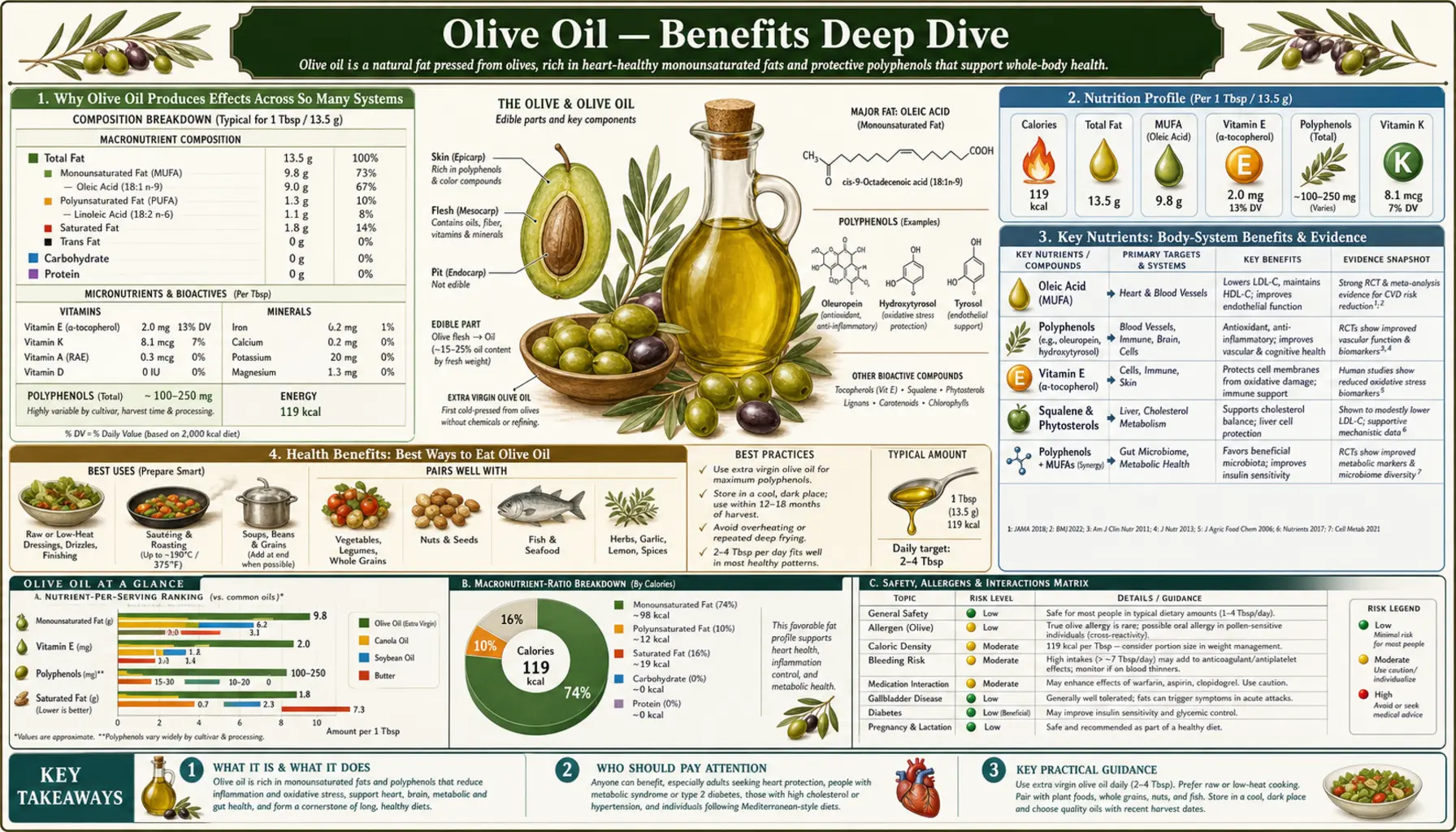
The PREDIMED trial in Spain (Estruch and colleagues) assigned 7,447 adults aged 55 to 80 who were at high cardiovascular risk to a Mediterranean diet supplemented with extra-virgin olive oil, a Mediterranean diet supplemented with mixed nuts, or a control diet (advice to reduce dietary fat). Its 2013 report was retracted after the investigators identified protocol deviations, including household members enrolled without randomization and non-random assignment of some participants at one of the 11 sites. In the 2018 republication, the hazard ratio for a major cardiovascular event was 0.69 (95% CI 0.53 to 0.91) with the olive-oil diet and 0.72 (0.54 to 0.95) with the nut diet, compared with the control diet. Most of olive oil's fat is oleic acid; besides it, extra-virgin oil carries phenolic compounds such as hydroxytyrosol, tyrosol and oleocanthal, and in a study of the refining process hydroxytyrosol and tyrosol were removed completely. In the EUROLIVE trial, three olive oils that were otherwise similar but differed in phenolic content were compared: HDL cholesterol rose and markers of oxidative stress fell as phenolic content increased. The five deep-dive pages below cover the phenolic compounds, the cardiovascular evidence, the grades and quality testing of extra-virgin oil, heating studies, and the claims that link olive oil with GLP-1 and appetite.
Deep-Dive Articles
Polyphenols and Oleocanthal
The phenolic fraction of extra-virgin olive oil — hydroxytyrosol, oleuropein, tyrosol, oleocanthal and oleacein. The 2005 laboratory finding that oleocanthal inhibits the same cyclooxygenase (COX) enzymes as ibuprofen despite a different structure, the EU health claim that may be used only for olive oil containing at least 5 mg of hydroxytyrosol and its derivatives per 20 g of oil, the laboratory assays used to measure phenolic content, and why that content differs from one oil to another.
Read the deep dive →Heart Health
The PREDIMED trial and its 2018 republication after the 2013 report was retracted (hazard ratio 0.69 for a major cardiovascular event with a Mediterranean diet supplemented with extra-virgin olive oil, against a reduced-fat control diet), the Seven Countries Study, the EUROLIVE trial of olive-oil phenolics and LDL oxidation, endothelial function, blood pressure, HDL function, and the amounts of olive oil used in trials, cohorts and health claims.
Read the deep dive →Extra Virgin Quality
The EU and IOC definitions of "extra virgin" (free acidity not more than 0.80%, peroxide value not more than 20 meq O2/kg, and a tasting panel with a defect median of 0), the grades from extra virgin to pomace oil, the UC Davis Olive Center reports of 2010 and 2011 (in 2011, 66 of 90 samples, 73%, from the five top-selling imported labels in the United States failed the IOC sensory standard; the 2010 report judged that any adulterant was most likely refined olive oil), the kinds of fraud described in the research literature, the chemical tests, and what regulated label terms mean — "cold extraction," for example, may appear only on extra-virgin or virgin oil obtained below 27°C by percolation or centrifugation of the olive paste.
Read the deep dive →Cooking Temperature
What the smoke point measures and what heating does to an oil. A 2018 ten-oil heating study by authors at a commercial olive-oil testing laboratory, in a journal not indexed in PubMed, found that under its conditions smoke point did not predict how an oil held up under heat; after 6 hours at 180°C, polar compounds were lowest in coconut oil (9.68%) and extra-virgin olive oil (10.5%) and highest in the polyunsaturated-rich seed oils. The page also covers indexed frying studies, the loss of polyphenols and tocopherols during heating, and the temperatures the studies used.
Read the deep dive →GLP-1 and Appetite
How 2-oleoylglycerol and oleoylethanolamide, two products of olive-oil digestion, act on the GPR119 receptor, GLP-1 release and PPAR-alpha, and where the comparison with the GLP-1 drug semaglutide breaks down. In a Copenhagen crossover study of 12 healthy men, carrots eaten with 19 g of olive oil and with a test oil that forms 2-oleoylglycerol gave the same GLP-1 response (Mandøe and colleagues, 2015); the PPAR-alpha evidence comes from mice (Fu and colleagues, 2003).
Read the deep dive →Table of Contents
- Deep-Dive Articles
- What Sets Extra-Virgin Olive Oil Apart
- Research Papers: Polyphenols and Oleocanthal
- Research Papers: Heart Health
- Research Papers: Extra Virgin Quality and Adulteration
- Research Papers: Cooking Temperature and Oxidative Stability
- Research Papers: Cross-Cutting (Brain, Cancer, Inflammation)
- External Authoritative Resources
- Connections
- Featured Videos
What Sets Extra-Virgin Olive Oil Apart
By fatty-acid composition, olive oil is a monounsaturated oil. The EU marketing standard (Commission Delegated Regulation (EU) 2022/2104) sets oleic acid at 55.00 to 85.00% of total fatty acids, linoleic acid at 2.50 to 21.00% and palmitic acid at 7.00 to 20.00%, with linolenic acid at no more than 1.00% for extra-virgin oil. Refining changes the minor fraction more than the fat. Virgin olive oils are richer in phenolic compounds than refined olive oil (Covas and colleagues, 2006), and in lampante olive oils sampled through each stage of refining, hydroxytyrosol and tyrosol were completely removed in the early steps, while tocopherols (vitamin E) fell significantly, by 7 to 16%, in only four of nine samples (Lucci and colleagues, 2020).
Three lines of research on that minor fraction:
- Phenolic compounds and blood lipids — in the EUROLIVE trial, 200 healthy men at 6 centres in 5 European countries took 25 mL a day of each of three olive oils, in random order, for 3 weeks each with 2-week washouts. The oils had low (2.7 mg/kg), medium (164 mg/kg) or high (366 mg/kg) phenolic content but were otherwise similar. HDL cholesterol rose linearly with phenolic content, the total-to-HDL cholesterol ratio fell, and oxidative stress markers, including oxidized LDL, decreased as phenolic content increased; the authors list self-reported diet and short intervention periods among the limitations (Covas and colleagues, 2006). In the EU, Commission Regulation (EU) No 432/2012, based on a 2011 EFSA opinion, authorizes the claim "Olive oil polyphenols contribute to the protection of blood lipids from oxidative stress" only for olive oil that contains at least 5 mg of hydroxytyrosol and its derivatives (e.g. oleuropein complex and tyrosol) per 20 g of olive oil, and requires that the consumer be told the beneficial effect is obtained with a daily intake of 20 g of olive oil. In 2025 EFSA's nutrition panel assessed two further claims. It concluded that a cause-and-effect relationship had not been established between phenolic compounds naturally present in olive oil and lower LDL cholesterol or systolic blood pressure, and that the evidence was insufficient for olive oil polyphenols and the maintenance of normal HDL cholesterol; for HDL, it noted that the one trial in adult men showing a dose-dependent increase over 3 weeks was not supported by other studies (EFSA NDA Panel, 2025). See the polyphenols deep-dive for the chemistry.
- Oleocanthal and the COX enzymes — in 2005 Beauchamp and colleagues reported in Nature that oleocanthal, a compound in newly pressed extra-virgin olive oil, causes a stinging sensation in the throat like that caused by solutions of the anti-inflammatory drug ibuprofen, and that in laboratory tests it acted as an anti-inflammatory compound with a potency and profile "strikingly similar" to ibuprofen's; although the two molecules are structurally dissimilar, both inhibit the same cyclooxygenase enzymes. The report describes laboratory activity, not the effects of olive oil intake in people. In human cancer cell lines grown in culture, oleocanthal caused cell death within 30 minutes in the absence of serum, while non-cancer cells stopped proliferating but did not die (LeGendre and colleagues, 2015, a cell-culture study).
- Fat in a meal and carotenoid absorption — in a seven-person crossover trial, salads eaten with a fat-free dressing gave a negligible appearance of alpha-carotene, beta-carotene and lycopene in plasma chylomicrons; absorption was greater with a reduced-fat dressing (6 g of oil) and greater again with a full-fat dressing (28 g of oil). The dressing oil was canola oil, so the trial tested the amount of fat, not olive oil specifically (Brown and colleagues, 2004).
The grade of oil therefore matters for its phenolic content. On EU labels, the grade sold as "olive oil" must be described as "oil comprising exclusively olive oils that have undergone refining and oils obtained directly from olives," while extra-virgin oil is "superior category olive oil obtained directly from olives and solely by mechanical means" (Delegated Regulation (EU) 2022/2104). The extra-virgin quality deep-dive covers the grades and the UC Davis Olive Center reports: in the April 2011 report, 66 of 90 samples (73%) from the five top-selling imported labels in the United States failed the International Olive Council's sensory standard for extra-virgin oil, as judged by two IOC-accredited panels, and the July 2010 report concluded that if any of its samples were adulterated, the adulterant was most likely refined olive oil rather than refined nut, seed or vegetable oils. Both reports state that their results, from samples bought in California in 2010, should not be used to characterize oil available later.
Research Papers: Polyphenols and Oleocanthal
- Beauchamp GK, Keast RS, Morel D, Lin J, Pika J, Han Q, Lee CH, Smith AB, Breslin PA (2005). Phytochemistry: ibuprofen-like activity in extra-virgin olive oil. Nature 437(7055):45-46. — PubMed PMID: 16136122
- EFSA Panel on Dietetic Products, Nutrition and Allergies (NDA) (2011). Scientific Opinion on the substantiation of health claims related to polyphenols in olive and protection of LDL particles from oxidative damage (ID 1333, 1638, 1639, 1696, 2865) and other claims, pursuant to Article 13(1) of Regulation (EC) No 1924/2006. EFSA Journal 9(4):2033. — doi:10.2903/j.efsa.2011.2033 (Basis of the claim authorized in Commission Regulation (EU) No 432/2012.)
- Commission Regulation (EU) No 432/2012 of 16 May 2012, list of permitted health claims (olive oil polyphenols: at least 5 mg of hydroxytyrosol and its derivatives per 20 g of olive oil; daily intake of 20 g). — EUR-Lex 32012R0432
- EFSA Panel on Nutrition, Novel Foods and Food Allergens (NDA) (2025). Phenolic compounds naturally present in olive oil and lowering of blood LDL-cholesterol and systolic blood pressure, therefore reducing the risk of coronary heart disease: Evaluation of a health claim pursuant to Article 14 of Regulation (EC) No 1924/2006. EFSA Journal 23(5):e9470. — PubMed PMID: 40416788 (Cause-and-effect relationship not established.)
- EFSA Panel on Nutrition, Novel Foods and Food Allergens (NDA) (2025). Olive oil polyphenols and the maintenance of normal HDL-cholesterol concentrations: Evaluation of a health claim pursuant to Article 13(5) of Regulation (EC) No 1924/2006. EFSA Journal 23(5):e9372. — PubMed PMID: 40321163 (Evidence insufficient.)
- Covas MI, Nyyssönen K, Poulsen HE, Kaikkonen J, Zunft HJ, Kiesewetter H, Gaddi A, de la Torre R, Mursu J, Bäumler H, Nascetti S, Salonen JT, Fitó M, Virtanen J, Marrugat J; EUROLIVE Study Group (2006). The effect of polyphenols in olive oil on heart disease risk factors: a randomized trial. Annals of Internal Medicine 145(5):333-341. — PubMed PMID: 16954359
- LeGendre O, Breslin PA, Foster DA (2015). (-)-Oleocanthal rapidly and selectively induces cancer cell death via lysosomal membrane permeabilization. Molecular and Cellular Oncology 2(4):e1006077. — PubMed PMID: 26380379 (Cell-culture study.)
- Lucci P, Bertoz V, Pacetti D, Moret S, Conte L (2020). Effect of the refining process on total hydroxytyrosol, tyrosol, and tocopherol contents of olive oil. Foods 9(3):292. — PubMed PMID: 32150867
PubMed Topic Searches
- Hydroxytyrosol bioavailability and pharmacokinetics — PubMed: Hydroxytyrosol PK
- Oleuropein hydrolysis to hydroxytyrosol in vivo — PubMed: Oleuropein metabolism
- Oleocanthal COX-1 and COX-2 inhibition assays — PubMed: Oleocanthal COX
- Hydroxytyrosol antioxidant capacity in vitro and in vivo — PubMed: Hydroxytyrosol antioxidant
- Polyphenol concentration in EVOO by cultivar (Koroneiki, Picual, Coratina) and harvest timing — PubMed: Polyphenol by cultivar
- Oleacein cardiovascular and anti-inflammatory effects — PubMed: Oleacein
Research Papers: Heart Health
- Estruch R et al. (2013). Primary prevention of cardiovascular disease with a Mediterranean diet. NEJM 368(14):1279-1290. (Original PREDIMED publication). — PubMed PMID: 23432189 — Retracted (retraction notice: PubMed PMID: 29897867); republished 2018: PubMed PMID: 29897866
- Estruch R et al. (2018). Primary Prevention of Cardiovascular Disease with a Mediterranean Diet Supplemented with Extra-Virgin Olive Oil or Nuts. NEJM 378(25):e34. (Corrected and republished version of the retracted 2013 report). — PubMed PMID: 29897866
- Guasch-Ferré M, Hu FB, Martínez-González MA, et al. (2014). Olive oil intake and risk of cardiovascular disease and mortality in the PREDIMED Study. BMC Medicine 12:78. — PubMed PMID: 24886626 (Observational analysis of 7,216 trial participants.)
- Guasch-Ferré M, Liu G, Li Y, Sampson L, Manson JE, Salas-Salvadó J, Martínez-González MA, Stampfer MJ, Willett WC, Sun Q, Hu FB (2020). Olive oil consumption and cardiovascular risk in U.S. adults. Journal of the American College of Cardiology 75(15):1729-1739. — PubMed PMID: 32147453
- Schwingshackl L, Hoffmann G (2014). Monounsaturated fatty acids, olive oil and health status: a systematic review and meta-analysis of cohort studies. Lipids in Health and Disease 13:154. — PubMed PMID: 25274026
PubMed Topic Searches
- Keys A, Seven Countries Study original publications — PubMed: Seven Countries Study
- Olive oil and LDL oxidation: clinical trials — PubMed: Olive oil LDL oxidation
- Endothelial function and EVOO: flow-mediated dilation studies — PubMed: Endothelial function
- Olive oil and blood pressure: meta-analysis — PubMed: Olive oil and BP
- Olive oil and HDL function: cholesterol efflux capacity — PubMed: HDL cholesterol efflux
Research Papers: Extra Virgin Quality and Adulteration
- Frankel EN, Mailer RJ, Wang SC, Shoemaker CF, Guinard JX, Flynn JD, Sturzenberger ND (2011). Evaluation of extra-virgin olive oil sold in California. UC Davis Olive Center report, April 2011. — UC Davis Olive Center report (PDF)
- Frankel EN, Mailer RJ, Shoemaker CF, Wang SC, Flynn JD (2010). Tests indicate that imported "extra virgin" olive oil often fails international and USDA standards. UC Davis Olive Center report, July 2010. — UC Davis Olive Center report (PDF)
- Commission Delegated Regulation (EU) 2022/2104 of 29 July 2022, marketing standards for olive oil (grade definitions, Annex I quality and fatty-acid limits, label descriptions, "first cold pressing" and "cold extraction"). — EUR-Lex 32022R2104
- Mueller T (2007). Slippery business. The New Yorker, August 13, 2007 issue (later expanded into the 2011 book Extra Virginity). — The New Yorker article
PubMed Topic Searches
- International Olive Council (IOC) trade standard for olive oils — PubMed: IOC standard
- Free fatty acidity, peroxide value, and K232/K270 absorbance as EVOO quality markers — PubMed: EVOO chemical markers
- Organoleptic panel test (IOC panel) for EVOO classification — PubMed: IOC sensory panel
- Refined olive oil and deodorized olive oil — chemical and bioactive differences from EVOO — PubMed: Refined vs EVOO
- EVOO authentication by fatty acid profile and stable isotope analysis — PubMed: EVOO authentication
- Polyphenol degradation during EVOO storage and shelf life — PubMed: Polyphenol degradation
- Soybean oil and sunflower oil adulteration of EVOO — detection methods — PubMed: Adulteration detection
- NMR spectroscopy fingerprinting of EVOO geographic origin — PubMed: NMR fingerprinting
Research Papers: Cooking Temperature and Oxidative Stability
- De Alzaa F, Guillaume C, Ravetti L (2018). Evaluation of chemical and physical changes in different commercial oils during heating. Acta Scientific Nutritional Health 2(6):02-11. — Full text (journal PDF) (Not indexed in PubMed; no DOI found in Crossref; authors at a commercial olive-oil testing laboratory.)
PubMed Topic Searches
- Smoke point versus oxidative stability of cooking oils — PubMed: Smoke point vs stability
- Polar compound formation during deep frying with EVOO vs seed oils — PubMed: Polar compounds frying
- Polyphenol antioxidant protection during EVOO heating — PubMed: Polyphenol thermal protection
- Trans fatty acid formation in heated oils — PubMed: Trans fat formation
- Aldehyde formation (4-HNE, acrolein) during sustained frying — PubMed: Aldehyde formation
- Olive oil tocopherol (Vitamin E) thermal degradation — PubMed: Tocopherol thermal
- Rancimat induction time for EVOO vs other oils — PubMed: Rancimat EVOO
- Health implications of degraded cooking oils (oxidized lipids and cardiovascular risk) — PubMed: Oxidized lipids and CVD
- Reuse of frying oils and cumulative degradation — PubMed: Frying oil reuse
Research Papers: Cross-Cutting (Brain, Cancer, Inflammation)
- Brown MJ, Ferruzzi MG, Nguyen ML, Cooper DA, Eldridge AL, Schwartz SJ, White WS (2004). Carotenoid bioavailability is higher from salads ingested with full-fat than with fat-reduced salad dressings as measured with electrochemical detection. American Journal of Clinical Nutrition 80(2):396-403. — PubMed PMID: 15277161 (Dressings made with canola oil.)
- Mandøe MJ, Hansen KB, Hartmann B, Rehfeld JF, Holst JJ, Hansen HS (2015). The 2-monoacylglycerol moiety of dietary fat appears to be responsible for the fat-induced release of GLP-1 in humans. American Journal of Clinical Nutrition 102(3):548-555. — PubMed PMID: 26178726
- Fu J, Gaetani S, Oveisi F, Lo Verme J, Serrano A, Rodríguez De Fonseca F, Rosengarth A, Luecke H, Di Giacomo B, Tarzia G, Piomelli D (2003). Oleylethanolamide regulates feeding and body weight through activation of the nuclear receptor PPAR-alpha. Nature 425(6953):90-93. — PubMed PMID: 12955147 (Mouse study.)
PubMed Topic Searches
- PREDIMED-NAVARRA sub-study: olive oil and cognitive decline — PubMed: PREDIMED cognition
- Oleocanthal and Alzheimer's amyloid beta clearance — PubMed: Oleocanthal and Alzheimer's
- Olive oil and breast cancer risk: meta-analysis — PubMed: Olive oil and breast cancer
- Olive oil and colorectal cancer prevention — PubMed: Olive oil and CRC
- Olive oil and type 2 diabetes prevention (PREDIMED diabetes sub-study) — PubMed: PREDIMED T2DM
- Olive oil and rheumatoid arthritis symptoms — PubMed: Olive oil and RA
- Olive oil and inflammatory bowel disease — PubMed: Olive oil and IBD
- Squalene in olive oil and skin protection — PubMed: Squalene skin
- Olive oil and gut microbiome modulation — PubMed: Olive oil microbiome
- Olive oil and all-cause mortality: meta-analysis — PubMed: All-cause mortality
External Authoritative Resources
- International Olive Council (IOC) — publisher of the IOC trade standard and methods for olive oils
- UC Davis Olive Center — research on olive oil chemistry and sensory analysis, including the 2010 and 2011 reports on retail extra-virgin oil
- EFSA — Scientific Opinion on Olive Oil Polyphenols Health Claim (2011)
- PREDIMED Trial Official Site — the trial's own site
- PubMed — All research on EVOO polyphenols
Connections
- All Food
- Olive Oil (Main Page)
- Polyphenols and Oleocanthal
- Heart Health
- Extra Virgin Quality
- Cooking Temperature
- GLP-1 and Appetite
- Omega-3 Fatty Acids
- Vitamin E (Tocopherols)
- Vitamin K (Fat-Soluble)
- Atherosclerosis
- Hypertension
- Type 2 Diabetes
- Mediterranean Diet
- Avocado (Monounsaturated)
- Nuts
- History
- Nutrients