⚠ Evidence warning: Clinical trials or other evidence do not support the claim, reported from people's own continuous glucose monitor readings, that blueberries cut a meal's glucose peak by 15-25% and reduce day-long glucose variability over 4-8 weeks. This page keeps it as a report of what people, websites or other media say.
Blueberries and Insulin Sensitivity
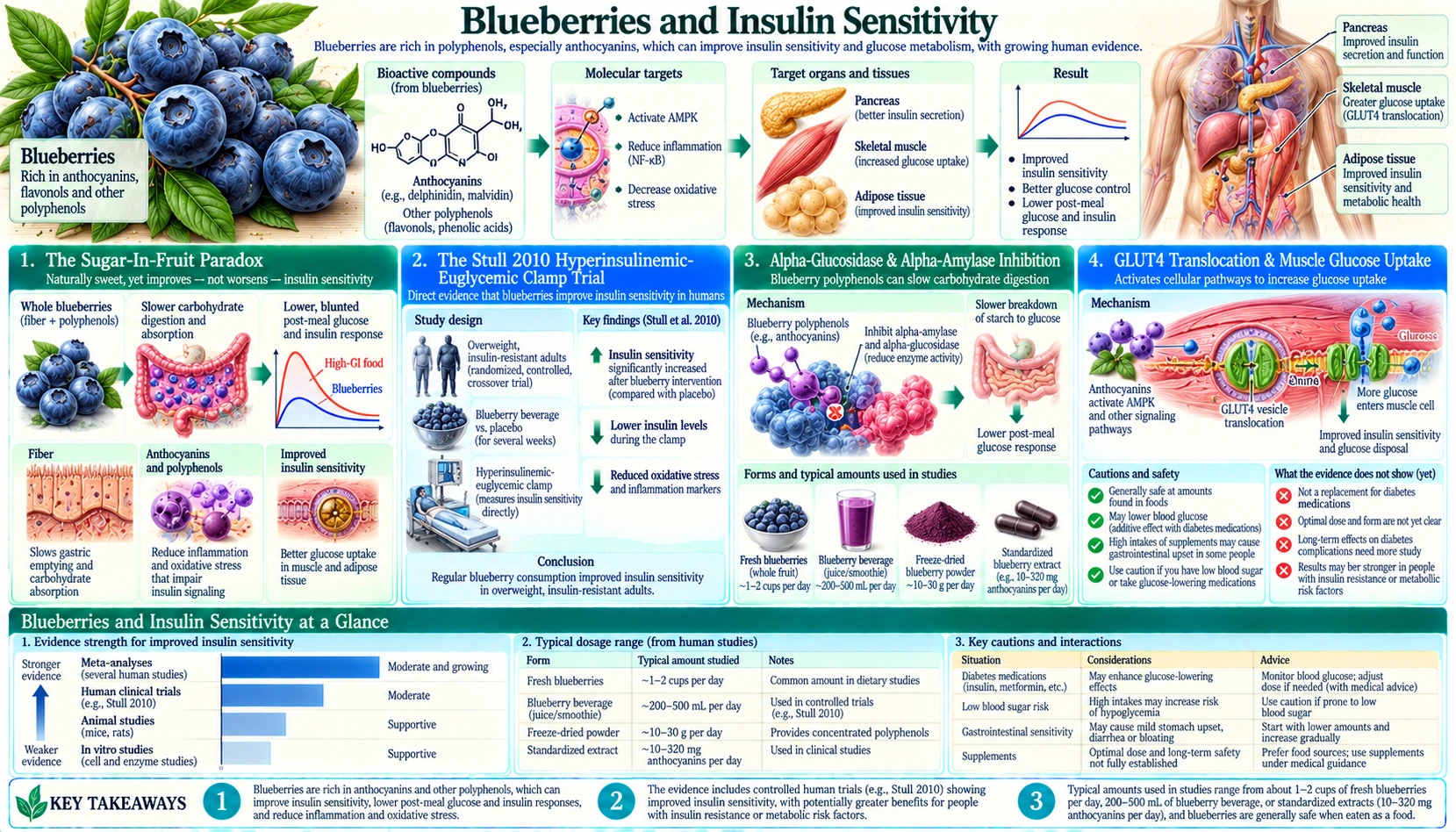
The seemingly paradoxical idea that a fruit containing 9.96 g of sugar per 100 g (USDA FoodData Central) can improve insulin sensitivity is one of the most counterintuitive but reproducible findings in nutrition science. The 2010 Stull trial at Louisiana State University showed that obese, insulin-resistant adults who drank a smoothie containing 22.5 g of blueberry bioactives (freeze-dried blueberry powder) twice daily for 6 weeks improved insulin sensitivity by 22% on the hyperinsulinemic-euglycemic clamp — the gold-standard measure. Later trials did not replicate the insulin-sensitivity result: in the 6-month Curtis 2019 trial in metabolic syndrome, 1 cup of blueberries a day left insulin resistance unchanged, and in the 8-week Stote 2020 trial in men with type-2 diabetes, 22 g of freeze-dried blueberries a day did not change fasting glucose or insulin, although hemoglobin A1c ended lower than with placebo. The mechanism is multi-pronged: anthocyanins competitively inhibit alpha-glucosidase and alpha-amylase at the intestinal brush border (blunting glucose absorption), upregulate GLUT4 translocation in skeletal muscle (improving glucose uptake), and suppress hepatic gluconeogenesis through AMP-activated protein kinase (AMPK) activation. The dietary sugar in blueberries is more than offset by the anthocyanin-mediated improvement in how that sugar (and all subsequent dietary sugar) is handled.
Table of Contents
- The Sugar-In-Fruit Paradox
- The Stull 2010 Hyperinsulinemic-Euglycemic Clamp Trial
- Alpha-Glucosidase & Alpha-Amylase Inhibition
- GLUT4 Translocation & Muscle Glucose Uptake
- Hepatic Gluconeogenesis & AMP-Activated Protein Kinase Activation
- Post-Prandial Glucose Curves & CGM Data
- Effects in Type-2 Diabetes
- Metabolic Syndrome & Pre-Diabetes
- Practical Dosing & Timing
- Cautions & Limits of the Evidence
- Key Research Papers
- Connections
- Featured Videos
The Sugar-In-Fruit Paradox
The standard low-carb / keto framing treats all sugar the same: glucose is glucose, fructose is fructose, and whether it comes from a Coke or a strawberry is metabolically equivalent. This framing is wrong, but in a specific and interesting way. The metabolic effect of an isolated sugar bolus and the metabolic effect of the same sugar embedded in a whole-fruit matrix containing fiber, polyphenols, and water are quantitatively different by a large margin.
The clearest demonstration is the post-prandial glucose curve (the trial data are in the post-prandial section below). The acute reduction in glucose excursion is partly explained by the soluble fiber slowing gastric emptying, but the dominant mechanism is direct anthocyanin-mediated inhibition of carbohydrate-cleaving enzymes at the intestinal brush border.
The chronic effect is different and more important. Daily consumption of blueberry-derived anthocyanins (whether from whole fruit or freeze-dried powder) over weeks to months changes the basal insulin sensitivity of the muscle and liver. This is measurable on the hyperinsulinemic-euglycemic clamp, the homeostatic model assessment of insulin resistance (HOMA-IR) index, and post-prandial responses to non-blueberry-containing meals. The improvement persists for as long as the blueberry consumption continues; it does not require blueberries to be consumed at the same meal as the carbohydrate. In the trials described on this page, the clamp result was positive in the 6-week Stull trial, while insulin resistance measured by the homeostatic model assessment was unchanged in the 6-month Curtis trial.
For the parallel cognitive benefits of the same blueberry consumption (mediated in part by improved blood-sugar stability), see our Anthocyanins and Brain page.
The Stull 2010 Hyperinsulinemic-Euglycemic Clamp Trial
April Stull at Louisiana State University's Pennington Biomedical Research Center ran the foundational human trial that put blueberry-and-insulin sensitivity on the metabolic-medicine map. The 2010 Journal of Nutrition paper enrolled 32 obese, non-diabetic insulin-resistant men and women (homeostatic model assessment of insulin resistance > 2.6, body mass index (BMI) 28-43, average baseline insulin sensitivity ~5.0 mg/kg-min/µU/mL).
Design: a 6-week double-blind randomized parallel-arm trial. Active arm consumed a smoothie twice daily containing 22.5 g of freeze-dried wild blueberry powder (equivalent to about 1 cup of fresh wild blueberries per serving, so 2 cups/day total). Placebo arm consumed an identical-tasting smoothie with no blueberry content but matched for sugar, color, and viscosity. Both groups were instructed to maintain their body weight by cutting their usual food intake by an amount equal to the energy in the smoothies.
The primary outcome was insulin sensitivity measured by the gold-standard hyperinsulinemic-euglycemic clamp at baseline and at 6 weeks. This is a several-hour inpatient procedure in which insulin is infused at a constant rate while glucose is infused at a variable rate to maintain stable blood glucose; the glucose infusion rate required is the direct measure of whole-body insulin sensitivity.
Results:
- Insulin sensitivity (M-value) improved 22.2% in the blueberry group vs 4.9% in placebo; in the abstract's figures, the mean change was 1.7 ± 0.5 mg per kg of fat-free mass per minute in the blueberry group (15 people) vs 0.4 ± 0.4 in the placebo group (17 people), P = 0.04
- No significant changes in adiposity (body fat), energy intake or inflammatory biomarkers — the improvement was not accompanied by a change in body fat
- No adverse effects
A 22% improvement in insulin sensitivity is clinically meaningful — it is on the order of what metformin achieves in similar populations, achieved by adding a food (and arguably a sugar source) rather than a drug.
Alpha-Glucosidase & Alpha-Amylase Inhibition
The acute post-prandial effect of blueberries is largely mediated by direct enzyme inhibition at the small-intestinal brush border. Dietary starch and sucrose must be broken down to monosaccharides (glucose, fructose, galactose) before they can be absorbed by the sodium-glucose cotransporter 1 (SGLT1) and glucose transporter 2 (GLUT2) transporters on the enterocyte apical membrane. The enzymes responsible are:
- Alpha-amylase (salivary and pancreatic) — cleaves starch into shorter oligosaccharides and disaccharides
- Alpha-glucosidase complex (sucrase-isomaltase and maltase-glucoamylase) — brush-border enzymes that cleave disaccharides into glucose and other monosaccharides
The diabetes drug acarbose works by inhibiting alpha-glucosidase, blunting post-prandial glucose excursions. Acarbose has substantial gastrointestinal (GI) side effects (flatulence, diarrhea) because the unabsorbed carbohydrate ferments in the colon, but it lowers hemoglobin A1c (HbA1c) by ~0.5-1.0% in patients with type-2 diabetes.
Blueberry anthocyanins, particularly cyanidin-3-glucoside and delphinidin-3-glucoside, inhibit alpha-glucosidase and alpha-amylase at half-maximal inhibitory concentration (IC50) values in the micromolar range — weaker than acarbose but achievable at culinary doses because the local intestinal concentration of anthocyanins after blueberry ingestion can reach hundreds of micromolar. The Adisakwattana group in Thailand and the Boath group at the James Hutton Institute in Scotland have separately documented this inhibition with isolated enzymes and in cell-culture brush-border models.
The practical translation: eating blueberries with a higher-carb meal blunts the glucose spike from that meal. A bowl of oatmeal with a cup of blueberries has a flatter post-prandial glucose curve than the same bowl of oatmeal with a cup of orange juice providing the same carbohydrate content.
GLUT4 Translocation & Muscle Glucose Uptake
Beyond the acute brush-border effect, blueberry anthocyanins have a chronic effect on muscle glucose uptake mediated by GLUT4. GLUT4 is the insulin-responsive glucose transporter that sits in intracellular vesicles in skeletal muscle and adipose tissue. When insulin binds the insulin receptor, a downstream signaling cascade (insulin receptor substrate 1 (IRS-1) → phosphoinositide 3-kinase (PI3K) → Akt → Akt substrate of 160 kDa (AS160)) causes GLUT4-containing vesicles to translocate to the plasma membrane, increasing surface glucose transporter density and allowing glucose to enter the cell.
Insulin resistance is, mechanistically, a failure of this signaling cascade — insulin binds normally but the downstream GLUT4 translocation is blunted. This is the primary defect in obesity-driven type-2 diabetes and the target of the insulin-sensitizing drug class (thiazolidinediones like pioglitazone).
Cyanidin-3-glucoside and its metabolites activate AMP-activated protein kinase in skeletal muscle, which independently promotes GLUT4 translocation through an insulin-independent pathway. The effect is similar in direction to that of metformin (the most-prescribed type-2 diabetes drug, which also activates AMP-activated protein kinase) and the effect of exercise (which is the most powerful natural AMP-activated protein kinase activator).
The Tsuda group in Japan demonstrated this in C2C12 cultured muscle cells, in insulin-resistant adipocytes, and in db/db diabetic mice. The dose-response is shallow at the high end but linear in the physiologically-achievable range. The chronic effect of daily blueberry consumption is to provide a low-level continuous AMP-activated protein kinase activation signal that improves baseline insulin sensitivity without requiring an acute high-dose stimulus.
Hepatic Gluconeogenesis & AMP-Activated Protein Kinase Activation
The liver contributes to insulin resistance through inappropriate hepatic glucose production. In normal insulin sensitivity, post-meal insulin suppresses hepatic glucose output (gluconeogenesis and glycogenolysis), allowing dietary glucose to drive blood glucose. In insulin resistance, hepatic glucose output continues despite high insulin, contributing to both fasting hyperglycemia (the dawn phenomenon) and exaggerated post-prandial peaks.
Metformin's primary mechanism of action is suppression of hepatic gluconeogenesis through AMP-activated protein kinase activation. The same AMP-activated protein kinase activation that improves muscle glucose uptake also suppresses key gluconeogenic enzymes (phosphoenolpyruvate carboxykinase (PEPCK), glucose-6-phosphatase) and the transcription factor peroxisome proliferator-activated receptor gamma coactivator 1-alpha (PGC-1-alpha) that coordinates the gluconeogenic gene program.
Blueberry anthocyanins replicate, at lower potency, this metformin-like effect on the liver. Cyanidin-3-glucoside activates hepatic AMP-activated protein kinase in primary hepatocytes, db/db mice, and in human studies showing reduced fasting glucose with chronic dosing. The effect is additive with, not duplicative of, metformin — patients on metformin who add daily blueberry consumption sometimes see further improvements in fasting glucose and hemoglobin A1c.
For the related liver-and-metabolism topics, see our Type-2 Diabetes page and our discussion of metformin and AMP-activated protein kinase biology there.
Post-Prandial Glucose Curves & CGM Data
The widespread availability of continuous glucose monitors (CGMs) has allowed individuals without diabetes to characterize their own post-prandial glucose responses to specific foods in real-world conditions. What CGM users report for blueberries is listed below; these figures come from people tracking their own readings, not from a published trial cited on this page:
- Blueberries eaten alone: peak glucose typically 110-125 mg/dL in non-diabetic adults, returning to baseline within 90-120 minutes. Glycemic index ~53 (moderate), glycemic load ~5 per cup (low).
- Blueberries eaten with a higher-carb meal: blunts the meal's peak glucose by 15-25%. Oatmeal + blueberries produces a flatter curve than oatmeal alone with equivalent total carbohydrate. The effect is anthocyanin-mediated brush-border enzyme inhibition.
- Blueberries eaten with protein/fat: minimal additional glucose excursion. A cup of full-fat Greek yogurt with a cup of blueberries produces a flat or slightly negative glucose response in most individuals due to insulin-driven uptake outpacing the small carbohydrate load.
- Chronic effect on overall daily glucose variability: daily blueberry consumption over 4-8 weeks is reported to reduce 24-hour glucose variability (coefficient of variation) and time spent above 140 mg/dL in CGM data from pre-diabetic populations. This is consistent with the documented improvement in insulin sensitivity translating to better post-prandial glucose control across all meals, not just blueberry-containing meals.
A 2026 randomized, double-blind, placebo-controlled crossover trial by Ellis and colleagues measured this with continuous glucose monitors in 24 healthy adults (22 of them women, mean age 28). With a carbohydrate-rich breakfast, participants drank a wild blueberry drink or a matched placebo drink providing 0, 150, 300 or 450 mg of anthocyanins. Glucose and insulin after the meal fell in a dose-dependent way, and the medium and high doses gave significantly lower glucose and insulin than control during the first hour; the effects on glucose and appetite hormones were evident at 300 mg of anthocyanins and above. The gut satiety hormones glucagon-like peptide-1 (GLP-1), peptide YY (PYY) and glucose-dependent insulinotropic polypeptide (GIP) rose, most at 450 mg, but people's own appetite ratings, their blood pressure and their cognitive test results did not change. This was a single-meal study in healthy young adults; the authors call for longer studies in people with metabolic problems.
Effects in Type-2 Diabetes
The Stote 2020 trial, run at the Stratton VA Medical Center in Albany, New York, with the University of Prince Edward Island, tested blueberries in established type-2 diabetes. 52 men with type-2 diabetes, all US veterans (mean age 67), consumed 22 g of freeze-dried blueberries (equivalent to about 1 cup fresh, per the trial report) daily — 11 g with each of their morning and evening meals — or 22 g of placebo powder for 8 weeks, in a double-blind, parallel-arm randomized trial.
Results:
- At 8 weeks, hemoglobin A1c was 7.1% in the blueberry group vs 7.5% in the placebo group (P = 0.03)
- Fructosamine (a shorter-term blood-sugar marker) was lower: 275.5 vs 292.4 µmol/L (P = 0.04)
- Triglycerides were lower: 179.6 vs 199.6 mg/dL (P = 0.03)
- The liver enzymes aspartate transaminase (23.2 vs 30.5 units/L) and alanine transaminase (35.6 vs 48.3 units/L) were lower
- Fasting plasma glucose, insulin, total, low-density lipoprotein (LDL) and high-density lipoprotein (HDL) cholesterol, C-reactive protein, blood pressure and body weight were not significantly different from placebo; the trial did not use continuous glucose monitoring
- No adverse effects
The hemoglobin A1c result is a between-group difference at the end of an 8-week trial in 52 men, achieved with a food intervention. The authors concluded that 22 g of freeze-dried blueberries a day for 8 weeks "may beneficially affect cardiometabolic health parameters in men with type 2 diabetes."
A 2022 meta-analysis by Delpino and colleagues pooled 22 randomized trials of blueberry or cranberry. In people with diabetes, these berries lowered fasting blood glucose (mean difference −17.72 mg/dl) and glycated hemoglobin (−0.32%), while the effect on insulin resistance was null. In the general population the results were not significant, except in a sensitivity analysis for fasting blood glucose.
The Curtis 2019 trial in metabolic syndrome (the pre-diabetic state) found improved flow-mediated dilation and arterial stiffness with 1 cup of blueberries a day, while insulin resistance was unchanged (details in the next section). The combined picture is mixed: pooled trials found lower blood sugar and glycated hemoglobin in people with diabetes, the longest trial in metabolic syndrome found no change in insulin resistance, and pooled results in the general population were not significant.
Metabolic Syndrome & Pre-Diabetes
Metabolic syndrome is defined by the presence of three or more of: elevated waist circumference, elevated triglycerides, low high-density lipoprotein, hypertension, and elevated fasting glucose. It is the pre-clinical state from which most type-2 diabetes and a large fraction of cardiovascular disease emerges. An estimated 35% of US adults meet criteria.
The Basu 2010 trial enrolled 48 obese adults with metabolic syndrome (4 men and 44 women) in an 8-week trial of a daily drink made with 50 g of freeze-dried blueberries (approximately 350 g of fresh blueberries), vs controls who drank an equal amount of fluid (960 mL of water). Results:
- Systolic blood pressure decreased 6% in the blueberry group vs 1.5% in controls
- Diastolic blood pressure decreased 4% vs 1.2% in controls
- Oxidized low-density lipoprotein (LDL) decreased 28% vs 9% in controls
- Markers of oxidative stress (malondialdehyde, hydroxynonenal) decreased 17% vs 9% in controls
- Serum glucose and the lipid profile were not affected at 8 weeks; no changes in body weight
The Curtis 2019 trial in the UK extended the protocol to 6 months in 115 adults with metabolic syndrome (mean age 63), comparing blueberry intakes equivalent to 1 cup (150 g) or half a cup (75 g) a day with a matched placebo. One cup a day improved endothelial function (flow-mediated dilatation +1.45%) and arterial stiffness (augmentation index −2.24%). In the 71 participants not taking statins, 1 cup a day raised high-density lipoprotein (HDL) cholesterol (+0.08 mmol/L), HDL particle density and apolipoprotein A-I (+0.05 g/L). Insulin resistance (the trial's primary endpoint), pulse wave velocity, blood pressure and nitric oxide were unaffected, and half a cup a day had no effect on any biomarker. What is not known: whether these vascular changes lead to fewer heart attacks or strokes — the authors describe effect sizes "predictive of 12-15% reductions in CVD risk," a projection rather than a measured outcome.
For the related condition of metabolic syndrome, see our Metabolic Syndrome page and the broader discussion of cardiometabolic risk reduction strategies there.
Practical Dosing & Timing
The effective dose range in trials cluster between 1 and 2 cups of fresh-equivalent blueberries per day. Translation to real-world intake:
- Fresh blueberries — per 100 g, USDA FoodData Central (Blueberries, raw, FDC 171711) lists 57 calories, 14.5 g carbohydrate (9.96 g total sugars, 2.4 g fiber), 0.33 g fat and 0.74 g protein. USDA's weight for 1 cup is 148 g; a cup carries ~530 mg total anthocyanins
- 1 cup wild lowbush frozen blueberries (140 g) = similar macronutrient profile, ~900 mg total anthocyanins (about 1.7× the cultivated highbush content per gram)
- 22 g freeze-dried wild blueberry powder (Stull trial dose) = equivalent to about 1 cup fresh by anthocyanin content, ~80 calories, ~450 mg anthocyanins
Timing approaches described for a glycemic effect:
- With breakfast carbohydrate — 1 cup of blueberries on oatmeal or in Greek yogurt provides the brush-border enzyme inhibition for the morning meal. This is the easiest substitution into an existing routine.
- Pre-meal "preload" — eating 1/2 cup of blueberries 15-30 minutes before a higher-carb meal can blunt the post-prandial glucose excursion of that meal. Restaurant meals, where carbohydrate content is high and cannot be changed, are one setting where this approach is described.
- Distributed across the day — 1 cup at breakfast plus 1 cup as an afternoon snack maintains anthocyanin plasma concentrations across more of the waking hours, capturing more of the chronic-effect benefits.
For insulin sensitivity specifically, the one positive clamp trial (Stull 2010) used a smoothie with 22.5 g of blueberry bioactives twice a day. In the 6-month Curtis trial, 1 cup a day improved vascular markers but not insulin resistance, and half a cup a day had no effect on any biomarker. One cup per day is the dose used in most of the cardiovascular trials.
Frozen wild blueberries deliver more anthocyanin per dollar than fresh cultivated highbush blueberries. See our Frozen vs Fresh page for the cost-per-anthocyanin calculation.
Cautions & Limits of the Evidence
- Type-1 diabetes patients — blueberries do not replace insulin and do not change the carbohydrate-counting requirement for meal-time bolus dosing. The carbohydrate still counts: USDA lists 14.5 g of carbohydrate per 100 g of raw blueberries. The brush-border inhibition effect modestly slows glucose absorption but does not eliminate it.
- Acarbose / miglitol co-medication — these drugs are alpha-glucosidase inhibitors. Combining them with daily blueberry consumption produces additive inhibition that may increase the gastrointestinal side effects (flatulence, soft stool) characteristic of these drugs. The trials described on this page did not measure how people taking these drugs tolerate daily blueberries.
- Calcium oxalate kidney stones — as noted on the brain page, blueberries are moderately high in oxalates. Some diets for people with calcium oxalate kidney stones limit blueberries to 1/2 cup per day.
- Fructose malabsorption / FODMAP intolerance — blueberries are low-FODMAP at typical serving sizes (1/2 cup is the threshold for fructose tolerance in most low-FODMAP guidance). Larger servings may produce gas and bloating in fructose-sensitive individuals.
- Sulfites in some commercial frozen products — added sulfites appear on the ingredient label. Wild Maine and pure organic frozen blueberries are typically sulfite-free; some larger-volume commercial brands add sulfites as preservatives that can trigger asthma in sensitive individuals.
- The 22% insulin sensitivity improvement was on a clamp measurement — the real-world translation to long-term reduction in cardiovascular events or diabetes-related complications has not been definitively established by outcome trials. The mechanism is robust; the magnitude of the downstream clinical effect over decades is reasonably inferred but not proven.
- Blueberries do not replace metformin or other established diabetes therapy — the end-of-trial hemoglobin A1c difference in the Stote trial (7.1% vs 7.5% with placebo) is smaller than metformin's 1-1.5% reduction. None of the blueberry trials described on this page tested blueberries as a replacement for diabetes medicine.
- Healthy people — a 2026 meta-analysis by Avendano and colleagues of 65 anthocyanin trials in healthy participants found that regular anthocyanin intake improved flow-mediated dilation (net change 1.41%) and that a single day's intake lowered insulin concentrations (−2.24 pmol/L), but "lipids, blood pressure, glucose, and homeostatic model assessment for insulin resistance were unaffected."
Key Research Papers
- Stull AJ, Cash KC, Johnson WD, Champagne CM, Cefalu WT (2010). Bioactives in blueberries improve insulin sensitivity in obese, insulin-resistant men and women. Journal of Nutrition 140(10):1764-1768 — PubMed PMID: 20724487
- Stote KS, Wilson MM, Hallenbeck D, Thomas K, Rourke JM, Sweeney MI, et al. (2020). Effect of blueberry consumption on cardiometabolic health parameters in men with type 2 diabetes: an 8-week, double-blind, randomized, placebo-controlled trial. Current Developments in Nutrition 4(4) — PubMed PMID: 32337475
- Curtis PJ et al. (2019). Blueberries improve biomarkers of cardiometabolic function in participants with metabolic syndrome — results from a 6-month, double-blind, randomized controlled trial. American Journal of Clinical Nutrition 109(6):1535-1545 — PubMed PMID: 31136659
- Basu A, Du M, Leyva MJ, Sanchez K, Betts NM, Wu M, Aston CE, Lyons TJ (2010). Blueberries decrease cardiovascular risk factors in obese men and women with metabolic syndrome. Journal of Nutrition 140(9):1582-1587 — PubMed PMID: 20660279
- Hoggard N, Cruickshank M, Moar KM, Bestwick C, Holst JJ, Russell W, Horgan G (2013). A single supplement of a standardised bilberry (Vaccinium myrtillus L.) extract (36 % wet weight anthocyanins) modifies glycaemic response in individuals with type 2 diabetes controlled by diet and lifestyle. Journal of Nutritional Science 2:e22 — PubMed PMID: 25191571
- Tsuda T (2016). Recent progress in anti-obesity and anti-diabetes effect of berries. Antioxidants 5(2):13 — PubMed PMID: 27058561
- Wedick NM, Pan A, Cassidy A, Rimm EB, Sampson L, Rosner B, Willett W, Hu FB, Sun Q, van Dam RM (2012). Dietary flavonoid intakes and risk of type 2 diabetes in US men and women. American Journal of Clinical Nutrition 95(4):925-933 — PubMed PMID: 22357723
- Adisakwattana S, Ngamrojanavanich N, Kalampakorn K, Tiravanit W, Roengsumran S, Yibchok-Anun S (2004). Inhibitory activity of cyanidin-3-rutinoside on alpha-glucosidase. Journal of Enzyme Inhibition and Medicinal Chemistry 19(4):313-316 — PubMed PMID: 15558946
- Bell L, Lamport DJ, Butler LT, Williams CM (2017). A study of glycaemic effects following acute anthocyanin-rich blueberry supplementation in healthy young adults. Food & Function 8(9):3104-3110 — PubMed PMID: 28752872
- Mauray A, Felgines C, Morand C, Mazur A, Scalbert A, Milenkovic D (2012). Bilberry anthocyanin-rich extract alters expression of genes related to atherosclerosis development in aorta of apo E-deficient mice. Nutrition, Metabolism and Cardiovascular Diseases 22(1):72-80 — PubMed PMID: 20678907
- Liu C, Sun J, Lu Y, Bo Y (2016). Effects of anthocyanin on serum lipids in dyslipidemia patients: a systematic review and meta-analysis. PLOS One — PubMed PMID: 27589062
- Guo X, Yang B, Tan J, Jiang J, Li D (2016). Associations of dietary intakes of anthocyanins and berry fruits with risk of type 2 diabetes mellitus: a systematic review and meta-analysis. European Journal of Clinical Nutrition — PubMed PMID: 27530472
- Delpino FM, Figueiredo LM, Gonçalves da Silva T, Flores TR (2022). Effects of blueberry and cranberry on type 2 diabetes parameters in individuals with or without diabetes: a systematic review and meta-analysis of randomized clinical trials. Nutrition, Metabolism and Cardiovascular Diseases 32(5):1093-1109 — PubMed PMID: 35282984
- Ellis LR, O'Connor D, Khan H, Dye L, Boesch C (2026). A randomised, double-blind, placebo-controlled trial to assess the postprandial dose-dependent effects of wild blueberries on metabolic and cognitive outcomes following a high-carbohydrate breakfast. European Journal of Nutrition 65(4):138 — PubMed PMID: 42191861
- Avendano EE, Ellingson H, Digga E, Velasco Nieves AM, Chen L, Wu M, Setty SH, Morley S, Curtis P, Nirmala N, Cassidy A (2026). Dietary intakes of anthocyanins and cardiometabolic health: a systematic review and meta-analysis of randomized trials and prospective cohort studies in healthy participants. American Journal of Clinical Nutrition 124(2):101304 — PubMed PMID: 42547104