Fake Avocado Oil: Seed-Oil Adulteration, Rancidity, and How Labs Detect It
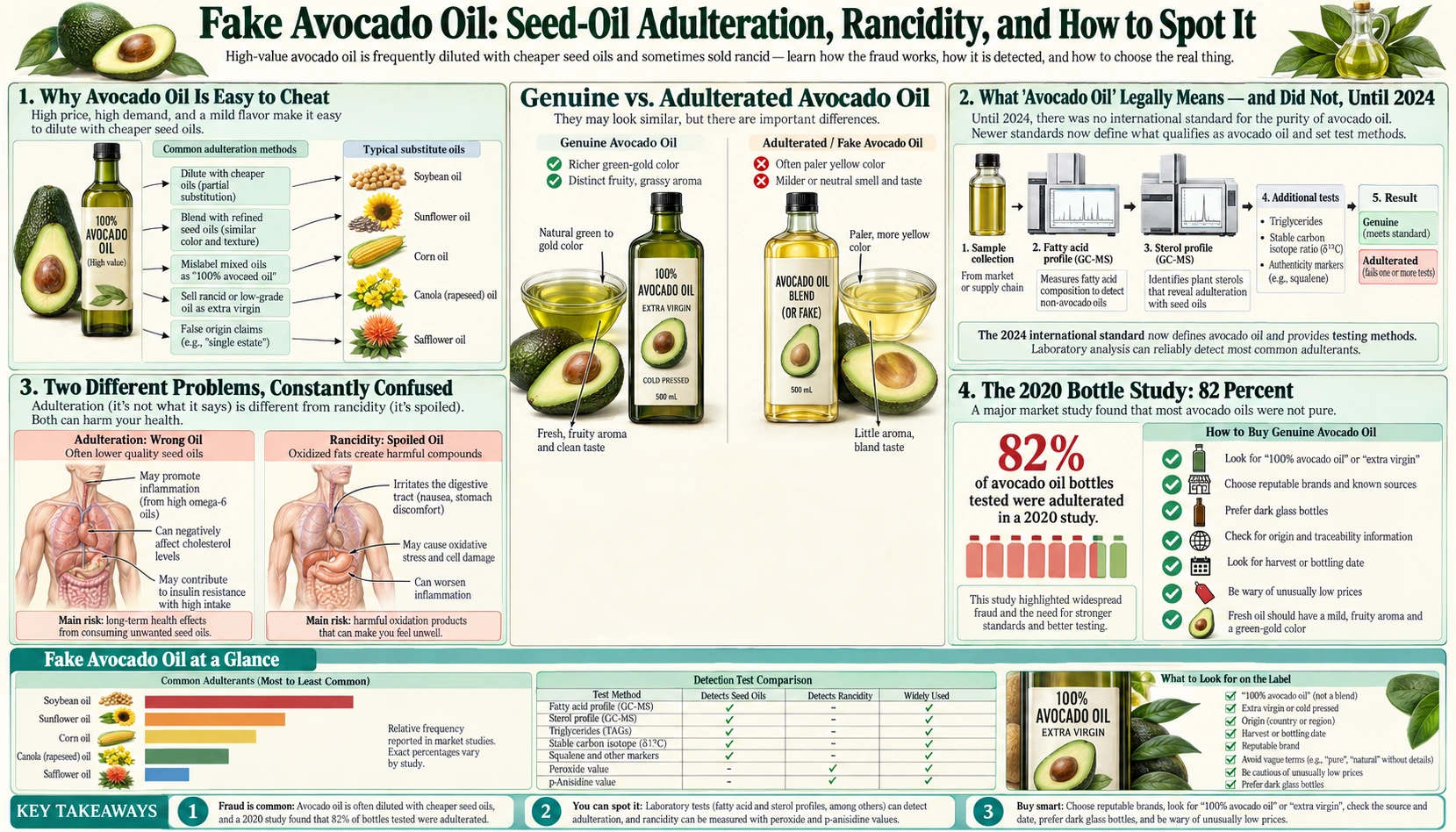
Avocado oil has the features that make a food a target for fraud. It is a premium oil that buyers pay more for; it is a liquid, so a cheaper oil can be blended into it; the 2020 UC Davis study found three bottles labelled “pure” or “extra virgin” avocado oil that were close to 100 percent soybean oil, which the university describes as much less expensive to produce; and, until November 2024, there was no international standard setting out what “avocado oil” had to contain. The UC Davis researchers contrast it with olive oil, whose authenticity has been studied, tested and scrutinized for decades, while avocado oil is a relatively new product category that has not been monitored at the same level.
This page names no brands. Three laboratory studies from the same University of California, Davis group — on bottled oils in 2020, on store-brand oils in 2023, and on chips, mayonnaise and dressings in 2026 — found that most of the products they bought were either oxidized or not consistent with authentic avocado oil. A result for one brand describes the batch that was tested, not the next one, so the page reports the findings by product category and explains the mechanism: what avocado oil is chemically, the two different failures that get lumped together as “fake,” how a laboratory tells a real oil from a blend, what the standards say now, the main question raised about the methods, and what can and cannot be checked outside a laboratory.
Table of Contents
- Why Avocado Oil Is Easy to Cheat
- What “Avocado Oil” Legally Means — and Did Not, Until 2024
- Two Different Problems, Constantly Confused
- The 2020 Bottle Study: 82 Percent
- The 2023 Store-Brand Study: Nearly 70 Percent
- The 2026 Processed-Food Study: 48 of 54
- How the Fingerprint Works: Fatty Acids and Sterols
- The Question of Reference Ranges, and What the Studies Did About It
- Why the Olive-Oil Products Passed
- Where in the Supply Chain It Happens
- What the Studies Mean for Shoppers
- The Kitchen Test That Does Not Work
- What It Means for Health
- The Bottom Line
- The Interview That Prompted This Page
- Key Research Papers
- Connections
- Featured Videos
Why Avocado Oil Is Easy to Cheat
The 2020 UC Davis release notes that foods fetching a higher price are especially open to manipulation, particularly when the adulteration is too subtle to detect outside a laboratory. Avocado oil fits that description in three ways: the price gap, how easily other oils blend in, and how hard a blend is to notice.
The blendability is a matter of chemistry. Avocado oil, like olive oil, is dominated by oleic acid, a monounsaturated fat, and high-oleic seed oils such as high-oleic sunflower and safflower oil resemble it. A 2026 study in the Journal of the American Oil Chemists’ Society describes these lower-cost high-oleic seed oils as resembling the fatty-acid specifications of avocado oil, and a 2022 UC Davis paper notes that telling avocado oil apart from them has been a particular challenge. The difficulty of noticing a blend is the third factor. Refined avocado oil is processed to remove flaws and, according to UC Davis, is light yellow and almost clear; in the 2023 store-brand study, 29 of the 36 oils tested were refined. Once an oil has been used to fry a chip or make a mayonnaise, the 2026 study had to extract the fat from the food and analyze it in a laboratory to check what it was.
A fourth factor separates avocado oil from olive oil: it is newer to the market. A 2019 review in Molecules stated that there were no international regulations on the quality of avocado oil, and that some authors referred instead to the parameters used for olive oil by the Codex Alimentarius or the International Olive Oil Council. The 2020 UC Davis release described avocado oil as relatively new on the scene, without the U.S. Food and Drug Administration (FDA) standards of identity that define many other foods.
What “Avocado Oil” Legally Means — and Did Not, Until 2024
In the United States the Food and Drug Administration sets standards of identity: according to the U.S. Food and Drug Administration, it began establishing them in 1939 and has issued more than 250, which often describe in detail what a food must contain. The 2020 UC Davis release stated that the U.S. Food and Drug Administration had not adopted a standard of identity for avocado oil, and that without one the U.S. Food and Drug Administration had no means to regulate avocado oil quality and authenticity. The 2023 release said that no enforceable standards defining the chemical and physical characteristics of avocado oil existed yet.
Internationally, the situation changed on 25 November 2024. The Codex Alimentarius Commission, a joint initiative of the Food and Agriculture Organization (FAO) and the World Health Organization (WHO), agreed to include avocado oil in its Standard for Named Vegetable Oils (CXS 210-1999). In the FAO’s summary, the addition establishes “science-based quality and purity as well as food safety criteria for this increasingly traded product,” and will help “provide a basis for determining the authenticity of the product.” Before that vote, a 2023 UC Davis paper compared a comprehensive set of authentic avocado oils — varying by region, harvest time, cultivar and fruit grade — with the proposed Codex purity standards. It found that fatty acids and sterols were most affected by region and harvest time, and that the fatty-acid limits and two sterols, delta-7-stigmastenol and delta-7-avenasterol, needed further research and adjustment.
A Codex standard is an agreed reference: it gives regulators, buyers and laboratories a shared chemical definition of genuine avocado oil, but it does not by itself require anyone to test a product. In California, a 2023 bill (AB 239) would have required the state to adopt standards of identity for avocado oil, covering quality, purity, labelling and a method of analysis, and would have created an Avocado Oil Commission of California. The legislature’s record shows the bill was filed with the Chief Clerk under Joint Rule 56 on 1 February 2024, with its status listed as in committee; it did not become law. In its 2026 release on processed foods, UC Davis described avocado oil as not yet monitored at the level olive oil is, and said consumers have less protection against misleading labels as a result. The 2023 paper noted that, since the 2020 study, some producers had made efforts to assure quality and to support the setting of standards.
Two Different Problems, Constantly Confused
“Fake avocado oil” covers two failures that have different causes, different tests and different consequences, and they are routinely added together into a single alarming percentage. They deserve to be separated.
Rancidity is a quality failure. The oil in the bottle may be entirely avocado oil, but it has oxidized. According to the 2020 UC Davis release, oil loses its flavor and health benefits when it oxidizes, which happens over time and with too much light, heat or air, and rancid oil starts to smell stale, “sort of like play dough.” The 2020 study measured quality with free fatty acidity, peroxide value, ultraviolet absorbance and vitamin E. In that study, 15 of the 22 oils were oxidized before the expiration date printed on the bottle.
Adulteration is a purity failure. Something that is not avocado oil has been blended in, or the bottle contains no avocado oil at all. It is detected by a different set of measurements: the 2020 study measured fatty acids, sterols and triacylglycerols, which act as a compositional fingerprint of the plant the oil came from.
The two can co-exist — a blend can also be rancid — but they are not the same claim. The 2020 finding usually repeated as “82 percent of avocado oil is fake” was that at least 82 percent of the samples were either oxidized before their date or mixed with other oils: 15 of the 22 were oxidized, and 6 were mixed with other oils. The two findings point to different causes.
The 2020 Bottle Study: 82 Percent
The first systematic look at avocado oil sold in the United States was published in Food Control in 2020 by Hilary Green and Selina Wang of UC Davis. They tested 22 domestic and imported avocado oils, which included all the brands they could find in local stores and online, extracted their own reference oil from fresh avocados for comparison, and ran both the quality and the purity measures.
The headline: at least 82 percent of the samples were either oxidized before their expiration date or mixed with other oils. Broken down, 15 of the 22 were oxidized before the expiration date; 6 were mixed with large amounts of other oils, including sunflower, safflower and soybean oil; and 3 bottles labelled “pure” or “extra virgin” avocado oil contained close to 100 percent soybean oil (the paper’s abstract lists them as two “extra virgin” samples and one “refined” sample). Samples from only two brands were both pure and not oxidized. Wang said she was surprised that some of the samples did not contain any avocado oil, and that because there were no standards, no one was regulating false or misleading labels.
The 2023 Store-Brand Study: Nearly 70 Percent
The follow-up, also in Food Control, looked specifically at private-label oils — products made by a third-party processor and sold under a store or retailer label. The researchers tested 36 such oils bought from 19 retailers in the United States and Canada at various price points. 31 percent were pure and 36 percent were of the advertised quality; UC Davis summarized the result as nearly 70 percent rancid or mixed with other oils. Of the 29 refined samples, 3 met both the quality and the purity standards, 11 met the quality standards and 8 met the proposed purity standards; of the 7 unrefined samples, 3 met the proposed purity standards. On price, Wang said: “We found that low-cost products indicate a higher probability for adulteration, but high cost didn’t guarantee purity or quality.” The paper also identified markers, such as an elevated stearic acid value together with an elevated delta-7-stigmastenol value, to help professional buyers judge which oils to purchase.
The 2026 Processed-Food Study: 48 of 54
The study that prompted this page moved from the bottle to the pantry. Reported by UC Davis in July 2026 and published in Applied Food Research by Lopez-Alvarez, Li, Vizgordiski and Wang, it addressed an area its authors say had received little analytical attention, since most earlier studies examined bottled oils: when a bag of chips, a jar of mayonnaise or a bottle of salad dressing names avocado oil as its only oil, is that what is inside? The group bought 74 such products in 2025 and 2026, from online retailers and California stores — 54 declaring avocado oil as the sole oil and 20 declaring olive oil — extracted the fat from each, and ran the fatty-acid and sterol fingerprints. The work received no outside funding.
Of the 54 avocado-oil products, 48 — 89 percent — had compositional profiles inconsistent with authentic avocado oil. By category, 93 percent of the chips, 71 percent of the mayonnaises and 100 percent of the salad dressings failed. The study’s abstract describes the failing samples as having reduced palmitic acid, palmitoleic acid, cis-vaccenic acid, beta-sitosterol and clerosterol, and elevated stearic acid, campesterol, stigmasterol, delta-7-stigmastenol and delta-7-avenasterol — a pattern that runs across both families of markers, the fatty acids and the sterols.
Two design choices address the obvious questions. The researchers allowed a 10 percent margin of deviation to account for natural variables such as geographic origin and avocado variety; in Wang’s words, “we gave the samples some wiggle room, giving them a 10% margin of deviation to account for that, but 89% of the avocado products still failed.” And because frying, blending or emulsifying might change an oil’s chemistry, the team ran laboratory frying and emulsification experiments and found that the fatty acids and sterols changed only minimally. The researchers concluded that typical processing did not explain the differences they observed.
On price, the study found that products marketed with premium oils generally commanded higher retail prices than comparable products made with vegetable oils, but price was not associated with whether the oil was authentic. The UC Davis release added that the avocado-oil products were priced comparably to the olive-oil products or higher, and that consumers paid premium prices either way.
How the Fingerprint Works: Fatty Acids and Sterols
Authenticity testing measures the proportions of the compounds in an oil and asks whether they fall inside the range that genuine oil from that plant produces. UC Davis describes fatty acids and sterols as chemical “fingerprints” unique to each oil, and these are the two families of markers used in all three studies.
Fatty acids are the building blocks of the fat itself. In the composition tables of the 2019 Molecules review, oleic acid (18:1) is the largest fatty acid in avocado oil, with palmitic (16:0), palmitoleic (16:1) and linoleic (18:2) acids also present in substantial amounts. A further marker is cis-vaccenic acid, an isomer of oleic acid. The UC Davis group reported in 2022 that avocado oil contains 5.5 to 7.5 percent cis-vaccenic acid, against less than 0.75 percent in high-oleic safflower oil and less than 1.3 percent in high-oleic sunflower oil, and noted that oil standards usually set a limit only for total oleic acid, which counts both isomers together. A 2026 follow-up measured 298 authentic avocado oils from 24 cultivars and 13 producing regions, found that geographic origin explained 73.7 percent of the variation in cis-vaccenic acid, and set a lower bound of 3.2 percent that covered 99.7 percent of the authentic oils, with a working screening threshold of 4.6 percent. In blending experiments, cis-vaccenic acid fell in a straight line as more seed oil was added. In the 2023 store-brand study, an elevated stearic acid value was one of the markers of adulteration.
Sterols are minor compounds in the unsaponifiable fraction of an oil, the part that is not fat. The 2019 review reports beta-sitosterol as the most abundant sterol in avocado oil. In the 2026 processed-food study, the failing samples had less beta-sitosterol and clerosterol and more campesterol, stigmasterol, delta-7-stigmastenol and delta-7-avenasterol than authentic avocado oil; in the 2023 store-brand study, an elevated delta-7-stigmastenol value, together with elevated stearic acid, was a marker of adulteration.
Newer methods exist alongside these. A 2023 UC Davis paper describes a triacylglycerol analysis combined with principal-component analysis that does not need standard ranges for each compound; the authors report the same purity accuracy as the fatty-acid and sterol methods, with less time and chemical waste. A 2021 study with Ohio State University used high-resolution NMR spectroscopy and chemometrics to tell avocado oil apart from olive, canola, high-oleic safflower, high-oleic sunflower and soybean oils. The 2023 evaluation of the proposed Codex standards analyzed fatty acids, sterols and tocopherols.
The Question of Reference Ranges, and What the Studies Did About It
A question that applies to any authenticity method is whether the reference ranges for “authentic” avocado oil are too narrow: avocados vary by cultivar, region and harvest time, and a range built on one set of fruit could flag a genuine oil from elsewhere as adulterated. The source interview discussed below addresses a claim that the 2026 study relied on an outdated database.
The studies report three things that bear on it. First, the same group has measured natural variation directly: its 2023 evaluation of the proposed Codex standards compared authentic oils across regions, harvest times, cultivars and fruit grades, and its 2026 cis-vaccenic acid study used 298 authentic oils from 24 cultivars and 13 regions to set a threshold that accounts for that variation. Wang said that the group had seen natural variables such as geographic origin and avocado variety change these fingerprints. Second, the 2026 processed-food study added a 10 percent margin of deviation for that reason. Third, the study’s abstract describes a consistent pattern in the failing samples across both the fatty acids and the sterols.
The limits are also stated in the sources. This is one study, from one laboratory, on products bought in 2025 and 2026, and UC Davis notes that the products represent only a portion of the avocado-oil processed-food market. The study reports products as inconsistent with authentic avocado oil; the study’s abstract and the UC Davis releases do not report how much other oil each product contained. The 10 percent figure describes the margin of tolerance, not a measured blend percentage. No replication by another laboratory was found in the sources reviewed for this page.
Why the Olive-Oil Products Passed
The 20 olive-oil products in the same study, tested with the same purity methods, gave a different result: only one failed. The UC Davis release explains the gap this way: olive oil authenticity has been studied, tested and scrutinized for decades, while avocado oil is a relatively new and expensive product category that has not been monitored at the same level, so consumers have less protection against misleading labels. In 2023 Wang described avocado oil as “similar to what I saw with olive oil 10 years ago,” adding that olive oil quality and purity had improved significantly since.
Where in the Supply Chain It Happens
The testing shows what is in a product, not where in the supply chain another oil was added. Wang said that brands whose products failed may not know they are using adulterated oil, because many food companies buy their oils from third-party brokers or from several suppliers, and that the adulteration likely originates with oil suppliers, who “may be hiding behind a couple of layers of supply chain.” She also said food companies could do more to monitor and verify the oil they buy. According to Food Safety Magazine’s report, Wang said the findings point to a need for greater verification of premium oil ingredients throughout the supply chain, and the authors concluded that increased analytical monitoring could improve labelling transparency.
What the Studies Mean for Shoppers
The studies were not designed to give shopping advice, but several of their findings bear on what a buyer can and cannot tell from a product.
- Published testing. None of the studies tested whether producer-published test certificates match the oil inside the bottle. The 2023 paper identified chemical markers, such as elevated stearic acid with elevated delta-7-stigmastenol, intended to help professional retail buyers choose suppliers, and the 2026 release quoted Wang as saying food companies could do more to monitor and verify the authenticity of the oil they buy.
- Bottled oil and oil as an ingredient. In the 2020 bottled-oil study, 6 of 22 oils were mixed with large amounts of other oils and 15 of 22 were oxidized before their date. In the 2026 processed-food study, 48 of 54 products naming avocado oil as their only oil were inconsistent with authentic avocado oil. The two studies used different samples and criteria, so their percentages are not directly comparable.
- Price. In the 2023 store-brand study, low-cost oils were more likely to be adulterated, but a high price did not guarantee purity or quality. In the 2026 processed-food study, price was not associated with authenticity.
- Freshness. Rancidity can be noticed by smell: the 2020 UC Davis release describes rancid oil as starting to smell stale, “sort of like play dough.” The same release states that even good oil becomes rancid with time and that the best-before date is not always a reliable indicator of quality, and it suggests buying a size that can be finished before the oil oxidizes, storing it away from light and heat, and choosing an oil close to its harvest or production date. The release also describes authentic fresh virgin avocado oil as tasting grassy, buttery and a little like mushrooms, and green in color, while refined avocado oil is light yellow and almost clear.
- The ingredients list. The 2026 study tested only products whose ingredients named avocado oil as the sole oil; most of them still failed, so an ingredients list naming only avocado oil was not a reliable sign of authenticity in that sample.
- Standards. The Codex definition was adopted in November 2024. In 2023 Wang said she saw avocado oil heading where olive oil had gone, “if we can establish fair standards and eliminate fraudulent products.”
The Kitchen Test That Does Not Work
A popular home test is to put the bottle in the refrigerator and see whether it solidifies. The UC Davis Olive Center tested this on olive oil in 2013: seven oils of different compositions were kept at 4.7 °C, none had congealed after 60 hours, and after 120 to 180 hours only the samples with at least 50 percent virgin olive oil showed partial congealing — including a 50/50 blend — while none fully solidified. The report concluded that the fridge test was unreliable for judging whether an olive oil was made from olives or for judging its quality, and that sensory and chemical testing is essential. No study of the fridge test on avocado oil was found in the sources reviewed for this page. The authenticity markers used in the avocado-oil studies are measured by laboratory instruments, and the 2020 UC Davis release notes that adulteration can be too subtle to detect outside a laboratory. The sibling page on olive oil covers what the senses can detect, which is mainly rancidity rather than substitution.
What It Means for Health
The studies measured authenticity and freshness, not health effects, so the health side has to be described from other sources.
The 2026 study did not identify which oil was in each failing product; it reported a fatty-acid and sterol pattern that differed from authentic avocado oil. The 2020 study identified sunflower, safflower and soybean oil in its blended bottles. High-oleic seed oils resemble avocado oil in their fatty-acid specifications, and the 2022 UC Davis paper describes them as hard to tell apart from it. Heating studies give a sense of how oil type matters in the pan: in a 2021 study in Foods, soybean and corn oils, which are rich in polyunsaturated fat, produced the highest aldehyde concentrations during laboratory-simulated shallow frying, while avocado and olive oils, rich in monounsaturated fat, were much more resistant to this oxidation; and a 2012 study in Food Chemistry found the stability of avocado oil heated at 180 °C similar to that of olive oil. The wider debate about seed oils is covered on their own page.
The problems the sources describe are of three kinds. The first is economic: according to UC Davis, consumers paid premium prices for products that were not what they claimed to be. The second is informed choice: the 2026 release notes that many of these products are marketed to consumers who are intentionally trying to avoid other oils, and Wang’s data suggest most of those consumers were not getting what they paid for. The third is freshness: according to the 2020 release, oil loses its flavor and health benefits when it oxidizes. The sources reviewed for this page did not report a measured health effect from eating the adulterated or oxidized products.
The Bottom Line
Avocado oil is a relatively new premium product. A Codex definition was adopted in November 2024; UC Davis reported in 2020 that the U.S. Food and Drug Administration had no standard of identity for it, and in 2023 that no enforceable standards existed yet. Three studies from one UC Davis laboratory found that at least 82 percent of 22 bottled oils were oxidized before their date or mixed with other oils (2020); that 31 percent of 36 store-brand oils were pure and 36 percent of advertised quality (2023); and that 48 of 54 processed foods naming avocado oil as their only oil were inconsistent with authentic avocado oil, while 1 of 20 olive-oil products failed (2026). The 2026 study allowed a 10 percent margin for natural variation and tested the effect of frying and emulsifying. Open questions remain: how much other oil each failing product contained, where in the supply chain it was added, and whether other laboratories will find the same. On price, a low price raised the odds of adulteration in the 2023 study, and neither a high price nor an avocado-only ingredients list guaranteed authenticity. The researchers attribute the difference from olive oil to decades of study, testing and scrutiny that avocado oil has not yet had.
The Interview That Prompted This Page
This page was written after the interview below, in which the channel’s host and a guest discuss the 2026 UC Davis study, which the video’s description links. It is embedded here permanently; unlike the Featured Videos at the foot of the page, which rotate, this frame is fixed.

Thomas DeLauer — The Avocado Oil Scandal Just Got 10x Worse, YouTube (18 minutes, 3 September 2026).
What the interview covers. According to the video’s chapter list, the interview covers how UC Davis tested 54 avocado-oil products, sterols, whether the study is flawed and the claim of an outdated database, the two tests that drifted in the same direction, the heat test and why the olive-oil products passed, where the adulteration comes from, fatty acids versus sterols, how a gas chromatograph works, and a call for third-party testing. The study figures stated on this page come from the paper’s abstract and the UC Davis and Food Safety Magazine reports, not from the interview.
What is not repeated here. Parts of the interview discuss specific brands; the study itself reports results by product category, and no brand is named on this page. On the chemistry of fatty acids generally: a 2023 review in Biotechnology and Bioengineering states that cells naturally produce even-chain fatty acids, with negligible odd-chain fatty acids, because acetyl-CoA is the starter unit for even chains and propionyl-CoA for odd chains; and a 2016 review in Advances in Nutrition describes the odd-chain fatty acids pentadecanoic (15:0) and heptadecanoic (17:0) acid as a small proportion of the saturated fat in milk fat and ruminant meat. The main fatty acids in avocado oil — oleic, palmitic, palmitoleic and linoleic — have 16 or 18 carbons.
Key Research Papers
The UC Davis authenticity studies
- Lopez-Alvarez N, Li X, Vizgordiski B, Wang SC. Authenticity of avocado and olive oils used as ingredients in commercially processed foods. Applied Food Research. 2026;6(2):102389. — the 2026 study: 74 products, 48 of 54 avocado-oil-labelled foods inconsistent with authentic avocado oil, 1 of 20 olive-oil foods; frying and emulsifying controls; no outside funding. — doi:10.1016/j.afres.2026.102389
- Green HS, Wang SC. First report on quality and purity evaluations of avocado oil sold in the US. Food Control. 2020;116:107328. — 22 bottled oils; at least 82 percent oxidized before their date or mixed with other oils; 15 oxidized, 6 mixed with other oils; three “pure” or “extra virgin” bottles close to 100 percent soybean oil. — doi:10.1016/j.foodcont.2020.107328
- Green HS, Wang SC. Purity and quality of private labelled avocado oil. Food Control. 2023;152:109837. — 36 store-brand oils from 19 US and Canadian retailers; 31 percent pure and 36 percent of advertised quality (nearly 70 percent rancid or adulterated, in the UC Davis summary); low price raised the odds of adulteration, high price did not guarantee purity or quality. — doi:10.1016/j.foodcont.2023.109837
- Green HS, Wang SC. Evaluation of proposed CODEX purity standards for avocado oil. Food Control. 2023;143:109277. — authentic oils varying by region, harvest time, cultivar and fruit grade compared with the proposed Codex purity standards; fatty acids, delta-7-stigmastenol and delta-7-avenasterol flagged for further research and adjustment. — doi:10.1016/j.foodcont.2022.109277
- Green HS, Wang SC. Extra virgin grade avocado oil can be achieved using whole fruits or only mesocarp. Applied Food Research. 2022;2(2):100190. — oil mechanically extracted from whole fruits can meet the virgin and/or extra virgin grade standard; fruit grade had the biggest effect on free fatty acidity. — doi:10.1016/j.afres.2022.100190
The fingerprint: markers and methods
- Green HS, Wang SC. Cis-vaccenic acid: New maker to detect seed oil adulteration in avocado oil. Food Chemistry Advances. 2022;1:100107. — 5.5 to 7.5 percent cis-vaccenic acid in avocado oil, against less than 0.75 percent in high-oleic safflower and less than 1.3 percent in high-oleic sunflower oil. — doi:10.1016/j.focha.2022.100107
- Wannasin D, Wang SC. Cis-vaccenic acid as a compositional marker for detecting high-oleic seed oil adulteration in avocado oil. Journal of the American Oil Chemists’ Society. 2026;103(10):1259–1266. — 298 authentic oils, 24 cultivars, 13 regions; lower bound 3.2 percent, operational threshold 4.6 percent. — doi:10.1002/aocs.70129
- Green HS, Wang SC. Tandem triacylglycerol (TAG) and PCA adulteration detection approach for avocado oil. Food Analytical Methods. 2023;16(5):850–856. — a method that does not need standard ranges for each compound, with the same purity accuracy as fatty-acid and sterol methods in the authors’ report. — doi:10.1007/s12161-023-02468-7
- Tang F, Green HS, Wang SC, Hatzakis E. Analysis and authentication of avocado oil using high resolution NMR spectroscopy. Molecules. 2021;26(2):310. — distinguishes avocado oil from olive, canola, high-oleic safflower, high-oleic sunflower and soybean oils by NMR. — doi:10.3390/molecules26020310 (PubMed PMID: 33435322)
- Flores M, Saravia C, Vergara CE, Avila F, Valdés H, Ortiz-Viedma J. Avocado oil: characteristics, properties, and applications. Molecules. 2019;24(11):2172. — the composition review: oleic acid the largest fatty acid, palmitoleic acid present, beta-sitosterol the most abundant sterol; extraction methods; no international quality regulations at the time. — doi:10.3390/molecules24112172 (PubMed PMID: 31185591)
- Wann AI, Percival BC, Woodason K, Gibson M, Vincent S, Grootveld M. Comparative 1H NMR-based chemometric evaluations of the time-dependent generation of aldehydic lipid oxidation products in culinary oils exposed to laboratory-simulated shallow frying episodes: differential patterns observed for omega-3 fatty acid-containing soybean oils. Foods. 2021;10(10):2481. — soybean and corn oils produced the most aldehydes; avocado and olive oils were much more resistant. — PubMed PMID: 34681530
- Berasategi I, Barriuso B, Ansorena D, Astiasarán I. Stability of avocado oil during heating: comparative study to olive oil. Food Chemistry. 2012;132(1):439–446. — at 180 °C for up to 9 hours, the stability of avocado oil was similar to that of olive oil. — PubMed PMID: 26434313
- Qin N, Li L, Wang Z, Shi S. Microbial production of odd-chain fatty acids. Biotechnology and Bioengineering. 2023;120(4):917–931. — cells naturally produce even-chain fatty acids with negligible odd-chain fatty acids. — PubMed PMID: 36522132
- Pfeuffer M, Jaudszus A. Pentadecanoic and heptadecanoic acids: multifaceted odd-chain fatty acids. Advances in Nutrition. 2016;7(4):730–734. — 15:0 and 17:0 are a small proportion of the saturated fat in milk fat and ruminant meat. — PubMed PMID: 27422507
Regulatory and primary records
- Codex Alimentarius. Standard for Named Vegetable Oils, CXS 210-1999, as revised 2024 to include avocado oil. fao.org (PDF)
- FAO. FAO-WHO Codex Alimentarius Commission adopts new standards, 47th session, 25 November 2024. fao.org — the source of the quoted wording on avocado oil.
- US Food and Drug Administration. Standards of Identity for Food. fda.gov — the FDA’s overview of standards of identity (more than 250 since 1939).
- California Legislature. AB 239 (2023–2024), Avocado oil: regulations: standards of identity. digitaldemocracy.org — filed with the Chief Clerk under Joint Rule 56 on 1 February 2024; did not become law.
- Li X, Wang SC, Flynn D. Refrigeration is not reliable in detecting olive oil adulteration. UC Davis Olive Center, March 2013. olivecenter.ucdavis.edu (PDF) — the fridge test on seven oils.
- UC Davis. That avocado oil chip you’re eating may not be made with pure avocado oil (most avocado oil chips and dressings are adulterated, study finds). 15 July 2026. ucdavis.edu
- UC Davis. Nearly 70% of private label avocado oil rancid or mixed with other oils. 24 May 2023. ucdavis.edu
- UC Davis. Study finds 82 percent of avocado oil rancid or mixed with other oils. 15 June 2020. ucdavis.edu
- Food Safety Magazine. UC Davis researchers find widespread authenticity issues with avocado oil in processed foods. 2026. food-safety.com — reports the marker-by-marker pattern in the failing samples and the price finding.
Connections
- Fake Food — The section hub: adulteration, dilution, mislabelling and grade fraud
- Fake Olive Oil — The same two frauds in the oil that has had a century of regulation, and what that regulation bought
- Avocado — The fruit the genuine oil is pressed from
- Avocado’s Monounsaturated Fats — The oleic acid that avocado and olive oil share
- Olive Oil — Nutrition, cooking and health benefits of the older premium oil
- Cooking Temperature — What heat does to an oil in your own pan
- Seed Oils — The oils most often used to cut a costlier one, and the health debate stated fairly
- Processed Oils — What refining, bleaching and deodorising do to a fat
- Ultra-Processed Foods — The category most of the failing products belong to
- Food Additives — What is deliberately added to food, and why
- Honey — Another of the most adulterated foods in world trade
- Saffron — The spice with the same economics and the same fraud problem
- Food — The complete food library