Coffee: Nutrient Profile
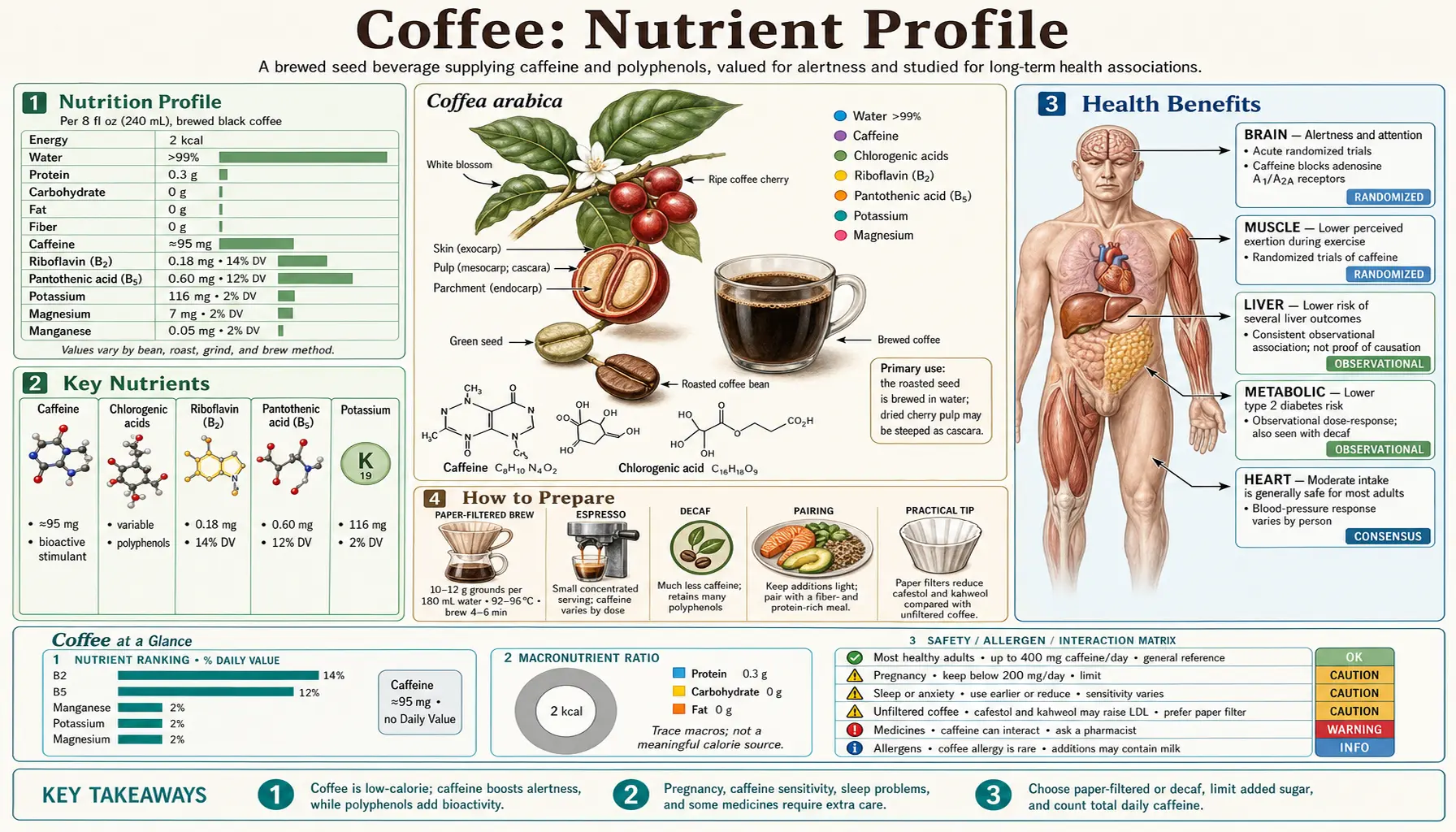
What is Coffee richest in? Below are the vitamins, minerals and amino acids that 100 g of Coffee delivers in the highest amounts. Each one links to that nutrient’s own page listing the best foods to get it from.
Per 100 g, Coffee does not supply any vitamin, mineral or amino acid at the 10%-of-Daily-Value level this site uses to flag a meaningful source. Foods like this are valued for other qualities — flavour, hydration, or compounds outside the vitamin, mineral and amino-acid families — rather than for their micronutrients.
These figures come from the U.S. Department of Agriculture (USDA) FoodData Central record FDC 171890, “Beverages, coffee, brewed, prepared with tap water” (SR Legacy) — that is, 100 g of brewed coffee, which the record lists as 99.4 g water. Its largest vitamin and mineral amounts per 100 g are riboflavin (vitamin B2) at 0.076 mg and potassium at 49 mg.
Caffeine and Other Compounds
Per 100 g of brewed coffee, the same USDA record lists 40 mg caffeine and 1 kcal of energy. It also lists 90.7 mcg fluoride; this record is for coffee brewed with tap water.
A 2017 systematic review of caffeine studies published from 2001 to June 2015 (381 studies met its criteria) concluded that the evidence generally supports up to 400 mg of caffeine a day in healthy adults as not associated with overt adverse effects on the heart and blood vessels, behaviour, reproduction and development, bone, or acute effects. It found up to 300 mg a day in healthy pregnant women generally not associated with adverse reproductive and developmental effects. Data for children and teenagers were limited; the review found that 2.5 mg of caffeine per kg of body weight a day remains an appropriate level for them (Wikoff and colleagues, 2017).
A 2017 umbrella review gathered 201 meta-analyses of observational research and 17 of interventional research on coffee. The largest relative risk reductions were seen at three to four cups a day compared with none, including all-cause mortality (relative risk 0.83), cardiovascular mortality (0.81) and cardiovascular disease (0.85); high compared with low intake went with an 18% lower risk of new cancer. Harmful links mostly disappeared once smoking was properly accounted for, except in pregnancy, where high compared with low or no intake was linked to low birth weight (odds ratio 1.31), preterm birth in the first (1.22) and second (1.12) trimester, and pregnancy loss (1.46). Coffee drinking was also linked to fracture risk in women but not in men. These are mostly observational links, and the authors state that randomized trials are needed to learn whether they are causal (Poole and colleagues, 2017).
Key Research Papers
- Wikoff D, Welsh BT, Henderson R, Brorby GP, Britt J, Myers E, Goldberger J, Lieberman HR, O’Brien C, Peck J, Tenenbein M, Weaver C, Harvey S, Urban J, Doepker C (2017). Systematic review of the potential adverse effects of caffeine consumption in healthy adults, pregnant women, adolescents, and children. Food and Chemical Toxicology; 109(Pt 1):585–648. — PubMed PMID: 28438661
- Poole R, Kennedy OJ, Roderick P, Fallowfield JA, Hayes PC, Parkes J (2017). Coffee consumption and health: umbrella review of meta-analyses of multiple health outcomes. BMJ; 359:j5024. — PubMed PMID: 29167102
Connections
- All Food
- Caffeine, Adenosine & Why Coffee Stops Working — interactive animation
- Coffee (Main Page)