U.S. Food and Drug Administration (FDA) Tests Talc Cosmetics for Asbestos and Finds None in 50 Samples (2021)
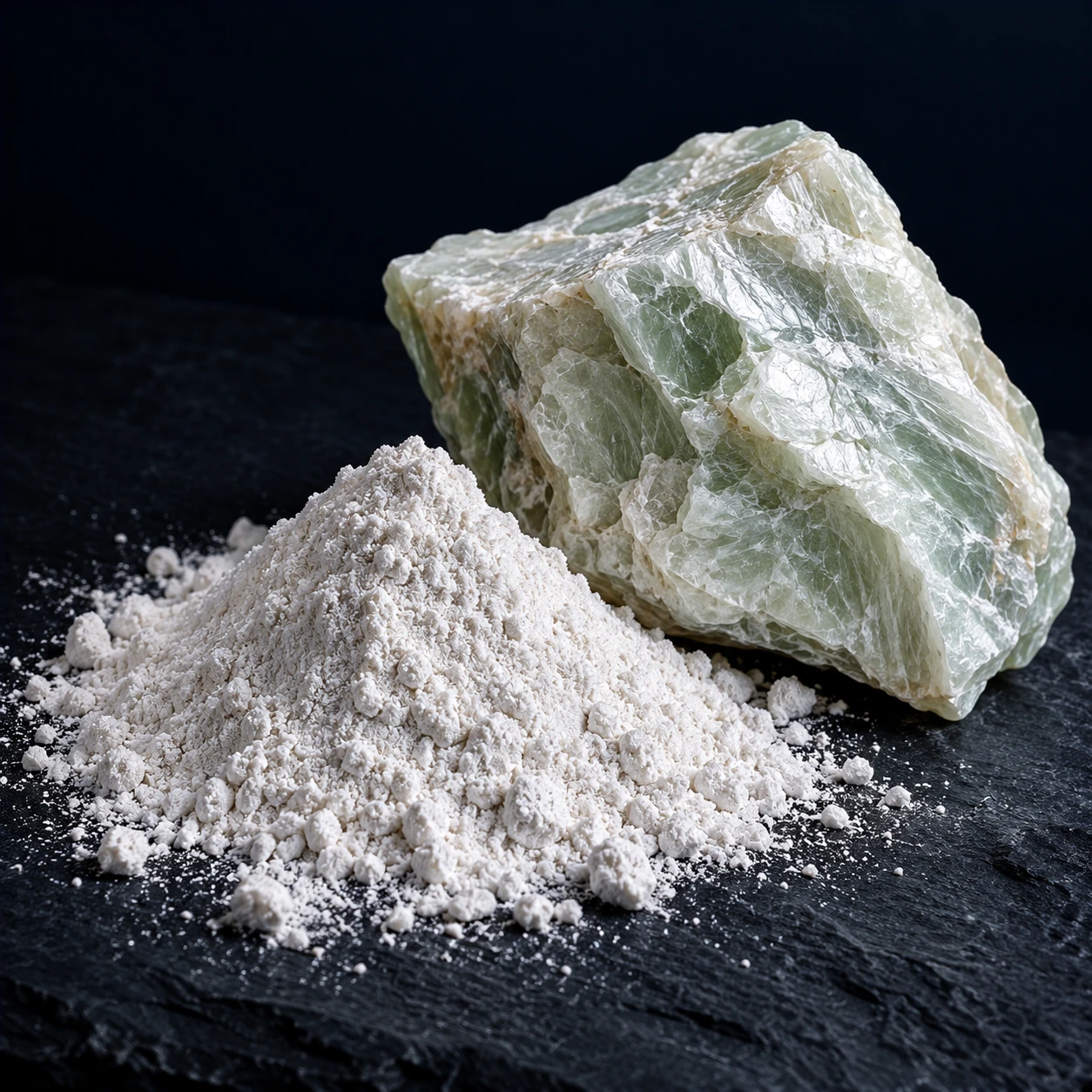
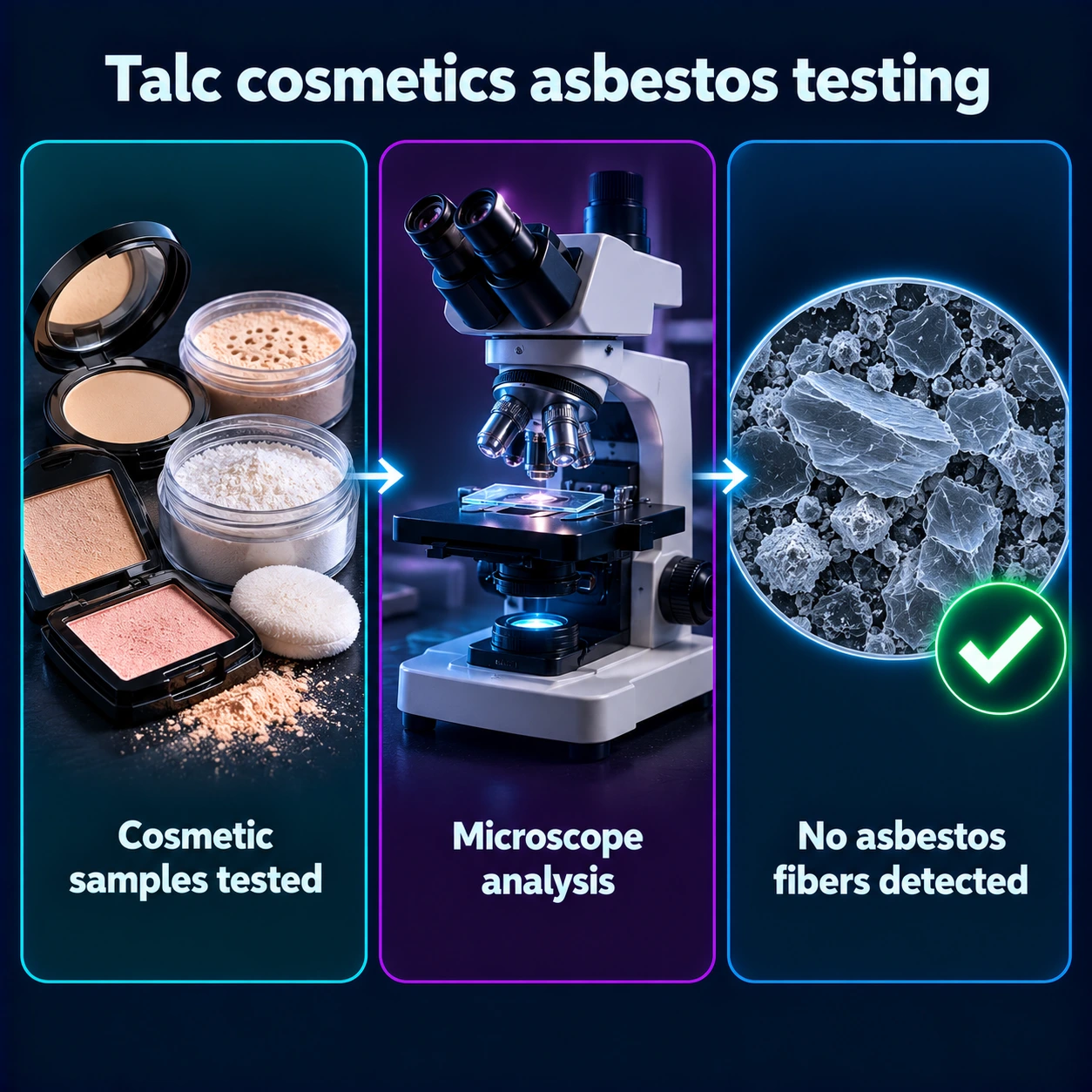
On October 25, 2021, the U.S. Food and Drug Administration (FDA) released the results of its 2021 round of testing talc-containing cosmetic products for asbestos. In the agency’s words, “Asbestos fibers were not detected in any of the 50 samples tested in 2021.” The U.S. Food and Drug Administration said it planned to test 50 more samples in 2022. The mineral itself is described on the site’s Asbestos page.
This page reports what the U.S. Food and Drug Administration’s own documents say: what was released and when, how the products were chosen and tested, why the round planned for 2020 ran in 2021, the background the U.S. Food and Drug Administration gives on talc, asbestos and its authority over cosmetics, what the agency said would come next, what the survey does not do, its status as of October 18, 2026, and how it fits earlier and later U.S. Food and Drug Administration talc actions. No cosmetic product, brand, company or laboratory is named here; the U.S. Food and Drug Administration’s own summary table lists every product tested, and it is not reproduced.
Table of Contents
- What the U.S. Food and Drug Administration Released on October 25, 2021
- How the Products Were Chosen
- How the Samples Were Tested
- Why the 2020 Round Ran in 2021
- Talc, Asbestos and the U.S. Food and Drug Administration’s Authority Over Cosmetics
- What the U.S. Food and Drug Administration Said Would Come Next
- What the Survey Does Not Do
- Dates and Legal Status as of October 18, 2026
- How It Fits Earlier and Later U.S. Food and Drug Administration Talc Actions
- Primary Documents
- Key Research Papers
- Connections
- Featured Videos
1. What the U.S. Food and Drug Administration Released on October 25, 2021
The announcement was a constituent update, one of the U.S. Food and Drug Administration’s short public notices. Titled “U.S. Food and Drug Administration Releases Data from the Agency’s 2021 Testing of Talc-Containing Cosmetic Products for Asbestos,” it states that the U.S. Food and Drug Administration “has released the results of the agency’s most recent sampling assignment testing talc-containing cosmetic products for the presence of asbestos.”
The central finding is one sentence: “Asbestos fibers were not detected in any of the 50 samples tested in 2021.” The update adds that “The testing was conducted using Polarized Light Microscopy (PLM) and Transmission Electron Microscopy (TEM),” two kinds of microscope analysis described in section 3.
The full results were posted on the U.S. Food and Drug Administration’s Talc page under “2021 Testing of Talc-Containing Cosmetics for Asbestos.” That section links the contract laboratory’s final report in five parts (Parts 1, 2A, 2B, 3 and 4) and a U.S. Food and Drug Administration summary table which, the page says, gives for each product “product distributor/manufacturer, brand, product name, batch/lot #, U.S. Food and Drug Administration Sample ID #, and the findings from the testing.” A sampling assignment is the U.S. Food and Drug Administration’s term for a planned project in which the agency collects and tests products of one kind.
2. How the Products Were Chosen
The constituent update states that the “Products were selected and purchased by the U.S. Food and Drug Administration, and then samples of the products were blinded and transferred” to the testing laboratory. Blinded means the samples were sent without the laboratory being told which product each one was.
The U.S. Food and Drug Administration lists the factors it used to pick the products. In its words, they were selected “based on various factors including, type of talc-containing cosmetic product, price range, popular products on social media and in advertisements, products marketed to children, and, if any, third party reports of potential asbestos contamination.” The same list appears on the U.S. Food and Drug Administration’s Talc page in its section on the 2021 testing.
The products were therefore chosen by these factors rather than drawn at random from the market. The U.S. Food and Drug Administration’s later updates for the 2022 and 2023 rounds repeat the same factors and add one more, “products marketed to women of color”; that factor does not appear in the 2021 list.
3. How the Samples Were Tested
The U.S. Food and Drug Administration did not run the tests in its own laboratories. The constituent update explains that in September 2019 a private laboratory was awarded a contract to test talc-containing cosmetics for asbestos fibers. The U.S. Food and Drug Administration states that the laboratory was chosen “because of its expertise and experience in asbestos testing,” and because it is accredited for analysis of asbestos in bulk materials through the National Voluntary Laboratory Accreditation Program administered by the National Institute of Standards and Technology (NIST-NVLAP).
Two microscopy methods were used on every round of U.S. Food and Drug Administration talc testing described in these documents:
- Polarized light microscopy (PLM), a light-microscope method: an ordinary light microscope fitted with polarizing filters.
- Transmission electron microscopy (TEM), an electron-microscope method, which uses a beam of electrons and can show far smaller particles. The U.S. Food and Drug Administration’s March 2020 constituent update on the previous round described TEM as “currently the most sensitive testing method for the detection and quantification of asbestos minerals.”
Why two methods matter was set out a few months later. A white paper released by the U.S. Food and Drug Administration on January 13, 2022, written by a federal Interagency Working Group on Asbestos in Consumer Products (IWGACP), gave as its first scientific opinion “Utilizing both Polarized Light Microscopy (PLM) and Transmission Electron Microscopy (TEM) methods to identify and report the presence of asbestos and other similar particles.” The U.S. Food and Drug Administration’s update on that white paper notes that “the U.S. Food and Drug Administration’s previous and current talc sampling assignments used PLM and TEM to detect asbestos.”
4. Why the 2020 Round Ran in 2021
The constituent update explains the timing: “The first sampling assignment was completed in 2019, however due to COVID-19, the sampling assignment planned for 2020 was carried out during 2021.”
The plan for that round had been announced earlier. The U.S. Food and Drug Administration’s March 9, 2020 constituent update, which released the results of the year-long 2019 assignment, said the agency was “planning to continue its talc sampling assignment throughout 2020, with 50 samples selected for blinded testing,” and that “Those final results will be released when available in early 2021.” The results came out in October 2021 instead. The laboratory report’s parts, as listed on the U.S. Food and Drug Administration’s Talc page, carry sample-batch numbers that begin with dates from February 2020 through April 2021.
The 2019 round had found asbestos in some samples, and the U.S. Food and Drug Administration had issued a consumer safety alert and worked with companies on recalls. Those results are reported on the site’s page on the 2024 proposal to require asbestos testing of talc cosmetics and are not repeated here.
5. Talc, Asbestos and the U.S. Food and Drug Administration’s Authority Over Cosmetics
The U.S. Food and Drug Administration’s Talc page (content current as of January 16, 2026) gives this background:
- What talc is. “Talc is a naturally occurring mineral, mined from the earth, composed of magnesium, silicon, oxygen, and hydrogen.” Chemically it is a hydrous magnesium silicate, Mg3Si4O10(OH)2.
- How it is used. The page says talc is used in many cosmetic products, “from baby powder to blush,” for example “to absorb moisture, to prevent caking, to make facial makeup opaque, or to improve the feel of a product.”
- Why asbestos is the concern. “Both talc and asbestos are naturally occurring minerals that may be found in close proximity in the earth.” Asbestos is also a silicate mineral, but with a different crystal structure, and “Unlike talc, asbestos is a known carcinogen when inhaled.” The U.S. Food and Drug Administration states that because of the potential for contamination, “it is important to select talc mining sites carefully and take steps to test the ore sufficiently.” It adds that questions about contamination of talc with asbestos “have been raised since the 1970s.”
- Ovarian cancer questions. The page states that published literature “going back to the 1960s has suggested a possible association between the use of powders containing talc in the genital area and the incidence of ovarian cancer,” and that “these studies have not conclusively demonstrated such a link, or if such a link existed, what risk factors might be involved. More research is needed to confirm if there is a link or not.” The 2021 survey tested for asbestos only; it did not study that question.
The same page explains the limits of the U.S. Food and Drug Administration’s authority as it describes them. Under the Federal Food, Drug, and Cosmetic Act, “cosmetic products and ingredients, with the exception of color additives, do not have to undergo U.S. Food and Drug Administration review or approval before they go on the market.” They must be properly labeled and safe under labeled or customary conditions of use. The U.S. Food and Drug Administration monitors for safety problems once products are on the market, and states: “Before we can take such action against a cosmetic product, we need sound scientific data to show that it is harmful under its intended use.”
6. What the U.S. Food and Drug Administration Said Would Come Next
The October 2021 update made two forward statements:
- More testing. “To continue this ongoing effort of testing talc-containing cosmetic products, the U.S. Food and Drug Administration is planning to test 50 additional samples in 2022 and will post a report when available.”
- What would happen on a positive result. “If any samples test positive for asbestos, the agency will promptly inform the public of the results and will work closely with the companies involved to help to remove affected products from the market.”
Both were followed by later documents (section 9): the 2022 round was reported in December 2022, and work on standard testing methods continued with the January 2022 white paper.
7. What the Survey Does Not Do
- It is not a certification of all talc cosmetics. It reports on 50 samples chosen by the U.S. Food and Drug Administration, not on every product on the market. The U.S. Food and Drug Administration’s Talc page makes the same kind of point about its 2009–2010 survey, which also found no asbestos: those results “did not prove that most or all talc or talc-containing cosmetic products marketed in the United States at that time were likely to be free of asbestos contamination.”
- It created no testing requirement for industry. The survey is testing done for the U.S. Food and Drug Administration. The later 2024 proposal to require testing was withdrawn in 2025 (section 8).
- It is not a rule, order or recall. It is a release of test data.
- It does not address talc itself as a hazard. The testing looked for asbestos contamination in talc-containing products. It did not assess the separate questions about talc and ovarian cancer that the U.S. Food and Drug Administration describes as unresolved (section 5).
- It does not ban talc. Talc remains a permitted cosmetic ingredient.
8. Dates and Legal Status as of October 18, 2026
- September 2019: a contract laboratory is awarded the contract to test talc-containing cosmetics for asbestos (as stated in the 2021 update).
- March 9, 2020: the U.S. Food and Drug Administration releases the 2019 results and announces a 50-sample round for 2020, with results expected in early 2021.
- 2020–2021: because of COVID-19, the round planned for 2020 is carried out during 2021.
- October 25, 2021: the U.S. Food and Drug Administration releases the 2021 results: no asbestos detected in any of 50 samples.
- January 13, 2022: the U.S. Food and Drug Administration releases the IWGACP white paper on testing methods for asbestos in talc-containing cosmetics.
- December 7, 2022: the U.S. Food and Drug Administration releases the 2022 results: “Asbestos was not detected in any of the 50 samples tested in 2022.”
- April 5, 2024: the U.S. Food and Drug Administration releases the 2023 results: “Asbestos was not detected in any of the 50 samples tested in 2023.”
- December 27, 2024: the U.S. Food and Drug Administration publishes a proposed rule, “Testing Methods for Detecting and Identifying Asbestos in Talc-Containing Cosmetic Products” (89 FR 105490; Docket No. FDA-2023-N-4225).
- November 28, 2025: the proposed rule is withdrawn (90 FR 54603). The notice’s dates line reads: “The proposed rule published December 27, 2024 (89 FR 105490) is withdrawn as of November 28, 2025.”
Status as of October 18, 2026: completed testing survey; no legal effect. The 2021 survey was a one-time release of test data and has no legal status to change. A check of the Federal Register for U.S. Food and Drug Administration documents on talc published from October 25, 2021 through October 18, 2026 returned only two: the December 2024 proposed rule and its November 2025 withdrawal. No replacement proposal had appeared by that date. The withdrawal notice’s summary states that the U.S. Food and Drug Administration acted “in response to comments received during the comment period for the proposed rule that warrant further consideration and assessment prior to issuing final regulations,” and the U.S. Food and Drug Administration’s Talc page states the same.
9. How It Fits Earlier and Later U.S. Food and Drug Administration Talc Actions
The 2021 round is one step in a longer sequence that the U.S. Food and Drug Administration’s Talc page and constituent updates describe:
- 2009–2010. A laboratory survey contracted by the U.S. Food and Drug Administration ran from September 28, 2009 to September 27, 2010 and found no asbestos fibers or structures in any of the samples of cosmetic-grade raw talc or talc-containing cosmetics. The U.S. Food and Drug Administration notes that only four of nine talc suppliers submitted samples, which limited the results.
- Fall 2018. The U.S. Food and Drug Administration forms an Interagency Working Group on Asbestos in Consumer Products to develop recommendations on testing methods, terminology and criteria for interpreting data. On November 28, 2018, U.S. Food and Drug Administration and other government agency representatives attend a scientific symposium on talc testing methods.
- 2019. The year-long sampling assignment finds asbestos in some samples; on October 18, 2019 the U.S. Food and Drug Administration updates a safety alert about certain products that tested positive. The results are told on the 2024 proposal page.
- February 4, 2020. The U.S. Food and Drug Administration opens a public docket (FDA-2020-N-0025) and holds a public meeting on testing methods for asbestos in talc and talc-containing cosmetics.
- October 25, 2021. The round reported on this page: none of 50 samples positive.
- January 13, 2022. The IWGACP white paper. Its stated opinions include using both PLM and TEM; reporting all asbestos and similar particles at least 0.5 µm long with a length-to-width ratio of at least 3:1; adequate documentation; rigorous training, quality assurance and quality control for testing laboratories; and further research on reference materials and sample preparation. The U.S. Food and Drug Administration’s update says the working group consisted of experts from eight federal agencies.
- December 7, 2022 and April 5, 2024. The 2022 and 2023 rounds, each of 50 samples, find no asbestos. The 2022 update says the U.S. Food and Drug Administration planned to issue draft guidance on asbestos testing; the 2024 update says that, “As required under the Modernization of Cosmetics Regulations Act of 2022 (MoCRA),” the U.S. Food and Drug Administration intends to propose regulations to establish and require standardized testing methods.
- December 2024 to November 2025. The proposed testing rule is published and then withdrawn. Its content and the stated reasons for the withdrawal are reported on the 2024 proposal page.
The 2022 cosmetics law, MoCRA, is described on the site’s page on the U.S. Food and Drug Administration’s first year carrying out the 2022 cosmetics law. Another 2021 cosmetics action, the repeal of the approval for lead acetate in hair dye, is reported on its own page. A docket is the public file for a U.S. Food and Drug Administration action, where its documents and public comments are kept on regulations.gov.
10. Primary Documents
- U.S. Food and Drug Administration. U.S. Food and Drug Administration Releases Data from the Agency’s 2021 Testing of Talc-Containing Cosmetic Products for Asbestos. Constituent Update, October 25, 2021 — fda.gov constituent update, October 25, 2021
- U.S. Food and Drug Administration. Talc. Cosmetics program page (sections on 2019, 2021, 2022 and 2023 testing and the 2022 white paper), content current as of January 16, 2026 — fda.gov Talc page
- U.S. Food and Drug Administration. U.S. Food and Drug Administration Releases Data from the Agency’s Year-Long Sampling Assignment to Test Talc-Containing Cosmetic Products for the Presence of Asbestos. Constituent Update, March 9, 2020 — fda.gov constituent update, March 9, 2020
- U.S. Food and Drug Administration. U.S. Food and Drug Administration Releases White Paper on Testing Methods for Asbestos in Cosmetic Products Containing Talc. Constituent Update, January 13, 2022 — fda.gov constituent update, January 13, 2022
- U.S. Food and Drug Administration. U.S. Food and Drug Administration Releases Data from the Agency’s 2022 Testing of Talc-Containing Cosmetic Products for Asbestos. Constituent Update, December 7, 2022 — fda.gov constituent update, December 7, 2022
- U.S. Food and Drug Administration. U.S. Food and Drug Administration Releases Data from the Agency’s 2023 Testing of Talc-Containing Cosmetic Products for Asbestos. Cosmetics Constituent Update, April 5, 2024 — fda.gov constituent update, April 5, 2024
- Food and Drug Administration, U.S. Department of Health and Human Services (HHS) (2024). Testing Methods for Detecting and Identifying Asbestos in Talc-Containing Cosmetic Products. Proposed rule. Federal Register 89 FR 105490, December 27, 2024. Docket No. FDA-2023-N-4225; RIN 0910-AI82 — FR Doc. 2024-30544
- Food and Drug Administration, U.S. Department of Health and Human Services (2025). Testing Methods for Detecting and Identifying Asbestos in Talc-Containing Cosmetic Products; Withdrawal. Proposed rule; withdrawal. Federal Register 90 FR 54603, November 28, 2025. Docket No. FDA-2023-N-4225; RIN 0910-AI82 — FR Doc. 2025-21407
- Public docket FDA-2020-N-0025 (2020 public meeting on testing methods; IWGACP white paper) — regulations.gov FDA-2020-N-0025
Key Research Papers
- O’Brien KM, Tworoger SS, Harris HR, Anderson GL, Weinberg CR, Trabert B, Kaunitz AM, D’Aloisio AA, Sandler DP, Wentzensen N (2020). Association of Powder Use in the Genital Area With Risk of Ovarian Cancer. JAMA 323(1):49-59 — PubMed PMID: 31910280
- Terry KL, Karageorgi S, Shvetsov YB, Merritt MA, Lurie G, Thompson PJ, et al.; Australian Cancer Study (Ovarian Cancer); Australian Ovarian Cancer Study Group; Ovarian Cancer Association Consortium (2013). Genital powder use and risk of ovarian cancer: a pooled analysis of 8,525 cases and 9,859 controls. Cancer Prevention Research 6(8):811-21 — PubMed PMID: 23761272
- Penninkilampi R, Eslick GD (2018). Perineal Talc Use and Ovarian Cancer: A Systematic Review and Meta-Analysis. Epidemiology 29(1):41-49 — PubMed PMID: 28863045
- Mirabelli D, Terracini B (2024). Carcinogenicity of asbestos-free talc and talcum powder: A systematic review of the epidemiological evidence after the 2006 monograph of the International Agency for Research on Cancer. Epidemiologia e Prevenzione 48(3):220-232 — PubMed PMID: 38995135
- Moline J, Bevilacqua K, Alexandri M, Gordon RE (2020). Mesothelioma Associated With the Use of Cosmetic Talc. Journal of Occupational and Environmental Medicine 62(1):11-17 — PubMed PMID: 31609780
- Finley BL, Benson SM, Marsh GM (2017). Cosmetic talc as a risk factor for pleural mesothelioma: a weight of evidence evaluation of the epidemiology. Inhalation Toxicology 29(4):179-185 — PubMed PMID: 28651470
- Sanchez MS, McGrath-Koerner M, McNamee BD (2023). Characterization of elongate mineral particles including talc, amphiboles, and biopyriboles observed in mineral derived powders: Comparisons of analysis of the same talcum powder samples by two laboratories. Environmental Research 230:114791 — PubMed PMID: 36965804
The first four papers are a pooled cohort analysis, a pooled case-control analysis and two systematic reviews on genital powder or talc use and cancer, the question the U.S. Food and Drug Administration describes as not conclusively settled. The next two take different views of the evidence on cosmetic talc and mesothelioma: a case series and a weight-of-evidence review of the epidemiology. The last compares how two laboratories classified mineral particles in the same talcum powder samples, the kind of method question the federal working group’s white paper addressed.
PubMed Topic Searches
Connections
- U.S. Food and Drug Administration Actions of 2021
- U.S. Food and Drug Administration and Regulation
- Proposal to Require Asbestos Testing of Talc Cosmetics (2024)
- The 2022 Cosmetics Law’s First Year (2023)
- Lead Acetate Hair Dye Ban (2021)
- Sunscreen Proposed Order (2021)
- Asbestos
- Industrial and Agricultural Chemicals
- Heavy Metals in Cosmetics
- Personal Care and Household
- Mesothelioma
- Ovarian Cancer