Restaurant & Travel Survival Guide for Alpha-Gal Syndrome
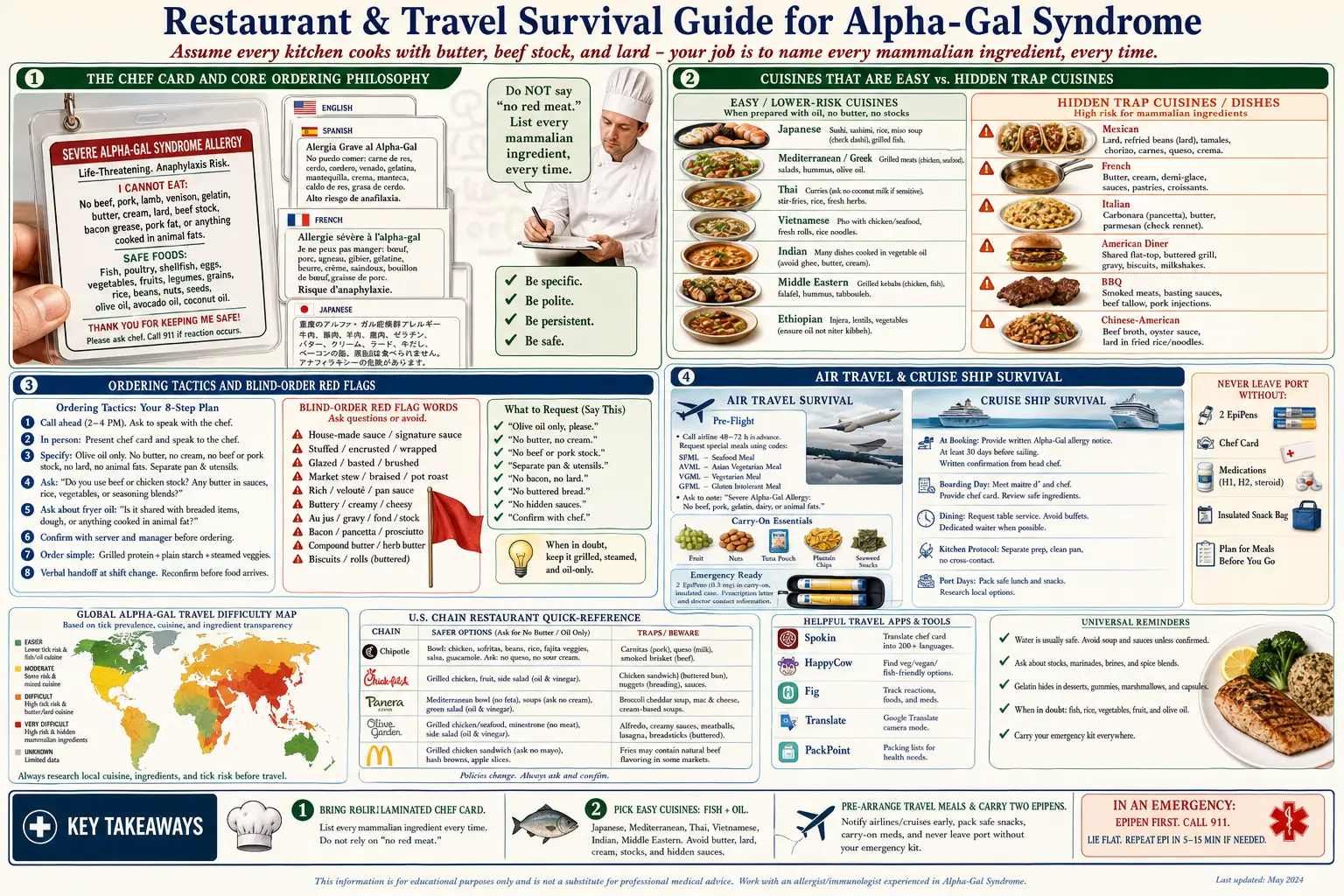
For people with Alpha-Gal Syndrome (AGS), the first restaurant menu after diagnosis can feel like a minefield. Every sauce is a question mark. Every grill is a maybe. A steakhouse dinner is obvious — but the “olive-oil-brushed” sea bass may turn out to have finished in a butter bath, the refried beans may be quietly cooked in lard, and the hotel omelette may slide across the same flat-top as the bacon. This page gathers, practically and specifically, how people with AGS eat out, travel, go to weddings, send their children to camp, and see the world.
Many people with AGS do all of it. What they describe is a new language for ordering food, a few tools carried everywhere, and the habit of asking twice. None of this is paranoia; it is the skill set of people who have chosen to stay alive and stay social.
Table of Contents
- The Core Ordering Philosophy
- The Chef Card Template
- Cuisines That Are Easy
- Cuisines With Hidden Traps
- Ordering Tactics at Any Restaurant
- Dishes That Are Risky to Order Without Asking
- Fast Food & Chain Restaurants
- Air Travel
- Cruise Ships
- International Travel — Country Notes
- Emergency Preparation for Travel
- Apps & Resources
- Dating, Business Meals, Social Situations
- Kids With AGS at School and Camp
- Key Research Papers
- Connections
- Featured Videos
1. The Core Ordering Philosophy
The mental shift people with AGS describe as the most important is assuming every restaurant cooks with butter, beef stock, and lard unless shown otherwise. Most kitchens do. Butter makes fish taste better. Beef stock is the base of almost every brown sauce. Lard is cheaper than oil in a lot of cuisines. A chef who has never heard of AGS will truthfully say “no beef in it” while the sauce under the fish is half demi-glace.
Saying “no red meat” tells the kitchen almost nothing. What works, people with AGS report, is naming every mammalian ingredient, every single time: beef, pork, lamb, venison, bison, butter, cream, lard, beef stock, bacon grease, pork fat, gelatin. Stopping at “no meat” leaves the butter. Stopping at “no dairy” leaves the beef stock. Listing all of it can feel excessive. It is not excessive. It is the whole allergy.
2. The Chef Card Template
Chef cards like this are commonly printed, laminated, and carried in several copies: one goes to the server, with a request that another goes to the chef. International travellers carry a translated version alongside the English one.
“I have a severe allergy called Alpha-Gal Syndrome (AGS). I cannot eat any mammalian foods: beef, pork, lamb, venison, gelatin, or foods cooked in butter, cream, lard, beef stock, bacon grease, or pork fat. Even small amounts can cause anaphylaxis, a life-threatening reaction. Please also avoid cross-contamination from grills or fryers used for meat.
I can eat: fish, poultry, shellfish, eggs, vegetables, grains, and oils like olive or avocado. Thank you for your care.”
The patient-run site Alpha-gal Information (alphagalinformation.org) has information pages in Spanish, French, and Polish. Travellers who translate their card keep a printed copy as well as the phone copy, because phones die at exactly the wrong moment.
3. Cuisines That Are Easy (High Signal)
Japanese
One of the safest cuisines in the world for AGS. Sushi, sashimi, udon in vegetable broth, teriyaki fish, and chirashi bowls are almost all built on fish, rice, seaweed, and soy. Broths: dashi, the base broth of most soups, is usually made from bonito (fish) and kombu — safe. A small number of shops use a pork-bone tonkotsu base for ramen or a chicken-pork blend, so ramen broth is the one question to ask.
Mediterranean / Greek
Grilled fish with olive oil and lemon is the defining dish of the region, and it is AGS-native. Greek salad, horiatiki, dolmades in olive oil, grilled octopus, and vegetable mezze work well. Feta is dairy, which matters for people who are also dairy-reactive. Dishes described as “moussaka” (lamb) or “pastitsio” (beef) are mammalian.
Thai
Coconut-milk curries replace dairy entirely — a gift. Green, red, yellow, and massaman curries made with chicken, shrimp, or tofu are usually safe. Fish sauce and oyster sauce contain no mammalian protein. Pad see ew and pad kee mao are often made with pork or beef, and the usual question about curry paste is whether it uses shrimp paste (fine) or anything ground with pork.
Vietnamese
Pho ga (chicken) or pho hai san (seafood) are safe. Pho bo is beef — including the broth. Fresh spring rolls with shrimp, bun with grilled chicken or shrimp, and com tam with grilled chicken are easy orders. Pork floss is a common garnish on rice dishes.
Indian
Vegetarian dals, chana masala, vegetable biryani, chicken tikka, and fish curries are often safe. Hidden sources: ghee (clarified butter) is used heavily, as are cream-based sauces like butter chicken, korma, and tikka masala. Many kitchens will cook dishes in oil instead of ghee on request. Lamb, goat, and mutton dishes are mammalian.
Middle Eastern / Lebanese
Hummus, baba ganoush, falafel, tabbouleh, fattoush, grilled chicken shawarma, and fish kebabs are all typically safe. Lamb shawarma, kibbeh, and anything labeled “lahm” (meat) are mammalian. Pita is not always dairy-free, which matters for people who react to butter.
Ethiopian
Most Ethiopian food is legume- and vegetable-forward and cooked in niter kibbeh (spiced butter) — so this cuisine is only safe when the kitchen can cook the order in oil instead. Doro wat (chicken) and vegetarian combos are usually adjustable. Kitfo (raw beef), siga tibs (beef), and anything labeled siga are beef.
4. Cuisines With Hidden Traps
Mexican
Refried beans traditionally contain lard, pork fat, or bacon drippings. Tamales are usually made with lard. Chorizo is pork. Queso and crema are dairy. Refried beans and the cooking fat are the two questions people with AGS ask every time. Safer bets: fish tacos, shrimp dishes, black beans prepared without lard, ceviche, and guacamole. Carne asada, barbacoa, carnitas, and al pastor are all mammalian meat.
French
Butter is everywhere — in the pan, in the sauce, in the bread basket. Beef stock is the foundation of bistro cooking. Beurre blanc, hollandaise, bearnaise, demi-glace, foie gras, rillettes, and almost every classic sauce are off-limits. Most French bistro menus are functionally closed to AGS patients. Safer: crudites, oysters on ice, simple grilled fish with olive oil specifically requested, and salade nicoise (the dressing is the question).
Italian
Butter appears in many pasta sauces; cream sauces are common; bolognese is beef; carbonara is pork (guanciale or pancetta plus pecorino). Parmesan is dairy. Safer: marinara (when made without meat stock), pasta primavera with olive oil, grilled seafood, pizza margherita for people who tolerate mozzarella, and vongole. Whether the pasta sauce is finished with butter is the usual question.
American Diner
The flat-top grill is the problem. Bacon, sausage, and burgers share a surface with the eggs and pancakes, and the residual fat is mammalian. Butter goes on pancakes and toast by default. Bacon grease flavors home fries. The usual request is a clean pan, olive oil only, and no butter on toast. Omelettes are often the cleanest order if cooked in a fresh pan.
BBQ
Almost everything is beef or pork — even the beans and collards are often cooked with pork. Smoke itself is not the problem, but shared smokers and sauces are. Side salads, grilled chicken cooked on a separate surface, and fish (if offered) may work, but many BBQ joints are a lose-lose for AGS.
Chinese-American
Good news: oyster sauce, hoisin, soy, and black bean sauce are all mammalian-free. Many wok dishes can be made to order. Shrimp with broccoli, kung pao chicken, moo goo gai pan, and vegetable lo mein are typically safe — but the stock used in fried rice and sauces can be beef rather than chicken, which is the question to the kitchen. Mongolian beef, twice-cooked pork, char siu, and spare ribs are the obvious mammalian dishes.
5. Ordering Tactics at Any Restaurant
Tactics people with AGS describe using at any restaurant:
- Calling ahead during slow hours (2–4 PM is the usual window) and speaking to the chef or kitchen manager, not just the host, to explain AGS and ask what the kitchen can safely prepare.
- Translating the chef card in advance with a translation app, for countries where the language is unfamiliar, and showing both the screen and the printed card.
- Saying it out loud: “Cooked in olive oil only, no butter, no cream, no beef or pork stock, separate pan from the grill, no bread with butter on top.”
- Asking about the fryer. Tortilla chips, fries, calamari, and onion rings often share oil with chicken-fried steak, popcorn shrimp breaded with milk, or bacon. Shared oil is a real cross-contamination source.
- Confirming with both the server and the manager. Redundancy saves lives, especially on busy nights.
- Ordering simple. Grilled fish, grilled chicken, steamed vegetables, plain rice, oil-and-vinegar dressing. Complex orders get confused; simple orders get right.
- Shift changes. When a server leaves mid-meal, the allergy is repeated to whoever takes over, because verbal handoffs inside restaurants are unreliable.
6. Dishes That Are Risky to Order Without Asking
- “Market stew” / “chef’s special” ingredients are unknown and change daily.
- “House-made sauces” frequently butter- and cream-forward.
- “Stuffed” anything — fillings are usually meat- or butter-based.
- “Glazed” often a butter or beef-stock reduction.
- Pre-made salad dressings — many contain dairy, anchovy is fine, but bacon bits turn up in Caesar or ranch variants.
- Anything described as “rich,” “buttery,” or “creamy.” Those words are warnings.
7. Fast Food & Chain Restaurants
Recipes differ between chains and countries and change over time; the major chains publish ingredient lists, which are the up-to-date source. The patterns below are what people with AGS describe in the United States.
Chicken-sandwich chains
At some chicken-sandwich chains, the fries are cooked in peanut oil in a fryer separate from the breaded chicken — generally safe. Grilled chicken may be cooked on a griddle that has also seen beef-containing menu items, which is the question to ask. Safer: grilled nuggets, wraps, fruit cups.
Mexican-style fast-casual chains
Chicken or plant-based fillings, rice, black beans, fajita veggies, salsas, and guacamole are typically safe. Pinto beans are the question — preparation can vary by location. Mammalian or dairy: barbacoa, carnitas, steak, queso.
Taco chains
Crunchy tacos with chicken and bean burritos (bean preparation is the question) are the orders that work. Beef items and anything with bacon are mammalian.
Bakery-café chains
Grilled chicken salads without bacon, turkey sandwiches on plain bread, vegetable sandwiches, and some vegetarian soups (garden vegetable, lentil). Mammalian or dairy: bisques (cream), most soups built on ham or beef stock, and Caesar salads with bacon.
Coffee chains
Most pastries are out (butter, lard, gelatin). Plain black coffee, tea, and drinks made with oat, almond, or coconut milk are safe. Dairy-reactive AGS patients describe oat milk as the biggest quality-of-life upgrade.
Burger chains
Grilled chicken sandwiches can work, though grills may be shared. Some U.S. fast-food fries contain “natural beef flavor” even when fried in vegetable oil, which puts them among the mammalian ingredients for AGS patients — the chains publish their ingredient lists. Salads without bacon are the safest order.
Sandwich chains
Turkey, oven-roasted chicken, tuna, and veggie subs on plain bread are typically safe. Ham, salami, pepperoni, meatball, steak, and bacon are mammalian. A glove change at the counter is a common request.
8. Air Travel
Airline special meals are coded with four-letter IATA abbreviations. They are requested 48–72 hours in advance through the booking. The most AGS-friendly codes:
- SFML — seafood meal (often the cleanest option when available)
- AVML — Asian vegetarian (plant-based, typically dairy-light)
- VGML — strict vegan (no dairy, no gelatin)
- GFML — gluten-free (often fish- or chicken-based, but confirm butter use)
Many people with AGS bring their own snacks as backup: fresh fruit, nuts, rice cakes, chicken or fish jerky, plantain chips, roasted seaweed, and sealed tuna pouches all pass airport security (TSA). On short-haul flights the mixed meal tray carries a real risk of cross-contamination from the cart. People with AGS typically carry two epinephrine auto-injectors in their carry-on bag (not checked luggage), with a printed prescription, in an insulated case that keeps them in their temperature range during tarmac delays. Major U.S. airlines allow this medical equipment; international carriers vary, which is why travellers carry their allergist’s note printed in both English and the destination language.
9. Cruise Ships
People with AGS do take cruises; what they describe is advance preparation.
- Written notice to the cruise line at booking, then again 30 days before sailing, with confirmation requested from the ship’s head chef (not just guest services).
- Table service for every meal. Buffets are a cross-contamination disaster — shared serving utensils, tongs that move between bacon and eggs, and steam-table drippings.
- Room service is often the safest option for grilled fish or chicken with plain rice. Some travellers build a relationship with one waiter in the main dining room and ask for the same waiter for the whole voyage.
- Large ships have full medical facilities and on-board physicians. Excursions are where risk goes up — many people pack their own lunch for port days.
- Online alpha-gal patient groups on social media track ship-by-ship cruise experiences, which people read before booking.
10. International Travel — Country Notes
UK / Ireland
Fish and chips is generally AGS-friendly when the shop uses vegetable oil, but beef tallow is still used at some traditional chippies — the frying fat is the question. Butter is heavy on everything else. Indian restaurants in the UK are excellent and plentiful.
Japan
Among the easiest countries in the world for AGS. Most meals are fish- or chicken-based, and dashi is almost always bonito. Convenience-store onigiri, soba, and sashimi sets are all reasonable defaults. Ramen broth is the exception to check.
France
Butter-dominant and often inflexible in small family bistros. Paris and Lyon have a growing number of allergy-aware restaurants; rural France is harder. Oyster bars, simple grilled fish at brasseries, and crudites with oil and lemon are the easier choices.
Italy
The combination of restaurant culture, the language barrier, and heavy butter use makes Italy surprisingly challenging. Coastal towns and seafood trattorie are easier — grilled branzino, vongole, and pizza margherita (if dairy is okay) are reliable.
Mexico
Lard and pork are everywhere in traditional inland cooking. Coastal regions (Baja California, the Yucatan, the Pacific coast) are seafood-forward and much easier. Refried beans traditionally contain lard, so they are the standing question.
Thailand / Vietnam
Coconut milk and fish sauce make this region naturally AGS-friendly. Street food is generally easy — grilled fish, pad thai with shrimp, pho ga. Northern Vietnamese and Isaan dishes are pork-heavy.
Germany / Austria / Poland
Heavy in meat and dairy; small-town menus can be nearly impossible. Fish (river trout, herring) and simple preparations are the easier choices. Hotel restaurants in major cities are usually more flexible than village gasthauses.
Israel
Kosher dietary law separates meat and dairy restaurants. Dairy restaurants (halavi) are often the safest because they exclude all meat by definition — though butter is still used. Fish is plentiful and well-prepared.
11. Emergency Preparation for Travel
What people with AGS commonly arrange before travelling:
- At least two epinephrine auto-injectors, plus a copy of the prescription on paper and on the phone.
- Travel insurance with medical evacuation coverage, especially in remote areas.
- Membership of a global medical-assistance service.
- English-language allergist contacts at the destination — Alpha-gal Information keeps a list of patient-recommended physicians, allergists the largest group, arranged by specialty, country, and U.S. state.
- The location of the nearest emergency room to the hotel, looked up before arrival rather than after symptoms start.
- Accommodation with a minifridge, for a stash of safe foods on hand.
12. Apps & Resources
- Allergy restaurant-review apps — curated allergy-friendly restaurant reviews searchable by allergen, and restaurant ratings submitted by the allergy community.
- Gluten-free restaurant-finder apps — a lot of gluten-free spots are also easier for AGS.
- Alpha-gal Information restaurant guide (alphagalinformation.org/restaurant-guide/) — patient-contributed, North America-focused: restaurants recommended by people with alpha-gal syndrome (the site notes its authors have no first-hand knowledge of most of them).
13. Dating, Business Meals, Social Situations
Many people with AGS keep a short list of trusted restaurants for first dates, anniversaries, and high-stakes dinners — places where the chef knows them by name. For business meals, the organizer is contacted a week ahead to pre-arrange with the restaurant; most hosts are grateful to get it right. For weddings and events, AGS goes on the RSVP, with a confirmation to the caterer one week before, because venues frequently outsource the meal and lose the note.
At potlucks, many bring their own entree plus a side to share, because other people’s labeling of ingredients, however well-meaning, is unreliable. “I didn’t think butter counted” is the sentence this prevents.
14. Kids With AGS at School and Camp
- A 504 Plan on file at a U.S. school can set out detailed menu accommodations and an epinephrine auto-injector protocol.
- Families commonly ask for separate lunch prep; for severely reactive children, a dedicated table or wiped-down microwave.
- Field trip leaders and summer camp staff are told well ahead of the event, with chef cards for camp kitchens.
- Many parents send a backup packed lunch in case the menu changes on the day.
Key Research Papers
Foundational and recent peer-reviewed publications on alpha-gal clinical features, food-allergy quality of life, cross-contamination in food service, and the practical realities of dining and traveling with AGS. Author names, titles, and journals are plain text; the year/volume/issue/pages link opens the DOI.
- Wilson JM, Schuyler AJ, Workman L, Gupta M, James HR, Posthumus J, McGowan EC, Commins SP, Platts-Mills TAE. Investigation Into the α-Gal Syndrome: Characteristics of 261 Children and Adults Reporting Red Meat Allergy. Journal of Allergy and Clinical Immunology: In Practice. 2019;7(7):2348–2358.e4. — doi:10.1016/j.jaip.2019.03.031
- Pattanaik D, Lieberman P, Lieberman J, Pongdee T, Keene AT. The Changing Face of Anaphylaxis in Adults and Adolescents. Annals of Allergy, Asthma & Immunology. 2018;121(5):594–597. — doi:10.1016/j.anai.2018.07.017
- Platts-Mills TAE, Li RC, Keshavarz B, Smith AR, Wilson JM. Diagnosis and Management of Patients with the α-Gal Syndrome. Journal of Allergy and Clinical Immunology: In Practice. 2020;8(1):15–23.e1. — doi:10.1016/j.jaip.2019.09.017
- Commins SP, Satinover SM, Hosen J, Mozena J, Borish L, Lewis BD, Woodfolk JA, Platts-Mills TAE. Delayed Anaphylaxis, Angioedema, or Urticaria after Consumption of Red Meat in Patients with IgE Antibodies Specific for Galactose-α-1,3-Galactose. Journal of Allergy and Clinical Immunology. 2009;123(2):426–433. — doi:10.1016/j.jaci.2008.10.052
- Commins SP, James HR, Kelly LA, Pochan SL, Workman LJ, Perzanowski MS, Kocan KM, Fahy JV, Nganga LW, Ronmark E, Cooper PJ, Platts-Mills TAE. The Relevance of Tick Bites to the Production of IgE Antibodies to the Mammalian Oligosaccharide Galactose-α-1,3-Galactose. Journal of Allergy and Clinical Immunology. 2011;127(5):1286–1293.e6. — doi:10.1016/j.jaci.2011.02.019
- Hilger C, Fischer J, Wölbing F, Biedermann T. Role and Mechanism of Galactose-Alpha-1,3-Galactose in the Elicitation of Delayed Anaphylactic Reactions to Red Meat. Current Allergy and Asthma Reports. 2019;19(1):3. — doi:10.1007/s11882-019-0835-9
- Steinke JW, Platts-Mills TAE, Commins SP. The Alpha-Gal Story: Lessons Learned from Connecting the Dots. Journal of Allergy and Clinical Immunology. 2015;135(3):589–596. — doi:10.1016/j.jaci.2014.12.1947
- Wilson JM, Erickson L, Levin M, Ailsworth SM, Commins SP, Platts-Mills TAE. Tick Bites, IgE to Galactose-α-1,3-Galactose, and Urticarial or Anaphylactic Reactions to Mammalian Meat: The Alpha-Gal Syndrome. Allergy. 2024;79(6):1440–1454. — doi:10.1111/all.16003
- Vaz-Rodrigues R, Mazuecos L, de la Fuente J. Current and Future Strategies for the Diagnosis and Treatment of the Alpha-Gal Syndrome (AGS). Journal of Asthma and Allergy. 2022;15:957–970. — doi:10.2147/JAA.S265660
- Carter MC, Ruiz-Esteves KN, Workman L, Lieberman P, Platts-Mills TAE, Metcalfe DD. Identification of Alpha-Gal Sensitivity in Patients with a Diagnosis of Idiopathic Anaphylaxis. Allergy. 2018;73(5):1131–1134. — doi:10.1111/all.13366
- Mehl A, Wahn U, Niggemann B. Anaphylactic Reactions in Children — A Questionnaire-Based Survey in Germany. Allergy. 2005;60(11):1440–1445. — doi:10.1111/j.1398-9995.2005.00909.x
- Greenhawt M, MacGillivray F, Batty G, Said M, Weiss C. International Study of Risk-Mitigating Factors and In-Flight Allergic Reactions to Peanut and Tree Nut. Journal of Allergy and Clinical Immunology: In Practice. 2013;1(2):186–194. — doi:10.1016/j.jaip.2013.01.002
PubMed Topic Searches
Live PubMed queries that update as new papers are indexed.
- PubMed: Alpha-gal and quality of life
- PubMed: Food allergy and dining out
- PubMed: Food allergy and travel
- PubMed: Alpha-gal and restaurant exposure
- PubMed: Food allergy cross-contamination
- PubMed: Alpha-gal anaphylaxis
- PubMed: Food allergy and airline meals
- PubMed: Food allergy 504 plans and schools
Connections
- Pain & Allergy
- Natural History and Tolerance
- Alpha-Gal Syndrome Overview
- Tick Bite Prevention
- Mammalian Foods List
- Tick-Origin Science
- Cross-Reactive Medications
- Anaphylaxis Emergency Plan
- Testing and Diagnosis
- Mast Cell Activation Syndrome
- Allergies
- Salmon
- Food Intolerance
- Cod
- Beef
- Pork
- Alpha-Gal and Cardiovascular Risk
- Gluten-Free Diet Practical Guide
- Lyme Disease
- Chicken — poultry carries no alpha-gal, making it one of the safest proteins to order when eating out with AGS.