Chlamydia trachomatis
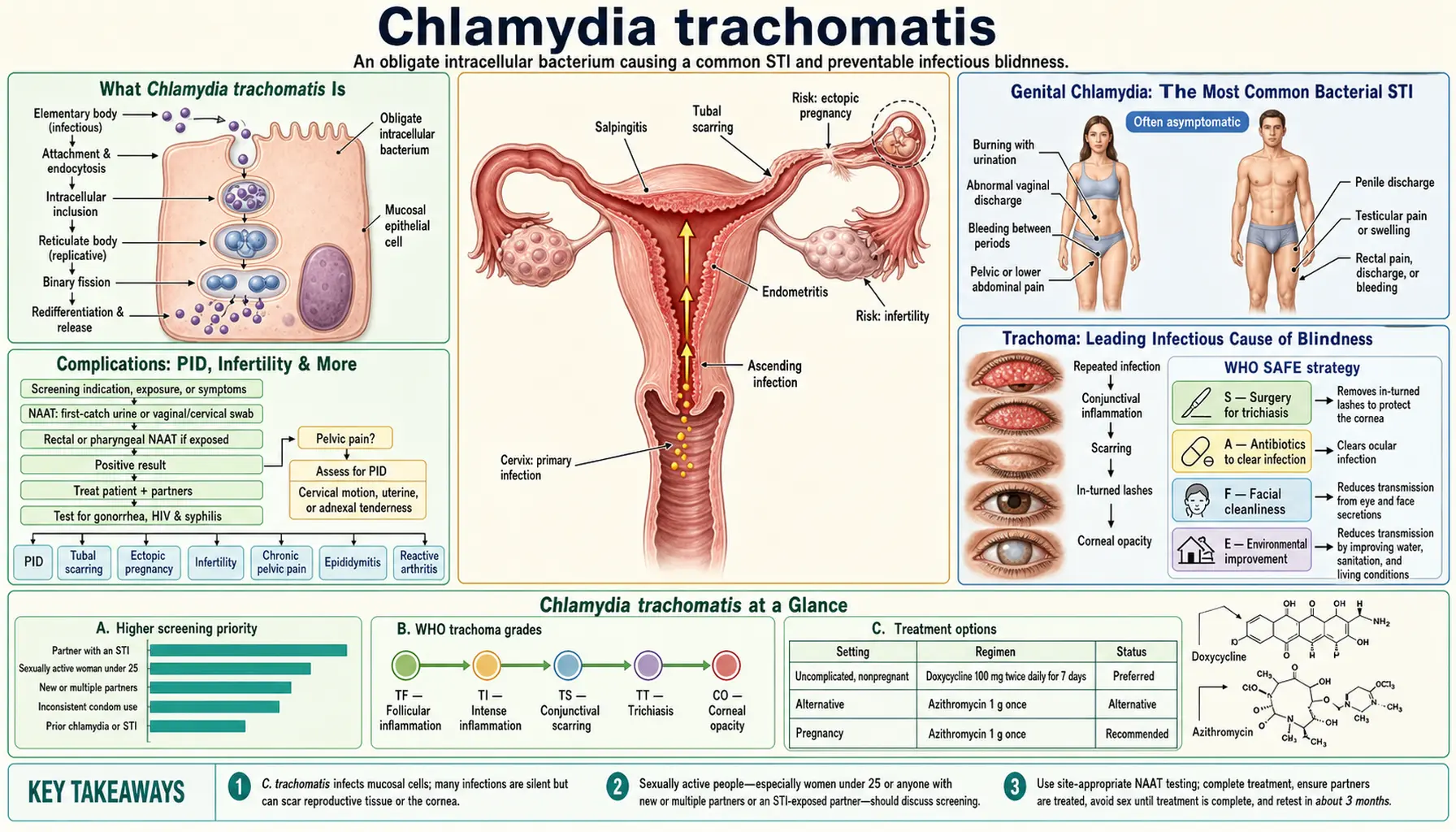
Chlamydia trachomatis is a tiny bacterium responsible for two very different global health problems: it is the most common bacterial sexually transmitted infection (STI) in the world, and, in a separate form, it is the leading infectious cause of blindness. What makes it so successful — and so easy to miss — is that its genital infection is frequently completely silent. Many people carry and pass it on without ever feeling sick, which is exactly why it spreads so widely and why quiet, cumulative damage to the reproductive organs can happen before anyone knows there is a problem. This page explains what the bacterium is, the range of diseases it causes, how it is spread and diagnosed, how it is treated, and how screening catches it early.
Table of Contents
- What Chlamydia trachomatis Is
- Genital Chlamydia: The Most Common Bacterial STI
- Complications: PID, Infertility & More
- Trachoma: Leading Infectious Cause of Blindness
- Lymphogranuloma Venereum (LGV)
- Infections in Newborns
- How It Spreads (Transmission)
- Diagnosis (NAAT)
- Treatment
- Screening & Prevention
- Key Research Papers
- Connections
- Featured Videos
What Chlamydia trachomatis Is
Chlamydia trachomatis is a bacterium, but an unusual one. It is an obligate intracellular organism, which means it cannot grow or reproduce on its own the way most bacteria can — it must get inside one of your cells and borrow the cell's energy and building blocks to multiply. In that respect it behaves a little like a virus. But unlike a virus, it is a genuine bacterium with its own DNA, its own ribosomes, and its own cell membrane. It simply lost, over millions of years of living inside host cells, the ability to make enough of its own energy to survive independently.
The most fascinating thing about this microbe is its two-form (biphasic) developmental cycle, which no ordinary bacterium has. It alternates between two shapes:
- The elementary body (EB) — small, tough, and spore-like. This is the infectious form. It is metabolically quiet, can survive briefly outside a cell, and its only job is to find a new host cell and get inside.
- The reticulate body (RB) — larger and metabolically active. Once an elementary body enters a cell, it settles inside a protective bubble called an inclusion and transforms into a reticulate body, which then multiplies rapidly by dividing again and again. Reticulate bodies are not infectious; they are the growing, reproducing form.
After a couple of days of multiplication, the reticulate bodies convert back into hundreds of new elementary bodies, the host cell releases them, and each one goes off to infect a fresh cell. This whole cycle takes roughly two to three days. Understanding it explains a lot: because the bacterium hides inside cells, it can evade parts of the immune system and establish long, low-grade infections, and it is why antibiotics that penetrate cells (like doxycycline and azithromycin) are the ones that work. The developmental cycle is described in detail by Elwell and colleagues (see Key Research Papers).
One species, several jobs. Different strains of C. trachomatis — distinguished as serovars (serotypes) — cause different diseases:
- Serovars A, B, Ba, and C cause trachoma, the blinding eye disease.
- Serovars D through K cause genital chlamydia and the eye and lung infections seen in newborns.
- Serovars L1, L2, and L3 cause lymphogranuloma venereum (LGV), a more invasive sexually transmitted infection.
Genital Chlamydia: The Most Common Bacterial STI
Genital infection with C. trachomatis (serovars D–K) is the most frequently reported bacterial STI in the world. The World Health Organization estimates on the order of 129 million new infections each year globally, and the burden falls most heavily on young, sexually active people. In the United States it is the most commonly reported notifiable infection of any kind.
The single most important fact about genital chlamydia is that it is usually silent. An estimated 70% of infected women and 50% of infected men have no symptoms at all. Because it causes no discomfort, most people have no idea they carry it — so they don't seek testing, they don't get treated, and they can pass it to partners for months or years. This is the core reason chlamydia is both so common and so damaging, and why routine screening (see below) matters so much.
When symptoms do appear, they usually show up one to three weeks after exposure and can include:
- In women — abnormal vaginal discharge, a burning feeling when urinating, bleeding between periods or after sex, and lower abdominal or pelvic pain. These come from infection of the cervix (cervicitis) and urethra.
- In men — a watery or cloudy discharge from the penis, burning on urination, and sometimes pain or swelling in one or both testicles. Urethral infection (non-gonococcal urethritis) is the usual picture.
- Rectal infection — from receptive anal sex, causing pain, discharge, or bleeding (proctitis), though it too is often symptom-free.
- Throat infection — from oral sex, almost always without symptoms.
- Eye infection — adult inclusion conjunctivitis, usually from transferring genital fluids to the eye by hand.
Because the symptoms overlap heavily with gonorrhea and urinary tract infections, chlamydia cannot be diagnosed by symptoms alone — it needs a lab test.
Complications: PID, Infertility & More
The reason silent chlamydia is more than a nuisance is what happens when it is left untreated and travels upward. The pooled evidence on these long-term consequences is summarized by Haggerty and colleagues (see Key Research Papers).
Pelvic inflammatory disease (PID) and infertility in women. If a lower-genital infection ascends into the uterus, fallopian tubes, and ovaries, it causes PID. The immune response to the infection scars and blocks the delicate fallopian tubes. That scarring is the main mechanism behind three serious outcomes:
- Tubal-factor infertility — scarred tubes can prevent egg and sperm from meeting.
- Ectopic (tubal) pregnancy — a fertilized egg gets trapped in a damaged tube; this is a life-threatening emergency.
- Chronic pelvic pain — lasting discomfort from adhesions and inflammation.
Crucially, much of this damage can occur even when the original infection caused no symptoms — which is why "I feel fine" is not reassurance against chlamydia.
Epididymitis in men. Chlamydia can spread to the epididymis (the coiled tube behind the testicle), causing pain and swelling. It is a leading cause of epididymitis in younger men. It is uncomfortable and occasionally affects fertility, though far less commonly than tubal damage in women.
Reactive arthritis. In a minority of people, the body's immune reaction to a chlamydial (or other) infection triggers reactive arthritis — joint inflammation that appears weeks after the infection, sometimes together with eye inflammation and urethral irritation. It was historically called Reiter syndrome.
Pregnancy and the newborn. Untreated infection in a pregnant person raises the risk of passing the bacterium to the baby during birth (covered in the newborns section) and is associated with pregnancy complications.
Fitz-Hugh–Curtis syndrome — an inflammation of the capsule around the liver — is an uncommon complication of pelvic infection that causes upper-right abdominal pain. And having chlamydia (like other STIs that inflame genital tissue) can increase the risk of acquiring or transmitting HIV.
Trachoma: Leading Infectious Cause of Blindness
The same species that causes a common STI is also, in its A–C serovar forms, responsible for trachoma — the world's leading infectious cause of blindness. Trachoma has nothing to do with sex; it is a disease of poverty, crowding, and limited access to clean water and sanitation, and it is passed from eye to eye. The definitive modern review is by Taylor and colleagues (see Key Research Papers).
Trachoma does its damage slowly, over years, through repeated re-infection, most often starting in childhood:
- Recurrent infection inflames the surface under the eyelids (active trachoma), producing rough, follicular bumps.
- Years of repeated inflammation gradually scar the inner eyelid.
- The scarring makes the eyelid turn inward so the eyelashes scrape against the eyeball — a painful, sight-threatening stage called trichiasis.
- The constant scratching clouds the normally clear cornea, and over time this corneal opacity leads to irreversible blindness.
The infection spreads through direct contact with eye and nose discharge — via fingers, shared towels and washcloths, and notably by eye-seeking flies that carry the bacterium from one child's face to another's. It is endemic in poorer rural communities across parts of Africa, the Middle East, Asia, and Latin America.
The encouraging news is that trachoma is being pushed back. The World Health Organization coordinates a control program built on the SAFE strategy: Surgery to correct in-turned eyelashes, Antibiotics (mass community distribution of a single-dose azithromycin) to clear infection, Facial cleanliness to reduce transmission, and Environmental improvement (clean water and sanitation to control flies). Many countries have already eliminated trachoma as a public-health problem.
Lymphogranuloma Venereum (LGV)
A third face of the bacterium comes from serovars L1, L2, and L3, which cause lymphogranuloma venereum (LGV). Unlike ordinary genital chlamydia, which stays mostly on surface tissues, the LGV strains are more invasive — they get into the lymphatic system, so the disease affects lymph nodes and deeper tissues. Its management is set out in the 2019 European guideline by de Vries and colleagues (see Key Research Papers).
Classic LGV unfolds in stages: first a small, often painless sore or bump at the site of infection that heals on its own and is easily missed; then, a few weeks later, tender, swollen lymph nodes in the groin (called buboes) that can enlarge and drain. If untreated it can go on to cause scarring and chronic swelling.
Over the past two decades, LGV has appeared in a different pattern in higher-income countries: outbreaks among men who have sex with men, presenting as proctitis or proctocolitis — rectal pain, discharge, bleeding, and a feeling of incomplete bowel emptying. This can closely mimic inflammatory bowel disease, so it is important that clinicians consider and test for it. LGV requires a longer course of antibiotics (three weeks of doxycycline) than ordinary genital chlamydia.
Infections in Newborns
A pregnant person with untreated genital chlamydia can pass the bacterium to their baby during a vaginal birth, as the infant passes through the infected birth canal. This causes two main problems in the newborn:
- Neonatal conjunctivitis (inclusion conjunctivitis, a form of "ophthalmia neonatorum") — a red, discharging eye infection that typically appears about 5 to 14 days after birth. Chlamydia is a leading infectious cause of conjunctivitis in newborns.
- Chlamydial pneumonia — a lung infection that tends to develop later, often between 4 and 12 weeks of age, with a characteristic staccato cough, congestion, and rapid breathing, usually without fever.
An important practical point: the antibiotic eye ointment routinely put in newborns' eyes at birth (to prevent gonococcal eye infection) does not reliably prevent chlamydial conjunctivitis, and it does nothing for the pneumonia. Newborn chlamydial infection is therefore treated with an oral antibiotic (such as erythromycin or azithromycin) that reaches the whole body, not just eye drops. The best prevention by far is screening and treating chlamydia during pregnancy so the baby is never exposed.
How It Spreads (Transmission)
Because one species causes several diseases, it also spreads by more than one route — but each disease has its own clear pathway:
- Genital chlamydia (D–K) and LGV (L1–L3) spread through unprotected vaginal, anal, and oral sex. Ejaculation is not required for transmission. Infection can also pass from a birthing parent to a baby during delivery, and someone can transfer genital fluids to their own eye by hand.
- Trachoma (A–C) spreads eye to eye — through fingers, shared cloths and towels, and eye-seeking flies carrying infected discharge. It is not sexually transmitted.
It is worth clearing up what does not spread genital chlamydia: it is not caught from toilet seats, swimming pools, hot tubs, sharing cutlery, or casual contact like hugging. The bacterium is fragile outside the body and needs close mucosal contact to move from person to person.
Diagnosis (NAAT)
The standard, recommended test for chlamydia is a nucleic acid amplification test (NAAT). A NAAT detects the bacterium's genetic material directly, is highly sensitive and specific, and has largely replaced older methods like culture and antigen tests for routine diagnosis.
A major advantage of NAAT is that it works on easily collected, non-invasive samples:
- First-catch urine (the first part of the urine stream) — convenient and effective, especially for men.
- Vaginal swabs — which can often be self-collected, performing as well as clinician-collected swabs and making testing more comfortable and accessible.
- Endocervical, urethral, rectal, and pharyngeal swabs — matched to the sites of possible exposure. Testing the rectum and throat matters because infection there is usually symptom-free and would be missed by urine testing alone.
Bacterial culture is now used mainly in special situations, and blood antibody (serology) tests have a limited role — chiefly for diagnosing LGV and for studying trachoma in populations, not for routine genital screening.
Treatment
Chlamydia is a bacterial infection and is curable with antibiotics. Current U.S. guidance comes from the CDC's 2021 Sexually Transmitted Infections Treatment Guidelines (Workowski and colleagues; see Key Research Papers).
First-line for uncomplicated genital chlamydia: doxycycline. The recommended regimen is doxycycline 100 mg by mouth twice a day for 7 days. This is a notable change from earlier years, when a single 1-gram dose of azithromycin was the go-to treatment. The guidance now favors doxycycline because it appears more effective, particularly for rectal infection (which is common and often silent). A large randomized trial by Geisler and colleagues found both drugs highly effective for urogenital infection, but accumulating real-world and rectal-infection data tipped the balance toward doxycycline.
Azithromycin as a single 1-gram dose remains a useful alternative — for example, when completing a week of pills is a concern, or when doxycycline should be avoided. In pregnancy, doxycycline is not used, and azithromycin is the recommended treatment.
LGV needs a longer course: doxycycline 100 mg twice a day for 21 days. Trachoma is treated in the community with a single oral dose of azithromycin as part of the SAFE strategy.
A cure depends on more than swallowing the pills, so a few practical rules matter:
- Treat partners too. Recent sexual partners need testing and treatment, or the infection simply bounces back and forth. Many places allow "expedited partner therapy," where a partner can be treated without a separate clinic visit.
- Wait before having sex again. Abstain for 7 days after single-dose treatment (or until a 7-day course is finished) and until partners have been treated, to avoid re-infecting each other.
- Retest in about 3 months. This is a test for re-infection (which is common), not a test of cure — most people don't need an immediate re-test to confirm the antibiotic worked.
- Test of cure (about 4 weeks later) is advised in specific situations: during pregnancy, when adherence is uncertain, if symptoms persist, or for rectal infection.
Screening & Prevention
Because genital chlamydia is so often silent, screening people who feel perfectly well is the single most effective tool against it — it finds and treats infections before they cause tubal damage or spread further. The U.S. Preventive Services Task Force recommendation (Davidson and colleagues; see Key Research Papers) sets out who should be screened:
- All sexually active women aged 25 and younger — screen at least once a year. This age group has the highest infection rates.
- Older women with risk factors — such as new or multiple partners, or a partner with an STI.
- Pregnant people — screened early in pregnancy (and again later if at continued risk) to protect the baby.
- Men who have sex with men — screened at the sites of exposure (urethra, rectum, throat), often more than once a year depending on risk.
Beyond screening, everyday prevention is straightforward and effective:
- Condoms, used consistently and correctly, substantially reduce transmission.
- Fewer partners and mutual monogamy with a tested, uninfected partner lower risk.
- Prompt partner treatment and abstaining until treatment is complete break the chain of re-infection.
- Open conversations and regular testing normalize catching infections early.
For trachoma, prevention is a community and public-health effort rather than an individual one: the WHO SAFE strategy — especially facial cleanliness, clean water, and sanitation to control flies, alongside mass antibiotic treatment — is steadily eliminating the disease region by region.
Key Research Papers
- Workowski KA, Bachmann LH, Chan PA, Johnston CM, Muzny CA, Park I, et al. Sexually transmitted infections treatment guidelines, 2021. MMWR Recommendations and Reports. 2021;70(4):1–187. — The CDC guidance that moved doxycycline (7 days) ahead of single-dose azithromycin as first-line therapy for urogenital chlamydia. — doi:10.15585/mmwr.rr7004a1
- Geisler WM, Uniyal A, Lee JY, Lensing SY, Johnson S, Perry RC, et al. Azithromycin versus doxycycline for urogenital Chlamydia trachomatis infection. New England Journal of Medicine. 2015;373(26):2512–2521. — A randomized trial in which both antibiotics cured urogenital infection at high rates, part of the evidence base for the shift in first-line choice. — doi:10.1056/NEJMoa1502599
- Taylor HR, Burton MJ, Haddad D, West S, Wright H. Trachoma. The Lancet. 2014;384(9960):2142–2152. — A comprehensive review of trachoma and the WHO SAFE elimination strategy. — doi:10.1016/S0140-6736(13)62182-0
- Elwell C, Mirrashidi K, Engel J. Chlamydia cell biology and pathogenesis. Nature Reviews Microbiology. 2016;14(6):385–400. — Details the unique elementary-body / reticulate-body developmental cycle and how the bacterium survives inside host cells. — doi:10.1038/nrmicro.2016.30
- Haggerty CL, Gottlieb SL, Taylor BD, Low N, Xu F, Ness RB. Risk of sequelae after Chlamydia trachomatis genital infection in women. The Journal of Infectious Diseases. 2010;201(S2):S134–S155. — Quantifies the risks of pelvic inflammatory disease, infertility, ectopic pregnancy, and chronic pelvic pain. — doi:10.1086/652395
- Lanjouw E, Ouburg S, de Vries HJ, Stary A, Radcliffe K, Unemo M. 2015 European guideline on the management of Chlamydia trachomatis infections. International Journal of STD & AIDS. 2016;27(5):333–348. — European diagnosis and treatment guidance, including the role of NAAT. — doi:10.1177/0956462415618837
- Davidson KW, Barry MJ, Mangione CM, Cabana M, Caughey AB, et al; US Preventive Services Task Force. Screening for chlamydia and gonorrhea: US Preventive Services Task Force recommendation statement. JAMA. 2021;326(10):949. — Recommends at least annual screening for sexually active women aged 25 and younger and for older women at increased risk. — doi:10.1001/jama.2021.14081
- O’Connell CM, Ferone ME. Chlamydia trachomatis genital infections. Microbial Cell. 2016;3(9):390–403. — A review of the pathogenesis and clinical burden of genital chlamydia, including why infection is so often asymptomatic. — doi:10.15698/mic2016.09.525
- de Vries HJC, de Barbeyrac B, de Vrieze NHN, Viset JD, White JA, Vall-Mayans M, et al. 2019 European guideline on the management of lymphogranuloma venereum. Journal of the European Academy of Dermatology and Venereology. 2019;33(10):1821–1828. — Diagnosis of LGV and the recommended 21-day doxycycline course. — doi:10.1111/jdv.15729
- Rowley J, Vander Hoorn S, Korenromp E, Low N, Unemo M, Abu-Raddad LJ, et al. Chlamydia, gonorrhoea, trichomoniasis and syphilis: global prevalence and incidence estimates, 2016. Bulletin of the World Health Organization. 2019;97(8):548–562. — The WHO estimate placing chlamydia among the most common curable STIs worldwide, with roughly 127–131 million new infections each year. — doi:10.2471/BLT.18.228486
Connections
- All Bacteria
- Chlamydia — the clinical page on the sexually transmitted infection this bacterium causes: symptoms, testing, treatment, and screening.
- Urinary Tract Infections
- All Conditions