Bilberry: History and Discovery
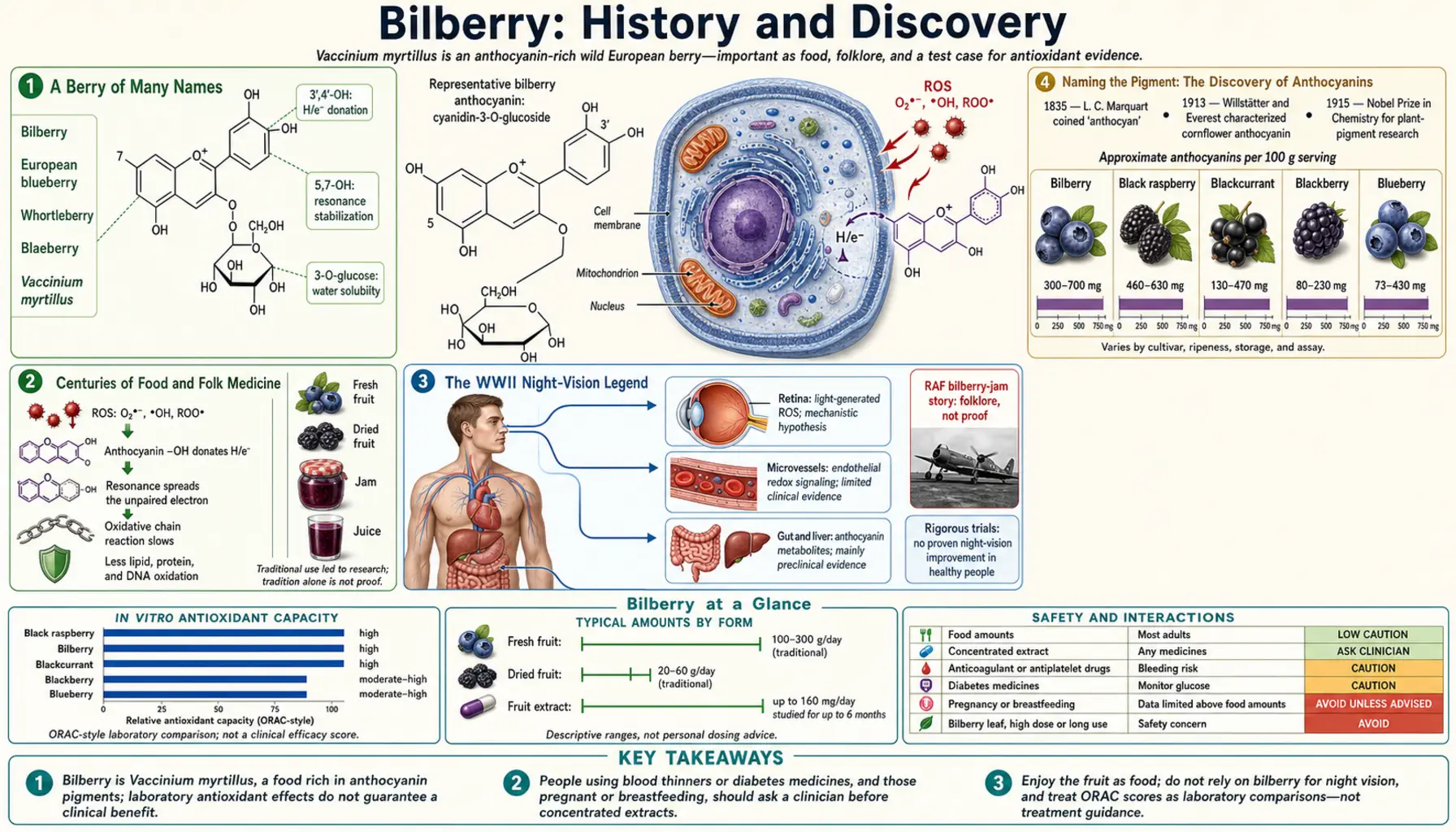
Bilberry (Vaccinium myrtillus) has been gathered and eaten across northern Europe for as long as people have lived there, but its history as a studied antioxidant is surprisingly modern. The wild berry spent centuries as food and folk remedy before chemists in the early twentieth century worked out what gives it — and every red, purple, and blue fruit — its colour: a family of pigments called anthocyanins. This article traces what the record actually supports: the meaning of the berry's many regional names; its traditional uses in European households; the famous (and largely mythical) Second World War story that it sharpened pilots' night vision; the laboratory work, crowned by a Nobel Prize, that first identified the anthocyanin pigments; the moment in the early 1970s when a standardized bilberry extract was first made; and the wave of modern research that tested the old reputation against measured evidence. Where the record is firm we say so; where a claim is folklore or still argued over, we name it as such.
Table of Contents
- A Berry of Many Names
- Centuries of Food and Folk Medicine
- The WWII Night-Vision Legend
- Naming the Pigment: The Discovery of Anthocyanins
- From Wild Berry to Standardized Extract
- Putting the Reputation to the Test
- What the History Honestly Tells Us
- Research Papers and References
- Connections
- Featured Videos
A Berry of Many Names
Few plants carry as many local names as bilberry, and that abundance is itself a clue to how deeply the berry was woven into everyday life. The English word bilberry is generally traced to a Scandinavian origin — it is closely related to the Danish bøllebær — and entered English use centuries ago. Across the British Isles the same small dark berry is called blaeberry in Scotland, and whortleberry, whinberry, winberry, or wimberry in different English regions; in Ireland it is the fraughan. On the continent the French call it myrtille and the Germans Blaubeere (literally "blue berry") or Heidelbeere.
The botanical name tells its own small story. Vaccinium myrtillus places the plant in the heath family (Ericaceae), the same genus as the cranberry, lingonberry, and the North American blueberries. The species name myrtillus means "little myrtle," a reference to the way the low, neat shrub resembles the unrelated myrtle plant — which is also why the French name is myrtille. This thicket of names matters for the history that follows: because bilberry was a familiar wild food known by a different word in nearly every valley, it was used long before anyone wrote a careful botanical or chemical account of it.
Centuries of Food and Folk Medicine
Long before it was an "antioxidant," bilberry was simply one of the most important wild fruits of northern and central Europe. It grows on heaths, moorlands, and the floors of coniferous forests across Scandinavia, the Baltic, the British uplands, the Alps, and into northern Asia, and it has been hand-gathered there for food — eaten fresh, dried for winter, and cooked into jams, juices, pies, and soups — for a very long time. Because the wild plant resists farming (it depends on particular soil fungi and acidic woodland conditions), bilberries have always been picked from the wild rather than cultivated like the North American blueberry, which is part of why the berry kept its reputation as a special seasonal harvest.
Alongside its place at the table, bilberry has a documented history in traditional European medicine, used over the centuries for a range of complaints. The two best-attested folk uses point straight at the directions modern research would later take. First, the dried fruit was a common household remedy for diarrhoea and digestive upset — a use plausibly explained by the astringent tannins in the berry. Second, the leaves were brewed as a tea in an attempt to lower blood sugar; reviews of the plant note that bilberry leaf was among the more frequently used herbal remedies for diabetes-like symptoms in Europe in the era before insulin became available in the 1920s. The berry was also associated traditionally with eye complaints and with the health of the small blood vessels.
Two honest cautions belong with this folk record. The leaf and the fruit are not interchangeable: bilberry leaf has a different chemistry and can be toxic in large or prolonged doses, whereas the fruit has an excellent safety record — a distinction the old remedies did not always draw. And a long tradition of use is a reason to investigate a plant, not proof that it works. What the folk record reliably tells us is that European communities reached for bilberry, in food and in medicine, for centuries — and that the uses they emphasised (the gut, blood sugar, the eyes, the blood vessels) are strikingly close to what later science chose to study.
The WWII Night-Vision Legend
No history of bilberry is complete without its most famous — and most misleading — story. The popular legend holds that during the Second World War, British Royal Air Force night-fighter pilots ate bilberry jam before sorties and reported greatly improved night vision, and that this anecdote launched the scientific interest in bilberry and the eye.
The historical reality is that this belongs to a well-documented wartime cover story. The RAF's real advantage in finding enemy aircraft in the dark came from a closely guarded new technology: airborne interception radar. To explain the night-fighters' success without revealing radar, wartime publicity credited the pilots' sharp eyesight to their diet — most famously to carrots (rich in vitamin A), which is why the belief that "carrots help you see in the dark" persists to this day. The carrot version is the one for which the documentary record is firmest; bilberry became attached to the same family of diet-and-night-vision stories, and over the decades the bilberry-jam telling took on a life of its own in supplement folklore.
So what does careful research actually show? When the night-vision claim was put to a rigorous test, it did not hold up in healthy people with normal sight. A frequently cited 2000 placebo-controlled crossover trial by Muth, Laurent, and Jasper, in young men with good vision, found no significant improvement in night visual acuity or contrast sensitivity from bilberry extract. A 2004 systematic review by Canter and Ernst in Survey of Ophthalmology examined the placebo-controlled trials on bilberry and night vision and concluded that the evidence did not support a beneficial effect in people with normal vision.
The honest summary is that the wartime night-vision legend is folklore, not pharmacology: bilberry does not turn a normally sighted person into a night-vision specialist. That matters historically, because this single myth did more than almost anything else to make bilberry famous — and the real, more measured evidence for the berry's effects on eye strain and on the small blood vessels is more interesting than the story it grew out of.
Naming the Pigment: The Discovery of Anthocyanins
For most of its history bilberry was used long before anyone could say what was inside it. The turning point came not with bilberry specifically but with the chemistry of plant colour. The deep blue-purple that stains your fingers when you crush a bilberry comes from a family of water-soluble pigments now called anthocyanins — from the Greek for "flower" (anthos) and "blue" (kyanos) — and the people who first isolated and made sense of them worked in the early twentieth century.
The central figure is the German chemist Richard Willstätter. In the years around 1913, working with co-workers and following his celebrated studies of chlorophyll, Willstätter isolated and characterised the coloured compounds of flowers and fruits, naming core pigments such as cyanidin (from the cornflower and the red rose), pelargonidin, and delphinidin. A striking part of his finding was that the same pigment could appear in different colours depending on its chemical environment — the reason a single class of molecules can paint a flower blue and a fruit red. Willstätter was awarded the Nobel Prize in Chemistry in 1915 — officially "for his researches on plant pigments, especially chlorophyll" — and his work on the anthocyanins is part of that legacy.
The story was carried forward by the British chemist Robert Robinson and his collaborators, who over the following decades worked out how to synthesise anthocyanins in the laboratory and described how colourless companion molecules can shift and stabilise their colour (an effect they named co-pigmentation). Robinson received the Nobel Prize in Chemistry in 1947 for his broader work on plant products. Together, Willstätter and Robinson turned anthocyanins from a mystery of colour into a defined class of molecules — the chemical identity that bilberry research would later be built on.
It is worth being precise about what this means for bilberry's story. No single scientist "discovered" bilberry, and these chemists were not studying bilberry in particular; what they discovered was the kind of molecule responsible for its colour and for much of its biological activity. Bilberry is unusually rich in these pigments — it contains all five of the major dietary anthocyanidins, pigmented through the whole flesh rather than just the skin — which is exactly why, once the chemistry was understood, bilberry became one of the berries researchers turned to first.
From Wild Berry to Standardized Extract
Knowing that anthocyanins existed was one thing; turning a perishable wild berry into a consistent, measurable medicine was another. That step came in the second half of the twentieth century in Italy. The first standardized bilberry extract is generally credited to the Italian phytochemical company Indena, which in the early 1970s produced a concentrated extract whose anthocyanin content could be measured and held constant from batch to batch. The reference figure that came out of this work — an extract standardized to roughly 25% anthocyanidins, equivalent to about 36% anthocyanins — was adopted by the Italian Pharmacopeia and became the benchmark by which bilberry extracts are still judged today.
This standardized material is the one that underlies most of the serious clinical research. It appears in the literature and on the market under names such as Mirtoselect and the anthocyanin complex Myrtocyan (marketed as the medicine Tegens), and it was developed and registered in Europe primarily as a vascular-protective agent — for the small blood vessels and venous circulation — rather than as the night-vision aid of legend. When a study says it used "bilberry extract," it most often means this kind of standardized anthocyanin preparation.
Standardization is the quiet but decisive event in bilberry's modern history. Fresh fruit, juice, and jam vary enormously in pigment content and are dilute besides; a defined extract made it possible to give a known dose, run controlled trials, and compare results. It also created a commercial problem that persists: because authentic bilberry extract is expensive and wild-harvested, it is a frequent target for adulteration with cheaper anthocyanin sources, and independent analyses have repeatedly found products that fail to match their labelled anthocyanin fingerprint. The history here cuts both ways — standardization is what made bilberry a researchable substance, and it is also where buyers must still be most careful.
Putting the Reputation to the Test
With a defined extract in hand, the last half-century of bilberry's story has been the testing of its inherited reputation against measured evidence — and the results have sorted the folklore from the substance. The night-vision claim, as described above, largely failed in people with normal sight. But other long-held uses fared better. The area with the most consistent positive human data is eye strain (asthenopia): several randomized, placebo-controlled trials of standardized extract in people with screen-related eye fatigue have reported modest but reproducible relief, which is why bilberry remains a popular "eye-fatigue" supplement in Japan and Europe.
The clearest match between tradition and evidence, though, is the one the European extract was built for: the small blood vessels. Bilberry anthocyanins stabilise capillaries, reduce their leakiness, and support venous tone, and the strongest clinical evidence concerns the leg symptoms of chronic venous insufficiency — aching, heaviness, and swelling. The old folk use of the berry for the circulation and for capillary fragility lines up with this modern vascular research. Meanwhile, the traditional use of the plant for blood sugar has been partly revisited: modern studies suggest bilberry can modestly blunt post-meal glucose rises and lower low-grade inflammation, though it is firmly an adjunct, never a replacement for diabetes treatment.
The detailed mechanisms, dosing, forms, and cautions for all of these are covered on the main Bilberry page; this history is concerned only with how the berry came to be used and studied in the first place. The pattern that emerges is the genuinely interesting feature of bilberry's story: the uses an old European tradition emphasised — the gut, the eyes, the blood vessels, blood sugar — are very nearly the same ones modern trials chose to test, and where the evidence is best (capillaries and venous tone, eye strain), it confirms the tradition rather than the myth.
What the History Honestly Tells Us
Bilberry's history is a useful case study in how a traditional food becomes a studied antioxidant, and in how easily fact and legend blur along the way. Three threads run through it. The first is folk knowledge: centuries of European households using the fruit for the gut and the eyes, and the leaf for blood sugar, in advance of any chemistry. The second is laboratory science: the early-twentieth-century discovery of the anthocyanin pigments by Willstätter and Robinson, which gave the berry's colour and activity a molecular identity, and the early-1970s Italian standardized extract that finally made the active fraction measurable and testable. The third is myth: the wartime night-vision story, which made bilberry famous for something it does not reliably do.
Separating those threads is the whole point of knowing the history. A long tradition of use earned bilberry its place in the laboratory; careful research has since confirmed some of that reputation (capillary and venous support, eye-strain relief), tempered other parts of it (blood sugar, retinal conditions — promising but preliminary), and dismantled the most famous claim of all (night vision in healthy eyes). The honest version of bilberry's story is more modest than the marketing but more durable: a genuinely pigment-rich wild berry, understood molecule by molecule over the last hundred years, whose real strengths turn out to be the quiet ones the old folk uses pointed to all along.
Research Papers and References
The list below combines key peer-reviewed sources on Vaccinium myrtillus (bilberry) and on the history of the anthocyanin pigments with curated PubMed topic-search links into the relevant literature. Author names, titles, and journals are given as plain text; only the stable DOI, PMID, or archive link is hyperlinked, and each opens in a new tab. Historical attributions (Willstätter's Nobel Prize, the wartime radar cover story, the early-1970s Italian standardized extract) are described in the article as documented history.
- Muth ER, Laurent JM, Jasper P. The effect of bilberry nutritional supplementation on night visual acuity and contrast sensitivity. Alternative Medicine Review. 2000;5(2):164-173. — PMID: 10767671
- Canter PH, Ernst E. Anthocyanosides of Vaccinium myrtillus (bilberry) for night vision — a systematic review of placebo-controlled trials. Survey of Ophthalmology. 2004;49(1):38-50. — doi:10.1016/j.survophthal.2003.10.006
- Chu WK, Cheung SCM, Lau RAW, Benzie IFF. Bilberry (Vaccinium myrtillus L.). In: Benzie IFF, Wachtel-Galor S, editors. Herbal Medicine: Biomolecular and Clinical Aspects. 2nd ed. CRC Press/Taylor & Francis; 2011. — NCBI Bookshelf: NBK92770
- Mattioli R, Francioso A, Mosca L, Silva P. Anthocyanins: a comprehensive review of their chemical properties and health effects on cardiovascular and neurodegenerative diseases. Molecules. 2020;25(17):3809. — doi:10.3390/molecules25173809
- Ștefănescu R, Laczkó-Zöld E, Ősz BE, Vari CE. An updated systematic review of Vaccinium myrtillus leaves: phytochemistry and pharmacology. Pharmaceutics. 2023;15(1):16. — doi:10.3390/pharmaceutics15010016
- Vaccinium myrtillus traditional and historical use — PubMed: bilberry traditional use and ethnobotany
- Anthocyanin pigments — discovery, chemistry, and history — PubMed: anthocyanin pigment history and chemistry
External Authoritative Resources
- NCCIH — Bilberry
- MedlinePlus — Bilberry
- Nobel Prize in Chemistry 1915 — Richard Willstätter (plant pigments)
- PubMed — All research on Vaccinium myrtillus
Connections
- Bilberry
- All Antioxidants
- Blueberries (close relative)
- Grape Seed Extract
- Quercetin
- Astaxanthin
- Lutein